
FX netting consolidates offsetting foreign exchange payment obligations into one net settlement per currency and value date, which reduces the number and size of payments between parties. The main payoff is lower settlement risk and fewer wires to manage. Corporates with recurring two-way FX flows, and treasury hubs running multiple subsidiaries, see the largest gains because their gross flows often hide a much smaller net exposure.
TL;DR:
- Only enforceable close-out or novation netting agreements can reliably reduce reported FX exposure in insolvency situations.
- Payment netting cuts operational volume but does not change legal or balance-sheet treatment, limiting its legal enforceability benefits.
- For effective implementation, firms must verify jurisdiction-specific legal recognition and run pilots before full-scale deployment.
- Residual FX exposure remains if netting is not paired with PvP settlement or collateral arrangements, especially for currencies outside targeted infrastructures.
Table of Contents
- Types of Netting and How They Differ
- How Netting Cuts FX Settlement Risk at Scale
- Legal Enforceability and What Counts for Accounting Purposes
- Setting Up Netting in Corporate Treasury: A Practical Checklist
- Where Netting Falls Short: Operational and Legal Limits
- A Worked Example: Netting Two Affiliates’ FX Trades
- When to Prioritize Netting Over Hedging or PvP
- How We Support Netting and Multi-Currency Treasury Operations
- FAQ
- Sources
Types of Netting and How They Differ
Not every form of netting carries the same legal weight, and treasury teams need to know which one they are actually using.
- Payment (settlement) netting combines multiple payments due on the same date and currency into a single transfer, cutting operational volume without changing the underlying contracts.
- Novation netting replaces two or more existing contracts with a single new one, which can create one legally binding net obligation where the arrangement is enforceable.
- Close-out netting applies on default or termination: it lets a surviving party calculate one net termination value across many transactions rather than settling each individually, a mechanism central to master agreements as described in New York Fed guidance on netting.
- Multilateral netting extends the same logic across three or more parties, often through a clearinghouse or treasury center, and is common where many subsidiaries trade with each other and with external banks.
Payment netting simplifies operations. Novation and close-out netting change the legal and accounting picture, which matters when a treasury team wants netting to reduce reported exposure, not just reduce wire volume.
How Netting Cuts FX Settlement Risk at Scale
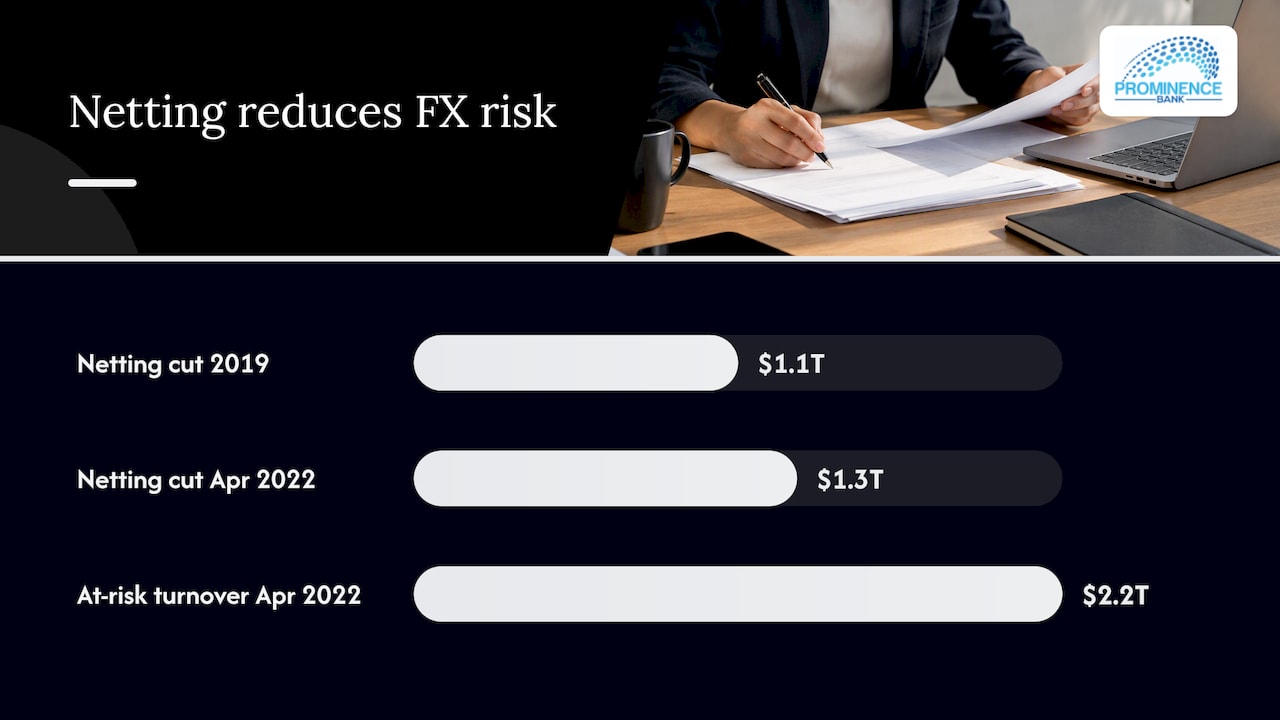
The case for netting is not just operational convenience. Settlement risk, the chance that one party pays out before confirming it received the matching currency, is one of the largest sources of loss in FX markets, and netting is one of the main tools used to shrink it.
Pre-settlement netting reduced FX settlement risk by about $1.3 trillion per day in April 2022, up from roughly $1.1 trillion in 2019, according to BIS analysis of FX settlement risk. That mitigation covered close to one-fifth of deliverable FX turnover.
- Netting reduces both the count and the gross value of payments exchanged between counterparties.
- Even with extensive netting, a sizable share of turnover is never eligible for it and remains exposed.
- Payment-versus-payment (PvP) settlement, including infrastructure such as CLS, complements netting but does not cover every currency pair or trade type, leaving roughly $2.2 trillion of deliverable turnover at risk in April 2022.
Netting and PvP work together rather than as substitutes. A treasury desk that relies on netting alone, without checking PvP eligibility for its major currency pairs, is likely underestimating its residual exposure.
Legal Enforceability and What Counts for Accounting Purposes
Netting only delivers its legal and capital benefits when it is enforceable in every jurisdiction involved. A netting clause that looks solid on paper can fail in an insolvency proceeding if a liquidator is allowed to “cherry-pick”, enforcing the contracts that favor the estate while disclaiming the rest. Supervisory guidance from BIS and the Basel Committee is explicit that exposures should be treated on a gross basis wherever enforceability is uncertain.
- Master agreements, most commonly ISDA or IFEMA templates, provide the close-out netting language that lets parties calculate a single termination value on default.
- Novation netting can replace multiple contracts with one legal obligation, which removes the cherry-picking risk entirely where it is recognized under local law.
- Only novation or an enforceable close-out provision changes legal or balance-sheet treatment; payment netting alone usually just reduces the number of settlement legs, not reported exposure.
Pro Tip: Before assuming a netting agreement reduces your reported counterparty exposure, confirm with legal counsel that close-out or novation netting is recognized under the insolvency law of every counterparty’s home jurisdiction, not just your own.
Setting Up Netting in Corporate Treasury: A Practical Checklist
Moving from theory to a working netting program is mostly a sequencing problem: get the legal basis right before automating anything, using reliable currency conversion tools to assist the process.
- Define scope: decide which entities, currencies, and transaction types will participate, and exclude anything with uncertain legal enforceability.
- Select counterparties and confirm legal basis: verify that netting or close-out clauses hold up under each relevant jurisdiction’s insolvency law.
- Put a master agreement in place: an ISDA or IFEMA-style contract with netting and close-out provisions gives the arrangement a documented legal foundation.
- Set cut-off times: agree on a fixed daily or weekly point at which trades are captured, matched, and netted.
- Automate matching: use netting and confirmation tools, along with SWIFT or SWIFT Accord-style messaging, to reduce manual reconciliation.
- Reconcile and confirm: require both parties to confirm the net amount before the payment is released.
- Plan liquidity for residual flows: keep a contingency funding line or PvP access ready for trades that fall outside the netting scope, a consideration tied closely to the trade finance side of liquidity planning.
Pro Tip: Run a one-currency, two-entity pilot before expanding netting across the full group. It surfaces cut-off and reconciliation problems while the stakes are still small.
Where Netting Falls Short: Operational and Legal Limits
Netting is not a universal fix, and treating it as one creates its own risks. It fails outright in jurisdictions where netting law is unclear or unenforceable, where value dates or currencies cannot be matched cleanly, or where a counterparty simply declines to participate. IMF guidance on netting enforceability stresses that treasury teams must verify local recognition rather than assume it.
- Missed cut-off times lead to mismatched settlement dates, which can force a trade back onto a gross settlement basis.
- Reconciliation errors between counterparties’ books are a common source of failed or disputed net payments, best caught by automated matching and same-day confirmations.
- Where netting enforceability is doubtful or a counterparty is unwilling, PvP settlement, CLS membership, collateral arrangements, or simply lower exposure limits are the more reliable fallback.
A Worked Example: Netting Two Affiliates’ FX Trades
Say two affiliates in the same group, Entity A and Entity B, have the following trades due on the same value date: A owes B $4,000,000 and 1,500,000 euros; B owes A $2,800,000 and 2,100,000 euros.
- Net the US dollar leg: $4,000,000 owed by A minus $2,800,000 owed by B leaves A owing B a net $1,200,000.
- Net the euro leg: 1,500,000 euros owed by A minus 2,100,000 euros owed by B leaves B owing A a net 600,000 euros.
- Result: instead of four separate payments, only two net transfers settle, one in each currency, which is payment netting at work.
- Novation note: if the two entities had novated their contracts into a single master agreement, these amounts could be combined into one net legal obligation rather than two separate currency settlements.
Both parties should confirm the net figures before the agreed cut-off time to avoid a late or mismatched payment.
When to Prioritize Netting Over Hedging or PvP
Netting earns its place first because it is cheap to pilot and pays off immediately in reduced settlement volume, while hedging addresses a different problem entirely, market risk from currency movements, not operational settlement risk. The two are not substitutes. Netting benefits scale with the frequency and bidirectionality of flows, so a treasury with many small, two-way intercompany trades gains more than one with occasional one-way payments. Start with a legal enforceability review, pilot automation on one currency pair, then expand.
— Harold
How We Support Netting and Multi-Currency Treasury Operations
Running a netting program smoothly depends on having the right account infrastructure underneath it, and that is where our multi-currency corporate accounts come in. We offer business banking built for holding and settling multiple currencies from one structure, which simplifies matching net payables and receivables across entities.

For groups with more complex intercompany structures, our corporate banking services are designed to support treasury centralization and settlement workflows at scale. Integration with external rails through FX4 and card networks can help a treasury team route residual gross settlements once netting has done its work.
- Multi-currency corporate accounts for holding and settling net balances across currencies.
- Corporate banking structures suited to groups centralizing treasury across several subsidiaries.
- Integration support for routing residual payments once netting reduces the bulk of settlement volume.
Before opening an account, check our fee schedule for account opening, monthly, and transaction costs, and reach out to request a treasury onboarding consultation.
This article is general information, not a substitute for advice from a qualified financial advisor. Consult a qualified financial professional about your own circumstances before acting on anything here.
FAQ
What is foreign exchange netting and how does it work?
FX netting combines offsetting payment obligations between the same parties, in the same currency and value date, into one net payment instead of several gross ones. It reduces the number of transfers and the total value moved, which lowers settlement and operational risk, as described in New York Fed netting guidance.
What is the 3-5-7 rule in forex?
This is not a recognized FX netting or settlement standard, and no primary source in treasury or settlement risk guidance defines a “3-5-7 rule.” Readers encountering the term in a trading context should treat it as informal trading advice unrelated to institutional netting practice.
What is the difference between forex hedge and netting?
Netting is an operational and legal tool that reduces the number and size of payments between parties with offsetting FX obligations, lowering settlement risk. Hedging is a market-risk tool that uses instruments like forwards or options to protect against adverse currency movement, and the two address separate problems rather than replacing each other, a distinction covered further in our FX hedging program guidance.
What is netting with an example?
Netting is the practice of offsetting mutual payment obligations so only the net difference settles. For example, two affiliates with offsetting payments due on the same date can reduce multiple transfers to fewer net transfers by currency.
Sources
These primary documents cover the data, legal mechanics, and operational guidance behind FX netting.