
Yes, a non-resident can open a non-resident business bank account, and there are two realistic routes to get there: form a domestic legal entity and secure an Employer Identification Number, then apply directly to a bank that accepts foreign owners, or go through a licensed international or fintech provider built for cross-border clients. The main obstacles are identity and beneficial-ownership verification, deposit-insurance nuances at custodial providers, and occasional in-person or notarization steps.
TL;DR:
- Non-residents must provide clear formation documents, an EIN, notarized IDs, proof of address, and an organizational chart to improve approval chances.
- Beneficial ownership verification and sanctions screening are the primary hurdles, especially for complex or high-risk structures.
- Applying through providers with fully digital onboarding, such as fintechs or international banks, can reduce processing time and eliminate in-person requirements.
- The timeline varies from days to months, with costs mainly depending on account type, complexity, and additional due diligence fees.
- Clear documentation, transparent explanation of transaction plans, and upfront disclosure of major counterparties significantly increase approval odds.
Table of Contents
- Eligibility and legal basics for non-resident applicants
- Concrete document checklist banks typically require
- Step-by-step workflow to open the account
- Choosing between traditional banks, fintechs, and offshore institutions
- Compliance, deposit protection, and regulatory risks you must understand
- Practical tips to increase approval odds and accelerate onboarding
- Typical timeline and fees to budget for opening and operating the account
- What Harold has seen work, and what typically goes wrong
- Tax implications and reporting requirements for your account
- Why the standard advice on this topic misses the point
- How Prominence Bank supports non-resident business accounts
- Sources
- FAQ
Eligibility and legal basics for non-resident applicants
Foreign nationals and foreign-owned companies are broadly eligible to open a business account, but eligibility on paper is not the same as approval in practice. Each bank sets its own risk appetite, and a non-resident application gets extra scrutiny because verifying identity, address, and ownership across borders takes more work than it does for a domestic applicant living down the street.
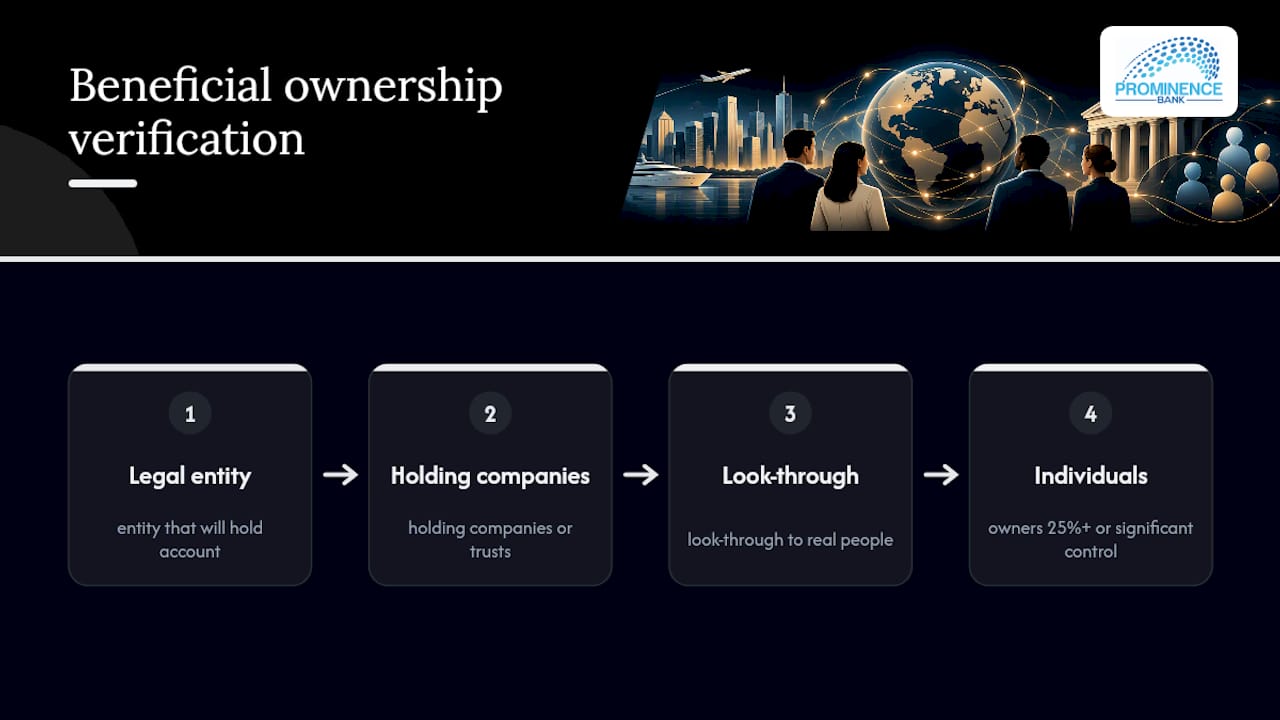
The biggest regulatory filter is beneficial ownership verification. Under FinCEN’s Customer Due Diligence rule, banks must identify and verify anyone who owns 25% or more of a legal entity, or who exercises significant control over it, before the account can open. If your ownership structure runs through several holding companies or trusts, expect the bank to ask for a full look-through to the real people at the top. That is not the bank being difficult: it is the bank meeting a legal obligation it cannot skip.
Sanctions screening is the second filter. Banks check applicants, owners, and often major counterparties against lists maintained by the U.S. Department of the Treasury, and a match, even a partial or coincidental one, can stall or kill an application until it is resolved. Applicants connected to sanctioned jurisdictions or individuals face a much harder path, regardless of how clean the rest of the file looks.
Before you apply anywhere, you want a practical eligibility checklist in hand:
Valid, current formation documents for the entity that will hold the account matters more than almost anything else in the file. A clean, unambiguous ownership structure, ideally two layers deep or less, moves faster through review than a chain of nominee entities. An Employer Identification Number issued by the IRS is required for nearly every U.S. business account, non-resident or not. Transparent, documented source-of-funds information heads off the follow-up questions that stall most applications.
Meeting these basics does not guarantee approval since individual banks weigh risk differently, but missing any one of them makes a denial close to certain.
Concrete document checklist banks typically require
Every bank phrases its requirements a little differently, but the underlying document set is remarkably consistent once you strip out the branding. Knowing what to gather before you apply, rather than scrambling after a request, is the single biggest time-saver in this whole process.
- Entity formation documents: articles of organization or incorporation, an operating agreement or bylaws, and proof of active state registration.
- EIN confirmation letter from the IRS, tied to the exact legal name on the formation documents.
- Government-issued photo identification for every beneficial owner and signatory, often requiring notarization or an apostille for foreign documents.
- Proof of residential address for each owner, typically a utility bill or bank statement less than three months old.
- An organizational chart showing ownership percentages down to the individuals who ultimately control the entity.
- Evidence of business activity, such as a signed contract, an invoice, or a business plan, showing the account has a genuine commercial purpose.
- Source-of-funds documentation explaining where the initial deposit and expected transaction volume come from.
The EIN itself deserves special attention because it trips up more non-resident applicants than any other document. The instructions for Form SS-4 allow a foreign responsible party who lacks a U.S. Social Security Number or Individual Taxpayer Identification Number to write “foreign” or “N/A” on line 7b. Many applicants assume they need an ITIN first and waste weeks pursuing one unnecessarily. The IRS EIN application page outlines the available submission routes, and a responsible party without a U.S. taxpayer number generally has to apply by phone, fax, or mail rather than through the instant online system, which is reserved for applicants who already have one.
Notarization is the other recurring friction point. Some banks accept documents notarized in your home country, provided they carry an apostille under the Hague Convention; others insist on a notary licensed in the account’s home state. Confirm this detail before you pay for notarization, since redoing it because the bank rejected the format costs both time and money.
Pro Tip: Build your organizational chart and source-of-funds summary before you submit anything else. Reviewers request these two documents more than any other, and having them ready from day one can shave a week or more off the review.
Step-by-step workflow to open the account
The process runs in a predictable sequence, and skipping a step almost always means backtracking later. Following the order below, rather than jumping ahead to the bank application, keeps the whole process moving.
- Choose your entity type and state of formation. An LLC or corporation formed in a business-friendly state gives you the registration documents banks expect to see.
- Form the entity and appoint a registered agent. Most states require a registered agent with a physical address in that state, and this step typically takes a few business days to a couple of weeks depending on the state’s processing speed.
- Apply for an EIN using Form SS-4. A foreign responsible party without a U.S. SSN or ITIN uses “foreign” or “N/A” on line 7b, and applies by phone, fax, or mail since the online system is not available in that case.
- Decide between remote and in-person onboarding before you apply. Some providers, particularly fintechs and licensed international banks, handle the entire process online; traditional banks more often require a branch visit for at least one signatory. Check this policy before investing time in an application you cannot finish remotely.
- Submit the bank application with your full document package. Include formation documents, EIN confirmation, identification, organizational chart, and source-of-funds materials in the first submission rather than waiting for the bank to ask.
- Respond to due-diligence requests within a day or two. Slow responses are the single most common reason a straightforward application drags on for weeks.
- Fund the account and activate the services you need. Wire transfer capability, multicurrency holding, and online banking access are usually activated in stages after the initial deposit clears.
The step-by-step international banking process that cross-border applicants generally follow mirrors this sequence closely, with the state and provider choice being the two decisions that most affect how smoothly everything else goes.
Choosing between traditional banks, fintechs, and offshore institutions
Not every provider solves the same problem, and picking the wrong type of institution for your situation is a common reason non-resident applications stall. Three broad categories cover most of the market.
- Traditional banks offer direct deposit accounts with the most straightforward path to standard deposit protection, but they tend to apply the strictest onboarding standards and sometimes require an in-person visit for at least one owner or signatory.
- Fintechs and electronic money institutions (EMIs) offer fast, fully remote onboarding and modern account management tools, but many operate through a custodial or pass-through banking partner rather than holding a banking license themselves, which changes how deposit protection and recordkeeping actually work behind the scenes.
- Licensed international or offshore institutions offer multi-currency accounts and corporate banking features built specifically for cross-border clients, along with different regulatory regimes, fee structures, and privacy standards than a domestic retail bank.
The right choice depends on what you actually need. A business that mainly needs to receive domestic payments and hold funds in one currency is usually well served by a traditional bank, assuming its owners can clear the onboarding bar. A business that needs to move money across several currencies quickly, without an in-person requirement, often finds a fintech or a licensed international bank a better fit, provided its owners understand how that provider’s underlying banking relationship actually works. Guidance on offshore account opening steps can help clarify which model fits a given ownership structure and transaction profile.
Privacy and compliance appetite matter too. A business that values discretion alongside multi-currency flexibility gravitates toward licensed international banking models built for that purpose, while a business optimizing purely for lowest fees on domestic transactions usually does better with a conventional bank.
Compliance, deposit protection, and regulatory risks you must understand
The part of this process most applicants skip past, and the part most likely to bite them later, is understanding what actually happens to their money once it sits inside a custodial or pass-through arrangement. Many fintech and neobank products market themselves as insured, but the practical reality depends heavily on how well the intermediary keeps records.
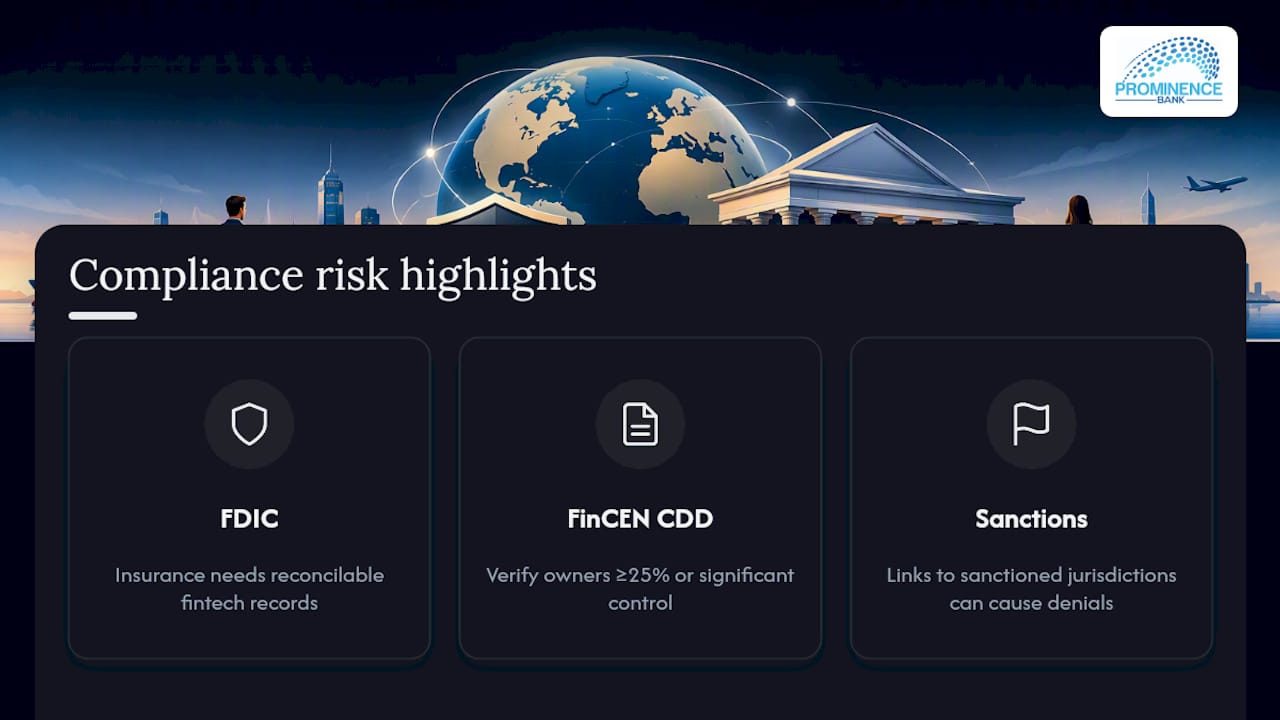
The FDIC discussed risks with custodial and pass-through accounts and proposed improved recordkeeping and reconciliation requirements to better protect end users.
The FDIC’s notice of proposed rulemaking on custodial deposit accounts, issued in September 2024, addresses exactly this gap: when a fintech holds customer funds through a bank partner rather than directly, insurance coverage for any individual customer depends on the fintech’s own records being accurate and reconcilable. The related Part 370 alternative recordkeeping guidance sets out the data format institutions need to support pass-through deposit insurance determinations, and gaps in that recordkeeping are precisely what turned prior fintech failures into prolonged customer disputes over frozen funds.
Beneficial ownership documentation matters just as much on the compliance side. FinCEN’s CDD rule requires verification of anyone holding 25% or more equity or exercising significant control, and a bank that cannot complete that look-through will not open the account, period. A ready organizational chart with notarized ownership statements for each named owner is the fastest way through this step, since it answers the question before the bank has to ask it a second and third time.
Sanctions exposure is the final layer. Even an indirect link, such as a counterparty or supplier tied to a restricted jurisdiction under Treasury sanctions programs, can trigger a denial that has nothing to do with the applicant’s own conduct. Disclosing major counterparties upfront, rather than letting the bank discover them during review, tends to shorten this part of the process considerably.
Practical tips to increase approval odds and accelerate onboarding
Most delays and denials trace back to a handful of avoidable causes. Fixing these before you submit an application, rather than after a rejection, is the highest-leverage thing you can do.
- Prepare a notarized ownership and identification package for every beneficial owner before you apply, including apostilled documents where the bank operates in a Hague Convention country.
- Build a clear organizational chart that shows ownership percentages down to individual people, not just the immediate holding entity.
- Assemble documented evidence of genuine business activity, such as signed contracts or recent invoices, since an account with no visible commercial purpose invites extra scrutiny.
- Write a short, specific explanation of expected transaction patterns, including typical transfer sizes, frequency, and the countries involved, and hand it over before the bank asks.
- Disclose major counterparties by name up front rather than waiting for a due-diligence request to surface them later.
An in-person visit is usually only necessary when a bank cannot complete identity verification remotely, when the ownership structure is unusually complex, or when the account is expected to handle high transaction volumes that trigger enhanced due diligence. In those cases, arranging notarization through your home country’s notary system with an apostille, rather than waiting to fly out, keeps the process moving on your end while the bank finishes its own review.
Pro Tip: Write your source-of-funds explanation in plain, specific language, naming the actual business activity and countries involved, rather than a vague summary. Reviewers move generic-sounding files to the back of the queue.
Typical timeline and fees to budget for opening and operating the account
Timelines vary sharply by provider type. Fintech and EMI onboarding often completes within days to about two weeks once the document package is complete. Traditional banks typically take two to eight weeks, and more if a branch visit or additional verification is needed. Complex ownership structures, high-risk business models, or applicants tied to enhanced due diligence review can stretch the process to several months.
- One-off account opening fees are the largest single upfront cost and vary widely by provider and account type.
- Monthly maintenance fees apply regardless of activity at most institutions offering dedicated business or numbered accounts.
- Wire transfer and currency conversion fees apply per transaction and can add up quickly for businesses moving money across several currencies.
- Enhanced due diligence fees apply when an applicant’s ownership structure or risk profile requires a deeper review than the standard process.
A single mismatched sanctions match or an incomplete beneficial-ownership chain, flagged under FinCEN’s CDD rule, is enough to add weeks to an otherwise straightforward application. The single biggest cost driver beyond the published fee schedule is complexity: multi-layered ownership, operations in higher-risk jurisdictions, or a business model that looks unusual on paper all push both time and cost higher.
What Harold has seen work, and what typically goes wrong
Most non-resident applicants who come through this process fall into a small number of profiles: a founder incorporating a new company from abroad, an established foreign business opening a U.S.-facing account for the first time, or a holding structure trying to consolidate several entities under one banking relationship. The roadblock is almost always the same regardless of the profile: an incomplete or unclear beneficial-ownership picture.
Applicants who show up with a tidy organizational chart, notarized identification for every owner, and a plain-language explanation of their source of funds tend to move through review far faster than applicants who wait for the bank to ask. That is not a secret; it is just rarely done, because most founders assume the bank will ask for what it needs when it needs it, and then get frustrated by how many rounds of follow-up that assumption produces.
For businesses that need multi-currency corporate accounts and a provider built around compliance-focused onboarding rather than a domestic retail template, a model with fully digital onboarding and KTT-enabled account processing can be built specifically to map onto that need. It will not remove the FinCEN or sanctions-screening steps described above; no legitimate institution can. What it changes is how those steps are packaged for an international applicant from the outset.
Tax implications and reporting requirements for your account
Opening a business account does not itself create a U.S. tax obligation, but the activity that flows through it often does. A foreign-owned entity that generates income connected to a U.S. trade or business may have effectively connected income, which carries its own filing requirements separate from the simple act of holding an account.
Foreign-owned single-member LLCs and certain foreign corporations also face information-reporting obligations tied to their U.S. activity, and these apply whether or not the owner ever sets foot in the country. A non-resident opening a business account should treat the bank relationship and the tax filing question as two separate tracks that need to be worked out together, ideally with a cross-border tax advisor, rather than assuming the bank’s onboarding process covers tax compliance. It does not: the account and the tax return are handled by entirely different sets of rules, and a business owner is on the hook for both regardless of where they personally live.
Why the standard advice on this topic misses the point
Most guides on this subject treat account opening as a documents problem: gather the right paperwork, submit it, wait. That framing is not wrong, but it undersells the real driver of approval or denial, which is how well an applicant’s ownership structure and transaction story hold together under scrutiny. Two applicants with identical document checklists can get opposite outcomes because one explained its business plainly and the other left the bank to guess.
The other blind spot is deposit protection. Plenty of founders pick a fintech for its polished app and assume the word “insured” on the landing page settles the question, without ever asking how that provider’s recordkeeping actually works if its banking partner fails. That is not a hypothetical: it is exactly the scenario regulators have been trying to close since recent custodial failures exposed the gap.
If you take one thing from this guide, prioritize clarity over speed. A slower application with a transparent ownership chart beats a fast one that invites a second round of questions.
— Harold
How Prominence Bank supports non-resident business accounts
Most of the friction described above comes down to one thing: banks built for domestic retail customers were never designed around a foreign owner’s paperwork, timeline, or privacy expectations. Prominence Bank’s business account model starts from the opposite assumption, with fully digital onboarding, multi-currency business accounts, and KTT-enabled account processing built for international ownership structures from the outset.

That does not mean the compliance steps disappear. Prominence Bank still runs the same beneficial-ownership verification and sanctions screening every licensed institution has to run, but the process is structured around what an international applicant actually has on hand rather than around domestic norms. Typical documentation requested includes formation documents, an organizational chart, identification for each beneficial owner, and source-of-funds materials, the same core package described earlier in this guide.
- Business Banking accounts are built around multi-currency holding and international transaction needs rather than a single-currency retail template.
- Corporate Banking solutions accommodate layered ownership structures that a standard retail bank application form was never designed to capture.
- Fees are published transparently on the fees page, including account opening, monthly maintenance, wire transfer, and enhanced due diligence charges, so applicants know the full cost before they submit anything.
If your business fits this profile, the most direct next step is to review the business account application and the current fee schedule together, so you know exactly what to prepare and what it costs before you start the clock on onboarding.
Sources
The regulatory claims in this guide are drawn directly from primary government sources rather than secondary summaries, so you can verify anything before acting on it.
- Fdic
- CDD rule FAQs | FinCEN
- Instructions for Form SS-4 | IRS
- Sanctions programs | U.S. Department of the Treasury
This article is general information, not a substitute for advice from a qualified financial advisor. Consult a qualified financial professional about your own circumstances before acting on anything here.
FAQ
What is the $3,000 rule for banks?
The Bank Secrecy Act includes thresholds requiring financial institutions to verify and record identifying information for certain funds transfers. It applies to transaction monitoring rather than to a specific account-opening limit, and non-resident applicants should expect this level of scrutiny on wire transfers regardless of account type.
What is the $10,000 bank rule?
Banks must file a Currency Transaction Report with the federal government for cash transactions above a certain threshold, a requirement tied to the Bank Secrecy Act rather than a cap on how much a business can deposit. It exists to flag large cash movements for review, not to block legitimate transactions, and it applies equally to resident and non-resident account holders.
Which banks allow non-resident accounts?
Policies vary by institution and change over time, so there is no fixed universal list; traditional banks, fintechs and EMIs, and licensed international institutions each accept non-resident applicants under different conditions. The most reliable approach is to confirm a specific provider’s current non-resident policy directly before applying, since requirements around in-person visits and documentation differ significantly between them.
Can I open a business bank account using only my EIN?
An EIN alone is not enough; banks also require entity formation documents, identification for beneficial owners, and typically proof of business activity and source of funds. The IRS Form SS-4 instructions explain how non-resident applicants without a U.S. SSN or ITIN can still obtain an EIN, but the EIN is only one piece of the full document package a bank needs.
Do I need to visit in person to open a non-resident business account?
Some providers, particularly fintechs and licensed international banks, support fully remote onboarding, while traditional banks more often require an in-person visit for at least one signatory. Whether a visit is required generally depends on the complexity of the ownership structure and the specific provider’s identity-verification process, so confirming this policy before applying saves wasted effort.