
Use a forward to lock a known obligation at zero premium; use an option when the exposure is uncertain or you want upside with limited downside. Forwards bind both sides to a fixed price and carry no upfront cost but full counterparty exposure. Options cost a premium and give the buyer a choice, not a duty, which is why they suit uncertain exposures or speculative positioning better than forwards do.
TL;DR:
- Forwards are ideal for locking in known prices without upfront costs but carry full counterparty risk, making them suitable for predictable exposures.
- Options offer flexibility and limited downside risk but require paying a premium, making them better for uncertain or speculative exposures.
- Exchange-traded options are cleared and standardized, reducing default risk, whereas OTC forwards are fully customizable but involve bilateral counterparty risk.
- Success depends on accurately assessing exposure certainty; using forwards for fixed commitments and options when the risk is uncertain optimizes cost and flexibility.
- Many firms blend forwards and options within hedging programs to manage predictable parts of exposures while reserving options for genuinely uncertain events.
Table of Contents
- Forwards vs Options: What a Forward Contract Actually Locks In
- Forwards vs Options: What an Option Actually Buys You
- Forward Contract Features vs Option Features, Side by Side
- When to Reach for a Forward, and When to Buy an Option Instead
- What a Hedge Actually Costs You: Credit, Margin, and Time Decay
- Two Numbers That Make the Difference Concrete
- The Bank’s View: Making Bespoke Hedges Actually Executable
- Editorial Take: Stop Treating This as a Trading Decision First
- How Prominence Bank Supports Institutional Hedging
- Sources
- FAQ
Forwards vs Options: What a Forward Contract Actually Locks In
A forward contract is a binding, over-the-counter agreement between two parties to buy or sell an asset at a fixed price on a set future date. Neither side can walk away without a breach. The delivery price is set so the contract has zero fair value at inception, calculated from the spot price and the cost of carrying the asset to maturity, whether that carry cost is interest, storage, or foregone yield.
Because forwards trade off-exchange, the two counterparties negotiate every term directly:
- Settlement: physical delivery of the asset or a cash settlement based on the price difference at maturity.
- Customization: notional amount, delivery date, and underlying asset are all negotiable.
- Cost: no premium changes hands upfront, only the eventual settlement.
- Typical users: corporate treasuries hedging a known payable, exporters, and commodity producers locking a future sale price.
That flexibility is also the catch. Every forward depends on the other side actually paying up when the contract matures.
Forwards vs Options: What an Option Actually Buys You
An option grants its buyer the right, not the obligation, to buy (a call) or sell (a put) an asset at a fixed strike price by a set expiry. That asymmetry is the entire point: the buyer can walk away and lose nothing beyond what was already paid.
What gets paid is the premium, and it breaks into two pieces. Intrinsic value is how far the option sits in the money right now. Time value reflects the chance the option moves further into the money before expiration, and it decays as that expiry approaches, a process traders call theta decay. Volatility inflates the premium too, since a jumpier underlying asset raises the odds of a big favorable swing.
A few structural details matter for anyone comparing forwards vs options strategies:
- Exercise style: American options can be exercised any time before expiry; European options only at expiry.
- Venue: options trade on exchanges with standardized terms, or over-the-counter with custom strikes and dates.
- Risk shape: the buyer’s maximum loss is the premium paid; the seller (writer) can face losses that are theoretically unlimited.
Forward Contract Features vs Option Features, Side by Side
| Dimension | Forward | Option |
|---|---|---|
| Obligation/right | Both parties must perform | Buyer has right, not obligation |
| Upfront cost | None (zero fair value at inception) | Premium paid upfront |
| Counterparty/clearing | Bilateral OTC, no clearinghouse | Exchange-traded contracts are cleared; OTC options carry bilateral risk |
| Customization | Fully negotiable terms | Standardized on exchanges; negotiable OTC |
| Typical users | Treasuries, exporters, commodity producers | Speculators, hedgers with uncertain exposure |
| Payoff shape | Linear, symmetric | Asymmetric, capped downside for buyer |
The clearing distinction is the one professionals underweight. Exchange-traded contracts pass through a clearinghouse that absorbs default risk and requires daily margin postings tied to the contract’s mark-to-market value. A forward has no such backstop. If your counterparty collapses before settlement, you are an unsecured creditor standing in line with everyone else.
Forwards remain a workhorse in FX markets. OTC forward and swap volumes have grown according to Bank for International Settlements data, and FX forwards remain one of the most common tools corporates use to hedge currency exposure. That scale exists precisely because so many payables and receivables are known in amount and date, exactly the case where a forward’s zero-premium structure wins over an option’s cost.
When to Reach for a Forward, and When to Buy an Option Instead
Match the instrument to how certain your exposure actually is.
- Exposure is fixed and known. A confirmed invoice due in 90 days, a locked-in commodity sale, a scheduled loan repayment in another currency. Use a forward. There’s nothing to hedge against except price, so paying a premium for optionality is a wasted cost.
- Exposure might not materialize. A bid you may not win, a sale that could fall through, revenue in a currency you’ll only receive under certain conditions. Buy an option. If the deal dies, you lose only the premium, not a binding obligation to trade an asset you never ended up needing.
- You want price protection but still want to participate in a favorable move. This is the classic case for options over forwards: a producer worried about falling prices but unwilling to give up upside if prices rally.
- You’re managing cost against certainty. A collar, which combines a purchased put with a written call, narrows the range of outcomes and can be structured for little or no net premium. Many treasury desks run forwards for the bulk of a predictable exposure and add a small option position for the portion that’s genuinely uncertain.
Pro Tip: Before choosing, ask whether the number and date are already fixed. If both are locked, a forward almost always beats paying a premium for a right you’re certain to use anyway.
What a Hedge Actually Costs You: Credit, Margin, and Time Decay
The premium is not the only cost worth budgeting. Three separate risks eat into a hedge’s real value, and they hit forwards and options differently.
- Counterparty credit risk sits at the center of every OTC forward. There’s no clearinghouse standing between you and the other side, so a default midway through the contract’s life leaves you exposed to whatever the market has moved against you.
- Margin and mark-to-market apply to exchange-traded, futures-style instruments, which are marked to market and settled daily, so a hedger needs enough liquidity on hand to meet margin calls during a bad stretch, even if the position is ultimately profitable at expiry.
- Time decay works against option buyers every single day. An option that looks correctly positioned but arrives too early loses value purely from the passage of time, independent of where the underlying asset actually trades.
Collateral agreements, netting arrangements, and choosing cleared contracts where liquidity allows are the standard mitigations. None of them are free, but they’re cheaper than discovering a counterparty can’t pay.
Two Numbers That Make the Difference Concrete
- FX payment due in 90 days. A company owes €1,000,000 in 90 days and the current forward rate is $1.08. Locking a forward means the company pays exactly $1,080,000 regardless of where spot lands, no premium, no upside if the euro weakens. Buying a call option on the euro at a $1.08 strike requires paying a premium upfront. If the euro spikes to $1.12, the option holder exercises and still effectively pays close to $1,095,000 including premium; if the euro falls to $1.03, the option lapses and the company simply buys euros at the cheaper spot rate, out only the premium.
- Commodity producer selling in six months. A wheat farmer can forward sell at $6.00 a bushel and lock that price regardless of harvest-time conditions. Buying a put with a $6.00 strike requires paying a premium per bushel, but if prices rally at harvest, the farmer lets the put expire and sells at the higher spot price, netting after premium.
The Bank’s View: Making Bespoke Hedges Actually Executable
Choosing between forwards vs options on paper is the easy part. Executing either one requires a banking relationship that can actually deliver: KYC and AML clearance before any hedge trades, a multi-currency account structure that can settle in the right denomination, and a treasury desk that understands whether your exposure calls for a cleared instrument or a bespoke OTC forward.
- Standardized exchange-traded options fit exposures that match listed contract sizes and dates.
- Custom OTC forwards fit exposures with odd amounts, unusual dates, or currency pairs that don’t trade on any exchange.
- Institutional execution channels and correspondent banking relationships determine how fast a hedge actually settles once the deal is struck.
Many treasury teams blend both instruments inside one hedging program, locking the predictable portion of an exposure with forwards and reserving options for the piece that might not materialize.
Editorial Take: Stop Treating This as a Trading Decision First
Most comparisons of forwards vs options get framed as a trading question: which instrument performs better. That framing misses what actually drives the choice for anyone hedging real cash flow. The right question is never “which pays off more.” It’s “how certain is this exposure, and what am I willing to pay to keep flexibility.”
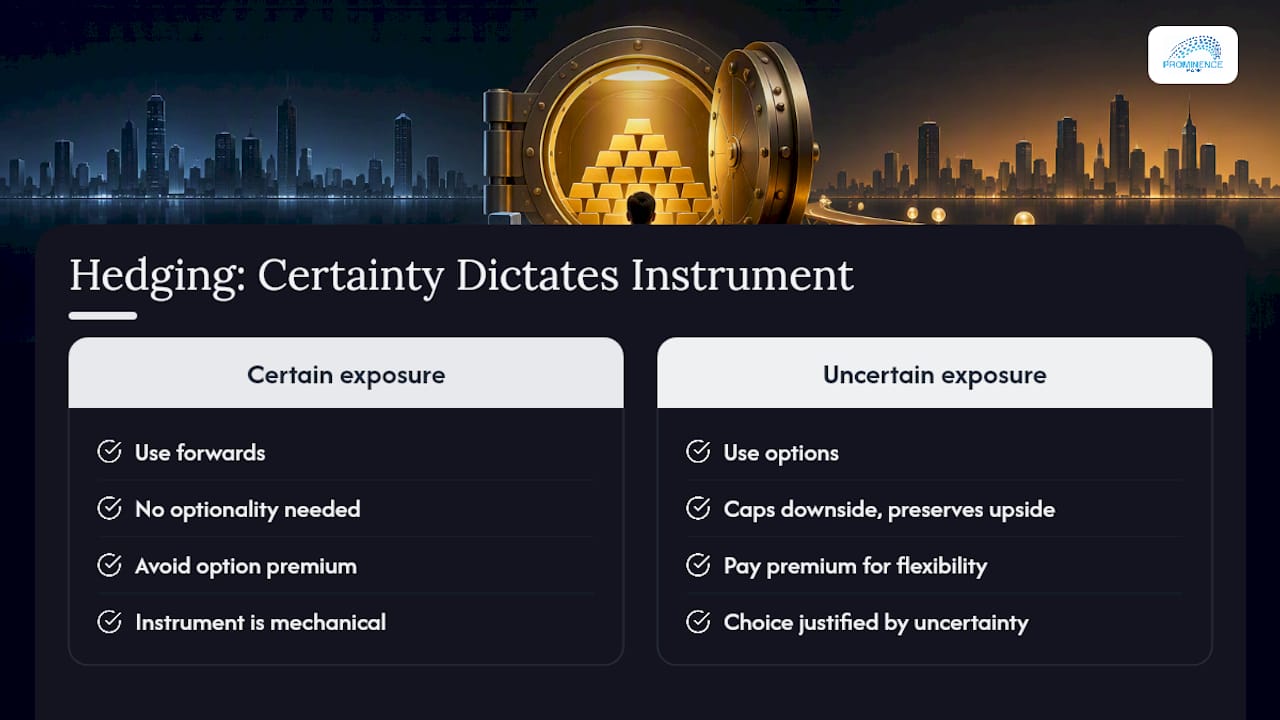
Conventional advice leans hard on options because they cap downside and preserve upside, which sounds like a free lunch until you count the premium against an exposure that was never in doubt to begin with. Paying for optionality on a fixed, contracted payable is money spent hedging a risk that doesn’t exist. That is the single most common mistake I see in how this comparison gets taught.
What actually separates good hedging programs from bad ones isn’t which instrument gets used more. It’s whether the person choosing correctly identified how certain the underlying exposure was before reaching for either tool. Get that judgment right, and the instrument choice becomes almost mechanical.
— Harold
How Prominence Bank Supports Institutional Hedging
Once you know whether you need a forward or an option, the harder part is execution: getting a bank that can actually settle a bespoke OTC hedge, hold multi-currency balances, and manage collateral without friction. A banking relationship capable of settling bespoke OTC hedges, holding multi-currency balances, and managing collateral is needed where standard retail banking rails can’t handle custom forwards on odd currency pairs or institutional treasury requirements.
Corporate treasuries and institutional clients typically need KYC documentation, proof of the underlying commercial exposure, and an account structure that matches how the hedge will settle.
Prominencebank’s business banking services cover multi-currency accounts built for exactly this kind of exposure, while corporate banking solutions handle more complex structures for businesses running multiple hedging programs at once. Full fee details, including account opening and transaction costs, are listed on the fees page. If your treasury team is ready to talk through account setup, that’s the place to start.
Sources
- Forward commitments versus contingent claims — AnalystPrep
- Futures versus Forward Contracts — NYU Stern (chapter excerpt)
FAQ
What Is the Key Difference Between Futures and Forwards?
Futures trade on an exchange with standardized terms and daily margining through a clearinghouse, while forwards are private, customized OTC agreements with no clearinghouse involved. Both obligate both parties to transact, unlike an option.
Why Would You Use a Forward Contract?
You’d use a forward to lock a known future price with zero upfront cost, which fits situations like a confirmed invoice or a scheduled commodity sale. The trade-off is giving up any upside if the market moves in your favor.
Why Do People Trade Futures Instead of Options?
Futures suit traders who want direct, leveraged exposure without paying a premium and are comfortable meeting daily margin calls. Options suit those who want to cap their downside at the premium paid, which futures don’t offer.
Are Forwards Considered Derivatives?
Yes. A forward is a derivative contract because its value derives entirely from the price of an underlying asset, exactly like futures, options, and swaps.
Which Is Better, Forwards or Options?
Neither is better in isolation. Forwards fit certain, known exposures at no upfront cost, while options fit uncertain exposures where you’re willing to pay a premium to keep the right to walk away.