
A cross-border escrow account is a neutral, third-party holding account that releases funds only when both sides of an international deal meet agreed contract conditions. Businesses use one whenever money and legal ownership need to move across a border at the same moment, without either party fronting the risk. That covers M&A closings, international real estate purchases, trade and supply chain milestones, IP licensing payments, and cross-border legal settlements.
TL;DR:
- A cross-border escrow account is essential for high-value deals like M&A, real estate, or trade, especially when multiple jurisdictions and currencies are involved.
- Opening an escrow takes longer than standard accounts, mainly due to extensive beneficial ownership verification and source-of-funds documentation; early preparation speeds up onboarding.
- Using a bank escrow agent is preferable for complex, high-value transactions because of integrated FX and custody, while platforms are better suited for frequent, smaller deals.
- Verify that the escrow provider uses segregated, insured custody in a well-regulated jurisdiction, and establish a clear dispute resolution and release process to avoid delays.
- Common risks include FX volatility, regulatory mismatches, onboarding delays, and fraud, which can be mitigated with objective, verifiable conditions and independent license verification.
Table of Contents
- What Is a Cross-Border Escrow Account and How Does It Work?
- Which Deals Actually Need Cross-Border Escrow?
- What Documents and Timeline Does Escrow Onboarding Require?
- How Do Funding, Releases, and Currency Conversion Work?
- What Jurisdiction and Custody Safeguards Should You Verify?
- Benefits and Risks You Need to Weigh
- Which Delivery Model Fits Your Transaction: Bank, Platform, or Hybrid?
- What Should You Ask a Bank Before Trusting It With Escrow-Related Custody?
- How Do Escrow Laws Differ Across the US, EU, and Asia?
- How Should Disputes Get Resolved in Cross-Border Escrow?
- What Security and Fraud Prevention Standards Actually Matter?
- What Are the Tax Implications of Cross-Border Escrow?
- A Prioritized Checklist for Closing Your Escrow Deal
- How Prominence Bank Supports Cross-Border Escrow Workflows
- Sources
- FAQ
What Is a Cross-Border Escrow Account and How Does It Work?
The mechanics are simple in theory and detailed in practice. A buyer or payer funds the account, a neutral escrow agent holds the money in trust, and funds move to the seller only after specific conditions are verified and documented.
Four roles typically show up in a cross-border deal: the payer, the payee, the escrow agent, and a set of verifiers, which might be inspectors, auditors, counsel, or an independent third party confirming a milestone was hit. Larger transactions often add legal counsel on both sides to review release conditions before signing off.
Release triggers vary by deal type:
- Milestone-based release, common in trade and construction, where funds move as production or delivery stages are confirmed.
- Document-based release, where a bill of lading, title transfer, or signed closing statement authorizes disbursement.
- Inspection-based release, used heavily in real estate and equipment sales, tied to a physical or third-party inspection report.
- Multi-signature release, requiring authorization from two or more designated parties before funds move.
Disputes get routed through a predefined resolution clause rather than left to the escrow agent’s judgment. A properly drafted escrow agreement specifies exactly who can instruct a release, what evidence satisfies a condition, and what happens if the parties disagree. The agent’s job throughout is administrative, not adjudicative. It maintains a transaction-level audit trail, reconciles the account daily, and produces reporting that both parties and their auditors can rely on later.
Which Deals Actually Need Cross-Border Escrow?
Not every international payment needs an escrow layer, but a handful of transaction types rarely close safely without one.
- M&A transactions: escrow holds back a portion of the purchase price for indemnity claims, earnout calculations, or working capital adjustments after closing.
- International real estate: escrow delivers sale proceeds only once title transfer, inspection, and local registration requirements are satisfied.
- Trade and supply chain: milestone or inspection-based releases protect importers and exporters against nonpayment or nondelivery across jurisdictions.
- IP licensing and joint ventures: escrow secures royalty payments or capital contributions pending performance benchmarks.
- Legal settlements: escrow holds settlement funds neutrally until conditions of a cross-border agreement, such as regulatory sign-off, are met.
Real estate closings are worth flagging specifically. Buyers moving property funds internationally often need supporting legal paperwork, such as apostilled documents for title or ownership records, before an escrow agent will release proceeds on a foreign property purchase.
What Documents and Timeline Does Escrow Onboarding Require?
Opening a cross-border escrow account takes longer than opening a standard bank account, mainly because the agent has to verify both parties, not just one. Prepare these documents before you start, not after:
- Corporate registration certificate and articles of incorporation for each corporate party.
- Beneficial ownership records identifying every individual with meaningful control or ownership.
- Board resolutions authorizing the specific transaction and naming signing authority.
- Government-issued ID and proof of address for directors and beneficial owners.
- Proof of funds or a source-of-funds narrative explaining where the money originated.
- Audited financial statements, particularly for larger corporate transactions.
- Tax documentation relevant to FATCA or CRS reporting where either party has US or reportable foreign tax exposure.
Timelines vary sharply by how prepared the client is. Bank-affiliated escrow agents with existing custody relationships can move fast. MUFG Investor Services reports that 85% of its escrow accounts open in under two weeks when documentation arrives complete. Independent platforms and law-firm white-label services can vary more widely depending on how many jurisdictions are involved.
The single biggest cause of delay isn’t the escrow agent. It’s incomplete beneficial ownership paperwork or a missing source-of-funds explanation, which triggers a second round of AML questions and can add a week or more to onboarding.
Pro Tip: Assemble your beneficial ownership documentation and a written source-of-funds narrative before you approach an escrow agent, not after they ask. Treasury and legal teams that front-load this paperwork routinely cut onboarding time in half.
Upfront fees also deserve attention. Escrow agents typically charge a setup fee, a percentage-based or flat holding fee tied to the transaction value, and sometimes a release fee per disbursement. Ask for the full fee schedule before signing, since bundled pricing from bank agents can differ meaningfully from per-transaction platform pricing.
How Do Funding, Releases, and Currency Conversion Work?
Funding a cross-border escrow account isn’t limited to a single method anymore. Traditional international wire transfers remain the default for large corporate transactions, routed through correspondent banking or direct interbank rails. Custodian-to-custodian transfers handle institutional deals where both sides already bank with trust-capable institutions. Some providers now also support stablecoin settlement, letting a buyer fund escrow digitally while the agent still holds the value under the same regulatory escrow protections as a fiat account, a hybrid model some modern escrow providers have built specifically for faster cross-border settlement.
Release authorization typically follows one of a few structures:
- Single instruction, where one authorized party can trigger release once conditions are documented.
- Dual approval, requiring sign-off from both payer and payee representatives.
- Escrow-agent discretionary release, where the agent verifies a coded condition independently and releases without further instruction.
- Partial or staged release, common in construction and trade, where portions move as milestones clear.
Multi-currency handling is where bank-affiliated agents tend to have an edge. Built-in FX conversion, transparent timing on rate locks, and basic hedging options matter when a deal spans two or three currencies and closes over several weeks. Fee profiles differ too: some agents quote an all-in spread on conversion, others charge conversion separately from the escrow fee. For disputed transactions, look for provisions on interest accrual on held funds and partial-release options that let undisputed portions move while a specific line item stays frozen pending resolution.
What Jurisdiction and Custody Safeguards Should You Verify?
Where the escrow account sits legally matters as much as who holds it. A stable, well-regulated jurisdiction reduces the odds that a local court order, currency control, or political disruption freezes funds mid-transaction. That’s a real consideration in deals touching jurisdictions with capital controls or unsettled banking regulation.
Before signing an escrow agreement, verify these five items directly with the agent:
- Segregated trust accounts: client funds must sit apart from the agent’s own operating capital, verifiable in writing.
- Insured or bonded custody: confirm insurance coverage limits and whether they scale with transaction size.
- Regulatory licensing: ask for the specific license or registration the agent operates under in its home jurisdiction.
- Custodian bank relationships: identify which regulated bank actually holds the cash, not just which platform manages the interface.
- Audit and reporting rights: confirm you can request transaction-level statements and reconciliation reports on demand.
Segregated trust accounts and transaction-level audit trails rank as the trust signal buyers ask about most when vetting an escrow agent, ahead of pricing or turnaround speed. Contract language should also specify dispute resolution mechanics, what happens to funds if the escrow agent itself becomes insolvent, and whether the agent carries independent professional liability coverage separate from the custodian bank’s own protections.
Benefits and Risks You Need to Weigh
Escrow’s core benefit is straightforward: it removes the trust problem from a deal where neither party wants to send money or goods first. That reduces counterparty risk, gives both sides conditional assurance the deal will close on the agreed terms, and creates a documented audit trail that satisfies auditors, regulators, and courts later if something goes wrong.
The risks sit on the operational side more than the conceptual one.
- Onboarding friction: incomplete KYC documentation can stall a deal for weeks at the worst possible moment.
- FX volatility: currency movements between funding and release dates can shift the real value either party receives.
- Regulatory mismatch: an agent licensed in one jurisdiction may face limits handling counterparties in another.
- Fraud vectors: fake escrow agents and phishing schemes impersonating legitimate providers remain common in cross-border property and trade scams.
Mitigation is mostly a matter of specificity. Write release triggers as objective, verifiable conditions rather than vague language open to interpretation. Confirm insured custody in writing before funding anything. Negotiate a service-level agreement that specifies release turnaround time once conditions are met, not just onboarding time.
Pro Tip: Never wire funds to an escrow agent you found through an unsolicited email or a link inside a deal message. Verify the agent’s license and banking relationship independently, through a phone call to a number you find yourself, before sending a cent.
Which Delivery Model Fits Your Transaction: Bank, Platform, or Hybrid?
Escrow delivery has split into four practical models, and picking the wrong one for your deal size usually shows up as either excess cost or excess friction.
Bank escrow agents suit high-value, complex deals. They bring integrated FX, regulated custody, and existing treasury relationships, which is why bank-led escrow agents often onboard high-value deals faster than standalone platforms. The trade-off is typically higher minimum fees.
Licensed escrow platforms fit frequent, mid-size transactions. API access and automated condition-checking mean faster settlement without a full private banking relationship, though currency and custody options can be narrower than a bank offers.
White-label escrow services target law firms and advisors who want escrow branded as their own client service while outsourcing the compliance and operational load. This model lets a firm offer escrow under its own brand without building custody infrastructure internally.
Stablecoin and hybrid rails suit deals that prioritize settlement speed over traditional banking hours. Funds move near-instantly across borders, though buyers should confirm the custody arrangement and regulatory status behind the digital rail before assuming it carries the same protections as a fiat trust account.
What Should You Ask a Bank Before Trusting It With Escrow-Related Custody?
Banks that offer multi-currency accounts, compliance onboarding, and treasury integration are often the practical backbone behind an escrow arrangement, even when a separate agent handles the escrow contract itself. The custody, the FX conversion, and the compliance checks that make an escrow closing go smoothly usually run through a regulated banking relationship underneath the escrow layer.
Before relying on any bank or escrow provider for a high-value cross-border deal, ask these questions directly:
- Are client funds held in segregated accounts separate from the institution’s own balance sheet?
- Is custody insured, and what are the coverage limits relative to your transaction size?
- What SLA governs release turnaround once conditions are verified, in writing?
- Can you request transaction-level audit and reporting access on demand, not just at closing?
- How does the institution handle FX conversion timing and rate locks across the life of the escrow?
A bank with mature KYC and compliance onboarding processes for complex corporate structures tends to remove friction earlier in the transaction, since beneficial ownership verification and document review happen once rather than getting duplicated across multiple institutions in the deal chain.
How Do Escrow Laws Differ Across the US, EU, and Asia?
Escrow regulation is not uniform, and that gap is where a lot of cross-border deals run into trouble. In the United States, escrow largely operates under state-level licensing for non-bank agents, while bank-affiliated escrow, like the corporate trust services U.S. Bank offers, falls under federal banking supervision. That dual structure means an escrow agent licensed in one state may not be automatically authorized to hold funds for a party in another, let alone across a border.
The European Union takes a more harmonized approach through frameworks like the Payment Services Directive, which some escrow-adjacent providers cite as their compliance basis for holding and moving client funds across EU member states. That doesn’t eliminate national variation entirely. Local civil codes still govern contract enforcement and what happens if a deal collapses mid-escrow, so the underlying agreement’s governing law clause matters as much as the escrow license itself.
Asia presents the widest variation. Jurisdictions like Singapore and Hong Kong run mature, internationally recognized escrow and trust regimes that many cross-border deals route through deliberately for that reason. Others in the region have thinner regulatory frameworks specifically built for escrow, which pushes many international deals toward using a US or EU-based agent even when neither counterparty is based there. The practical takeaway: match the escrow jurisdiction to where enforcement is realistic, not just where either party happens to be headquartered.
How Should Disputes Get Resolved in Cross-Border Escrow?
Escrow disputes multiply in complexity the moment two legal systems are involved, which is why the resolution mechanism has to be written into the agreement before funding, not negotiated after a disagreement starts.
Arbitration clauses tend to outperform litigation clauses in cross-border escrow contracts for one practical reason: enforceability. An arbitration award under a framework like the ICC or the UNCITRAL Model Law is generally easier to enforce across borders than a foreign court judgment, particularly when the counterparty’s assets sit in a third jurisdiction. Specify the arbitration seat, the governing rules, and the language of proceedings directly in the escrow agreement rather than leaving it to the underlying sale contract to cover.
Partial-release provisions matter more than most parties initially design for. When a dispute covers only one line item in a larger transaction, a well-drafted agreement lets undisputed funds move while the contested portion sits frozen pending resolution. Without that clause, an entire transaction can stall over a fraction of its value.
Escrow agents themselves should stay out of substantive judgment calls. Their role is to hold funds and follow instructions or documented evidence, not to interpret contract intent. Any agreement that gives the escrow agent discretionary authority over a genuine dispute is asking an administrative party to make a legal call it isn’t positioned to make. Route that decision to arbitration or a named third-party expert instead.
What Security and Fraud Prevention Standards Actually Matter?
Escrow fraud in cross-border deals usually targets the wire instructions, not the escrow account itself. Business email compromise schemes intercept correspondence and substitute fraudulent banking details right before a large release, which is why verifying wire instructions by phone, through a number sourced independently rather than from the email itself, remains one of the most effective fraud controls available.
On the technical side, look for escrow platforms using end-to-end encryption for document transfer and TLS 1.2 or higher for any web-based portal handling transaction data. Two-factor or multi-factor authentication should be mandatory for any party authorized to instruct a release, not optional. Platforms handling large transaction volumes increasingly log every account action, login, document upload, and instruction, in an immutable audit trail that can be reviewed independently if a dispute or fraud claim arises later.
Data residency is a related, less obvious consideration. Where the platform physically stores transaction records can matter for regulatory reporting and for evidence purposes if a dispute goes to arbitration. Ask providers directly where data is hosted and under what jurisdiction’s data protection standards it operates. For general fraud awareness ahead of any large cross-border transfer, reviewing practical security guidance for international banking is worth doing before funds ever reach the escrow stage, not after.
What Are the Tax Implications of Cross-Border Escrow?
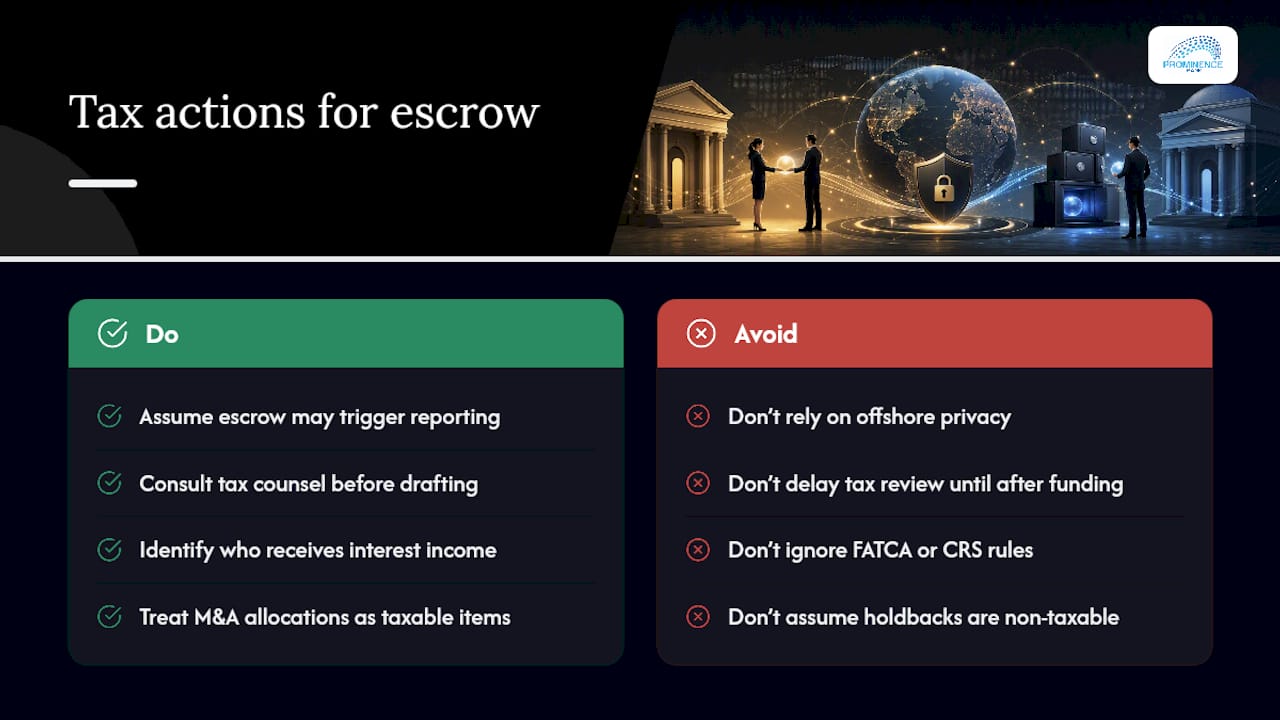
Funds sitting in escrow don’t automatically trigger a tax event just by being held, but the underlying transaction they support almost always does, and the reporting obligations can hit earlier than parties expect. For US persons and entities, funds moving through a foreign escrow account may trigger FATCA reporting requirements, and foreign financial institutions holding those funds may need to report account details to the IRS under existing intergovernmental agreements.
CRS, the international counterpart used across most OECD countries, works similarly. Financial institutions holding escrow funds report account holder information to their home tax authority, which then shares it with the tax authority of the account holder’s residence country. That means a business funding escrow through a foreign account should expect that activity to be visible to its own domestic tax authority, not assume offshore holding creates reporting privacy.
Interest earned on escrow balances, where the agreement allows accrual, is typically taxable income to whichever party is entitled to receive it under the escrow agreement, regardless of which country the account sits in. Purchase price allocations in M&A escrow, particularly holdbacks and earnouts, can also have distinct tax treatment depending on whether the payment is characterized as purchase price, compensation, or a separate contingent liability. Get tax counsel involved in drafting the escrow agreement itself, not after funds are already sitting in the account, since how the agreement characterizes a release can lock in a tax treatment neither party intended.
A Prioritized Checklist for Closing Your Escrow Deal
If I had to boil this down to what actually kills or saves a cross-border escrow closing, it’s five things: complete beneficial ownership documents, a verified custodian relationship, a written FX handling plan, objective release triggers in plain language, and a named dispute path before funding starts. Skip any one of those and you’re negotiating under pressure at the worst possible moment.
On bank versus platform: use a bank-affiliated agent for high-value, one-off deals where FX complexity and custody assurance matter most, and reserve licensed platforms for frequent, moderate-size transactions where speed and automation pay off more than white-glove handling.
— Harold
How Prominence Bank Supports Cross-Border Escrow Workflows
If you’re comparing bank escrow agents, licensed platforms, and white-label services, the practical gap most of them share is the banking layer underneath: where the money actually sits, how fast it converts currencies, and how clean the compliance file is when a counterparty’s lawyers ask for it. A bank can build that layer directly, with multi-currency business accounts, custody-ready structures, and compliance onboarding designed for exactly the kind of complex corporate parties escrow agreements involve.
A multi-currency account lets you hold and convert the currencies your escrow deal actually uses instead of routing everything through a single default currency and absorbing extra conversion cost. Pair that with Prominencebank’s corporate banking solutions for structuring the accounts complex ownership arrangements require, and the onboarding documentation you’d need for any escrow agent gets assembled once, correctly, instead of twice.
If you’re preparing for a cross-border closing, start by reviewing the account structure that fits your transaction and reach out to open a conversation about what your deal specifically needs.
This article is general information, not a substitute for advice from a qualified financial advisor. Consult a qualified financial professional about your own circumstances before acting on anything here.
Sources
- PayKeeper | Global Escrow | International Payments
- Cross-Border Escrow Services for Law Firms | Lawyers Escrow International
- Business escrow services | Global Corporate Trust | U.S. Bank
- Escrow Services | International & Corporate Solutions | JTC
FAQ
Are There Different Types of Escrow Accounts?
Yes. Common types include real estate escrow, M&A holdback and earnout escrow, trade and supply chain escrow, IP licensing escrow, and legal settlement escrow, each with release conditions tailored to that transaction type.
What Are the Biggest Risks in Cross-Border Payments?
The main risks are FX volatility between funding and release, regulatory mismatches between jurisdictions, KYC-related onboarding delays, and fraud schemes that impersonate legitimate escrow agents or intercept wire instructions.
How Long Does It Take to Open a Cross-Border Escrow Account?
It depends heavily on documentation readiness. Bank-affiliated agents can open accounts in under two weeks when paperwork arrives complete, while incomplete beneficial ownership records are the most common cause of longer delays.
What Should I Look for in an Escrow Service Provider?
Confirm segregated trust accounts, insured or bonded custody, verifiable regulatory licensing, transaction-level audit and reporting access, and a clear service-level agreement for release turnaround times.
Can a Bank Account Support an Escrow Arrangement Directly?
A regulated bank can hold the underlying custody and multi-currency conversion behind an escrow agreement even when a separate agent manages the contract terms; some banks offer multi-currency and corporate banking accounts built to support that structure.