
A multi-signatory corporate account is a business bank account where two or more people hold signing authority, each able to approve transactions under rules the company sets. Before applying, gather your EIN, formation documents, government IDs for every signer, and a signed corporate resolution naming who can act on the account and under what rule.
TL;DR:
- Most banks require an employer identification number and formation documents before opening a multi-signatory account, with additional scrutiny for complex ownership structures.
- Setting clear control policies such as transaction limits, dual signature thresholds, and role-based credentials can prevent delays and internal control failures.
- Joint ownership exposes owners to joint liability and offers FDIC coverage up to $250,000 per owner, making it suitable for holding large balances but riskier in liability.
- In-person verification may be necessary for complex structures, and proper resolution language is crucial to prevent application delays.
- Digital banks now incorporate role-based signatory controls from the start, reducing compliance issues and simplifying multi-currency or multi-jurisdiction setups.
Table of Contents
- What Banks Require to Open a Multi Signatory Corporate Account
- What Are the Different Signer Authority Levels?
- What Are the Risks of Joint Corporate Account Ownership?
- Controls and Policies to Set Before You Open the Account
- How Long Does It Take to Open a Multi Signatory Account?
- The Digital Banking Perspective on Signatory Controls
- How Prominence Bank Supports Multi-Signer Corporate Accounts
- Sources
- FAQ
What Banks Require to Open a Multi Signatory Corporate Account
Banks build their document checklist around one question: who can legally bind this company? That starts with your Employer Identification Number. Most banks require an EIN before they’ll open any entity account, and the IRS lets you apply for one online at no cost, with the number issued immediately in most cases.
Beyond the EIN, expect banks to ask for:
- Formation documents: articles of incorporation or organization, partnership agreements, or joint venture agreements depending on your entity type
- A corporate resolution naming each authorized signer and the signature rule that applies to them
- Government-issued ID, Social Security number or ITIN, and proof of address for every listed owner and signer
- Beneficial ownership disclosures for anyone holding 25% or more of the company
That last item exists because banks operate under Bank Secrecy Act rules requiring them to verify who actually controls a legal entity, not just who’s listed on paper. The FFIEC’s guidance on customer due diligence explains why banks push harder on identity verification for multi-owner entities than for a sole proprietor walking in alone. Multi-member LLCs, partnerships, and joint ventures often trigger additional scrutiny since ownership percentages and control rights aren’t always obvious from the paperwork alone. For a fuller rundown of what compliance teams look for, our structuring checklist for executives breaks down what to prepare before you sit down with a banker. Some banks still require in-person verification for complex ownership structures, even when the rest of the application happens online.
What Are the Different Signer Authority Levels?
Not everyone on the account needs the same power, and treating every signer identically is how companies end up with either bottlenecks or blind spots. Four roles cover most setups:
- Owner: has full authority, appears on formation documents, and generally carries personal liability tied to the account
- Authorized signer: can approve transactions up to whatever limit the company sets, without holding equity
- Delegated approver: reviews or co-approves specific transaction types, often used for wires or large transfers
- View-only user: sees balances and statements but can’t move money
The signature rule you choose determines how these roles function day to day. An “any one” rule lets a single authorized signer act alone. An “any two” rule requires two signatures on every transaction, which slows things down but closes the single-point-of-failure gap. Growing companies often start with one owner as the sole signer, then add authorized signers as headcount grows, reserving full ownership status for people with actual equity. Guidance on structuring joint business accounts consistently points to authorized signers as the better fit when someone needs transactional access but shouldn’t carry ownership-level liability.
What Are the Risks of Joint Corporate Account Ownership?
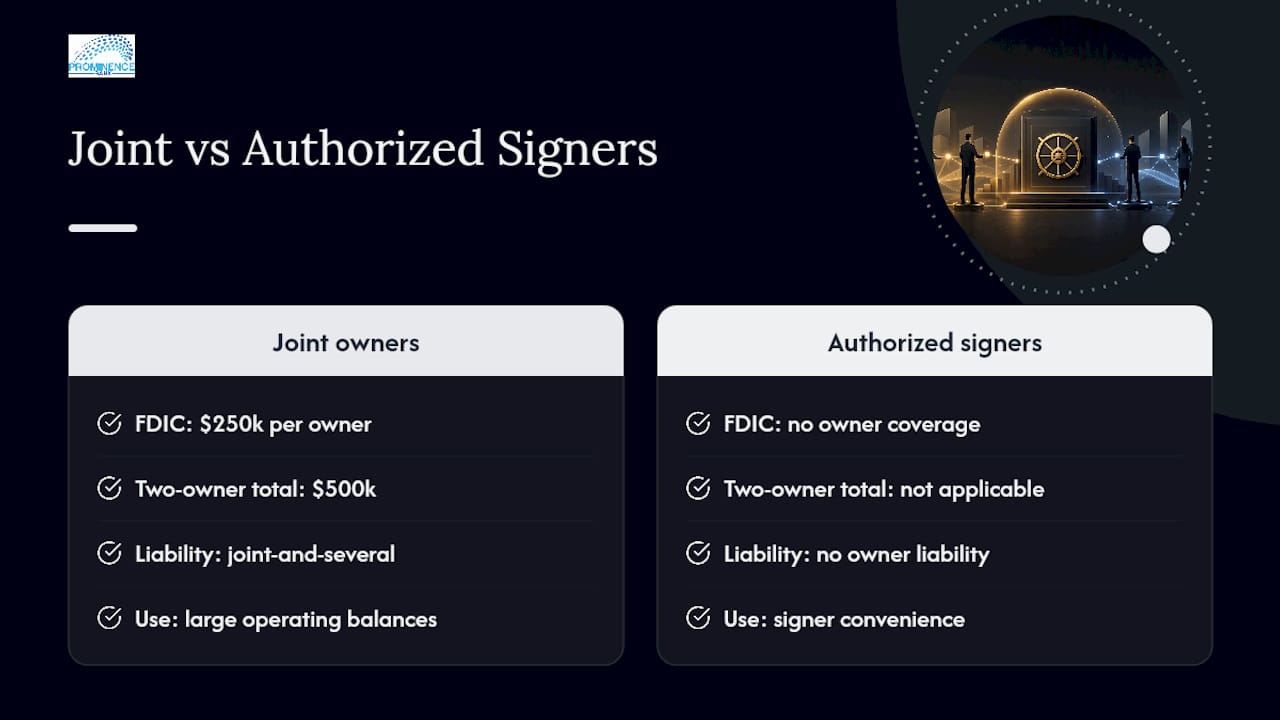
Joint ownership comes with joint-and-several liability, meaning each owner can be held responsible for the full balance of any debt or overdraft on the account, regardless of who created it. If one co-owner faces a personal judgment or creditor claim, that exposure can reach funds sitting in the shared account, a point commercial lending guidance makes clear to anyone considering joint structures for reasons beyond convenience.
FDIC insurance covers each owner of a jointly owned account up to $250,000, so two co-owners can have combined coverage of up to $500,000 on the same account. That’s a real advantage for companies holding large operating balances, and it’s often the deciding factor for choosing joint ownership over a single-owner account with authorized signers. Authorized signer roles don’t carry that same personal liability exposure, since signers aren’t owners of the deposit for insurance purposes.
Controls and Policies to Set Before You Open the Account
Get your control structure decided before you walk into the bank, not after. A few patterns work well across most company sizes.
- Set a dollar threshold for dual signatures. Many companies allow single-signer approval under $5,000 and require two signatures above it; for detailed advice on implementing these controls, see our Security & Reliability guidance.
- Assign per-signer transaction limits so no single authorized signer can move more than their role justifies.
- Issue unique, role-based credentials to every user. Never share logins across signers.
- Reconcile accounts weekly and retain transaction logs for audit purposes.
- Require dual authority on wire transfers regardless of the general signature rule, since wires are largely irreversible.
Password sharing among signers remains one of the most common internal control failures, since it erases the audit trail that separates legitimate activity from unauthorized access. If you need a signer to act on behalf of an owner without full account authority, a power of attorney structure can grant specific, limited authority instead of full signatory status.
Pro Tip: Keep a separate reserve account walled off from your daily operating account. It limits how much any single signer, authorized or otherwise, can touch on a bad day.
How Long Does It Take to Open a Multi Signatory Account?
Before you apply, draft the corporate resolution and confirm every signer has valid ID ready. Unclear authority language in that resolution is one of the top reasons applications get delayed. A bankability checklist for complex entities walks through the documentation banks expect before they’ll move forward.
At the application appointment:
- Every owner with 25% or more equity typically needs to appear or complete separate verification
- Bring formation documents, IDs, EIN confirmation, and the signed resolution
- Expect an opening deposit requirement that varies by bank and account type
Large national banks often require signers on multi-member LLCs to appear in-branch, though some allow pre-authorized signers a short window, typically around 30 days, to complete in-person identity verification. Beneficial ownership screening under BSA/AML rules can add several business days beyond a simple identity check. Most rejections trace back to incomplete beneficial ownership disclosures or resolution language that doesn’t clearly state who can bind the company, both fixable before you ever schedule the appointment.
The Digital Banking Perspective on Signatory Controls
Security-first digital banks approach signatory management differently than a branch built around paper forms. Role-based credentials, individual login trails, and tiered approval thresholds get built into the account structure from day one rather than bolted on later. Compliance checks under AML/KYC standards happen the same way for a two-signer LLC as for a complex multi-currency corporate structure, just with proportionally more documentation. The practical lesson: draft resolution language that names each signer’s exact authority level before you apply anywhere, digital or traditional.
— Harold
How Prominence Bank Supports Multi-Signer Corporate Accounts
Prominence Bank gives corporate officers something a paper-heavy branch process usually can’t: role-based signatory controls built into the account from the start, not added as a workaround. Every authorized signer gets a unique credential and a defined authority tier, so a two-signer partnership and a five-signer holding company both get clean audit trails without extra manual setup.

That structure matters most for businesses juggling multiple currencies, jurisdictions, or ownership layers, where a single missed control can turn into a compliance headache months later. Compliance-first onboarding means beneficial ownership and identity verification happen upfront, which cuts down on the delays that trip up applicants elsewhere. If you’re ready to structure signatory authority correctly from the first deposit, see how to secure corporate banking with role-based controls built in from day one.
This article is general information, not a substitute for advice from a qualified financial advisor. Consult a qualified financial professional about your own circumstances before acting on anything here.
Sources
- FDIC — Joint accounts and deposit insurance
- IRS — Apply for an Employer Identification Number (EIN) online
- FFIEC — Assessing compliance with BSA regulatory requirements
- NerdWallet — How to open a joint bank account with a business partner
FAQ
How many authorized signers can a business account have?
Most banks don’t cap the number, but each additional signer usually means more documentation and identity verification, so companies typically limit signers to the people who genuinely need transactional authority.
What is the $3,000 rule for banks?
This isn’t a standard federal banking rule; it’s often confused with reporting thresholds under separate regulations, and definitions vary by institution, so confirm the specific policy directly with your bank rather than relying on a general figure.
How many signers can you have on a checking account?
There’s no universal limit for business checking accounts, though banks may charge more or require additional verification as the signer count grows, particularly past four or five people.
Are there bank accounts that offer dual signature requirements?
Yes, most business banks let companies set an “any two” signature rule requiring two approvals on every transaction, which is standard for firms wanting extra control over large transfers.
Should a business partner be an owner or an authorized signer?
If someone holds equity and shares liability, they should appear as an owner; if they need transactional access without ownership stakes or personal liability exposure, an authorized signer role fits better.