
Yes, qualified high-net-worth individuals, international businesses, and institutions can complete remote bank onboarding entirely online, without ever visiting a branch. The catch is preparation: you need certified identity documents, verifiable source-of-wealth evidence, and a clean corporate ownership trail before you apply. Straightforward cases clear in days; complex structures with Enhanced Due Diligence can take several weeks. Start with a pre-assessment from a bank built for this clientele before you submit anything.
TL;DR:
- Complex onboarding cases with layered ownership or cross-border income claims require thorough source-of-wealth verification and may take several weeks to complete.
- Essential documents include notarized passports and corporate resolutions, with notarizations and apostilles advised to be completed before applying to avoid delays.
- Inconsistent information, unverified source-of-funds, or missing notarizations are common causes of application escalation and extend processing times.
- Ongoing compliance checks, including PEP and sanctions screening, mean your application might be re-evaluated periodically even after account opening.
- Pre-assessment and structured document preparation greatly improve the speed and success rate of remote onboarding for high-net-worth and corporate clients.
Table of Contents
- What Does Remote Bank Onboarding Actually Involve?
- What Documents Do You Need for Remote Onboarding?
- How Long Does Remote Onboarding Usually Take?
- Why Do Banks Require Such Extensive Verification?
- What Should You Do Before You Apply?
- How Prominence Bank Approaches Remote Onboarding
- Ready to Open a Multi-Currency Account Remotely?
- Where to Verify the Rules Yourself
- Sources
- FAQ
What Does Remote Bank Onboarding Actually Involve?
Remote bank onboarding means opening an account, and completing every KYC and AML check that goes with it, without setting foot inside a branch. For a standard retail account, that might mean a selfie scan and an ID upload. For a multi-currency or offshore account tied to an HNW individual or a corporate structure spanning three jurisdictions, it means something closer to a compliance file being built in real time.
Banks apply Enhanced Due Diligence to these cases because the risk profile is different. Complex ownership layers, cross-border income sources, and politically exposed persons (PEPs) all trigger deeper scrutiny than a routine checking account ever would. The verification stack behind online banking registration for this segment typically includes:
- eID verification against government identity registries
- Secure video KYC calls with a live compliance officer
- Biometric face matching against submitted photo ID
- OCR-based document extraction to cross-check names, dates, and numbers automatically
- Immutable audit logs that timestamp every verification step for later regulatory review
None of this is friction for its own sake. It’s the digital equivalent of a private banker reviewing your file in person, just compressed into a process that runs on servers instead of desks.
What Documents Do You Need for Remote Onboarding?
Document quality is where most remote applications succeed or fail. Banks reviewing offshore or multi-currency accounts in 2026 expect far more than a passport scan. They want a documented, verifiable narrative of who you are, where your money came from, and who actually controls the entity opening the account, since inadequate or opaque documentation is one of the most common reasons applications stall or get refused outright.
For individual applicants, prepare:
- A certified copy of your passport (notarized or apostilled, depending on jurisdiction)
- A secondary photo ID, such as a national ID card or driver’s license
- Proof of address dated within the last three months (utility bill, bank statement, or lease)
- Your tax identification number for your country of residency
- Certified source-of-wealth documentation: sale contracts, inheritance records, audited financial statements, or business sale agreements
For corporate applicants, prepare:
- Certificate of incorporation and current articles or bylaws
- Operating agreements and recent board meeting minutes
- A Certificate of Good Standing issued within the last 90 days
- A Federal Employer Identification Number (FEIN), where a U.S. entity is involved
- A corporate resolution formally naming authorized signatories
- A full ownership chart identifying every beneficial owner above the applicable threshold
Beneficial ownership verification usually kicks in at 25% ownership or effective control, though thresholds vary by bank and jurisdiction. Expect to submit share registers, trust deeds, or nominee agreements as evidence, not just a diagram. If you don’t have a U.S. entity but a bank requests one, alternatives like a registered agent or a virtual mailing address are often accepted, though some banks require the U.S. entity outright and won’t budge on that point.
Pro Tip: Get your Certificate of Good Standing and any apostilles notarized before you start the application, not after a compliance officer asks for them. Reordering documents mid-review is the single biggest cause of avoidable delay.
How Long Does Remote Onboarding Usually Take?
A straightforward individual account with clean documentation can be approved in a matter of days. A corporate account with layered ownership, cross-border income, or ties to a higher-risk jurisdiction routinely takes several weeks once Enhanced Due Diligence kicks in. Standard U.S. account opening timelines run around three weeks even under normal conditions, and complexity adds to that baseline rather than replacing it.
Several triggers reliably push a file into escalation:
- Inconsistent information across documents (a name spelled differently on a passport versus a bank statement)
- Source-of-funds claims that can’t be independently verified
- A business rationale that doesn’t clearly explain expected transaction volume or currency flows
- Missing apostilles or notarizations on foreign-issued documents
- No single designated contact for the compliance team to reach when questions come up
Every one of these is preventable. Pre-verify your documents against the bank’s checklist before submission. Provide concrete transaction examples, invoices, contracts, and shipping records rather than vague descriptions of “international trade.” Handle notarizations and apostilles before you apply, not while a reviewer is waiting on them. And designate one person, with one phone number and one inbox, as the point of contact for the entire review. Banks escalate files that go quiet far faster than files where someone answers on the first ask.
Why Do Banks Require Such Extensive Verification?
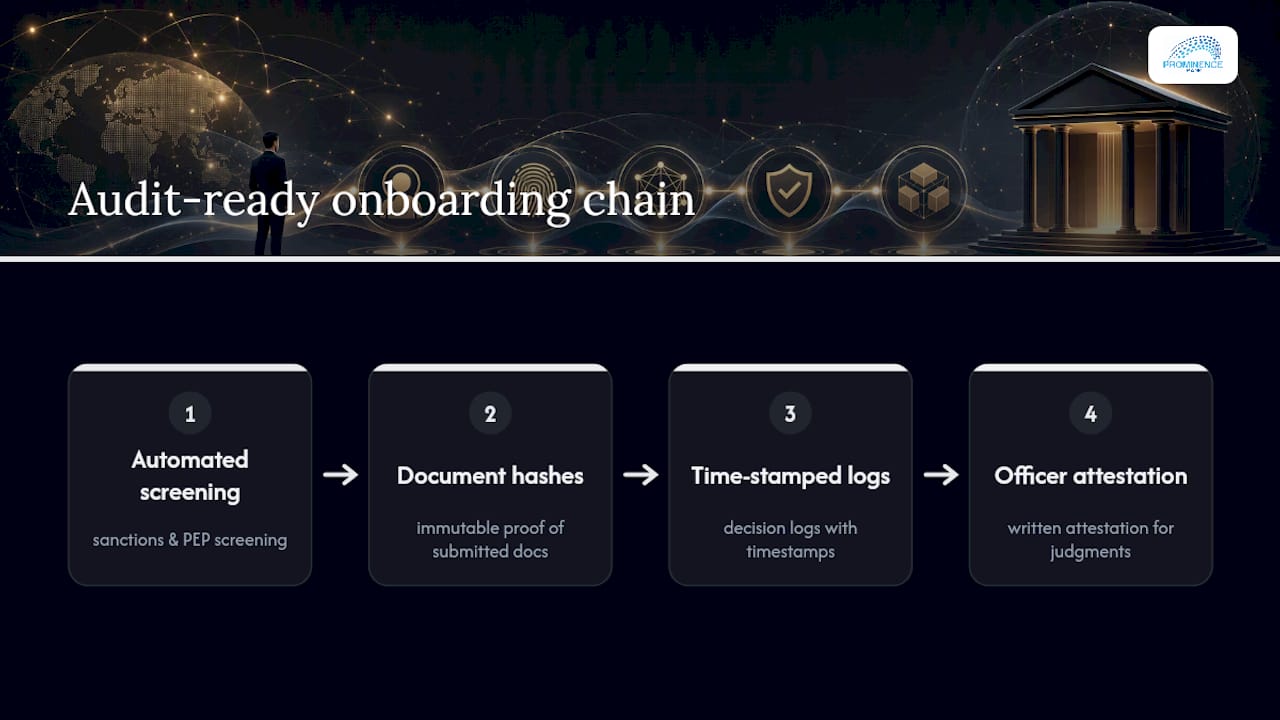
Every remote decision a bank makes has to survive a regulator’s second look. That means an audit-ready onboarding record: document hashes, sanctions and PEP screening outputs, time-stamped decision logs, and a compliance officer’s written attestation for every judgment call. Auditable artifacts for each automated decision are what let a bank move fast without losing the paper trail a regulator will eventually ask for.
The regulatory backbone here includes FinCEN’s Customer Due Diligence (CDD) rule in the U.S., along with FATCA and CRS obligations that govern cross-border tax reporting. None of that stops once your account opens. HNW and institutional relationships typically carry continuous PEP and sanctions screening, meaning your file gets rescreened on a rolling basis, not just at intake. That ongoing monitoring is why your relationship manager may occasionally ask for updated documentation years into the relationship. It’s not suspicion. It’s the system working as designed.
What Should You Do Before You Apply?
Treat document preparation as its own project, not a last-minute scramble the week you submit. Clients who organize apostilles, notarizations, and certified translations in advance consistently see faster bank responses than those who submit incrementally.
Step 1: Inventory every identity and corporate document you’ll need, then get certified copies, translations, and apostilles handled before you touch an application form.
Step 2: Build a clear source-of-funds package: sale agreements, audited financial statements, tax returns, and a short written narrative explaining your business model and the kinds of transactions your account will actually process.
Step 3: Nominate your authorized signatories in writing, prepare their notarizations, test the bank’s secure upload channels ahead of time, and agree internally on one contact person the bank’s compliance team can reach without delay.
Pro Tip: *Write the source-of-funds narrative before a compliance officer asks for one.
How Prominence Bank Approaches Remote Onboarding
Prominence Bank is a fully licensed digital banking institution built specifically for high-net-worth individuals, international businesses, and institutional clients who need private, fully online financial services. We built our onboarding process around one hard requirement: every accelerated step still has to produce evidence a regulator can review later.
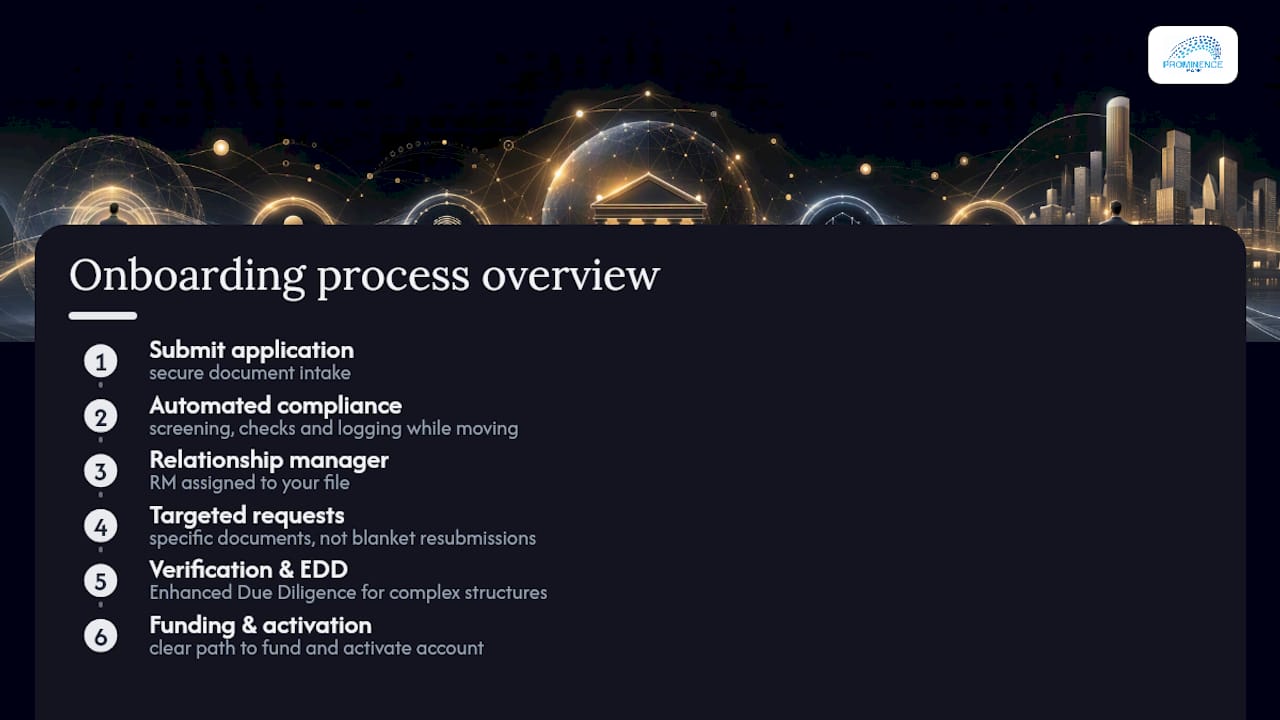
That means secure document intake paired with compliance choreography running in the background, checking, screening, and logging while your file moves rather than after it stalls. We don’t skip Enhanced Due Diligence for complex structures. We just don’t make you wait weeks between requests to complete it.
Once you submit, expect a relationship manager assigned to your file, targeted document requests instead of blanket resubmissions, and a clear path to funding and activating your account once verification closes out.
— Harold
Ready to Open a Multi-Currency Account Remotely?
Most banks make you choose between speed and discretion. The bank handles multi-currency business accounts, corporate structures with layered ownership, and KTT-enabled account setups through a compliance-first process that runs entirely online, from document intake through activation.
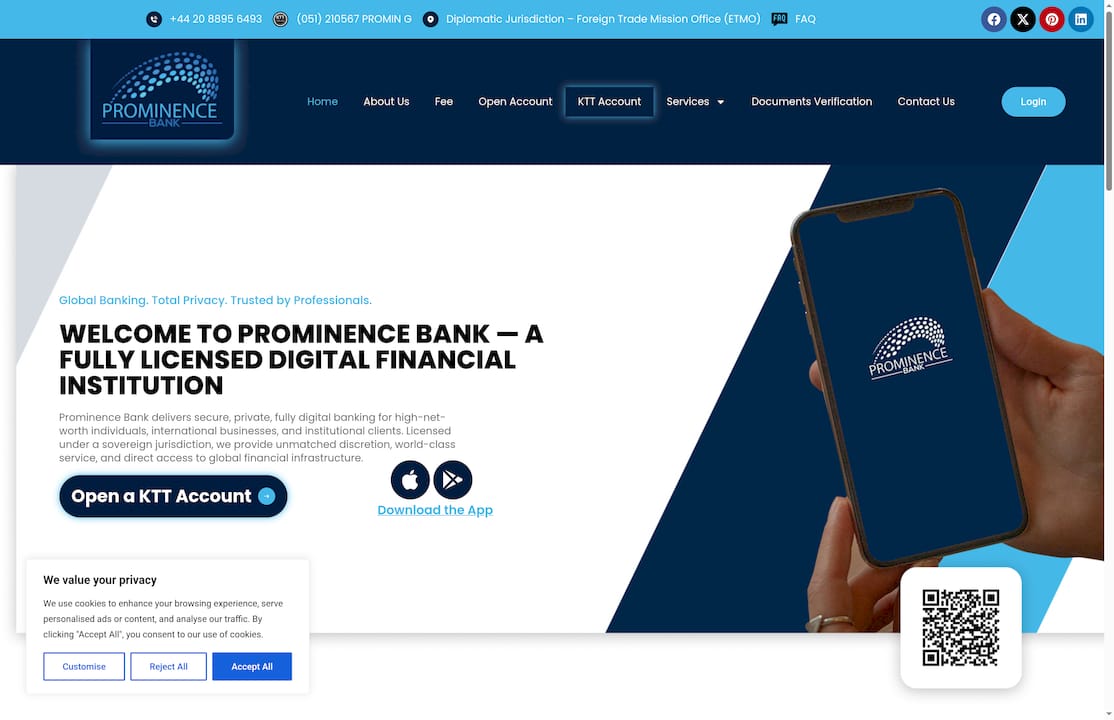
The entry point is simple: a secure pre-assessment reviewing your situation, an assigned relationship manager as your single point of contact, and a document intake channel built for certified, sensitive paperwork. If your ownership structure spans multiple jurisdictions, the mapping is handled as part of the same process, not as a separate delay.
Start with Prominence Bank’s international account setup guide to see exactly what your specific structure will require, then request your pre-assessment to get a relationship manager assigned this week.
Where to Verify the Rules Yourself
- The U.S. Department of Commerce’s banking checklist for market entrants covers FEIN requirements and realistic account-opening timelines.
- Eternity Law’s breakdown of 2026 offshore KYC changes details current source-of-funds expectations.
- Prominence Bank’s guide to KYC for complex corporate structures walks through UBO mapping in more depth.
This article is general information, not a substitute for advice from a qualified financial advisor. Consult a qualified financial professional about your own circumstances before acting on anything here.
Sources
- Banking checklist for U.S. market entrants
- KYC and compliance when opening a bank account for an offshore company: what changed in 2026
- Flowx
- KYC & AML for Wealth & Asset Managers | One Constellation
FAQ
Can a Foreign Business Open a U.S. Bank Account Remotely?
Yes. There is no legal bar to foreign entities holding U.S. bank accounts, though individual banks set their own policy and may require a U.S. entity and FEIN, with account opening typically taking around three weeks.
What Triggers Enhanced Due Diligence During Remote Onboarding?
Complex ownership structures, cross-border income sources, exposure to higher-risk jurisdictions, and politically exposed person (PEP) status all commonly trigger Enhanced Due Diligence reviews.
How Long Does Video KYC Take for a Multi-Currency Account?
A video KYC call usually takes a short time, but the full onboarding timeline depends on document readiness. Straightforward files clear in days, while EDD cases can take several weeks.
What Is the Single Biggest Cause of Onboarding Delays?
Opaque ownership structures and insufficient source-of-funds evidence are the most common reasons banks flag applications for extended review or refuse them outright.
Does Prominence Bank Support Fully Remote Account Opening?
Yes. Prominence Bank runs a fully online onboarding process for multi-currency, corporate, and KTT-enabled accounts, including secure document intake and a dedicated relationship manager assigned to each applicant.