
You establish a defensible UBO determination by tracing ownership to natural persons through look-through logic, corroborating every link with an independent source, and escalating anything you can’t verify. That’s the whole job in one sentence. The harder part is doing it consistently across layered holding companies, trusts, and nominee arrangements without burning weeks of analyst time on a single file.
Three actions matter most in the first hour of any complex-structure review:
- Build the ownership chain from the customer’s declaration, then cross-check it against a registry extract, not the other way around.
- Pull constitutive documents (articles of incorporation, trust deeds, shareholder registers) for every intermediate entity, not just the top and bottom of the chain.
- Verify each natural-person UBO’s identity and, where risk warrants it, source of wealth, before you call the file closed.
“Defensible” means an examiner can reconstruct your reasoning six months later from the file alone: who you identified, what document proved it, who reviewed it, and when. According to FATF guidance on transparency and beneficial ownership, firms must identify the natural persons who ultimately own or control a legal entity and verify that ownership using reliable, independent sources. Everything below is how to make that happen without guessing.
Key Takeaways
A defensible UBO determination requires look-through mapping to natural persons, independent corroboration of every ownership link, and documented escalation wherever verification stalls.
| Point | Details |
|---|---|
| Map before you verify | Build the ownership chain from the customer’s declaration, then test it against registry extracts. |
| Control counts without equity | Voting agreements, board seats, and veto rights can make someone a UBO even at low ownership percentages. |
| Evidence hierarchy matters | Prioritize certified registry extracts and independent corroboration over declarations alone. |
| EDD triggers need fixed actions | PEP exposure, sanctioned jurisdictions, and nominee gaps should each map to a specific escalation step. |
| Automation handles the routine cases | Let automated screening auto-clear resolved files and route unresolved ownership nodes to analysts. |
| Prominence Bank supports the file, not just the account | Its onboarding preserves document handling and audit trails for multi-jurisdictional corporate clients. |
Table of Contents
- KYC for Complex Structures: Mapping Ownership Chains Step by Step
- Trusts, Foundations, and Nominees: What Actually Hides Ownership
- What Documentation Turns a Hypothesis Into a Verified Determination
- When Does a Complex Structure Require Enhanced Due Diligence?
- Can Automation Actually Handle Complex-Structure KYC?
- What Belongs in an Examiner-Ready Audit File
- A Practical Checklist for Onboarding and Periodic Review
- Where Compliance Teams Actually Lose Time
- How Prominence Bank Supports Complex-Structure Onboarding
- Sources
- FAQ
KYC for Complex Structures: Mapping Ownership Chains Step by Step
Ownership mapping isn’t a single lookup. It’s a sequence, and skipping steps is exactly how UBOs get missed in three-layer holding structures.
- Start with the declaration, not the registry. Ask the customer to submit a signed ownership chart identifying every entity, percentage, and natural person involved. Treat it as a hypothesis to test, not a fact to file.
- Pull a registry extract for every intermediate legal person to understand the different legal structures involved in the ownership chain. A parent company incorporated in one jurisdiction and a subsidiary in another both need their own extract. Reconcile each shareholder register against the entity’s own constitutive documents. Gaps here are the single most common reason files get kicked back at review.
- Calculate ownership at each layer, then multiply through. A person holding 40% of Company A, which holds 50% of Company B, holds an effective 20% indirect stake in B. Most jurisdictions set the UBO threshold around 25%, so this math determines who counts and who doesn’t.
- Treat control as evidence even without equity. A shareholder with 15% equity but a majority board seat, veto rights, or a voting agreement can still be a UBO under control-based tests. FATF’s guidance explicitly extends beneficial ownership beyond simple share counts.
- Log the source for every step as you go. Which registry, which document, which date, who reviewed it. If a link in the chain can’t be corroborated, flag it for escalation immediately rather than waiting until the file is “done.”
Pro Tip: Build the ownership graph visually, even in a simple diagram tool, before you write a single line of the compliance memo. Analysts miss circular structures and duplicate entities far less often when the chain is drawn out rather than described in prose.
Trusts, Foundations, and Nominees: What Actually Hides Ownership
Layered companies are the easy case. Trusts, foundations, and nominee arrangements are where UBO discovery gets genuinely difficult, because the legal owner on paper often isn’t the person who controls the money.
For trusts, request the trust deed itself, not a summary of it, along with any letters of wishes, identification for the trustee, and documentation on the settlor. Trust structures often include a protector role with veto power over trustee decisions, and that person can qualify as a UBO even without owning anything. Practitioner guidance on trusts and foundations breaks down exactly which party needs which document, and it’s worth building your intake checklist around that role-by-role logic rather than a generic document list.

For foundations, common in civil-law jurisdictions and popular for holding family wealth, get the foundation’s statutes, the council register, and any beneficiary schedule or founder’s declaration.
For nominee shareholders or directors, a name on a share register means nothing until you have a signed nominee declaration and the underlying agreement tying instructions to a real, identified person.

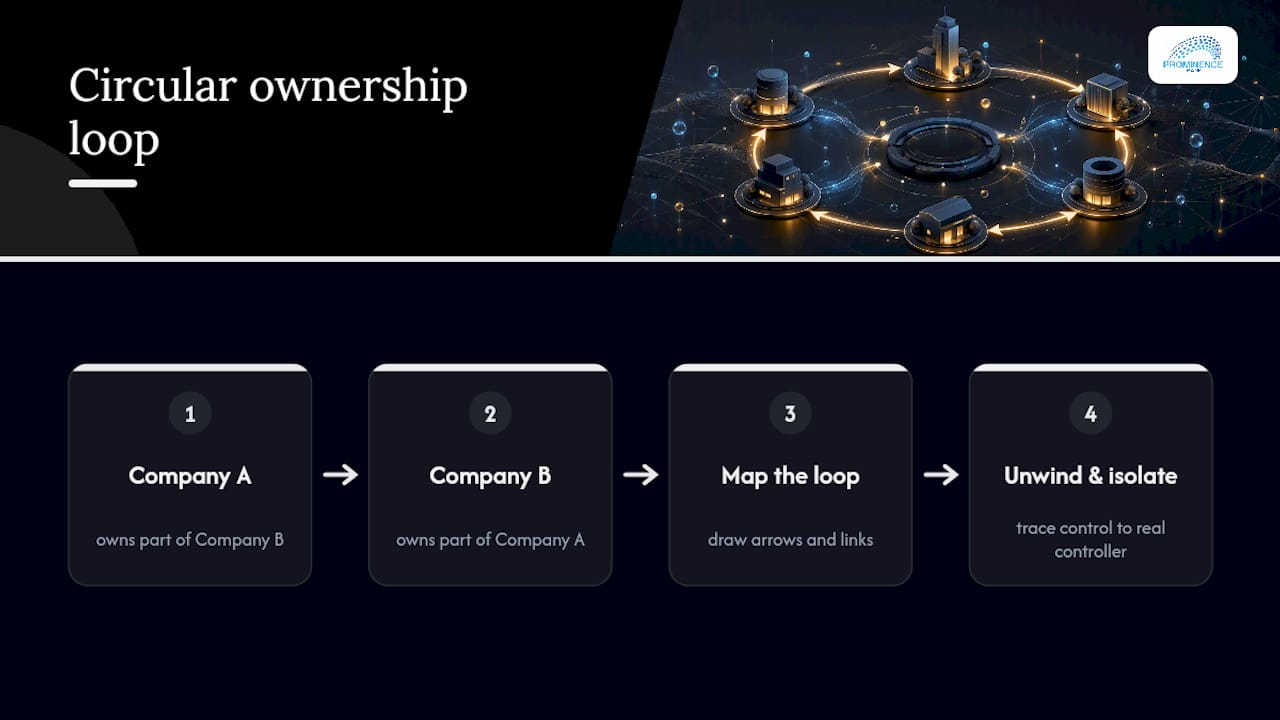
For circular ownership, where Company A owns part of Company B, which owns part of Company A, map the loop explicitly, unwind the percentages, and isolate who actually exercises control rather than accepting the circularity as a dead end.
What Documentation Turns a Hypothesis Into a Verified Determination
A UBO hypothesis isn’t a finding until it’s backed by evidence a third party could check.
Prioritize your evidence gathering in this order:
- Authoritative registry extracts and certified copies of constitutive documents come first. These are your primary evidence, not a nice-to-have.
- Identity verification for each natural-person UBO, using government-issued ID, proof of address, and biometric or non-documentary checks where the jurisdiction and risk level support them.
- Source-of-wealth and source-of-funds documentation for any UBO flagged as higher risk, tax returns, sale agreements, inheritance records, whatever demonstrates the money’s origin credibly.
- Independent corroboration, not just registry data. Research on UBO discovery makes the point directly: registries are inputs, not conclusions, and cross-jurisdictional structures almost always need a second, independent source before you can call ownership verified.
When evidence conflicts, a registry says one shareholder, a declaration says another, don’t average the difference or pick the more convenient version. Request a third-party attestation, a notarized statement, or a legal opinion, and document why you needed it.
When Does a Complex Structure Require Enhanced Due Diligence?
Certain red flags convert a routine file into an EDD case automatically, and the trigger list is fairly consistent across regulatory frameworks.
- PEP exposure at any layer of the ownership chain, not just at the top. A politically exposed person holding an indirect 10% stake three layers down still counts.
- Sanctioned or high-risk jurisdictions appearing anywhere in the corporate chain, even as a pass-through entity with no apparent economic purpose.
- Nominee arrangements without full underlying documentation. A nominee declaration alone, with no supporting agreement, is a gap, not a resolution.
- Circular ownership or minimal substance, shell entities with no employees, no physical presence, and no clear commercial rationale for their place in the chain.
- Inconsistent registry data, where filings in different jurisdictions contradict each other on who owns what.
Each trigger should convert into a specific action: additional documentation requests, mandatory senior compliance signoff, transaction or account limits until resolution, or, where the gap can’t be closed, declining the relationship. Swift’s guidance on the KYC process treats EDD as a documented escalation with defined controls, not an informal judgment call, and your file should reflect that same discipline. Where uncertainty remains after reasonable effort, document it explicitly and pair it with a monitoring commitment rather than pretending the picture is complete.
Can Automation Actually Handle Complex-Structure KYC?
Good automation builds the ownership graph from registry feeds, flags any node it can’t resolve, runs sanctions, PEP, and adverse-media screening against every identified party, and preserves a timestamped audit trail of what it found and when. The primary data sources worth connecting to are national corporate registries, central beneficial-ownership registers, the SWIFT KYC Registry for standardized cross-institution data exchange, sanctions and PEP screening providers, and commercial registry aggregators that fill gaps between national systems.
The limitation is real: registry data is often stale, incomplete, or simply unavailable for certain jurisdictions and entity types. When that happens, platform documentation on business verification describes falling back to expert-assisted verification, a human researcher confirming what the database can’t. Cross-border data access also raises its own privacy constraints, since not every jurisdiction permits the same registry queries or data retention.
Pro Tip: Set a hard rule that automation can auto-clear a file only when every ownership node resolves cleanly to a verified natural person. One unresolved node should force manual review by default, never a “probably fine” auto-approval.
What Belongs in an Examiner-Ready Audit File
The file itself is often what separates a clean exam from a finding. At minimum, it should contain:
- Registry extracts and certified constitutive documents for every entity in the chain.
- Signed beneficial-ownership declarations from the customer.
- Verifier notes explaining how each UBO was confirmed and which independent source was used.
- Timestamps on every document and action, plus a reviewer signoff for the final determination.
- A written note on any unresolved issue and the mitigating control applied, transaction limits, enhanced monitoring, or a defined re-verification date.
Reviews shouldn’t run on a fixed calendar alone. Registry changes, new sanctions hits, or adverse media should trigger an immediate re-verification regardless of where the entity sits in your periodic review cycle, an approach increasingly expected under evolving frameworks like the EU’s anti-money laundering regulation push toward continuous monitoring rather than point-in-time checks.
A Practical Checklist for Onboarding and Periodic Review
Use this sequence for every complex-structure customer, whether it’s a first-time onboarding or a scheduled review:
- Pre-onboarding: collect the beneficial-ownership declaration, registry links, and constitutive documents for every entity in the chain.
- Verification: apply the document set matching the ownership type, trust deed and trustee ID for trusts, nominee declarations for nominee arrangements, registry extracts for layered corporates.
- Consolidation: assemble all evidence, route to senior compliance for signoff if any EDD trigger fired, and document a mitigation plan for anything still unresolved.
- Ongoing review: set both a periodic cadence and event-driven triggers, registry changes, new sanctions designations, adverse media, so the file never goes stale between scheduled reviews.
Related structuring considerations, including why layered entities exist legitimately, are worth reviewing alongside this checklist when structuring corporate accounts for multinational clients.
Where Compliance Teams Actually Lose Time
Complex files eat senior analyst hours disproportionately, and it’s rarely the mapping itself that causes the delay. It’s re-litigating decisions because the first pass didn’t document its sources well enough to survive a second look. Junior analysts should own the mechanical work, registry pulls, document reconciliation, graph construction, while senior reviewers spend their time exclusively on judgment calls: ambiguous control, conflicting evidence, EDD signoff.
Prominence Bank’s own onboarding for corporate and institutional clients is built around that same triage logic, separating routine verification from the cases that genuinely need a compliance officer’s attention. [brand_signal: Prominence Bank compliance posture]
If you triage nothing else, triage by unresolved nodes. It’s not done.
— Harold
How Prominence Bank Supports Complex-Structure Onboarding
Everything covered above, ownership mapping, document verification, audit trails, EDD escalation, is operational work your bank has to support, not just your compliance team. Prominence Bank’s corporate accounts are built around that reality: secure document handling for trust deeds and registry extracts, KTT-enabled account opening that doesn’t force you to choose between speed and a proper paper trail, and multi-currency structures suited to entities operating across several jurisdictions at once.
For clients with contested or multi-jurisdictional documentation, layered holding companies, foreign trusts, nominee arrangements, Prominence Bank’s onboarding process is designed to preserve every compliance record generated during verification, so your file stays examiner-ready long after the account opens. That matters more for complex structures than for any other client type, since the documentation burden doesn’t end at onboarding. If your team is structuring or reviewing a multi-entity corporate account, start with the corporate account structuring checklist or explore multi-currency account options built for exactly this kind of client.
Sources
FAQ
What Are the Five Major Elements of KYC?
Most frameworks cover customer identification, beneficial ownership verification, understanding the nature of the business relationship, ongoing monitoring, and risk assessment, with complex structures placing the heaviest weight on the beneficial ownership step.
What Are the Stages of KYC?
Typical stages run from customer identification and data collection through beneficial ownership mapping, document verification, risk scoring, approval, and ongoing monitoring, a cycle that repeats whenever a registry change or adverse-media hit triggers a re-review.
What Are the Different Types of KYC?
KYC varies by customer type: simplified due diligence for low-risk individual customers, standard KYC for typical corporate accounts, and enhanced due diligence for high-risk profiles like PEPs, sanctioned-jurisdiction entities, or layered ownership structures.
What Are the Four Elements of KYC?
A common four-part framing covers customer identification, beneficial ownership determination, understanding the purpose of the account, and ongoing transaction monitoring, though regulators and institutions sometimes split these differently.
How Does Prominence Bank Handle Complex Corporate Documentation?
Prominence Bank’s onboarding process is built to handle multi-jurisdictional and trust-based documentation while preserving the audit trail compliance teams need for later review, alongside KTT-enabled account setup for corporate clients.