
TL;DR:
- Offshore accounts are legal when properly declared and compliant with international tax laws.
- Selecting a stable jurisdiction and preparing complete documentation are crucial to successful onboarding.
- Ongoing compliance, diversification, and strategic structuring enable privacy and asset protection today.
Imagine closing a seven-figure deal only to discover your domestic bank won’t process the transfer because the counterparty is flagged as a foreign entity. Or picture a family office unable to hold assets in multiple currencies because their home country’s banking system simply isn’t built for that kind of flexibility. These aren’t edge cases. For high-net-worth individuals and international businesses, banking restrictions are a real operational threat. The right offshore account solves this by giving you legal access to global financial infrastructure, currency diversification, and the kind of privacy that serious wealth management demands. This guide walks you through every step.
Table of Contents
- Understanding offshore accounts: Legality, privacy, and realities
- Choosing the right jurisdiction and bank
- Requirements and documents: What you need to prepare
- Step-by-step account opening process and timelines
- Troubleshooting issues and best practices for ongoing compliance
- A nuanced perspective: Why strategy trumps secrecy in offshore banking
- Next steps: Start or enhance your global banking strategy
- Frequently asked questions
Key Takeaways
| Point | Details |
|---|---|
| Offshore banking is legal | When accounts are declared and compliant, offshore banking is a legitimate tool for HNWIs and global businesses. |
| Preparation is crucial | Having the right documents and understanding local rules supports a complete account-opening review, but does not start or guarantee the estimated processing period. |
| Jurisdiction choice shapes privacy | Selecting the right jurisdiction and bank determines privacy, regulation, and long-term financial flexibility. |
| Diversification reduces risk | Maintaining accounts in multiple jurisdictions helps manage new rules and reduces exposure to regulatory changes. |
| Ongoing compliance is essential | Staying compliant with CRS, FATCA, and local laws is now more important than ever for offshore account holders. |
Understanding offshore accounts: Legality, privacy, and realities
An offshore bank account is simply a bank account held in a country other than your country of residence or primary business operations. The account types range from personal savings and current accounts to multi-currency corporate accounts, investment accounts, and fiduciary structures. The word “offshore” carries baggage, but the mechanics are straightforward: you’re banking in a jurisdiction that offers regulatory, financial, or strategic advantages your home country doesn’t.
The most important thing to understand upfront is that offshore accounts are legal for high-net-worth individuals and international businesses when properly declared and compliant with home country tax reporting frameworks like CRS and FATCA. Legality isn’t a gray area. It’s a matter of disclosure and compliance.
Here’s what actually shapes the offshore banking landscape in 2026:
- CRS (Common Reporting Standard): An OECD framework requiring financial institutions to automatically exchange account information with the tax authorities of account holders’ home countries.
- FATCA (Foreign Account Tax Compliance Act): A U.S. law requiring foreign banks to report U.S. account holders to the IRS.
- CARF (Crypto-Asset Reporting Framework): Extending CRS-style reporting to crypto and digital assets, rolling out through 2026 and 2027.
The myth that offshore banking is inherently illegal or exclusively used for tax evasion is simply wrong. Wealthy families, multinational businesses, and institutional investors use offshore accounts every day for entirely legitimate purposes: asset protection, currency diversification, estate planning, and access to markets unavailable at home.
“The era of absolute banking secrecy is over. What remains is legal discretion, and that’s still enormously valuable when structured correctly.”
On privacy specifically, the landscape has shifted. Post-CRS and CARF, absolute secrecy is gone. What sophisticated clients now pursue is legal discretion through diversification across three or more jurisdictions, which meaningfully reduces regulatory and political risk. Understanding the discreet banking advantages that remain available under current law is the foundation of any smart offshore strategy. A solid private banking setup isn’t about hiding. It’s about structuring.
Choosing the right jurisdiction and bank
Knowing that offshore banking is both legal and strategic, the next key decision is where and with which institution to open your account. This choice shapes everything: your compliance burden, your access to financial products, your privacy posture, and how smoothly the account actually functions.

The selection process should be driven by stability, regulatory quality, available services, and digital access. Here’s a comparison of commonly used jurisdictions:
| Jurisdiction | Regulatory strength | Privacy level | Digital banking | Best for |
|---|---|---|---|---|
| Switzerland | Very high | High (legal) | Strong | HNWIs, family offices |
| Singapore | Very high | Moderate | Excellent | Asia-Pacific businesses |
| Cayman Islands | High | High | Moderate | Investment structures |
| UAE (Dubai) | High | High | Excellent | Regional businesses, HNWIs |
| Mauritius | Moderate | Moderate | Good | African/Indian Ocean operations |
Beyond the table, consider these factors before committing:
- Political and economic stability: A jurisdiction that looks attractive today can become problematic if its regulatory environment shifts.
- Treaty network: Double taxation agreements and information exchange treaties directly affect your reporting obligations.
- Language and time zone: Practical factors that affect day-to-day banking, especially for urgent transactions.
- Minimum deposit requirements: These vary widely, from $10,000 to $1 million or more at private banking institutions.
- Digital access: Full online account management is no longer a luxury. It’s a baseline requirement for global clients.
The scale of offshore banking activity reflects how mainstream this is. CRS exchanges cover roughly €13 trillion across 171 million accounts as of 2025, which tells you that the world’s wealthiest individuals and institutions are actively using offshore structures, not hiding from them.
Pro Tip: Don’t concentrate your offshore banking in a single jurisdiction. Spreading assets across two or three stable, well-regulated banking centers reduces your exposure to any single regulatory shift or political event. Review offshore jurisdiction options with an advisor who understands your full financial picture, and consider how banking abroad for asset protection fits into your overall structure.
Requirements and documents: What you need to prepare
Once you’ve pinpointed your banking destination, thorough preparation with the right documents becomes the make-or-break factor. Incomplete or inconsistent documentation is the single most common reason applications stall or get rejected outright.
For individual accounts, the standard KYC document set includes:
- Valid passport (often two forms of government-issued ID)
- Proof of residential address (utility bill or bank statement, dated within 90 days)
- Source of funds documentation (tax returns, sale agreements, investment records)
- Bank reference letter from your existing primary bank
- Personal financial statement or net worth summary
For corporate accounts, the requirements expand significantly:
- Certificate of incorporation and memorandum of association
- Register of directors and shareholders
- UBO (ultimate beneficial owner) declaration and supporting ID for all owners above the threshold (typically 10% or 25%)
- Business plan or description of intended account activity
- Audited financial statements (for established businesses)
- Source of business funds documentation
| Document type | Individual | Corporate |
|---|---|---|
| Government ID | Required | Required (directors/UBO) |
| Proof of address | Required | Required (registered + directors) |
| Source of funds | Required | Required (business + personal) |
| Bank reference | Often required | Often required |
| Corporate documents | Not applicable | Required |
| UBO declaration | Not applicable | Required |
Non-residents face higher scrutiny, and some jurisdictions like Singapore require an in-person visit or a certified meeting with a bank representative. Don’t assume a fully remote process is available everywhere.
Pro Tip: Before submitting, have a qualified attorney or compliance specialist review your document package. Inconsistencies between your stated source of funds and your financial history are the most common trigger for enhanced due diligence. Review the corporate banking steps that apply to your structure, and use the account documentation checklist to verify you’re fully prepared before applying.
Step-by-step account opening process and timelines
Now that you have your materials prepared, here’s how the account opening process really unfolds, step by step.
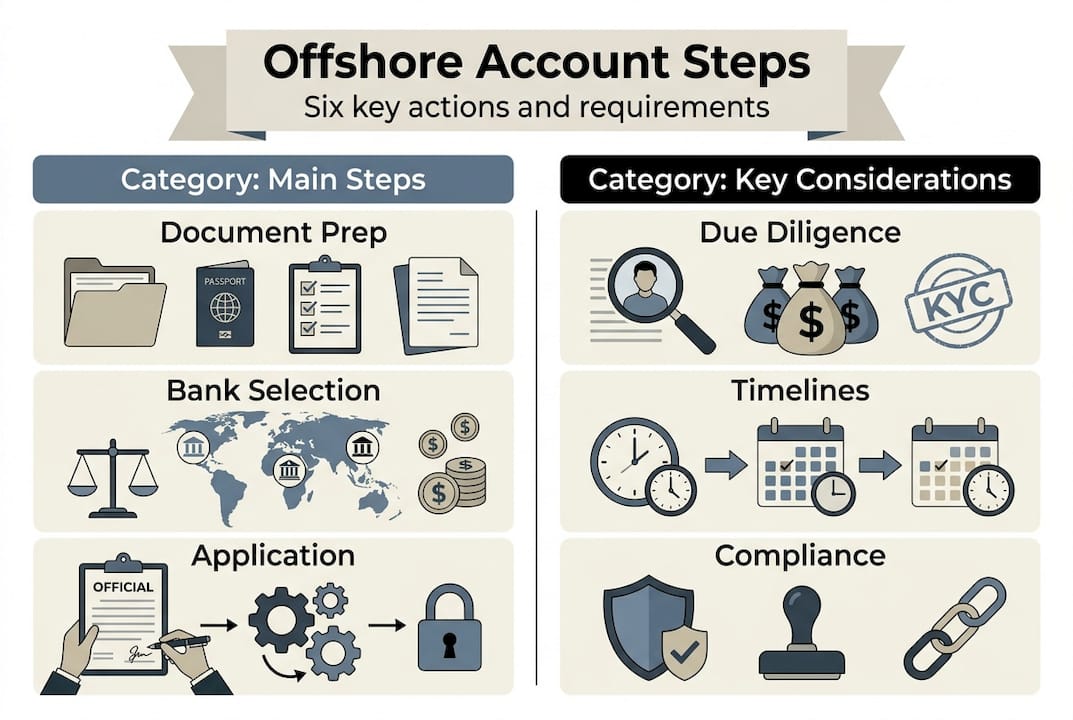
- Select your jurisdiction and institution based on the criteria covered above. Confirm the bank’s minimum deposit, account types, and digital capabilities before proceeding.
- Gather and certify your documents. Many banks require notarized or apostilled copies. Digital submissions are increasingly accepted, but certification requirements vary.
- Submit your application with full KYC and AML details. This includes your personal or corporate profile, intended account activity, and expected transaction volumes.
- Undergo due diligence review. The bank’s compliance team will verify your identity, assess your risk profile, and may request additional documentation.
- Make your initial deposit and activate the account. Once approved, funding the account and completing any final onboarding steps brings it fully live.
Prominence Bank normally completes account opening within 48 to 72 hours after all required KYC/AML procedures have been completed and all requested information and documentation have been received, verified, and accepted. This is an estimated processing period, not a guaranteed deadline. Additional time may be required if further compliance, verification, or due-diligence review is necessary. Submitting an enquiry, application, or payment does not start the estimated processing period and does not guarantee account approval or activation.
“Rigorous due diligence is essential to a stable, compliant institution protecting your assets. Prominence Bank’s account-opening estimate and conditions are stated above, and additional review time may be required.”
The due diligence phase is where most delays occur. Banks may request clarification on your source of funds, ask for updated documents, or require additional references. Responding promptly and completely reduces avoidable follow-up, but the estimated processing period begins only after all required KYC/AML procedures are complete and all requested information and documentation have been received, verified, and accepted.
Pro Tip: Assign one point of contact internally (or use a professional intermediary) to manage all bank communications during the application process. Fragmented responses from multiple people in your organization can create confusion and require additional follow-up. Learn more about online account opening for institutions that offer structured digital onboarding.
Troubleshooting issues and best practices for ongoing compliance
After opening your account, proactive management and compliance become critical to sustaining offshore banking benefits. The opening is just the beginning.
Common mistakes that create problems after account activation:
- Inconsistent transaction patterns: If your account activity doesn’t match what you described during onboarding, expect a compliance review.
- Outdated KYC information: Most banks require annual or biennial updates to your personal and corporate information. Missing these triggers account freezes.
- Ignoring document requests: Banks operating under CRS and FATCA have ongoing obligations. Failing to respond to information requests is treated seriously.
- Undeclared account changes: Adding signatories, changing business structure, or moving significant assets without notifying the bank creates red flags.
CRS, FATCA, and CARF create ongoing compliance and reporting obligations that don’t end at account opening. You need a system for tracking what’s reported, when, and to which authorities.
Best practices for long-term account health:
- Maintain a compliance calendar with key reporting deadlines for each jurisdiction where you hold accounts.
- Keep your source of funds documentation current, especially after major transactions like property sales or business exits.
- Work with a tax advisor who specializes in multi-jurisdictional reporting, not just your home country.
- Review your account structure annually to ensure it still aligns with your financial goals and current regulations.
Pro Tip: Use professional advisors for multi-jurisdictional reporting. A single advisor who understands both your home country obligations and the reporting requirements of your offshore jurisdictions is worth the cost. Review the corporate banking best practices that apply to your specific account structure.
A nuanced perspective: Why strategy trumps secrecy in offshore banking
With practical steps complete, it’s worth reflecting on the bigger shifts reshaping offshore banking for global families and businesses.
The clients who struggle most with offshore banking are those who opened accounts expecting a permanent shield from scrutiny. That era is over. Post-CRS and CARF, absolute secrecy is gone, and chasing it leads to poor decisions: choosing unstable jurisdictions, working with non-compliant institutions, or building structures that collapse under regulatory pressure.
The clients who thrive are those who treat offshore banking as an ongoing strategic relationship, not a one-time setup. They diversify across jurisdictions not to hide, but to reduce concentration risk. They work with institutions that take compliance seriously because those banks are more stable and less likely to face sudden regulatory action. They update their structures as their circumstances change.
Legal discretion is still real and still valuable. The difference is that it’s built through thoughtful structuring and trusted institutional relationships, not opacity. Understanding the discreet banking strategies that work under current law is where the real competitive advantage lies for sophisticated global clients.
Next steps: Start or enhance your global banking strategy
Ready to act? The next move is to partner with institutions that value privacy, flexibility, and compliance.
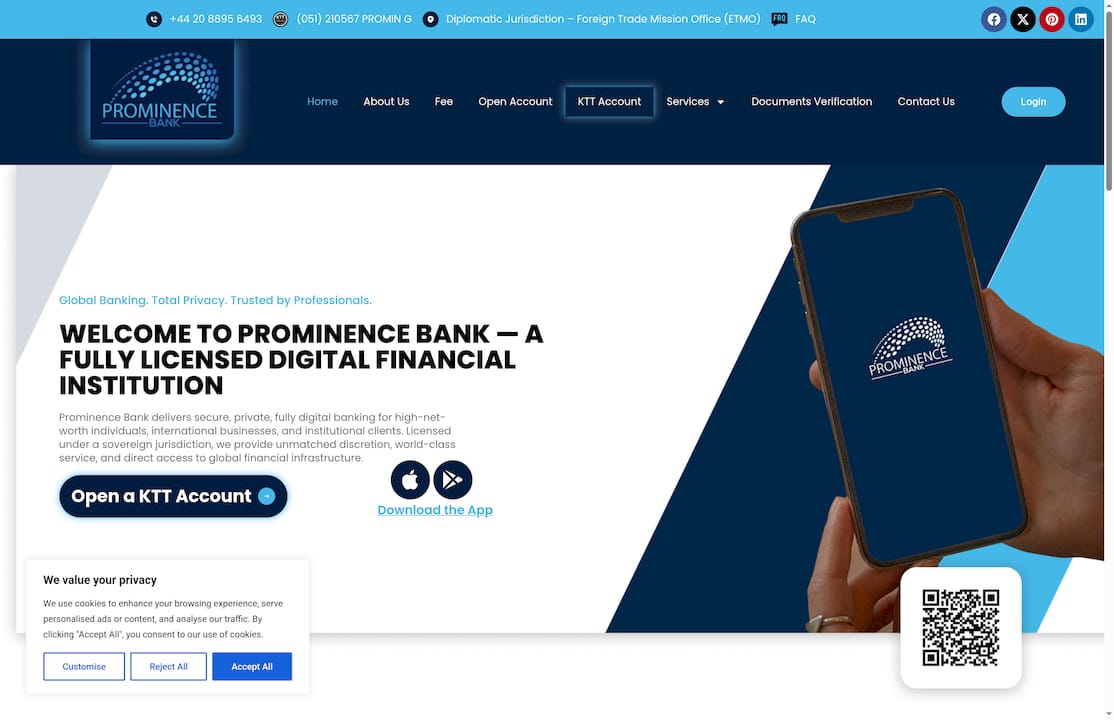
Prominence Bank is built specifically for high-net-worth individuals and international businesses that need more than a domestic bank can offer. Whether you’re opening a personal account with multi-currency access, establishing corporate banking solutions for complex international structures, or exploring asset protection accounts that align with your global strategy, we offer fully digital onboarding, AML/KYC-compliant processes, and the institutional discretion your wealth demands. Start your application today and move from intent to action with a banking partner that understands what’s at stake.
Frequently asked questions
Is it legal to open an offshore bank account?
Yes, offshore accounts are fully legal when properly declared and compliant with international tax regulations such as CRS and FATCA. The obligation is disclosure, not avoidance.
What is the typical timeline to open an offshore account?
Prominence Bank normally completes account opening within 48 to 72 hours after all required KYC/AML procedures have been completed and all requested information and documentation have been received, verified, and accepted. This is an estimated processing period, not a guaranteed deadline. Additional time may be required if further compliance, verification, or due-diligence review is necessary. Submitting an enquiry, application, or payment does not start the estimated processing period and does not guarantee account approval or activation.
Do I need to be physically present to open an offshore account?
Not always, but some jurisdictions require it. In-person visits are often required in top-tier banking centers like Singapore, particularly for non-residents or high-value accounts.
What are the most important documents for opening an offshore account?
Core documents include your passport, proof of address, source of funds, and bank references. Corporate applicants must also provide company documents and UBO details for all qualifying beneficial owners.
How can I maximize privacy with my offshore account in 2026?
Full secrecy no longer exists, but legal discretion through diversification across three or more compliant jurisdictions meaningfully reduces both regulatory and political risk while preserving legitimate privacy.
Recommended
- Why open a corporate bank account abroad for asset protection
- Online account opening: secure solutions for global banking
- How to secure corporate banking: a step-by-step guide
- Private banking setup: Secure wealth & global access
- How to set up a trading account: complete guide for 2026