
Complex corporate structures routinely obscure who actually owns and controls a company, which forces banks to spend more on onboarding, credit assessment, and ongoing monitoring. The fix is not fewer layers of ownership but better controls: enhanced KYB/KYC evidence, consolidated reporting, and governance that can survive a resolvability test. The account-structuring process around this logic is important, and the checklists below outline where to start.
TL;DR:
- Effective controls like consolidated reporting and clear governance are essential for managing risks associated with complex ownership structures.
- Identifying ultimate beneficial owners in layered or circular structures requires thorough investigation, cross-referencing filings, and recognizing red flags.
- Regulators expect banks to assess risk at the group level through consolidated supervision, with strong documentation and resolution planning in place.
- Proper governance, including board oversight and internal capital reporting, determines whether complexity acts as a risk mitigator or a liability.
- Banks need tailored onboarding and continuous monitoring processes to handle multi-jurisdictional entities, layered ownership, and intra-group capital flows.
Table of Contents
- What Counts as a Complex Corporate Structure in Banking?
- How Do Complex Structures Change Banking Risk and Onboarding?
- What Do Regulators Expect From Complex Banking Groups?
- Does Corporate Complexity Increase or Reduce Bank Risk?
- How Do You Detect Opaque Ownership Structures?
- Which Controls Actually Manage This Risk?
- What Should Executives Prepare Before Opening a Complex Group Account?
- Where Should Compliance Leaders Focus First?
- How Prominence Bank Supports Complex Corporate Groups
- Sources
- FAQ
What Counts as a Complex Corporate Structure in Banking?
A complex corporate structure is any ownership arrangement layered enough that identifying the ultimate beneficial owner (UBO) takes real investigative work rather than a quick registry lookup. That includes holding companies stacked above operating subsidiaries, trusts with nominee trustees, and, in the more unusual cases, circular ownership, where Company A owns a stake in Company B, which owns a stake in Company C, which owns a stake back in Company A.
Circular ownership sounds like a technicality until you try to trace it. No single filing shows who actually controls the group. A bank’s compliance team has to reconstruct the loop manually, and until they do, the UBO calculation stays technically incomplete.
Common building blocks include:
- Holding companies that separate legal liability between business lines
- Trusts and nominee arrangements used for estate planning or confidentiality
- Shell entities with no independent operations, often holding IP or real estate
- Layered subsidiaries created through acquisitions and never consolidated
Most of this is legitimate. Businesses split entities to isolate risk, ring-fence liabilities, or comply with local incorporation rules in different countries. Complexity becomes a problem when it exists specifically to hide who benefits from the money moving through the structure, not when it exists to manage legal exposure.
How Do Complex Structures Change Banking Risk and Onboarding?
Complex ownership adds friction at almost every stage of the banking relationship, starting with the paperwork a bank has to demand before opening an account. UBO verification for a layered group often requires certified ownership charts, notarized declarations, trust deeds, and board resolutions authorizing the account, not just a certificate of incorporation.
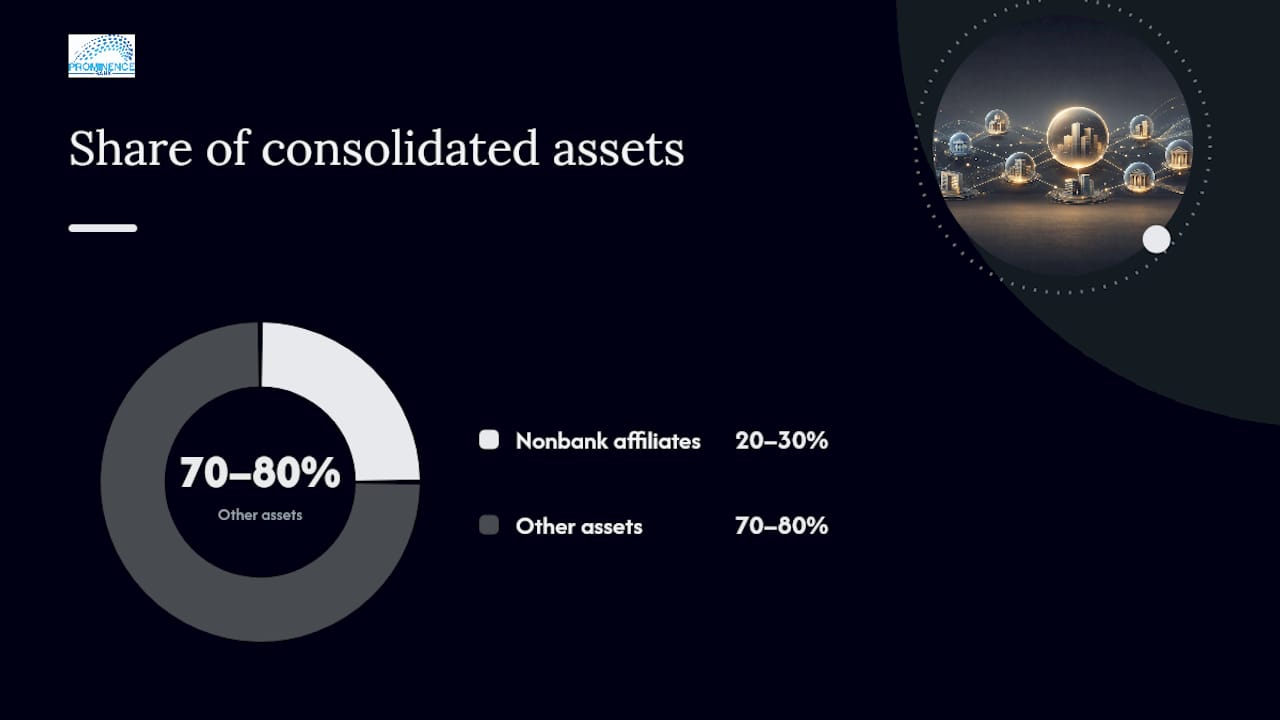
Nonbank subsidiaries inside a banking group complicate the picture further. These entities, mostly broker-dealers and finance arms, account for roughly 20 to 30 percent of consolidated bank holding company assets in the post-2010 period. That share matters because these subsidiaries often operate under lighter capital regimes than the deposit-taking bank sitting at the top of the structure, and they can function as internal equity reservoirs that shift capital around the group in ways a simple balance sheet won’t show.
Practical effects compliance teams see repeatedly:
- Longer onboarding timelines when UBO evidence spans multiple jurisdictions
- Higher manual review rates because automated KYC screening struggles with layered ownership
- Reduced balance-sheet visibility when intra-group capital flows move through nonbank affiliates
- Greater credit risk uncertainty, since consolidated exposure is harder to price accurately
Bank holding companies now route a meaningful share of their consolidated assets through nonbank affiliates, which is why supervisors watch those entities as closely as the regulated bank itself.
What Do Regulators Expect From Complex Banking Groups?
Supervisors have built an entire framework around one idea: assess risk at the group level, not the entity level, because entity-level reporting is exactly what lets complexity hide risk. The Basel framework requires consolidated supervision for banking groups, meaning capital adequacy gets measured across the whole structure rather than one legal entity at a time. That consolidated view is the primary tool regulators use to close regulatory arbitrage gaps between differently regulated subsidiaries.
Basel guidance also tracks specific complexity indicators, including OTC derivatives exposure, Level 3 assets, and trading securities, because these line items correlate with valuation opacity and make a bank harder to resolve in a crisis.
Post-2008 reforms added another layer. Dodd-Frank living-will requirements push large banks toward resolution planning that assumes failure, forcing institutions to show regulators exactly how each subsidiary could be wound down without triggering systemic damage. That requirement has driven real entity rationalization at several large banks since the rule took effect.
What this means operationally for a bank managing a complex group:
- Solo capital checks at the subsidiary level, in addition to group-wide consolidation
- Living-will documentation showing how each material entity could be resolved independently
- Disclosure of intra-group exposures that regulators can cross-reference against consolidated filings
- Periodic entity-rationalization reviews to eliminate legal entities that no longer serve a purpose
None of this is optional paperwork. It is the baseline a bank needs just to keep a complex corporate relationship on its books.
Does Corporate Complexity Increase or Reduce Bank Risk?
The honest answer is that it depends almost entirely on governance, not on complexity itself. Research on bank complexity and risk finds that organizational complexity can reduce idiosyncratic risk through diversification and better liquidity management. A well-governed group with multiple business lines can weather a shock in one segment because the others keep generating cash.
The same research shows the opposite outcome is just as common. Weak governance turns complexity into an agency problem: management or controlling shareholders exploit opaque intra-group exposures for their own benefit, and the bank’s risk profile deteriorates even as its balance sheet looks diversified on paper. Complexity is also sticky. It tends to build up fastest through mergers and acquisitions, since acquiring firms often keep acquired entities intact rather than absorbing them, and transaction costs discourage later simplification.
Governance indicators worth checking before you take a complexity trade-off at face value:
- Board composition and whether independent directors have real visibility into intra-group flows
- Internal capital reporting frequency and whether it reaches consolidated, not just entity-level, detail
- Independent audit capability across all material subsidiaries, not just the flagship entity
Pro Tip: Ask for the group’s internal capital allocation report before you ask for its consolidated balance sheet. A group that can produce the internal document quickly usually has governance strong enough to make its complexity an asset rather than a liability.
How Do You Detect Opaque Ownership Structures?
Detecting opaque ownership is mostly a data-matching exercise, and the sources that matter most are the ones most compliance teams underuse.
- Pull regulatory filings first. FR Y filings, company registries, and beneficial ownership registries give a baseline ownership chart before any interview happens.
- Cross-reference against commercial KYB providers and sanctions/PEP lists to catch names that don’t appear in public filings but show up in enforcement or watchlist data.
- Flag structural red flags for automated escalation: rapid entity creation shortly before an account application, nominee directors with no other business relationship to the group, circular shareholdings, and jurisdictional mismatches between where an entity is incorporated and where it actually operates.
- Run entity-resolution and graph analysis to reconcile ownership claims against transaction histories. A UBO chart that doesn’t match the actual flow of funds is the single strongest signal of a structure built to obscure, not simplify.
- Reconcile registry data against FR Y filings and corporate registries directly, which materially cuts the manual chase time during enhanced due diligence compared with relying on client-submitted charts alone.
Which Controls Actually Manage This Risk?
A risk-based onboarding checklist should trigger enhanced due diligence automatically whenever ownership spans more than two jurisdictions, involves a trust or nominee arrangement, or shows any circular shareholding pattern. Below that threshold, standard KYC documentation is usually sufficient.
Ongoing monitoring needs its own escalation thresholds, separate from onboarding. Material ownership changes, unexplained intra-group liquidity shifts, and new subsidiaries appearing outside the original due diligence scope should all trigger a review, not wait for the next periodic refresh.
Organizational controls that hold this together:
- Consolidated reporting that rolls entity-level exposures up to a single group view
- Living-will documentation kept current, not just produced once for a regulatory deadline
- Transparent internal capital allocation so nonbank affiliates can’t quietly absorb risk
- A functioning three lines of defense model, with operational risk governance giving the CRO real authority to challenge business-line decisions, not just report on them after the fact
Pro Tip: Require a one-page resolution or succession plan for every material entity in a complex group before final account approval. It forces the client to articulate what happens if a key entity fails, and it gives your credit committee a document they can actually score.
What Should Executives Prepare Before Opening a Complex Group Account?
For a multi-entity business, the account structure usually matters as much as the bank itself. Most groups end up combining a multi-currency corporate account at the parent level with multi-signatory arrangements at the subsidiary level, plus custody arrangements for entities holding investment assets rather than operating cash.
Documentation packages for layered ownership typically include a consolidated cap table, board minutes authorizing funding flows between entities, and evidence of the UBO chain down to the individual level. Digital onboarding speeds this up considerably when the bank can ingest structured documents rather than requiring notarized paper originals for every jurisdiction. Executives who prepare an account structuring checklist in advance, rather than assembling it reactively during underwriting, typically move through approval faster.
Where Should Compliance Leaders Focus First?
If you’re managing a complex group’s banking relationship, resolve the data problem before the governance problem. Entity-resolution tools that reconcile ownership graphs against filings save more time than any policy rewrite, because most escalations stall on missing documentation, not unclear rules.
Once that data layer works, push governance alignment between the CRO, general counsel, and the board specifically around resolvability. A board that agrees on what “resolvable” means before a crisis forces the question is a board that survives the next one.
— Harold
How Prominence Bank Supports Complex Corporate Groups
The onboarding process addresses the reality that layered ownership needs more than a standard KYC form. Multi-currency corporate accounts, multi-signatory structures, and enhanced onboarding built for groups with cross-jurisdictional ownership mean clients are supported through complex cap table explanations.

That matters most for businesses juggling subsidiaries across several countries, where a traditional bank’s onboarding process can stretch for months over documentation requests alone. Prominence Bank’s corporate banking solutions are built for exactly this profile: multiple entities, layered ownership, and a need for account structures that reflect the group’s actual governance rather than forcing everything through a single generic business account. If your group needs a multi-signatory account that matches how your board actually authorizes transactions, or a multi-currency setup that keeps subsidiary cash visible without collapsing it into one undifferentiated pool, request a tailored account-structuring consultation and get a documentation checklist built around your specific ownership chain.
Sources
- Capitalizing on Nonbanks: Regulatory Arbitrage Within Bank Holding Companies — Liberty Street Economics
- Basel Framework: scope and application (BIS summary)
- Bank Complexity, Governance, and Risk — NBER working paper
- Complexity in Large U.S. Banks — Federal Reserve / Liberty Street research (EPR 2020)
FAQ
What Are Complex Ownership Structures?
Complex ownership structures are arrangements, such as layered holding companies, trusts, or circular shareholdings, where identifying the ultimate beneficial owner requires investigation beyond a standard registry search.
What Are the Different Types of Corporate Structures Banks Encounter?
Banks typically see holding company hierarchies, operating subsidiaries, trusts with nominee arrangements, and shell entities, ranging from simple single-owner structures to multi-jurisdictional groups with circular ownership.
What Does Corporate Structuring Mean in a Banking Context?
Corporate structuring refers to how a business organizes its legal entities, ownership chains, and account arrangements. Banks like Prominence Bank evaluate this structure to determine documentation requirements, account setup, and ongoing monitoring intensity.
Why Do Regulators Care About Corporate Complexity?
Regulators apply consolidated supervision because complexity can hide risk across entities with different capital treatments; the Basel framework requires group-wide capital assessment specifically to close that gap.
Can Complex Structures Ever Reduce Bank Risk?
Yes. Research on bank complexity shows diversification and liquidity benefits are possible when governance is strong, though the same complexity increases resolution risk when governance is weak.