
A cross currency sweep concentrates cash from several currency accounts and converts it automatically into a target currency or account, so liquidity lands where you need it. Treasurers use it to cut idle balances and manual FX work. At Prominence Bank, we can discuss your treasury requirements and account structure.
TL;DR:
- Choose zero balance transfers, threshold based moves, or fixed date conversions according to whether you need full consolidation, minimum reserves, or scheduled funding.
- Choose spot conversion, a rate agreed in advance, or pooled execution, and confirm currency cutoffs because later instructions may settle the next business day.
- Reconcile both cash legs daily, assign owners to breaks, approve rule changes, monitor FX costs and currency limits, and document intragroup charges for tax reviews.
- Start with a limited account pilot and compare released cash with idle balances; no verified savings figure supports forecasting benefits before measurement.
Table of Contents
- What cross-currency sweeps are and which types exist
- How cross-currency sweeps work step by step
- Treasury benefits and where sweeps pay off
- Implementation checklist for treasury teams
- Operational controls, reconciliation and governance
- Why the bank behind your sweeps matters
- Prominence Bank corporate banking and treasury services
- FAQ
- Sources
What cross-currency sweeps are and which types exist
An automated cross-currency sweep is cash concentration with programmed FX conversion. Balances in source accounts move to a target account in your functional currency, and the conversion happens as part of the same instruction.
It helps to separate sweeps from two derivatives that sound similar. An FX swap is a short-term spot-and-forward transaction used for cash management. A cross-currency swap is a longer-term instrument in which counterparties exchange principal and periodic interest payments, with the basis adjusting the pricing between the legs. A sweep is an account-level service for moving and converting cash between accounts.
Common sweep types:
- Zero-balance sweep: source account balances are transferred according to the sweep instructions at the end of each cycle.
- Threshold sweep: only the amount above (or below) a set balance moves.
- Scheduled conversion: funds are converted on fixed dates, such as weekly or at month end.
How cross-currency sweeps work step by step
Behind each sweep sits trigger logic, an FX execution choice and a settlement window. Mapping these to your systems is what makes the feature usable in daily treasury work.
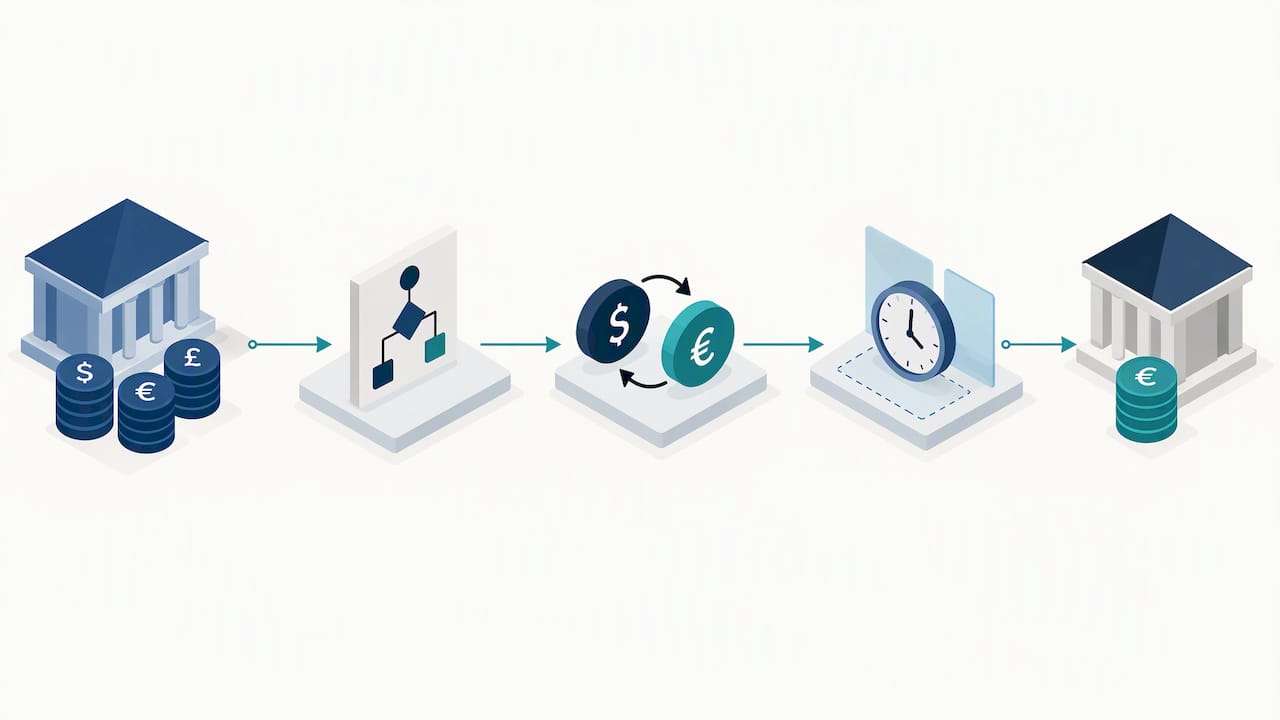
Triggers include balance thresholds, scheduled intervals, zero-balancing and event-driven rules, such as an incoming receipt above a set size. For FX execution, the bank can convert at spot at the moment of the sweep, at a pre-negotiated rate, or through pooled execution on its FX platform, where several small amounts are converted together.
A typical sweep runs in this order:
- The trigger fires (a threshold is breached or the schedule arrives).
- The bank calculates the sweepable amount in each source account.
- The FX rate is applied under your chosen execution method.
- Converted funds are credited to the target account.
- Both legs appear in cash reporting, with any FX gain or loss booked per your accounting policy.
Timing matters. Intraday sweeps free liquidity sooner, while end-of-day sweeps are simpler to reconcile but leave cash idle for hours. Cut-off windows differ by currency and settlement rail, so a sweep set after a cut-off may settle the next business day.
Pro Tip: Ask for the sweep confirmation message to carry both the source amount and the applied rate, so your reconciliation tool can match the two legs automatically.
Treasury benefits and where sweeps pay off
The main gain is centralized liquidity. Cash that used to sit in many small currency accounts becomes available in one place for payments or investment.
- Lower idle balances across currency accounts.
- Fewer manual FX conversions and fewer keying errors.
- Faster funding for payments, payroll or short-term investments.
- Clearer FX visibility, since conversions follow documented rules instead of ad hoc requests.
Consolidated conversion timing may help treasury teams manage FX exposure. The IMF working paper on exchange rate risk notes that forwards can fully hedge an exposure but may be costly.
Typical use cases are multinational payroll consolidation, supplier payments in local currency and intragroup funding optimization.
We publish a verified figure on sweep savings only where a source supports it, and none of our reviewed sources states one, so the case for a pilot rests on measuring your own idle balances. Review your balance data and compare it with the cash a sweep might have released.
Implementation checklist for treasury teams
Work through these steps with your bank or internal treasury before switching a sweep on.
- Map the account structure. Identify source accounts, the target functional currency and the target account.
- Set trigger rules and FX preferences. Choose thresholds or schedules, and decide between spot and pooled execution.
- Verify currency pairs and rails. Confirm which pairs are supported, how liquid they are and what the intraday settlement windows and cut-offs are.
- Define reporting and reconciliation. Agree accounting codes, report formats and how often you reconcile.
- Agree SLAs, fees and documentation. Settle how the FX spread is handled, who owns exceptions and what paperwork the bank needs.
Questions to bring to the bank:
- Which currencies and rails are supported today?
- Can triggers differ by account?
- How are failed sweeps reported?
Internal groundwork helps too. Our guide to international treasury management strategy covers account mapping and policy governance, and KPMG’s review of cash pooling pitfalls explains why account structures need care as operations globalize.
Operational controls, reconciliation and governance
A sweep that runs unattended still needs oversight. Build these controls before go-live:
- Daily reconciliation: match every sweep debit and credit to its FX conversion, and route breaks to a named owner.
- Approval workflows: require sign-off for changes to triggers, target accounts and execution method.
- Limits: set exposure limits per currency and counterparty limits for FX execution.
- Cost monitoring: track spreads and fees against a benchmark. Our note on how multi-currency FX spreads add up shows why small percentages matter at volume.
- Transfer pricing records: document intragroup charging for sweeps so audit and tax reviews find a clear trail. A partner guide on cross-border tax planning is a useful reference for cross-border governance.
A word on “basis”: in cross-currency transactions, the basis is a premium or discount added to pricing so that the two currency legs balance. Sweeps do not carry a basis, but if you also run longer-term swaps, the BIS description of basis swaps is worth reading, since those contracts often run from one to 30 years.
Pro Tip: Review sweep exceptions weekly, not just daily. Patterns, such as one currency missing a cut-off every Friday, point to a settings fix rather than a one-off error.
Why the bank behind your sweeps matters
In our experience, sweeps only work well when three things sit under one roof: multi-currency accounts, FX execution and people who understand treasury. If any piece sits with a different provider, you spend your time stitching instructions, cut-offs and reports together.
We configure account structures, service levels and reporting for enterprise clients, so the sweep logic you design on paper is the logic that runs. Before you commit, start with a small pilot using a limited set of accounts, then review the results. Then consider whether to widen it. Our treasury team is ready to talk through a pilot or a configuration whenever you are.
— Harold
Prominence Bank corporate banking and treasury services
Our corporate banking service gives treasury teams access to multi-currency accounts and treasury solutions. That means fewer handoffs between the account that holds your cash and the desk that converts it.
Onboarding follows a clear path: KYC and due diligence, account setup, then agreement on service levels and sweep parameters. Fees for each step are listed on our fees page.
Ready to start? Submit the business account application and our team will walk you through the next steps.
This article is general information, not a substitute for advice from a qualified financial advisor. Consult a qualified financial professional about your own circumstances before acting on anything here.
FAQ
What does “cross-currency” mean in treasury?
It describes any transaction or structure that involves two currencies, such as converting balances from euros to dollars. In a sweep, it means cash moves between accounts held in different currencies and is converted along the way.
What is the difference between FX swaps and cross-currency swaps?
An FX swap is a short-term spot-and-forward transaction used for cash management. A cross-currency swap is longer-term and involves exchanging principal and periodic interest payments.
How does cross-currency basis work?
The basis is a spread that adjusts the pricing of the two legs of a cross-currency swap so that parity relationships hold. It acts as a premium or discount that changes your effective funding cost.
How do cross currency sweeps work day to day?
A trigger fires, the bank calculates the amount to move, converts it at the agreed rate and credits the target account. Both legs show in your cash reporting for reconciliation.
Sources
- Exchange Rate Risk Measurement and Management: Issues and Approaches for Firms; Michael Papaioannou; IMF Working Paper 06/255; November 1, 2006
- CIP, FX swaps, cross-currency swaps and the factors that move the basis
- The basic mechanics of FX swaps and cross-currency basis swaps
- What Are Common Transfer Pricing Pitfalls in Cash Pooling?