
A board resolution for a bank account must name the company, authorize opening and operating accounts, and designate who may sign. Banks may ask for it, often as a certified copy alongside your articles and EIN paperwork. We give you a copy-and-paste template right below, plus a regulatory checklist and certification steps to help prepare it for bank review.
TL;DR:
- Banks identify owners with at least 25% and one control person; each must provide a birth date, address, and Social Security number or passport details.
- Bank forms and signature cards remain necessary; submit them with matching formation documents, EIN confirmation, signer IDs, and a good standing certificate when requested.
- An independent officer should certify the copy after adoption; notarization or a corporate seal is needed only when the bank requests it.
- Banks may keep honoring the last resolution until they process a written replacement, so promptly report signer changes and confirm the effective date.
- For multicurrency accounts, explicitly authorize foreign exchange and international wires, and set dual signatures or transaction limits if the board wants extra control.
Table of Contents
- Ready-to-use board resolution template and how to fill it in
- What banks commonly require with a resolution
- What U.S. banks will ask under FinCEN beneficial ownership rules
- How to adopt, sign, and certify the board resolution
- Submission checklist and what to expect on timing
- Publisher perspective: why this template matches bank practice
- How to update or revoke a board resolution once the account is open
- What digital-only banks look for in a board resolution
- Multi-currency accounts and your board resolution
- International and offshore clauses for global compliance
- Resolution variations for LLCs, corporations, and partnerships
- Our take: template first, then match the bank
- Open your corporate account with our onboarding support
- FAQ
- Sources
Ready-to-use board resolution template and how to fill it in
Copy the language below and replace each bracketed field with your own details before the board adopts it.
RESOLVED, that [Exact Legal Name of Company], a [state] corporation (EIN [number]), is authorized to open one or more deposit accounts with [Bank Name].
RESOLVED FURTHER, that the following persons, [Name, Title] and [Name, Title], are authorized to sign, endorse, and transfer funds on those accounts, acting [alone / jointly, two signatures required].
RESOLVED FURTHER, that this authority takes effect on [date] and remains in force until the board revokes it in writing and the bank receives notice.
Start with an adoption clause such as “At a meeting duly called and held on [date], a quorum being present, the board adopted the following resolutions.”
- Legal name and EIN: copy them exactly from your articles and your IRS EIN confirmation.
- Signer titles: use the titles in your corporate records, not nicknames.
- LLC variant: replace “board of directors” with “the members” or “the manager,” and “corporation” with “limited liability company.”
- Sole director or sole member: “The undersigned, being the sole director, hereby adopts the following resolutions by written consent.”
Pro Tip: Ask your bank for its preferred wording before the vote. A resolution that mirrors the bank’s own form may help make review smoother.
What banks commonly require with a resolution
The resolution rarely travels alone. Expect to hand over a small packet:
- Articles of incorporation or organization, matching the name on the resolution.
- A certificate of good standing or incumbency, if the bank requests one.
- Your Employer Identification Number confirmation.
- Government-issued ID for every named signer.
- The bank’s own account application and signature cards.
That last item surprises people. Banks prioritize their own forms, so your resolution works as internal authorization that complements the bank’s packet rather than replacing it.
A “certified copy” means the corporate secretary or another officer signs a statement that the attached resolution is true, correct, and still in effect. Typical wording: “I certify that the foregoing is a true and complete copy of resolutions duly adopted by the board on [date], and that they have not been amended or rescinded.” A bank may ask for notarization when it cannot meet the officer in person, and some banks ask for a corporate seal where one exists. Document quality matters at this stage, and a partner article on document verification discusses clean, consistent identity documents.
What U.S. banks will ask under FinCEN beneficial ownership rules
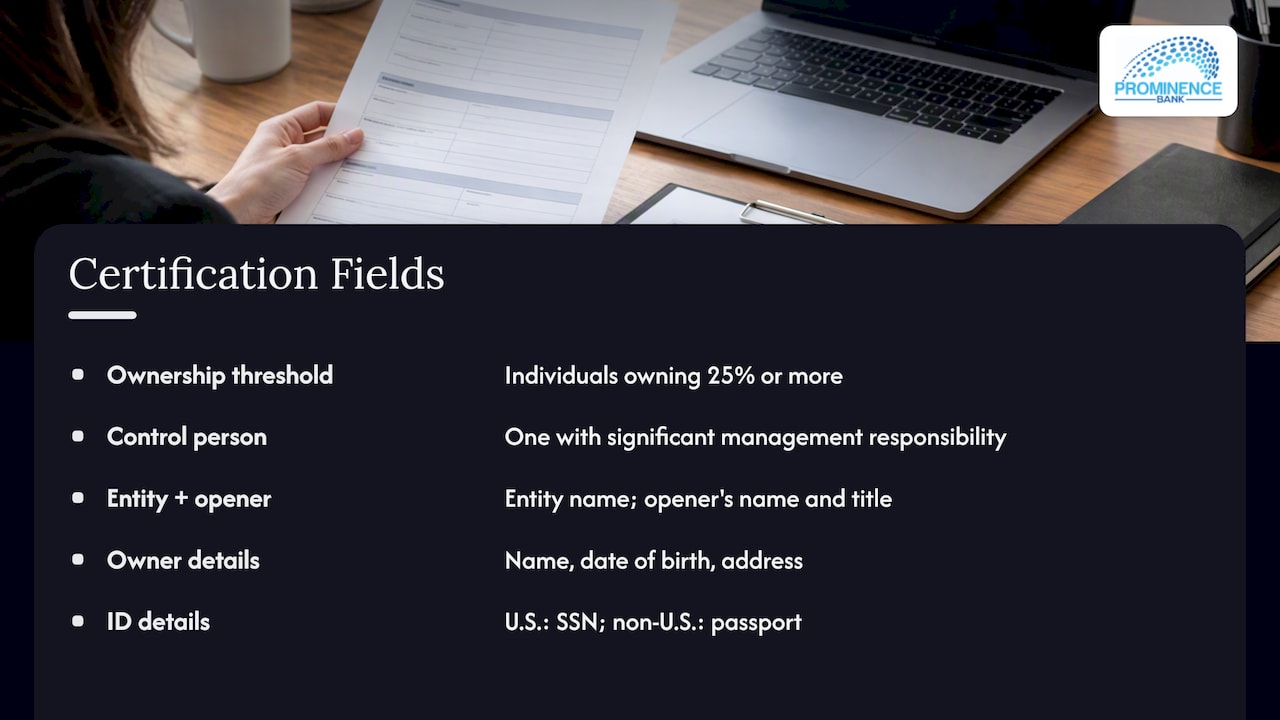
When a legal entity opens an account, the bank must look past the company to the people behind it. Under FinCEN’s customer due diligence rule, financial institutions identify and verify beneficial owners, meaning individuals who own 25% or more of the entity, along with one individual who has significant management responsibility.
The legal baseline sits in Section 1010.230, which also requires the bank to verify identities with risk-based procedures and keep records of what it collected.
Expect to supply the information on the standard certification form in Appendix A: the name and title of the person opening the account, the legal entity name, and for each beneficial owner a name, date of birth, and address. U.S. persons provide a Social Security number, and non-U.S. persons provide passport details.
Some accounts get a closer look. FinCEN’s guidance on beneficial ownership information says institutions should apply enhanced due diligence to higher-risk accounts and understand the source of wealth and expected activity on private-banking accounts. Plan for follow-up questions if your structure is layered.
How to adopt, sign, and certify the board resolution
Follow these steps in order:
- Draft the resolution from the template and confirm names, titles, and the EIN against your records.
- Adopt it. Either record a motion and vote in the board minutes (“Upon motion duly made and seconded, the board voted to adopt the foregoing resolutions”), or have every director sign a unanimous written consent.
- Have the corporate secretary or another officer certify a copy with the “true and correct” statement shown earlier, dated and signed.
- Notarize or seal if the bank asks.
- File the original in your minute book and send the certified copy to the bank.
Practical rules: a named signer should not certify their own authority when another officer is available, because banks view self-certification skeptically. If your signers are also the only officers, ask the bank how it wants that handled. Add an incumbency certificate, a short statement listing officers and sample signatures, whenever the bank asks it or when authority flows through titles.
Pro Tip: Date the certification after the adoption date, never before, and keep both dates consistent in every document you send.
Submission checklist and what to expect on timing
Deliver this set together so the file is complete on day one:
- Certified board resolution
- Articles of incorporation or organization
- EIN confirmation
- Government IDs for each signer and beneficial owner
- The bank’s application and signature cards
Processing usually follows one sequence: document intake, identity verification and customer due diligence, internal review, then account activation and funding. Banks set their own timelines, and complex ownership or higher-risk profiles take longer, so ask your banker for an estimate instead of assuming one.
The most common delays are avoidable. A company name that differs between the resolution and the articles (“Inc.” versus no suffix) stalls review, as does a certification missing its date or officer title. Read every document against the articles before you send the packet, and keep one master copy of the legal name to paste from.
Publisher perspective: why this template matches bank practice
This guide is written by Harold. We run a licensed digital bank that opens multi-currency corporate accounts under international AML/KYC standards, so the checks described here are ones we apply every day. For deeper operational help, see our corporate account structuring checklist for executives and our bank-first guide to corporate account power of attorney.
How to update or revoke a board resolution once the account is open
Authority is not permanent. Signers leave, roles change, and a resolution that no longer matches reality becomes a risk. The fix is a new resolution, not an edit to the old one.
To change signers, the board adopts a fresh resolution that names the new authorized persons and states that earlier resolutions on the same accounts are superseded. To revoke authority entirely, the board adopts a resolution that withdraws a named person’s power effective on a stated date. Then follow the same adoption and certification steps used for the original: minutes or written consent, a secretary’s certified copy, and notarization if the bank wants it.
Notify the bank promptly and in writing, because most banks keep honoring the last resolution on file until they receive and process a replacement. Expect to complete new signature cards and fresh ID checks for any added signer, and ask the bank to confirm in writing when the change is effective.
Treasury’s own resolution form shows the pattern: it lists authorized individuals, states whether they act separately or jointly, can include time limits, and requires original signatures on an unaltered form. Borrow that discipline. Put an expiration or review date in resolutions where it fits, and calendar an annual check that the signer list is still correct. If an authorized person departs on bad terms, revoke first and tidy the paperwork afterward.
What digital-only banks look for in a board resolution
An online bank cannot meet you at a branch desk, so its acceptance criteria lean on document quality and traceability. Sending a phone photo of a crumpled page is the quickest way to lose a week.
Expect these expectations at most digital institutions, including ours:
- Clear scans or PDFs of the certified resolution, with every page legible and the signature visible.
- Consistent identity data. The company name, signer names, and titles must match across the resolution, ID documents, and application.
- A clean certification. The officer’s name, title, signature, and date should be easy to read.
- Originals on request. Some banks accept electronic copies at intake and later ask for the notarized original by courier.
- Electronic signature rules. Confirm whether the bank accepts e-signatures on the resolution, or wants wet ink.
Because everything is reviewed remotely, banks lean on verification technology and will ask follow-up questions faster than a branch would. At Prominence Bank, we onboard fully online, so we review certified resolutions as part of the digital packet and tell you early if something needs correcting. Our business banking overview explains how that onboarding works for corporate clients. The practical advice is the same wherever you bank: ask for the checklist first, then build the resolution to match it.
Multi-currency accounts and your board resolution
If the company will hold balances in several currencies, say so in the resolution. A resolution that only mentions “a checking account” can leave a banker unsure whether you may open or operate currency sub-accounts, and ambiguity is where delays start.
Useful language covers four points:
- Scope: authorize accounts “in any currency the authorized signers deem appropriate,” or name the currencies.
- Conversion: authorize signers to instruct currency exchanges between the company’s own accounts.
- Cross-border payments: authorize incoming and outgoing wire transfers, including international wires.
- Limits: if the board wants guardrails, add per-transaction approval thresholds or require two signatures above a set amount.
Think about cost and control together. Currency conversion and international wires carry fees at most banks, and our own published schedule on the fees page lists conversion and transfer charges so a board can see what it is authorizing. Boards that expect heavy foreign-exchange activity often set a dual-signature rule for conversions while letting one signer handle routine domestic payments.
Finally, keep currency authority aligned with the business reason for the account. If the resolution says the accounts support trading with suppliers in several countries, the bank’s due diligence team can follow the story, and approval tends to move more smoothly.
International and offshore clauses for global compliance
Cross-border structures draw extra attention, so the resolution should help the bank understand the company rather than leave it guessing. A few clauses do real work.
- Authority to provide ownership and compliance information. Authorize the signers to supply beneficial ownership, source-of-funds, and any other due diligence documents the bank requests, and to certify them.
- Foreign signers. If a signer lives abroad, name them with their title and nationality, and expect passport-based verification, since Appendix A allows passport details for non-U.S. persons.
- Foreign-jurisdiction formation. State the jurisdiction in which the company was formed and, where relevant, confirm that the resolution was adopted under its governing documents.
- Compliance undertaking. Many boards add that the company will comply with the bank’s AML/KYC policies and notify the bank of material ownership changes.
Higher-risk structures should expect enhanced due diligence. As FinCEN’s guidance notes, institutions look harder at source of wealth and anticipated activity, so answer those questions in writing before the bank asks. Our guide to setting up corporate accounts for global businesses walks through the documents involved across jurisdictions.
One boundary: a resolution cannot override legal requirements in any country. It authorizes people; it does not exempt the company from sanctions screening, tax reporting, or local regulation. For jurisdiction-specific rules, consult counsel in each country involved.
Resolution variations for LLCs, corporations, and partnerships
The core of the document stays the same, but who authorizes it changes with the structure. The SBA’s business structure guide explains why governance differs, and that difference drives the wording.
- Corporation: the board of directors adopts the resolution, and the secretary certifies it. Reference the corporate bylaws if they limit signing authority.
- Member-managed LLC: the members approve it, often by written consent. Cite the operating agreement as the source of authority.
- Manager-managed LLC: the manager or managers sign, and some banks also want evidence that the members delegated that power.
- Partnership: partners authorize accounts through a partnership resolution or the partnership agreement, and banks often ask for a statement of partnership or similar filing.
- Sole director or sole member: use a short written consent as shown in the template section.
Banks may call the document by other names: a “banking resolution,” “LLC authorization,” or “certificate of authority.” Content matters more than the label. Whatever the structure, confirm that the resolution names the entity exactly, identifies the people with authority, and specifies how many signatures a transaction needs. If you manage several entities, our multi-signatory corporate account guide shows how to phrase joint and individual authority cleanly.
Our take: template first, then match the bank
Most guides hand you a legal-sounding template and stop. I think that gets the order backward. The resolution is the easy part, and a competent director can draft it in ten minutes. What actually decides your timeline is whether the paperwork matches what a particular compliance team needs to see.
So treat the template as the starting draft and the bank’s checklist as the real specification. Prioritize three things, in this order. First, make sure the legal name, EIN, and signer titles are consistent throughout, since mismatches can delay review. Second, make the certification airtight: an independent officer, a clear date, and the “true and correct” language. Third, prepare your beneficial ownership information before the bank asks, since the 25% owners and one control person are non-negotiable under the rule.
What’s overrated? Elaborate boilerplate. Long “whereas” recitals add length without adding acceptance. What’s underrated? A short written note to your banker asking what they want to see. A brief call may help avoid another round of corrections.
— Harold
Open your corporate account with our onboarding support
If you want help turning a finished resolution into a working account, we handle corporate onboarding end to end. We accept certified board resolutions as part of the application packet, review your documents for mismatches before they cause delays, and coordinate enhanced due diligence when your structure calls for it. Start with the business account application, or read our business banking overview first to see which services fit your company.

Send us your draft resolution and supporting documents, and we will tell you what to fix before you submit.
FAQ
What is the format of a company board resolution for opening a bank account?
A board resolution opens with an adoption clause naming the meeting and date. It then lists “resolved” statements that name the company, authorize the accounts, identify the signers, and set the signing rule. It closes with an effective date and a signature or certification.
How do you write up a board resolution?
State the decision in plain language, name each person with authority and their title, and say how signatures work, such as alone or jointly. Adopt it through minutes or unanimous written consent, then have a corporate officer certify a copy for the bank.
How do you write a letter of request to open a bank account?
Keep it short: identify the company and its legal name, state that you are requesting to open a business account, and list the signers and documents enclosed. Attach the certified resolution, the articles, and your EIN confirmation, and follow the bank’s own application process.
What is a board of directors for a bank?
It is the group elected to oversee the bank’s management and strategy, much as a company’s board governs the business. For your account, a different board matters: your own company’s board approves the resolution authorizing your accounts and signers.