
A bank confirmation letter is a third-party request an auditor sends to a bank to verify balances, loan terms, or other account details directly with that institution. The next step is simple: use an account-specific positive confirmation, include full identifiers and signed authorization, and submit it according to PCAOB AS 2310 and ABA guidance.
TL;DR:
- Confirmations should be account-specific, include full identifiers, and be sent directly to banks using secure channels to avoid delays and rejection.
- Under AS 2310, auditors must justify the use of confirmations based on assessed risks, especially in cases of fraud suspicion or complex transactions.
- Using digital platforms for confirmations can improve turnaround times if the platform’s controls and authentication processes are verified as secure.
- Mistakes like bundling requests, missing identifiers, vague language, or improper routing account for most delays and rejections from banks.
- Preparing a comprehensive internal file beforehand, including recent statements and signer authorization, significantly speeds up receipt and verification.
Table of Contents
- Positive, Negative, and Other Forms of Confirmation
- When Auditors Should Use Confirmations Under AS 2310
- What Banks Require: Identifiers, Authorization, and Documentation
- How to Submit a Confirmation Request and Keep It Secure
- Sample Wording for Positive Balance and Loan Confirmations
- Handling Nonresponses and Confirmation Exceptions
- Digital Confirmation Platforms, Fees, and Turnaround
- Standards and Operational Proof Points Behind This Guidance
- Security and Confidentiality When Exchanging Confirmation Letters
- Common Mistakes That Get Confirmation Letters Rejected
- Preparing Internally Before Sending a Confirmation Request
- How Auditors Verify That a Confirmation Response Is Genuine
- Electronic Signatures and Digital Confirmations in Audit Compliance
- How Confirmation Practice Is Shifting and Two Changes Worth Making
- How Prominence Bank Supports Faster Confirmation Responses
- FAQ
- Sources
Positive, Negative, and Other Forms of Confirmation
A positive confirmation asks the bank to state whether the information on the request is correct and requires a reply either way. A negative confirmation asks the bank to respond only if something is wrong, which gives weaker assurance and is rarely accepted for audit purposes anymore. Beyond balance confirmations, auditors also use loan or facility confirmations (covering principal, maturity, and interest terms) and relationship confirmations that describe the full scope of a client’s banking relationship, including guarantees or contingent liabilities.
- Positive confirmations require a response regardless of agreement, making them the standard for cash and loan balances.
- Negative confirmations only flag disagreements, so silence is treated as agreement, a weaker form of evidence.
- Loan and terms confirmations cover principal, interest rate, maturity date, and collateral, not just a balance figure.
- Relationship confirmations capture the full picture, including letters of credit, pledges, or compensating balance arrangements.
Confirmations are most persuasive when the responder is independent and the request reaches the bank directly. When a bank cannot respond or a relationship is too complex to confirm cleanly, auditors fall back on alternative procedures instead of forcing a confirmation through.
When Auditors Should Use Confirmations Under AS 2310
PCAOB AS 2310 took effect for audits of fiscal years ending on or after June 15, 2025, and it asks auditors to apply judgment rather than follow a fixed checklist. The standard was built to modernize confirmation practice, including how auditors assess digital responders and intermediary platforms.
AS 2310 reframes confirmations as a judgment call and not an automatic step for fiscal years ending after mid-2025. That shift matters because it puts the burden on the auditor to justify the approach taken, not just document that a letter was sent.
Several risk indicators push toward using confirmations rather than skipping them:
- Elevated fraud risk around cash, debt, or related-party transactions.
- Weak internal controls over cash reconciliations or treasury functions.
- Significant, unusual, or complex transactions near period end.
When risk is low and other evidence (recent bank statements, subsequent cash activity) is reliable and corroborated, alternative procedures can substitute for a formal confirmation.
What Banks Require: Identifiers, Authorization, and Documentation
Banks reject a large share of confirmation requests simply because they are incomplete, according to ABA operational guidance. Getting these fields right the first time avoids a second round trip that can add weeks to fieldwork.
- Account-level identifiers. Include the exact DDA or deposit account number, loan facility ID, note number, or obligor number for every item requested.
- Authorized signer evidence. Attach a signed authorization from a current account signer, and update it immediately after any ownership or signer change.
- One account per request. Submit separate requests per account rather than a blanket letter covering multiple relationships; banks commonly return bundled requests unprocessed.
- Supporting history. Include the prior year’s confirmation or a recent statement so the bank’s operations team can locate legacy accounts and complex facilities faster.
Pro Tip: Keep a running file of every confirmation response you receive each year. Reusing those identifiers on next year’s request is one of the fastest ways to cut processing time.
Confirmations tied to accounts opened through specific bank instruments or facilities should name the instrument type explicitly, since generic descriptions are a common reason banks ask for resubmission.
How to Submit a Confirmation Request and Keep It Secure
The request should come from the client with the auditor as the designated recipient of the response, or the auditor may use a vetted intermediary platform when the bank supports one. Either way, the bank should send its reply directly to the auditor, never back through the client.
- Prepare the packet. Gather the account identifiers, audit date, scope of items requested, and the engagement contact’s direct information.
- Attach prior confirmations. Include the last response on file for each account to help the bank’s confirmation unit locate records quickly.
- Choose a secure channel. Use the bank’s confirmation portal or a vetted vendor file-transmission service rather than unencrypted email attachments.
- Send and log. Record the send date and method for every request so follow-up timing is tracked against a known baseline.
A few habits reduce avoidable delay:
- Avoid faxing or emailing unencrypted PDFs that contain account numbers.
- Build in two to three weeks of lead time before fieldwork deadlines, since bank operations teams often batch confirmation requests.
- Schedule a first follow-up at roughly ten business days if no response has arrived.
Sample Wording for Positive Balance and Loan Confirmations
A positive balance confirmation should state the account number, the balance as of the audit date, and a direct request for the bank to confirm or correct that figure in writing back to the auditor. A loan or terms confirmation needs the same identifying rigor, plus the specific financial terms that matter to the audit.
- Positive balance confirmation: state the account holder’s legal name, account number, the balance as of a specific date, and a request that the bank reply directly to the auditor confirming agreement or noting any difference.
- Loan/terms confirmation: include the facility or note number, original principal, outstanding principal as of the audit date, interest rate, maturity date, and the date interest was last paid.
- Authorization line: every template should carry a line stating the account holder authorizes the bank to release this information to the named audit firm.
Customize each template to the specific bank’s preferred format where one exists. Some institutions publish their own confirmation forms, and using the bank’s own layout, populated with the identifiers above, tends to get processed faster than a generic auditor-drafted letter.
Handling Nonresponses and Confirmation Exceptions
Not every confirmation comes back, and not every response that does come back is reliable. AS 2310 explicitly permits alternative procedures when a confirmation is unavailable or cannot be trusted.
- Follow up on a set schedule. Send a second request at the ten-business-day mark, and treat any response returned to the client rather than the auditor as suspect until verified independently.
- Investigate exceptions. When a confirmed balance disagrees with the client’s records, reconcile the difference before concluding whether it reflects a timing issue or an error.
- Apply alternative procedures. Direct access to the bank’s secure website, review of subsequent cash receipts, or examination of underlying contracts can substitute for a confirmation that never arrives.
- Document the decision. Working papers should state why a confirmation was or was not obtained, what alternative evidence was used, and how the auditor concluded the evidence was sufficient.
A confirmation that arrives through an unusual channel, such as a personal email address rather than a bank domain, deserves the same scrutiny as a nonresponse.
Digital Confirmation Platforms, Fees, and Turnaround
Confirmation practice has moved away from static, mailed PDFs toward digital portals, a shift that industry commentary ties directly to the updated standard. Portals can cut turnaround and reduce transcription errors, but they introduce a new question: can the platform’s controls actually prevent interception or alteration of a response in transit.
- Evaluate intermediary controls before relying on them. If a vendor cannot demonstrate how it prevents tampering, perform alternative procedures instead.
- Budget for fees. Some digital confirmation services and standardized audit statement providers charge a processing fee, so build that cost into engagement budgets early.
- Plan lead time. Processing can take multiple business days even on a digital platform, so submit requests well before fieldwork deadlines.
Many banks now favor portal-based submission over paper or email precisely because it narrows the window for a request or response to be altered. That shift is a direct response to the fraud risks the American Bankers Association has flagged to the PCAOB.
Standards and Operational Proof Points Behind This Guidance
This approach follows PCAOB AS 2310, which sets the judgment-based framework for using confirmations, and ABA guidance, which documents what banks actually require processing a request without returning it.
- PCAOB AS 2310 requires auditors to evaluate intermediary controls, not simply accept a digital response at face value.
- ABA guidance confirms that account-specific requests with full identifiers and authorization clear faster than blanket letters.
- Our own documents verification process reflects the same identifier-and-authorization discipline these standards describe.
Security and Confidentiality When Exchanging Confirmation Letters
A bank confirmation letter typically carries an account number, a balance, and sometimes loan terms tied to a named legal entity, which makes it sensitive by default. Industry letters to the PCAOB have flagged that confirmation requests can be exploited in phishing and impersonation schemes, since the format itself looks routine and is easy to spoof.
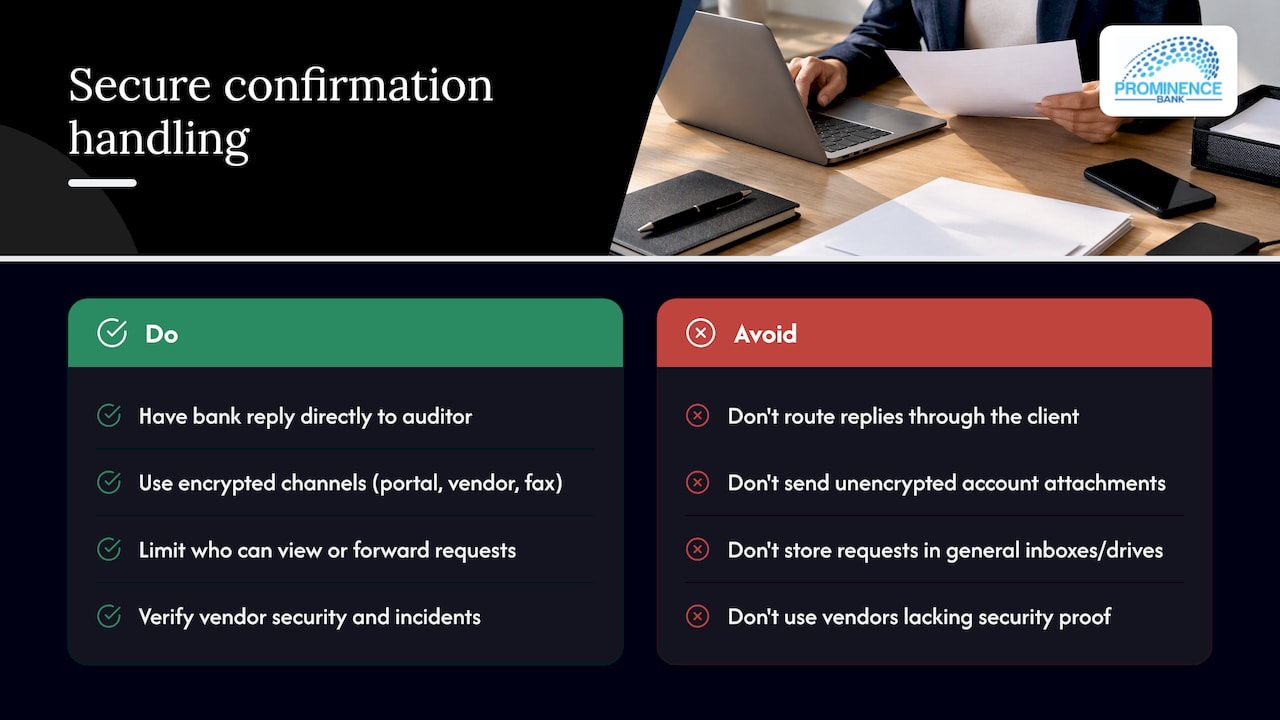
The safest pattern keeps the bank replying directly to the auditor rather than routing a response back through the client, closing off a step where a reply could be intercepted or altered. Requests should travel through encrypted channels: a bank’s own secure portal, a vetted vendor transmission service, or a direct mail or verified fax line, never an unencrypted email attachment carrying full account numbers.
Internally, limit who at the client and at the audit firm can see or forward the request packet. A confirmation letter does not need to pass through a general inbox or a shared drive with broad access; treat it with the same handling rules as other sensitive financial records.
When a vendor or intermediary platform is involved, ask directly how it secures data in transit and at rest, and whether it has had any known incidents. If that answer is not satisfactory, the standard’s own guidance points toward skipping the intermediary and using alternative procedures instead. A partner resource on document verification covers similar ground on why secure handling of sensitive financial documents matters beyond the audit context itself.
Common Mistakes That Get Confirmation Letters Rejected
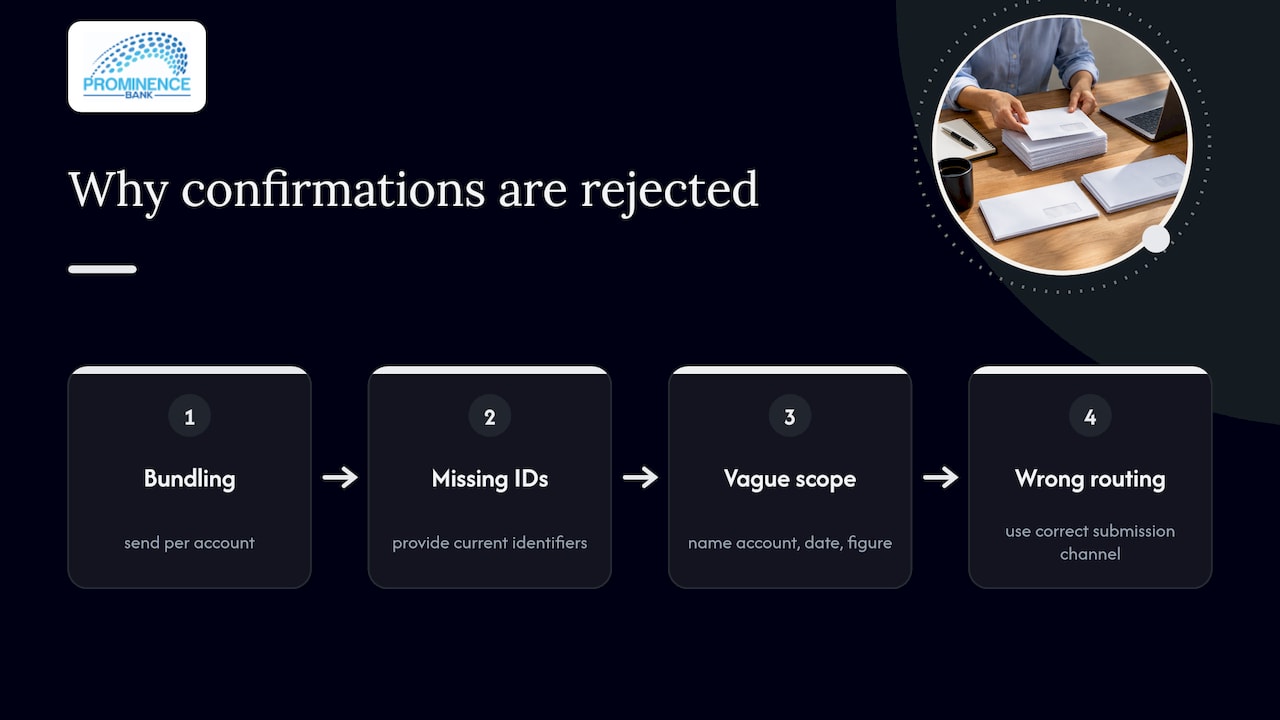
The most frequent error is sending a blanket request covering several accounts at once. Most banks process confirmations account by account, and a bundled letter usually comes back unprocessed rather than partially completed.
A close second is missing or outdated identifiers: an account number that has since been reissued, a facility ID left blank, or a signer whose authorization has lapsed. Banks have no reliable way to match a request to the right file without these details, so the request stalls in a queue or gets returned outright.
Vague language is another recurring problem. A request that asks a bank to “confirm our balances” without naming the specific account, date, and figure forces the bank’s operations team to guess at scope, which slows everything down. Spell out exactly what is being confirmed and as of what date.
Finally, requests sent to the wrong department, such as a branch mailbox instead of a bank’s dedicated confirmation unit, often sit unanswered far longer than necessary. Confirming the correct submission channel before sending, whether that is a portal, a specific fax line, or a named unit, avoids losing days to a misrouted letter.
Avoiding these four issues (bundling, missing identifiers, vague scope, and wrong routing) resolves the large majority of delays auditors encounter with bank responses.
Preparing Internally Before Sending a Confirmation Request
Before a confirmation letter ever reaches a bank, the client’s finance team has its own work to do. Start by reconciling the general ledger cash and debt balances to the most recent bank or loan statements on file, so any discrepancy is already understood before the bank weighs in.
Next, confirm who currently holds signing authority on each account. If a signer has left the company or a new officer was added, that change needs to be documented and ready to attach as authorization evidence, since an outdated signer list is a common reason banks reject a request.
Internal approval matters too: someone with authority over the account relationship, not just the audit liaison, should sign off on releasing account details to the audit firm. This avoids a bank calling back to verify the request is legitimate, which adds delay.
Finally, pull together everything the bank will need to locate the account quickly: the prior year’s confirmation, recent statements, and any facility or loan documents referenced in the request. Having this packet ready before the audit team drafts the letter turns a multi-step back-and-forth into a single clean submission, and it is the single biggest lever a client-side team has over how fast a confirmation comes back.
How Auditors Verify That a Confirmation Response Is Genuine
Receiving a reply is not the same as receiving reliable evidence. Auditors need to confirm the response actually came from the bank and was not altered along the way.
The first check is the source: did the reply arrive through the channel the auditor controls, such as a direct mail, a verified bank fax number, or a secure portal, rather than being handed back through the client. A response that shows up through an unexpected route, including a personal email account, warrants a direct follow-up call to the bank using an independently verified phone number, not one printed on the letter itself.
Auditors also compare the response against known details: does the letterhead, format, and signatory match what that bank has used in prior years or on other engagements. Any inconsistency, a different logo, an unfamiliar signature block, or terms that do not match the client’s own records, is a signal to investigate further rather than accept the reply at face value.
For digital or portal-based responses, the standard asks auditors to go a step further and evaluate whether the platform’s own controls prevent interception or alteration before the reply reaches them. That means understanding how the platform authenticates the bank as the sender, not just trusting that a response arrived through a digital system. When those controls cannot be demonstrated, the appropriate response under AS 2310 is to fall back on alternative procedures rather than rely on an unverifiable confirmation.
Electronic Signatures and Digital Confirmations in Audit Compliance
Digital confirmation platforms and electronically signed responses are now a normal part of audit practice, and the updated standard was written with that reality in mind rather than assuming every confirmation arrives on letterhead. An electronically signed response is not automatically weaker evidence than a wet-ink signature, but it does shift the auditor’s work: instead of checking a signature by eye, the auditor needs some basis for trusting that the signing process itself is controlled by the bank.
That is why intermediary evaluation sits at the center of digital confirmation practice. A platform that lets a bank authenticate itself, lock a response against edits once submitted, and deliver that response directly to the auditor gives a comparable or stronger level of assurance than paper. A platform that cannot demonstrate those controls does not, regardless of how polished its interface looks.
Practically, this means documenting the evaluation of any digital confirmation tool used on an engagement: what the platform claims about authentication and tamper prevention, and whether that claim holds up. It also means audit teams should not treat “it came through a confirmation platform” as a substitute for that evaluation. The format changed; the underlying question (can this response be trusted as coming unaltered from the bank) did not.
How Confirmation Practice Is Shifting and Two Changes Worth Making
AS 2310 pushed confirmation practice from a checkbox habit toward a documented judgment call, and that shift rewards auditors who adapt early. Two changes pay off quickly: keep every prior confirmation on file for reuse, and vet any intermediary platform’s controls before trusting its responses. The templates above are a practical place to start.
— Harold
How Prominence Bank Supports Faster Confirmation Responses
Audit teams lose time when a bank’s own records are hard to locate or when authorization documentation is unclear, and that is exactly where a responsive institutional partner matters. Our documents verification process is built around the same identifier-and-authorization discipline auditors need, which helps confirmation requests move without a second round of back-and-forth.
- We maintain documented account and signer records that support confirmation responses.
- Our business banking services are built for corporate account holders who need a bank that responds promptly to audit requests.
Finance teams evaluating a banking partner that handles confirmations and documentation smoothly can review our business banking page or check current fees for account services.
FAQ
How do I get a bank confirmation for an audit?
Send an account-specific positive confirmation request directly to the bank, including the exact account number, authorized signer evidence, and the audit date, following PCAOB AS 2310. Attach the prior year’s confirmation if one exists, since banks use it to locate the account faster.
How do I get a bank confirmation letter?
A bank confirmation letter is typically drafted by the auditor and sent, with client authorization, directly to the bank’s confirmation unit or portal. It should name the specific account or facility, state the information being verified, and ask the bank to reply directly back to the auditor.
What is an audit confirmation letter?
An audit confirmation letter is a request an auditor sends to an independent third party, most often a bank, asking that party to verify information such as an account balance or loan terms directly. It serves as external evidence under PCAOB AS 2310, which governs how and when auditors should rely on this type of evidence.
What is a bank confirmation letter sample?
A sample confirmation letter includes the account holder’s name, the exact account or facility number, the balance or terms as of a stated date, and a line authorizing the bank to release that information to the named audit firm. Loan confirmations add the interest rate, maturity date, and last interest payment date to that same structure.
Sources
- AS 2310: The Auditor’s Use of Confirmation | PCAOB
- Audit Confirmations Guide | American Bankers Association