
Bank treasury endorsements and countersignatures authenticate, authorize, or release custody-held assets and documents on a client’s behalf. In private banking and institutional custody, the primary uses are safekeeping receipt (SKR) endorsement for collateral purposes, custody transfers between parties, and countersignature of settlement or release instructions. The sections below walk through how each works, the controls that make them reliable, and what to check before you rely on one.
TL;DR:
- Verifying bank controls such as dual control, signer lists, and confirmation procedures is essential before relying on endorsements or custody transfers.
- Maintaining up-to-date documentation, including original SKRs, corporate resolutions, and identification, minimizes delays and reduces dispute risks.
- Custodian strength and regulatory standing are as important as the endorsement document’s wording, especially in high-value or cross-border transactions.
- Independent asset verification from custodians provides added security against fraud or improper authorization beyond paper endorsements.
- Digital onboarding and transparent fee structures streamline processing and ensure consistent operational rigor in treasury endorsement services.
Table of Contents
- 1. Common uses in private and institutional custody
- 2. How the endorsement workflow actually runs
- 3. Operational controls and custody risks to verify
- 4. A client checklist before you engage a bank or custodian
- Why discretion and operational rigor have to coexist
- How Prominence Bank supports endorsement and custody needs
- FAQ
- Sources
1. Common uses in private and institutional custody
Treasury endorsements show up whenever a client needs to prove, move, or release an asset held in custody without physically transferring it. An endorsed SKR, for instance, functions as proof that a specific asset exists under custody and that the custodian has authenticated the client’s claim to it. In secured lending or structured credit, lenders often ask for an endorsed SKR as part of a collateral pledge, since it gives them a verifiable, bank-countersigned record that the asset is real, held, and available to secure the facility.
Custody transfers work differently: instead of proving an asset exists, the endorsement authorizes moving it, or the record of its ownership, from one custody account or beneficiary to another. A countersignature on a transfer instruction tells the receiving institution that the sending bank has verified the request and the signer’s authority.
A few scenarios illustrate how these uses play out:
- An institutional borrower pledges an endorsed SKR as collateral support for a credit facility, giving the lender a documented, bank-verified claim on the underlying asset.
- Two parties in an international settlement rely on an endorsed SKR to confirm asset custody before funds or securities change hands.
- A corporate client instructs a custody transfer between accounts, and the bank’s countersignature confirms the instruction came from an authorized signer before the transfer executes.
Each of these uses depends on the same underlying mechanism: the bank is putting its name behind a fact, whether that fact is “this asset exists and is held here” or “this instruction is authorized.” For more background on how endorsements function across asset custody and secured lending contexts, see our overview of bank document endorsements, and for a closer look at how safekeeping receipts protect private wealth, including their role in trade finance collateral structures.
2. How the endorsement workflow actually runs
An endorsement request moves through a fairly standard sequence, regardless of whether it covers an SKR, a custody transfer, or a release instruction. The steps typically run:
- The client submits a request identifying the asset, the action needed, and the receiving party.
- The bank verifies entitlement: confirming the signer’s authority, matching it against KYC records, and checking the request against the account’s authorized signer list.
- A second reviewer performs a dual-control check, independent of the person who processed the initial request.
- An authorized officer applies the endorsement or countersignature to the document or instruction.
- The bank transmits settlement or release instructions to the custodian or counterparty and confirms completion.
Clients should expect to provide the original SKR or proof-of-funds document, corporate resolutions authorizing the transaction, a power of attorney where someone other than the principal is signing, and government-issued identification for all signers. Missing documentation is the most common reason a request stalls.
Settlement and release instructions are usually confirmed through structured messaging rather than email or fax. SWIFT message types such as the MT 540 through MT 547 series, along with MT 535 and MT 536 status and holdings reports, support settlement instructions and reconciliation between custodians, reducing the chance that a transfer gets lost between systems or misapplied to the wrong account.
A relevant control point: FFIEC guidance calls for callback or confirmation procedures on wire and custody requests, meaning a verified endorsement request should trigger an independent confirmation step before funds or assets move, not just a signature check.
Turnaround for a standard endorsement or countersignature generally runs a few business days once documentation is complete, longer when enhanced due diligence applies or when a custodian in another jurisdiction needs to confirm its own records.
3. Operational controls and custody risks to verify
An endorsement is only as reliable as the controls behind it. Before you fund or act against an endorsed document, confirm the bank and custodian maintain:
- Dual control on endorsement requests, so no single employee can approve and execute a transfer alone.
- Verified, current authorized signer lists tied to KYC records rather than static documents from account opening.
- Callback or confirmation procedures for high-value or unusual requests, consistent with FFIEC operational controls guidance.
- Encrypted, logged messaging channels rather than unsecured email for transmitting instructions.
- Regular reconciliation between custody records and the underlying asset positions.
Custodian selection matters as much as the endorsement itself. The OCC’s Comptroller’s Handbook on custody services frames custody as covering settlement, safekeeping, and reporting, each requiring documented procedures. A separate OCC bulletin on safekeeping arrangements warns that a custodian’s insolvency or failure can cause total loss of assets held with it, which is why due diligence on a custodian’s regulatory status and financial strength matters as much as the paperwork around the endorsement itself.
Before relying on any endorsed document, insist on contractual protections: a clear service agreement, audit and reporting rights, and insurance or indemnity provisions covering custody failures. Outsourcing custody without retaining oversight tends to concentrate risk rather than remove it, a point echoed in international guidance on third-party and operational risk for custody-reliant institutions. Firms that outsource back-office and compliance functions, as Workanova’s overview of outsourced compliance support describes, still need to retain enough internal oversight to verify that the third party’s controls match what the bank represents.
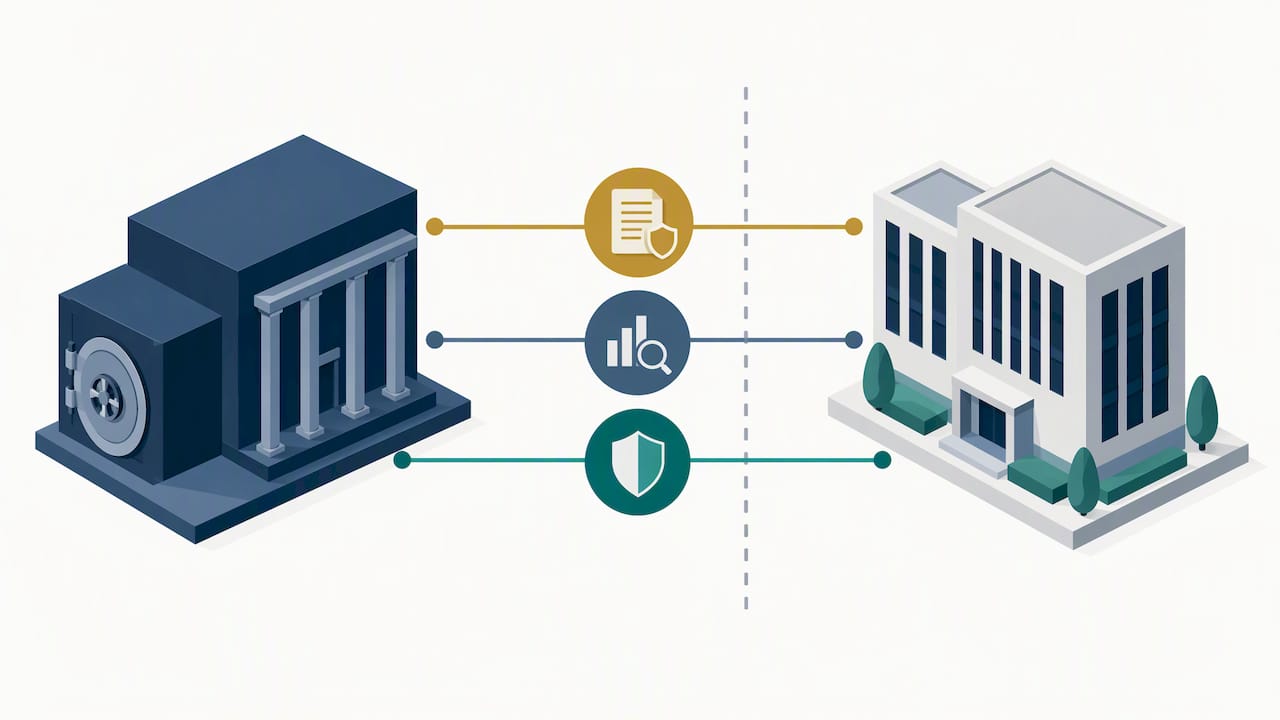
Pro Tip: Before funding against an endorsed SKR, ask the issuing custodian to confirm the asset’s existence directly through an independent verification channel, not just through the paper endorsement itself.
4. A client checklist before you engage a bank or custodian
Preparation shortens the process and reduces the chance of a dispute later. Before requesting an endorsement or custody transfer, work through this sequence:
- Confirm the bank’s and custodian’s regulatory status and ask how often they reconcile custody records against underlying positions.
- Ask about their history with custody incidents or insolvency exposure, and how client assets are segregated from the institution’s own balance sheet.
- Gather original SKRs or proof-of-funds documents, corporate resolutions, powers of attorney, and signer identification in advance.
- Clarify fee components upfront: issuance fees for endorsements or SKRs, transaction or messaging fees for settlement instructions, and verification or due-diligence fees for enhanced checks.
- Ask for a realistic timeline band rather than a single promised date, since enhanced due diligence can extend processing by days or weeks.
- Consider escrow or additional legal counsel for high-value transfers where the counterparty or jurisdiction is unfamiliar.
A client who walks in with this checklist completed typically moves through verification and dual-control review far faster than one submitting documents piecemeal. For more on custodian selection and the risks tied to outsourcing custody, our piece on treasury custody venues for settlement and collateral goes deeper into what to ask a prospective custodian.
Why discretion and operational rigor have to coexist
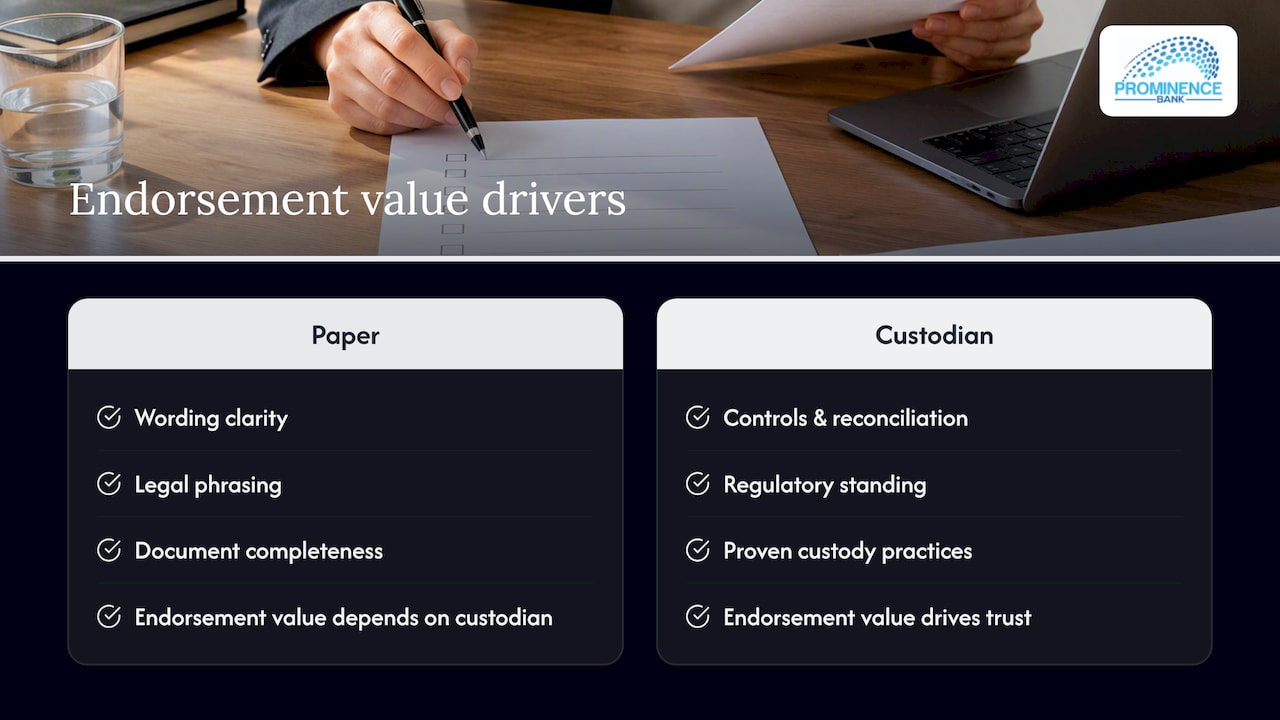
The common assumption is that privacy and strict operational control pull in opposite directions, that a bank serious about discretion must be looser about verification, and one serious about controls must sacrifice confidentiality. That trade-off is mostly a myth. The private clients and institutions who need endorsement services most, those moving significant assets across borders or structuring complex credit against custody-held instruments, are precisely the ones who cannot afford a loose signer list or an unverifiable custodian relationship. Discretion without rigor just means nobody finds out until something goes wrong.
What tends to get underestimated is how much of an endorsement’s value sits in the custodian’s standing, not the document’s wording. A perfectly worded SKR from a custodian with weak reconciliation practices or unclear regulatory status is worth less than a plainer one from an institution that can prove its controls. Readers evaluating endorsement services should weight the institution behind the paper at least as heavily as the paper itself.
— Harold
How Prominence Bank supports endorsement and custody needs
Prominence Bank issues banking documents for eligible account holders after review. Published fees include €25,000 for a Proof of Funds (POF) letter, €25,000 for a Reference Letter / Comfort Letter and 1.5% for a Bank Endorsement. Anyone who receives a document presented as issued by Prominence Bank can check it through Document Verification or by writing to verify@prominencebank.com.
All accounts, transactions and services are subject to eligibility, KYC/AML, sanctions screening, due diligence and final bank approval. See the fees page for the current published schedule.
Prominence Bank reviews custody arrangements for eligible tangible and financial assets with verifiable ownership and value, such as precious metals, fine art, gemstones and important documents, and documents an approved arrangement through a Safe Keeping Receipt (SKR). The published fee for the Safekeeping Receipt (SKR) / custody service is €25,000 for the custody account plus 2%.
Asset acceptance depends on verification of ownership, valuation, insurance and storage terms, and is subject to KYC/AML, compliance review and final bank approval. An SKR records custody; it is not a guarantee, a payment instrument or a source of credit. See the fees page for the current published schedule.
FAQ
What is an endorsement in banking?
A bank endorsement is a formal act by a bank, typically a signature or countersignature, that authenticates, authorizes, or releases a document or custody-held asset. It confirms that the bank has verified the signer’s authority and the facts the document asserts, such as asset existence or ownership transfer.
What documents do I need for a treasury endorsement?
You typically need the original SKR or proof-of-funds document, corporate resolutions authorizing the transaction, a power of attorney if someone other than the principal is signing, and valid identification for all authorized signers. Missing documentation is the most common cause of delay in these requests.
How much does a bank endorsement cost?
Our published bank endorsement fee is 1.5%, and the published SKR / custody fee is €25,000 for the custody account plus 2%. Enhanced due diligence, when required, carries its own separate fee tied to the level of review needed.
Can an endorsement be fraudulent or incorrectly applied?
Yes, which is why operational controls like dual control, signer verification, and callback confirmations exist. Verifying the underlying asset independently, rather than relying solely on the paper endorsement, is the most reliable way to catch a fraudulent or improperly authorized document before acting on it.
What is the difference between a blank, special, and restrictive endorsement in treasury contexts?
A blank endorsement authorizes transfer to whoever holds the document, a special endorsement names a specific recipient, and a restrictive endorsement limits how the asset or document can be used after transfer. Private and institutional treasury transactions generally favor special or restrictive endorsements because they leave a clearer, more enforceable record of intended use.
Sources
- Comptroller’s Handbook: Custody services (OCC)
- SWIFTRef: Reference data and messaging types (resource)