
Mezzanine financing is hybrid capital, subordinated debt or preferred equity, that sits between senior debt and common equity, and gets used when borrowers need incremental capital without full equity dilution. It fits situations where senior lenders have reached their lending limits but owners still want to protect their equity stake. The trade-off is cost: mezzanine carries higher pricing than senior debt and often includes an equity kicker that gives the lender upside alongside interest payments.
TL;DR:
- Mezzanine financing generally involves higher costs and potential dilution from warrants or conversion rights, which can impact overall returns and ownership stakes.
- It usually takes five to eight years to mature, with payment structures including cash coupons, PIK interest, or a combination, and often involves refinancing risk before maturity.
- Intercreditor agreements between senior lenders and mezzanine investors define payment priority, standstill periods, and enforcement rights, which can significantly affect recovery in defaults.
- Typical borrowers are middle-market, sponsor-backed companies with predictable cash flow and limited collateral, often seeking to bridge gaps in financing for acquisitions, growth, or recapitalizations.
- Choosing mezzanine over senior debt or equity depends on balancing higher risk and cost against lower dilution and greater control, with careful modeling of downside scenarios recommended.
Table of Contents
- What Mezzanine Financing Is and the Common Instrument Types
- How Mezzanine Financing Works: Economics, Payments, and Intercreditor Issues
- Common Uses and Typical Borrower Profiles
- Costs, Pricing Ranges, Fees, and Term Conventions
- Underwriting, Documentation, and U.S. Regulatory Context
- Advantages and Disadvantages From Borrower and Investor Viewpoints
- Illustrative Worked Example of a Mezzanine Capital Stack
- How Mezzanine Compares to Senior Debt, High-Yield Debt, and Equity
- How to Evaluate Whether Mezzanine Is Right for Your Business
- Prominence Bank Perspective on Structured-Finance Support
- A Practitioner’s Take on Mezzanine Financing
- How We Can Help With Structured Financing Needs
- FAQ
- Sources
What Mezzanine Financing Is and the Common Instrument Types
Mezzanine financing is a layer of capital that ranks below senior secured debt but above common equity in a company’s capital structure. According to Investopedia’s overview of mezzanine financing, it commonly takes the form of subordinated unsecured debt or preferred equity, and it often comes bundled with equity participation through warrants or conversion rights. That combination lets investors earn a base return from interest or dividends while keeping a claim on the upside if the business performs well.
A handful of structures dominate the market, each with its own risk and return profile:
- Subordinated unsecured debt: pays cash interest, sits below senior debt, and carries no collateral claim.
- Second-lien debt: secured, but its claim on collateral is junior to the senior lender’s.
- Preferred equity: pays a fixed or accruing dividend and sits ahead of common shares in a liquidation.
- Convertible instruments: start as debt or preferred equity and convert into common shares under specified conditions.
- Warrants: give the holder the right to buy equity at a set price, typically attached to a debt or preferred instrument as a kicker.
Where mezzanine ranks matters more than its label. In a default or sale, senior lenders get paid first from available cash or collateral proceeds, then mezzanine holders, then common equity holders last. Earlier OCC guidance on leveraged financing describes how banks participate at multiple levels of a leveraged transaction, including senior and subordinated credit, and sometimes take equity interests or warrants as part of the financing package.
Maturities typically run five to eight years, longer than a revolving credit facility but shorter than long-term equity capital. Payment profiles vary: some mezzanine notes pay cash interest monthly or quarterly, others defer part or all of the coupon until maturity, and most carry a bullet repayment rather than a steady amortization schedule.
How Mezzanine Financing Works: Economics, Payments, and Intercreditor Issues
Mezzanine pricing usually blends two components: a cash coupon and a payment-in-kind (PIK) feature. Cash coupon payments work like ordinary interest, paid on a set schedule. PIK interest accrues instead of being paid in cash, adding to the loan’s principal balance so the borrower conserves cash during the investment period but owes more at maturity.
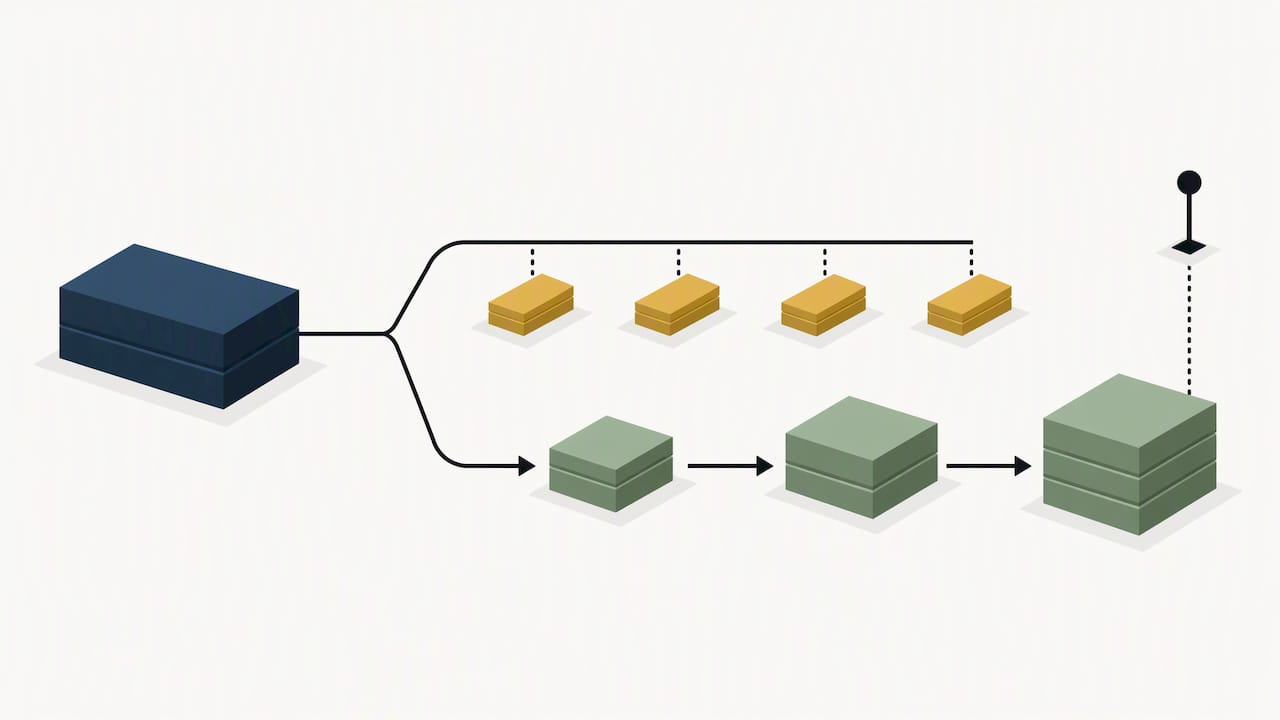
Many mezzanine deals attach warrants or conversion rights to the debt or preferred instrument. These give the investor the option to acquire equity, usually at a nominal or discounted price, which dilutes existing shareholders if exercised. The dilution is the price borrowers pay for lower cash interest costs and more flexible terms than a straight equity raise would require.
Subordination is formalized through an intercreditor agreement between the senior lender and the mezzanine investor. This document sets:
- Payment priority and when mezzanine payments can be blocked if the senior lender is owed money.
- Standstill periods that delay the mezzanine lender’s enforcement rights after a default.
- Voting and consent rights the mezzanine investor keeps, or gives up, during a workout.
Pro Tip: Read the intercreditor agreement’s standstill and payment-blocking provisions as closely as the coupon rate. They often matter more to actual recovery than the headline interest number.
The senior lender holds a first claim on assets and cash flow. The mezzanine investor sits below that claim but above the equity holders, accepting more risk in exchange for a coupon well above the senior rate plus warrants that let it participate in equity gains if the company grows. That structure lets the sponsor commit less equity upfront while still controlling the business, which is the core appeal of mezzanine capital for acquirers and growing companies alike.
Common Uses and Typical Borrower Profiles
Mezzanine financing tends to show up in a narrow set of situations where a borrower needs more capital than senior lenders will provide but wants to avoid giving up a large equity stake.
- Acquisitions and leveraged buyouts: sponsors use mezzanine to fill the gap between senior debt capacity and the purchase price, reducing the equity check needed to close.
- Growth capital: companies with strong cash flow but limited hard collateral use mezzanine to fund expansion without issuing new shares.
- Recapitalizations: owners use mezzanine to buy out a partner or return capital to shareholders while retaining operating control.
- Real estate gap financing: developers use mezzanine to bridge the difference between a senior construction loan and the total project cost.
The typical borrower is a middle-market, sponsor-backed company with predictable cash flow and limited tangible collateral, often in services, technology, or light manufacturing. Businesses in asset-light sectors frequently turn to financing solutions built for technology companies for exactly this reason: a software or services business can support meaningful debt service from recurring revenue even though it has little equipment or real estate to pledge as security.
Mezzanine gets chosen over straight equity in these cases because it’s cheaper on a blended basis than issuing new shares, and it lets existing owners keep more of the company’s upside if the business performs as expected.
Costs, Pricing Ranges, Fees, and Term Conventions
Mezzanine capital costs more than senior debt and less than pure equity, reflecting its position in the capital stack. Mezzanine investors typically target relatively high yields that significantly exceed senior debt returns, according to Investopedia, blending cash interest with equity participation to reach that target internal rate of return.
The all-in cost comes from several layers:
- Cash coupon: the portion of yield paid periodically in cash.
- PIK interest: accrued interest added to principal, increasing the balance due at maturity.
- Equity kicker: warrants or conversion rights that let the investor capture additional upside if the company performs well.
- Fees: structuring fees paid at closing, commitment fees for capital set aside before funding, and original issue discount (OID) where the investor funds less than the face amount of the note.
- Expense reimbursement: borrowers typically cover the lender’s legal and diligence costs.
Terms typically run five to eight years, often with a bullet repayment at maturity rather than a gradual amortization schedule. Borrowers often plan to refinance mezzanine debt with cheaper senior financing once cash flow improves or enterprise value grows, which is why refinancing timing and market access matter as much as the initial coupon.
Pricing shifts with borrower quality. A company with stable, contracted cash flow and some hard collateral will see a lower coupon and smaller equity kicker than a company with volatile revenue and no collateral at all. Sponsor strength and the deal’s overall leverage also move pricing: more total debt relative to cash flow usually means a higher mezzanine rate to compensate for the added risk sitting below the senior lender.
Underwriting, Documentation, and U.S. Regulatory Context
Mezzanine lenders underwrite primarily to enterprise value and cash flow, not to hard collateral, since many mezzanine deals are unsecured or secured only by a junior lien. Lenders look closely at the sponsor’s track record, the company’s ability to refinance the mezzanine piece before maturity, and the cushion between projected cash flow and total debt service across the capital stack.
Typical documentation includes:
- Loan or note purchase agreement: sets the coupon, PIK terms, maturity, and covenants.
- Intercreditor agreement: governs the relationship and payment priority between the senior lender and the mezzanine investor.
- Warrant or conversion documents: specify the equity participation terms and any anti-dilution protections.
- Security documents: required when the mezzanine piece carries a second lien rather than standing unsecured.
Covenants commonly include leverage ratios, fixed-charge coverage tests, and restrictions on additional debt or asset sales. A breach typically triggers a default that can accelerate repayment, though the intercreditor agreement’s standstill provisions often delay the mezzanine investor’s ability to act while the senior lender’s claims are resolved.
Bank participation in mezzanine-adjacent leveraged lending is shaped by federal guidance. The Comptroller’s Handbook section on leveraged lending treats subordinated financing as part of the leveraged-lending ecosystem and expects banks to apply underwriting, documentation, and risk management consistent with safe-and-sound lending principles. More recently, the OCC and FDIC issued a 2025 interagency statement withdrawing earlier leveraged-lending guidance and directing banks to manage these exposures under general safe-and-sound standards instead of a specialized framework. That shift has pushed some leveraged activity toward nonbank lenders, which raises the importance of careful covenant design and runway analysis for any borrower relying on mezzanine capital, since nonbank lenders operate under different oversight than regulated banks.
Advantages and Disadvantages From Borrower and Investor Viewpoints
Mezzanine financing changes the risk and reward picture differently depending on which side of the transaction you sit on.
- Borrower advantage: less equity dilution than a straight equity raise, since the capital comes primarily as debt or preferred equity rather than common shares.
- Borrower advantage: interest payments are often tax-deductible, lowering the effective after-tax cost compared with equity.
- Borrower disadvantage: the coupon and fees cost meaningfully more than senior debt, raising overall debt service.
- Borrower disadvantage: covenants and, in some deals, board observation or consent rights limit operating flexibility.
- Investor advantage: the blended return from coupon plus equity kicker can exceed what senior lending offers for comparable risk.
- Investor risk: recovery in a default sits behind the senior lender’s claim, so a downturn can wipe out mezzanine value before senior debt is even impaired.
The right balance depends on how much control and cash flow flexibility the borrower is willing to trade for a smaller equity check, and how comfortable the investor is with subordinate recovery risk in exchange for a higher target return.
Illustrative Worked Example of a Mezzanine Capital Stack
Say a company is being acquired for a substantial amount. The buyer arranges financing in three layers: a large portion in senior debt at a moderate cash coupon, mezzanine financing at a higher cash coupon plus warrants for a minority equity stake, and the remainder in sponsor equity.
- Base scenario: the business grows as projected, generates enough cash flow to cover senior and mezzanine interest comfortably, and refinances the mezzanine piece with cheaper senior debt after four years, avoiding warrant exercise costs for the sponsor beyond the agreed 5% dilution.
- Downside scenario: cash flow falls short, the company elects to PIK part of the mezzanine coupon rather than pay cash, and the mezzanine balance grows while the sponsor retains breathing room to avoid a covenant default.
- Stress scenario: the company cannot refinance on schedule, the mezzanine investor’s warrants become more valuable as the company’s equity value recovers later, and dilution to the sponsor increases beyond the original 5% if additional kickers were tied to extension provisions.
A worked example like this one shows why the all-in cost of mezzanine capital depends as much on timing and refinancing as on the stated coupon, a point echoed in practice notes on mezzanine finance structuring. Earlier repayment generally reduces total PIK accrual and limits dilution, while a delayed refinancing extends the investor’s equity participation and raises the sponsor’s effective cost.
How Mezzanine Compares to Senior Debt, High-Yield Debt, and Equity
Choosing between financing types comes down to cost, speed, control, and how much of the company’s upside you’re willing to share.
- Senior debt is the cheapest and fastest to close but limited by collateral and cash flow coverage ratios, capping how much a lender will provide.
- Mezzanine debt costs more than senior debt but less than equity, closes on a timeline similar to a negotiated private deal, and dilutes ownership only modestly through warrants or conversion rights.
- High-yield debt is typically used by larger, rated issuers accessing public or institutional bond markets, with pricing and terms driven by broader credit markets rather than a single negotiated deal.
- Common equity carries no repayment obligation and no covenants but costs the most in the long run since new shareholders share fully in future upside.
Blended solutions, pairing a senior bank facility with a mezzanine layer, are common precisely because they let a borrower maximize leverage while minimizing the equity check, without taking on the full cost of an all-equity raise or the restrictive borrowing caps of an all-senior structure. Businesses weighing these options against conventional business loan structures often find mezzanine attractive specifically because it fills a gap that neither senior lenders nor equity investors will cover alone.
How to Evaluate Whether Mezzanine Is Right for Your Business
Deciding whether mezzanine financing fits your situation comes down to a short list of practical questions about your cash flow, your tolerance for leverage, and your exit plan.
- Assess cash flow stability: mezzanine debt service requires predictable cash flow, since missed payments trigger covenant breaches even when the business has long-term potential.
- Gauge leverage tolerance: stacking mezzanine on top of senior debt raises total leverage, so model debt service coverage under a stress case, not just the base plan.
- Confirm sponsor alignment: make sure equity holders and the mezzanine investor share the same view on timeline and exit strategy, since misaligned expectations surface during a refinancing crunch.
- Map the exit or refinancing path: identify realistically how and when the mezzanine piece gets repaid or refinanced before signing anything.
When talking to lenders, ask directly about the cash versus PIK split on the coupon, the intercreditor terms that would govern a default, any board or governance rights attached to the investment, and the full fee schedule including commitment and structuring charges.
Pro Tip: Treat vague answers about exit mechanics or intercreditor rights as a red flag. A lender that can’t clearly explain what happens in a default scenario hasn’t thought it through either.
Watch for excessive fees stacked on top of an already high coupon, governance provisions that give the lender outsized control over ordinary operating decisions, and exit terms left deliberately undefined until closing.
Prominence Bank Perspective on Structured-Finance Support
Businesses exploring mezzanine-style capital often need more than just a term sheet. We provide services that map directly onto these transaction needs, including corporate finance structuring support, mergers and acquisitions advisory for sponsor-backed deals, and treasury solutions through our corporate banking offering for managing multi-currency cash flow during a financing or refinancing event.
We also address bankability and documentation readiness directly in our resource on high-risk banking solutions for global businesses, since lenders scrutinize account history and transaction transparency as part of underwriting. This section reflects our own perspective as a publisher on the space. We encourage readers to compare it against other structured-finance providers and advisors before committing to a transaction.
A Practitioner’s Take on Mezzanine Financing
The biggest mistake I see in conversations about mezzanine financing is treating the coupon rate as the whole story. The real cost shows up in the PIK accrual if cash flow dips, in the warrant dilution if the business succeeds beyond plan, and in the intercreditor terms if anything goes wrong at all. If you’re weighing mezzanine against a straight equity raise or a larger senior facility, build a downside case before you build the base case, and run the numbers on what happens if refinancing takes two years longer than expected. My practical recommendation: model the scenario with a structured-finance advisor before signing a term sheet and treat the equity kicker as a real cost, not a footnote.
— Harold
How We Can Help With Structured Financing Needs
When a mezzanine-style transaction is in motion, the surrounding banking infrastructure matters as much as the financing terms themselves. We offer corporate banking solutions built for complex structures, multi-currency accounts for managing cross-border transaction flows, and investment banking services suited to transaction advisory work around acquisitions, recapitalizations, and growth financing.
For businesses opening new banking relationships around a financing event, we offer:
- Account solutions through business banking for transaction execution and day-to-day cash management.
- A published fee schedule covering account opening, wire transfers, and due diligence tiers so costs are clear before you commit.
- Direct application through our business and corporate account application for companies ready to move forward.
If you’re structuring a transaction that involves mezzanine or other subordinated capital, reach out through our business account application to discuss which account and treasury setup fits your deal.
This article is general information, not a substitute for advice from a qualified financial advisor. Consult a qualified financial professional about your own circumstances before acting on anything here.
FAQ
What Do You Mean by Mezzanine Financing?
Mezzanine financing is hybrid capital that ranks between senior debt and common equity, most often structured as subordinated unsecured debt or preferred equity. It frequently includes warrants or conversion rights, as described in Investopedia’s overview, giving the investor a share of equity upside alongside interest or dividend payments.
How Does a Mezzanine Loan Work?
A mezzanine loan typically pays a cash coupon, a PIK component that accrues to principal, or a blend of both, while sitting below senior debt in repayment priority. An intercreditor agreement with the senior lender sets out payment priority and standstill terms that govern what happens if the borrower defaults.
What Are the Downsides of Mezzanine Finance?
The main downsides are cost and dilution: mezzanine coupons run well above senior debt rates, and attached warrants or conversion rights dilute existing shareholders if exercised. Borrowers also take on covenants that can restrict additional borrowing or asset sales, and in a default, mezzanine investors recover after the senior lender is paid in full.
Can You Give Me an Example of Mezzanine Financing?
In a typical middle-market acquisition, a buyer might use mezzanine financing alongside senior debt and sponsor equity, with the mezzanine layer letting the sponsor reduce the equity check while the senior lender holds the first claim on cash flow and collateral.