
Most banks stop accepting international payments for same-day processing somewhere in the early-to-mid afternoon local time, well ahead of the Fedwire network’s hard close at 7:00 p.m. ET. That Fed-level deadline governs the rail itself, but your bank’s own internal cutoff, set earlier to leave room for review and routing, is the one that actually determines whether your payment moves today. Weekends and holidays push both deadlines back further.
TL;DR:
- Most banks’ internal cutoffs for international payments are in the early to late afternoon local time, often several hours before the Fedwire 7:00 p.m. ET closing time.
- Fedwire’s customer transfer cutoff is at 6:45 p.m. ET, requiring banks to process payments well before this to guarantee same-day settlement.
- Delays can occur due to compliance checks, manual review, or routing through correspondent banks, especially when payments are submitted late or via batch files.
- Weekend and holiday closures in the US and destination countries extend settlement times, with international payments often settling on the next business day at the earliest.
- Setting internal cutoffs at least two hours before official deadlines and verifying beneficiary details can significantly reduce missed same-day processing risks.
Table of Contents
- How cutoff times work: rails versus bank customer cutoffs
- Fedwire and rails: authoritative cutoff times, queues, and special rules
- Typical bank customer-facing cutoff ranges and channel examples
- Factors that change cutoff times and settlement speed
- Action checklist: what to do before you submit an international payment
- Prominence Bank perspective: managing cutoffs on a digital banking platform
- Recommended policy for treasury teams
- How Prominence Bank helps you hit international payment deadlines
- Sources
- FAQ
How cutoff times work: rails versus bank customer cutoffs
A cutoff is the last moment a payment can enter a processing cycle and still settle on that business day. Two different clocks matter here. The first belongs to the payment rail, principally Fedwire in the United States, alongside the SWIFT messaging network that correspondent banks use to communicate instructions across borders. The second belongs to your bank, which sets its own, earlier deadline for customers.
Banks cut off earlier than the rails for a simple reason: a wire does not go straight from your instruction to the Fed. It passes through compliance screening, internal routing, and often a correspondent bank relationship before it ever reaches Fedwire.
- Online banking portals often hold the latest internal cutoff of any channel.
- Branch-submitted wires typically need to clear earlier because of manual entry and paperwork.
- Batch file submissions for corporate treasury follow their own scheduled windows, often tied to file-processing cycles rather than a single clock time.
Fedwire and rails: authoritative cutoff times, queues, and special rules
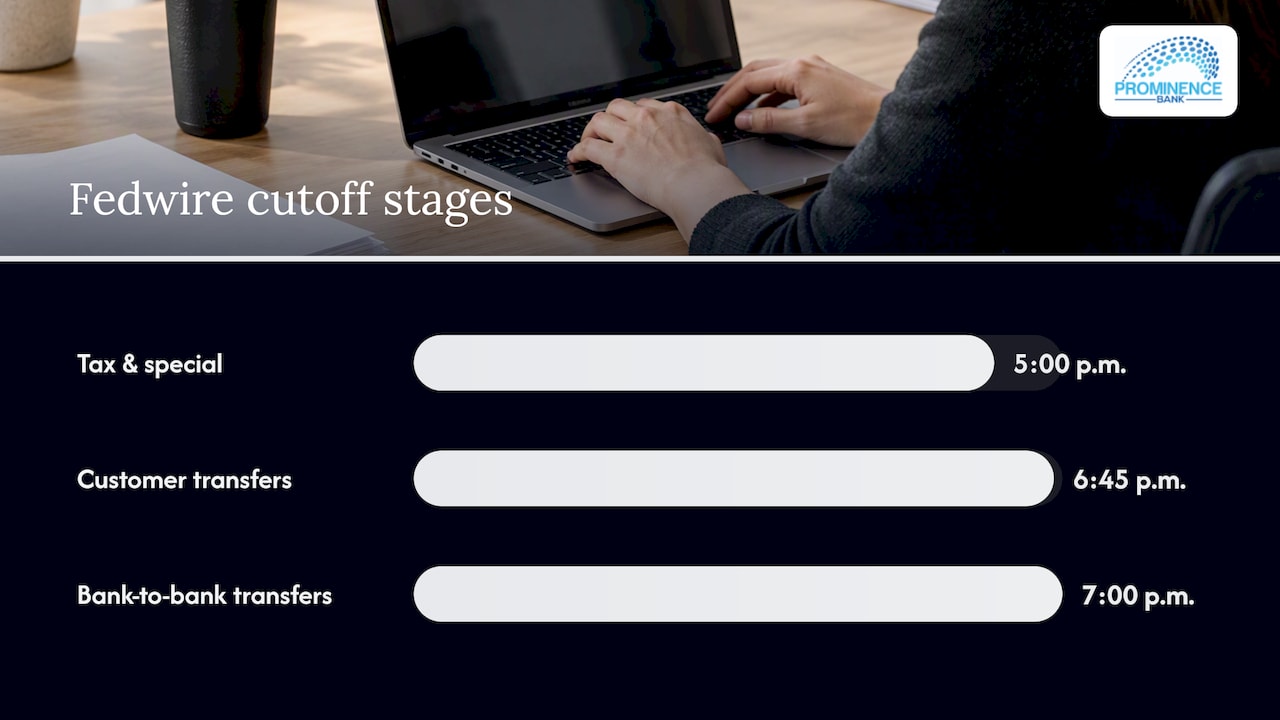
The Fedwire Funds Service stops processing online value messages and closes at 7:00 p.m. ET on a funds-transfer business day, according to the Federal Reserve’s own operating hours documentation. That close is staged rather than a single moment.
| Cutoff stage | Time (ET) | Applies to |
|---|---|---|
| Tax and special accounts | 5:00 p.m. | Treasury tax and loan, special account transfers |
| Customer transfers | 6:45 p.m. | Payments originated on behalf of bank customers |
| Bank-to-bank transfers | 7:00 p.m. | Interbank funds transfers |
The Fedwire close sits at 7:00 p.m. ET, according to the Federal Reserve, which means any customer transfer instruction needs to clear your bank’s internal processing well before 6:45 p.m. ET to have any chance of same-day settlement.
FedPayments Manager, the application layer participants use to submit and monitor messages, has its own availability windows that differ from Fedwire’s processing hours. Institutions can queue messages during specified windows, but anything submitted after the service closes for a cutover period risks deletion rather than delayed processing. The Fed also reserves the right to extend operating hours by guideline when circumstances require it, which is worth knowing if you are relying on a published time as an absolute.
Typical bank customer-facing cutoff ranges and channel examples
Rail deadlines tell you the outer limit of the system. What actually matters to you is your bank’s published cutoff, and those tend to cluster well before the Fed’s close.
- Standard online wire submissions commonly cut off in the early-to-late afternoon local time, often several hours ahead of the Fedwire deadline.
- Branch-initiated wires frequently carry an earlier cutoff than online submissions because of manual review steps.
- Corporate batch files often run on a fixed processing schedule rather than a same-day cutoff, meaning a file submitted even minutes late can roll to the next cycle.
Miss your bank’s cutoff and the payment does not disappear, it simply routes as next-business-day, which also resets any FX rate you were quoted if the payment involves a currency conversion. Because these times vary by institution and channel, the only reliable step is checking your bank’s own published cutoff page and confirming correspondent routing instructions before you submit anything time-sensitive.
Factors that change cutoff times and settlement speed
A single cutoff time is only a starting point. Several variables can move your effective deadline earlier or delay settlement even after a payment is accepted.
- Currency and destination clearing rules: the receiving country’s own banking system and correspondent chain can add processing days regardless of when you sent the payment.
- Time zones and calendars: a payment sent late in a US afternoon may already be past the next day’s opening window in the destination market, and weekends or public holidays in either country push settlement further out.
- Compliance and data exceptions: AML review, missing or mismatched beneficiary details, or anything that triggers manual handling removes the payment from automated same-day processing entirely.
Action checklist: what to do before you submit an international payment
A little preparation removes most of the risk of a missed cutoff.
- Confirm your bank’s published internal cutoff for the specific channel you are using, and submit with a buffer rather than at the deadline itself.
- Verify the beneficiary name, IBAN or account number, and SWIFT/BIC code before submission to avoid a manual exception.
- Confirm correspondent bank instructions for the destination currency, and prebook an FX rate if the transfer involves a conversion.
- Flag the payment as priority or same-day if your bank offers that option.
- For Friday or pre-holiday transfers, contact your bank in advance to confirm queue status, and escalate high-value transfers early rather than waiting for the cutoff window.
Pro Tip: Treat the published cutoff as your deadline for submission review, not for clicking send, since compliance checks can take longer than you expect on a busy day.
Prominence Bank perspective: managing cutoffs on a digital banking platform
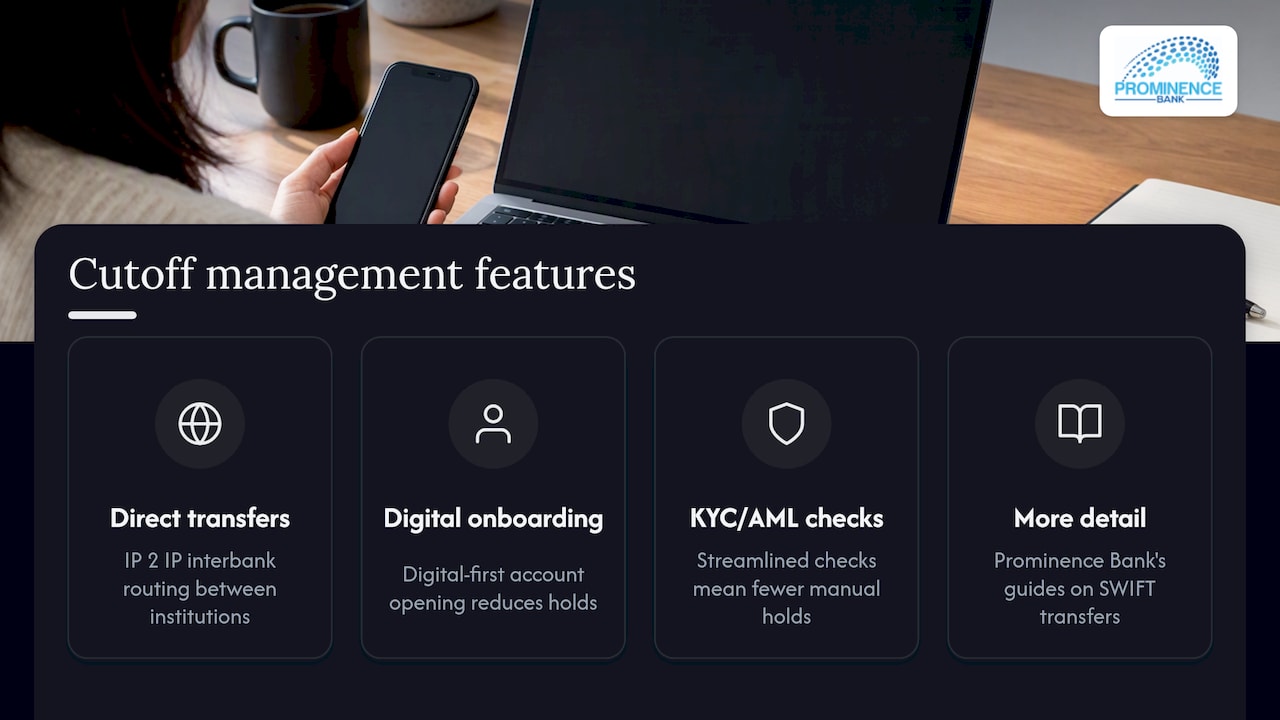
Reducing missed cutoffs comes down to shrinking the gap between instruction and execution. Prominence Bank’s multi-currency business accounts and IP 2 IP Interbank Transfer service are built around that goal, routing funds directly between institutions to cut the latency a traditional correspondent chain can add. Digital-first account opening and streamlined KYC/AML checks mean fewer manual holds at the review stage, one of the more common reasons a payment misses its window. Clients who want a closer look at how direct bank transfers move through SWIFT can find more detail in Prominence Bank’s own guides.
Recommended policy for treasury teams
Set your internal cutoff at least two hours ahead of your bank’s published deadline, and automate beneficiary and SWIFT/BIC validation before a payment ever reaches a human reviewer. Fed close windows are predictable: schedule staff coverage around them rather than reacting late on a Friday afternoon. For high-value or time-sensitive transfers, flag and escalate before the queue builds, not after.
— Harold
How Prominence Bank helps you hit international payment deadlines
Operational delay is usually the real cost of a missed cutoff, not the wire fee itself. Multi-currency business accounts and interbank transfer routing can help reduce the steps between instruction and settlement for businesses and institutions moving money across borders regularly.

- Multi-currency business accounts that hold and route funds without a separate conversion step for every currency pair.
- Direct interbank transfer options built to reduce the correspondent delays that push payments past a cutoff.
- Treasury-level support for structuring recurring or high-value international transfers.
Full fee details, including wire and transfer charges, are listed on the Prominence Bank fees page. If your payment volume or structure calls for dedicated support, the Business Banking team is the starting point.
FAQ
What is the cutoff time for international payments?
There is no single answer: your bank sets its own customer-facing cutoff, usually well before the Fedwire network’s 7:00 p.m. ET close. Check your bank’s published wire cutoff page for the exact time that applies to your channel.
What time do banks typically cut off outbound wire transfers?
Most banks close outbound wire submissions sometime in the early-to-late afternoon local time, though the exact time depends on the institution and whether you submit online, in a branch, or through a batch file. Always confirm the specific time on your bank’s own cutoff page rather than assuming a standard hour applies.
What is the Fedwire cutoff time for the US dollar?
Fedwire closes for customer transfers at 6:45 p.m. ET and for bank-to-bank transfers at 7:00 p.m. ET, per the Federal Reserve’s operating hours. These are the rail-level deadlines, not the earlier cutoff your bank likely sets for customer submissions.
How do holidays and weekends affect payment cutoffs?
Fedwire and correspondent banking systems do not process on weekends or Federal Reserve holidays, so a payment submitted on a Friday afternoon often settles the following business day at the earliest. International corridors add another layer, since a holiday in the receiving country can delay settlement even when U.S. markets are open.
Why did my payment miss the cutoff even though I submitted it on time?
A payment can miss same-day processing because of incomplete beneficiary details, a compliance review flag, or correspondent bank routing delays that occur after your bank accepts the instruction. Verifying beneficiary information and confirming correspondent instructions before submission is the most reliable way to avoid this.