
Asset custody fees are charges a bank or custodian collects for safekeeping securities, settling trades, and handling administrative tasks like dividend collection and reporting. Most are billed as a small percentage of assets held, a flat fee, or both. Before signing anything, check three things: how the fee is calculated (average balance versus month-end snapshot), whether a minimum charge applies, and whether your holdings include special assets that trigger surcharges.
TL;DR:
- Most custody fees are tiered with lower rates for larger assets, but minimum charges can make small accounts pay more percentage-wise.
- Fees are typically calculated based on the average daily balance, not just month-end, influencing the actual cost for fluctuating portfolios.
- Surcharges often apply for holding non-standard assets like private equity, real estate, or crypto, and should be clarified before signing agreements.
- Negotiating custody fees is common among institutional clients, especially when presenting competing quotes or requesting tailored pricing based on actual transaction volume.
- Verification of fee calculation methods, sub-custodian arrangements, and potential pass-through charges should be confirmed beforehand to avoid surprises.
Table of Contents
- What Do Custody Fees Actually Cover?
- Types and Components of Custody Fees
- How Are Custody Fees Calculated?
- What Are Typical Custody Fee Ranges?
- How Do You Read Common Custody Fee Line Items?
- Can You Negotiate Custody Fees?
- What Should You Verify Before Signing a Custody Agreement?
- Prominence Bank’s View on Transparent Custody Pricing
- Get a Custody Fee Proposal Built Around Your Portfolio
- Where to Verify These Numbers Yourself
- Sources
- FAQ
What Do Custody Fees Actually Cover?
Custody fees pay for the operational work of holding your securities safely and processing everything that happens around them. That includes safekeeping and settlement of trades, corporate-actions processing (mergers, spinoffs, tender offers), dividend and coupon collection, proxy voting support, and the statements you receive each month.
This is fundamentally different from what you pay an investment manager. Custody fees cover safekeeping and administrative work, while management fees compensate someone for deciding what to buy and sell. A custodian doesn’t pick your stocks; it makes sure the ones you own are recorded, settled, and reported correctly.
On a statement, custody charges usually show up as:
- A line-item deduction labeled “custody fee” or “safekeeping fee,” often billed monthly or quarterly
- Separate entries for transaction-based charges (wire transfers, asset transfers)
- A note distinguishing the custody charge from any advisory or management fee billed by a separate party
Types and Components of Custody Fees
Custody pricing breaks down into four recurring categories, and knowing which one applies to a given charge on your bill saves a lot of confusion.
- Asset-based fees: quoted in basis points annually, often structured in tiers where larger balances get a lower marginal rate
- Transaction fees: charged per event, such as asset transfers, withdrawals, coupon or interest processing, and rush handling for expedited settlements
- Minimums and inactivity fees: a flat quarterly or annual floor that kicks in when your asset-based fee would otherwise fall below it, common on smaller accounts
- Special-asset surcharges: extra charges for holding private equity stakes, direct real estate, physical precious metals, or crypto in cold storage, since these require non-standard handling
A private bank’s published schedule shows the pattern clearly: rates that step down as assets grow, paired with a quarterly minimum regardless of balance. That structure, seen in Julius Baer’s published custody schedule, is standard across the industry, not an outlier.
How Are Custody Fees Calculated?
The core formula is simple: fee = asset value × rate in basis points ÷ 10,000. One basis point equals 0.01%, so a rate of 15 basis points on a $1 million account works out to $1,500 a year.
Tiered schedules complicate that math in one of two ways:
- Cumulative pricing applies one blended rate to your entire balance based on which tier you fall into
- Marginal pricing charges each slab of assets only the rate assigned to that slab, similar to how income tax brackets work
The difference between the two methods can move your effective rate by several basis points on the same portfolio, so it’s worth asking a custodian to run both scenarios before you commit.
Billing cadence matters too. Most custodians calculate fees on an average daily balance rather than a single month-end snapshot, which smooths out the impact of large deposits or withdrawals mid-period.
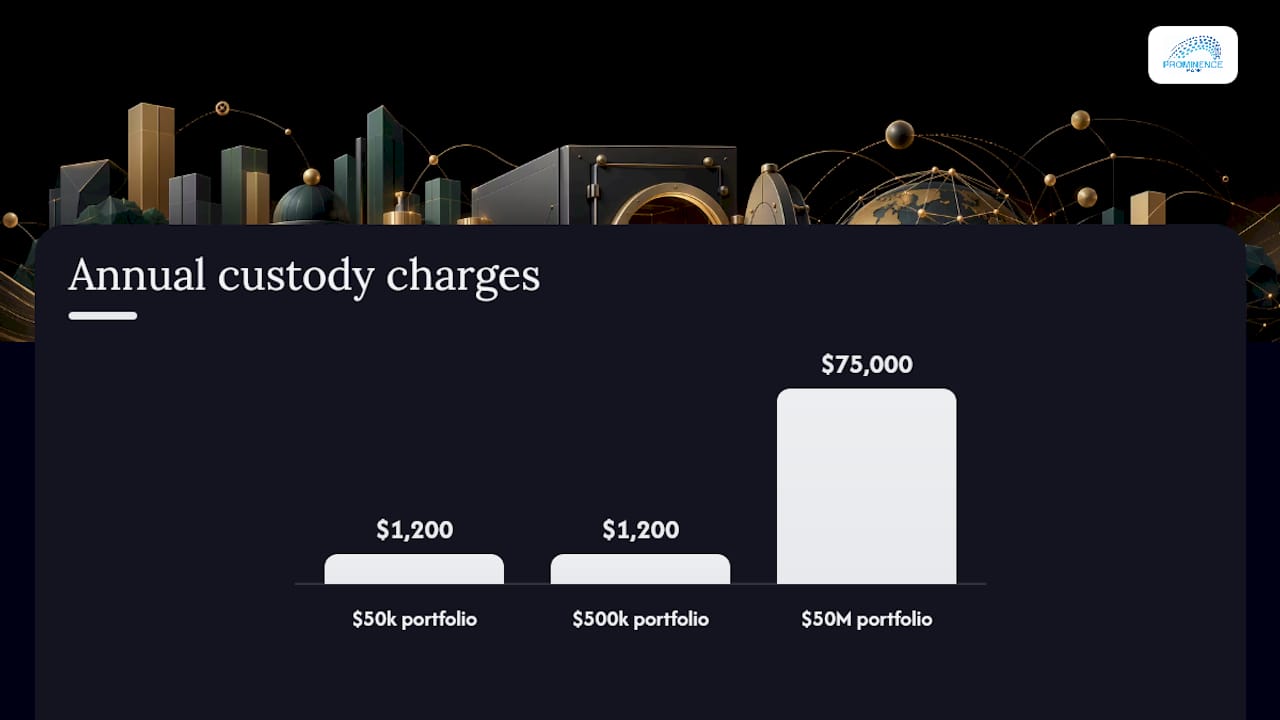
Rough math at three portfolio sizes, using a 15 basis point rate: a $50,000 account would owe about $75 a year, but a $1,200 annual minimum would override that and become the actual charge. A $500,000 account would owe roughly $750, likely still below a typical minimum. A $50 million account would owe $75,000, well past any minimum and now a candidate for negotiated tiers.
What Are Typical Custody Fee Ranges?
Custody pricing spans a wide range depending on account size, asset complexity, and who’s holding the assets.
- Institutional custody-only mandates on liquid securities often run from a few basis points up to around ten to fifteen basis points annually
- Retail and complex custody arrangements, especially those involving alternative or illiquid assets, can run into several tenths of a percent
- RIA-custodian relationships commonly land in a low basis-point range for standard securities, based on industry benchmarking
- Flat quarterly minimums frequently fall between moderate to several hundred dollars, based on published fee guides, regardless of the asset-based calculation
Statistic Callout: A typical published custodian schedule shows a rate near 0.60 basis points on certain asset classes paired with a flat monthly minimum charge, illustrated in an SEC-filed custodian fee schedule. That combination of a low headline rate plus a fixed floor is exactly why small accounts often pay a higher effective percentage than large ones.
Management fees sit in a completely different band. They typically run from 0.10% for passive strategies to well over 1% for active and alternative strategies, a range that has nothing to do with the custody charge layered on top of it.
How Do You Read Common Custody Fee Line Items?
Fee schedules use terse labels that don’t always explain themselves. A DTCC/DTC fee guide lists dozens of per-item charges with specific dollar amounts attached, and most custodians borrow similar naming conventions.
- Custody transfer: moving securities between accounts or institutions, usually a flat per-transfer fee
- Rush transfer: an expedited version of the above, charged at a premium for same-day handling
- Withdrawal/pickup: physical or electronic removal of assets from custody
- Coupon clipping/processing: collecting interest payments on bonds, a holdover term from paper-certificate days
- Reorg research: staff time spent tracking a corporate action like a merger or spinoff
Some of these are direct custodian charges; others are pass-throughs from a sub-custodian or depository that the bank simply forwards to you. If a line item is unclear, ask the custodian directly whether it’s a fixed internal charge or a third-party cost, since pass-through items are often where negotiation room exists.
Can You Negotiate Custody Fees?
Yes, and larger clients do it routinely. Published rate cards are a starting point, not a final answer, especially once your asset base crosses a threshold that makes you worth retaining.
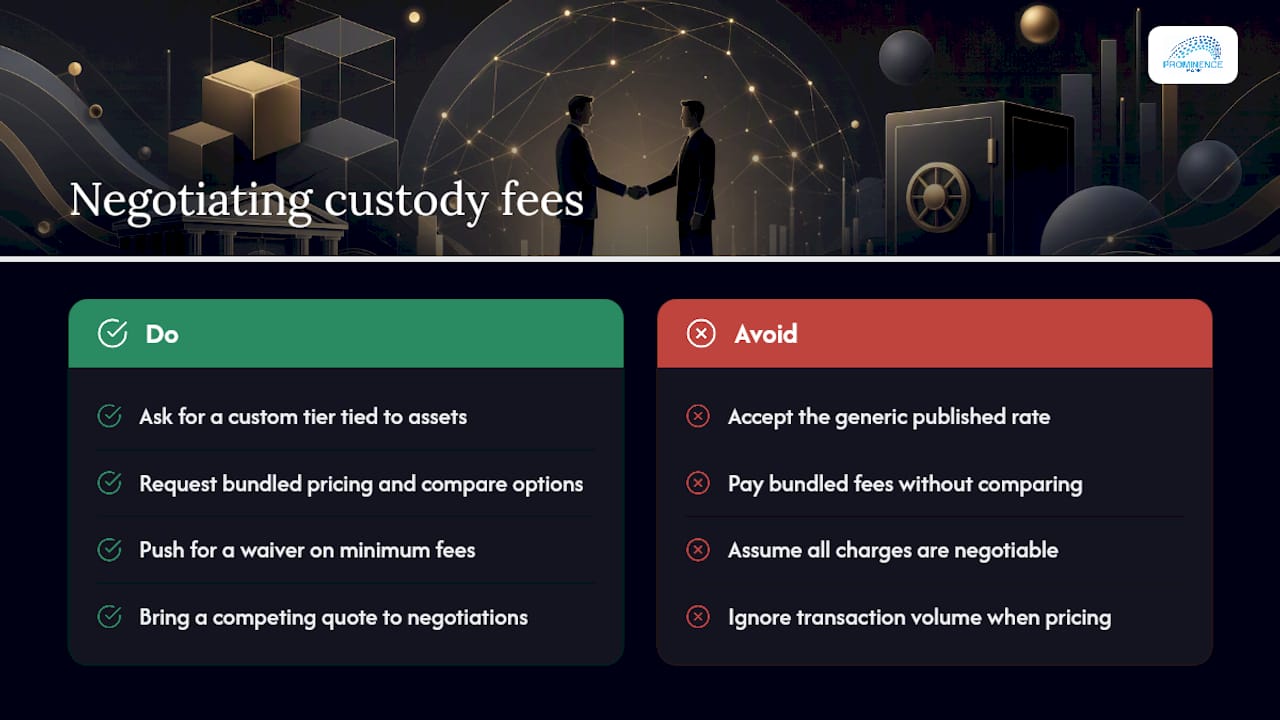
Ask for a custom tier tied to your actual asset mix and expected transaction volume rather than accepting a generic published rate. Bundled pricing, where custody, reporting, and settlement are wrapped into one fee, sometimes beats paying for each piece separately, but not always. If your account generates few transactions, unbundling and paying per-event can come out cheaper. Push for a waiver on minimum fees if your balance is growing, and ask specifically which charges are negotiable versus fixed third-party pass-throughs.
Pro Tip: Institutional investors frequently negotiate custody costs below the published schedule, according to Callan’s cost-of-business analysis. Bring a competing quote to the table. Custodians move faster on price when they know you have one.
What Should You Verify Before Signing a Custody Agreement?
Before signing, walk through this list with the custodian directly rather than relying on the marketing summary of their services.
- Confirm the exact calculation basis (average daily balance versus month-end) and how often billing occurs
- Request a sample monthly bill modeled on your actual portfolio, with every pass-through itemized
- Ask how foreign currency holdings are converted and priced for custody purposes
- Verify sub-custodian arrangements, insurance coverage on held assets, and settlement turnaround times
- Confirm the dispute process, how fee changes get communicated, and what termination requires
Getting a real number on paper, tied to your actual account, beats trusting a rate card that was built for an average client who doesn’t exist.
Prominence Bank’s View on Transparent Custody Pricing
Custody pricing shouldn’t require a decoder ring. Prominence Bank builds negotiated fee mandates around actual portfolio composition rather than forcing clients into a one-size schedule, with support for multi-currency holdings and specialized custody for non-standard assets, including crypto cold storage.
Transparent billing and sample fee modeling before onboarding matter because hidden pass-throughs are where most clients get surprised months into a relationship. A custodian willing to show you a real projected bill, line by line, before you sign is telling you something about how they’ll treat you afterward.
— Harold
Get a Custody Fee Proposal Built Around Your Portfolio
If you’ve made it this far, you already know published rate cards rarely match what a complex portfolio actually costs to custody. Prominence Bank builds tailored custody proposals around your specific asset mix, including multi-currency holdings and specialized assets that standard custodians surcharge heavily or won’t hold at all.

Reach out when your current custodian’s quote feels vague, when you’re holding assets a generalist custodian struggles to price fairly, or when you simply want a second number to compare against what you’re paying now. Review Prominence Bank’s current fee structure and request a proposal built around your actual holdings rather than a generic tier.
Where to Verify These Numbers Yourself
For readers who want the primary sources: the SEC’s filed custodian fee schedule shows real basis-point rates and minimums, the DTCC/DTC fee guide itemizes per-transaction charges, Callan’s fee analysis benchmarks management fees against custody costs, and The Balance’s custodial fee guide explains how minimums affect smaller accounts.
This article is general information, not a substitute for advice from a qualified financial advisor. Consult a qualified financial professional about your own circumstances before acting on anything here.
Sources
- Morningstar: US fund fee study / custody fee explanation
- Callan: Investment management fees 2025
- SEC filing: Revised fee schedule to custodian agreement
FAQ
What Is a Reasonable Asset Management Fee?
Management fees typically range from about 0.10% for passive strategies to over 1% for active or alternative strategies, according to Callan’s fee research. That’s separate from custody fees, which cover safekeeping rather than investment decisions.
What Are Custody Fees, Exactly?
Custody fees are charges for safekeeping, settling, and administering your securities, typically billed as basis points on assets, a flat fee, or both, and automatically deducted with the charge shown on your statement.
Can You Lose Assets Held With a Custodian?
A properly licensed custodian segregates client assets from its own balance sheet, which limits exposure if the custodian fails, though the specific protections depend on the custodian’s structure and asset type. For assets like crypto, cold storage arrangements exist specifically to reduce this risk, and it’s worth confirming those protections directly with any custodian before transferring assets.
Why Is There an Asset Fee on My 401(k)?
Retirement plan statements often show a custody or administrative fee separate from the fund’s own expense ratio, covering recordkeeping and safekeeping of plan assets. These fees can be flat, asset-based, or both, and smaller account balances sometimes face a higher effective rate due to fixed minimums.
How Do Custody Fees Affect Long-Term Returns?
Even a small annual custody charge compounds over decades, since it reduces the balance available to grow each year. A 0.15% fee versus a 0.05% fee on the same portfolio can add up to a meaningfully different ending balance over 20 or 30 years, which is why comparing the calculation basis, not just the headline rate, matters before choosing a custodian.