
Any U.S. person with foreign financial accounts totaling more than $10,000 at any single point during the calendar year must file an FBAR for offshore accounts, submitted as FinCEN Form 114 through the BSA E-Filing System. The deadline is April 15, with an automatic extension to October 15 that requires no request. Miss it entirely, and penalties range from steep to catastrophic depending on whether the IRS considers the failure willful or non-willful.
TL;DR:
- The $10,000 FBAR threshold is based on the total maximum balances of all foreign accounts, requiring reporting if combined balances exceed this amount at any point in the year.
- Signature authority over foreign accounts, even without ownership, creates a filing obligation if funds can be controlled or wired out.
- Penalties for non-willful violations are capped at $16,536 per year, but are assessed per report, not per individual account, following the Bittner v. US ruling.
- Filing is entirely separate from the tax return, requiring direct submission through the BSA E-Filing System and documentation of maximum balances and account details.
- FBAR and Form 8938 have different thresholds, scope, and filing methods, so most filers must submit both if their account values approach either threshold.
Table of Contents
- Who Has to File an FBAR for Offshore Accounts?
- What Counts Toward the $10,000 FBAR Threshold?
- How Do You File FinCEN Form 114?
- When Is the FBAR Due?
- What Are the FBAR Penalties, and How Did Bittner Change Them?
- How Do You Fix Missed FBAR Filings?
- What Records Should You Keep for FBAR Compliance?
- FBAR vs Form 8938: What’s the Difference?
- A Publisher’s Perspective on Compliance-Ready Offshore Banking
- How Prominencebank Supports Compliant Offshore Banking
- Sources
- FAQ
Who Has to File an FBAR for Offshore Accounts?
The FBAR rule captures more people than most expect. A “U.S. person” means any citizen, green card holder, resident alien, or domestic entity, including corporations, partnerships, trusts, and LLCs formed under U.S. law. If you were born in the U.S. but moved abroad at age two and haven’t held a U.S. passport in decades, you’re still a U.S. person for FBAR purposes unless you’ve formally renounced citizenship.
Two separate triggers create a filing obligation, and people frequently miss the second one:
- Financial interest. You own the account, either directly or through a controlled entity, or you’re the beneficiary of most of its assets or income.
- Signature authority. You can control the disposition of funds by direct communication with the institution, even if you don’t own a dollar in the account. A controller who can wire money out of a company’s Singapore account has signature authority, whether or not the company is theirs.
This second category catches corporate officers, bookkeepers, and even some employees who never considered themselves account “owners.” Anyone managing a foreign subsidiary’s payroll account likely has an FBAR obligation independent of their employer’s filing.
Joint accounts add another wrinkle. When spouses jointly own all reported accounts and one spouse files a complete FBAR, the other spouse can be covered under the same report by filing FinCEN Form 114a as an authorization rather than filing separately. Tax professionals who prepare FBARs for clients face a different registration path entirely: they must register as institution filers with BSA E-Filing, distinct from the individual filer track most account holders use. Entities with more complex ownership, particularly those layered through foreign holding structures, should also review how FinCEN’s beneficial ownership reporting rules interact with FBAR obligations, since the two regimes ask overlapping but not identical questions.
What Counts Toward the $10,000 FBAR Threshold?
The $10,000 figure is an aggregate, not a per-account limit. Add up the highest balance each foreign account reached at any point in the year, even if for a single day, and if the total tops $10,000, every account on that list needs reporting, not just the ones that individually crossed the line.
Reportable accounts include:
- Foreign bank deposit and savings accounts
- Foreign brokerage and custodial accounts holding securities
- Foreign mutual funds and pooled investment vehicles
- Certain foreign life insurance or annuity contracts with cash value
- Equity or debt interests in foreign financial institutions, including some foreign pension arrangements
A handful of exclusions matter. Accounts held at U.S. military banking facilities overseas don’t count, nor do accounts owned by certain international organizations. Correctly structured IRA and retirement accounts generally fall outside FBAR scope too, though the details depend on account type, so verify with a qualified preparer before assuming an exemption applies.
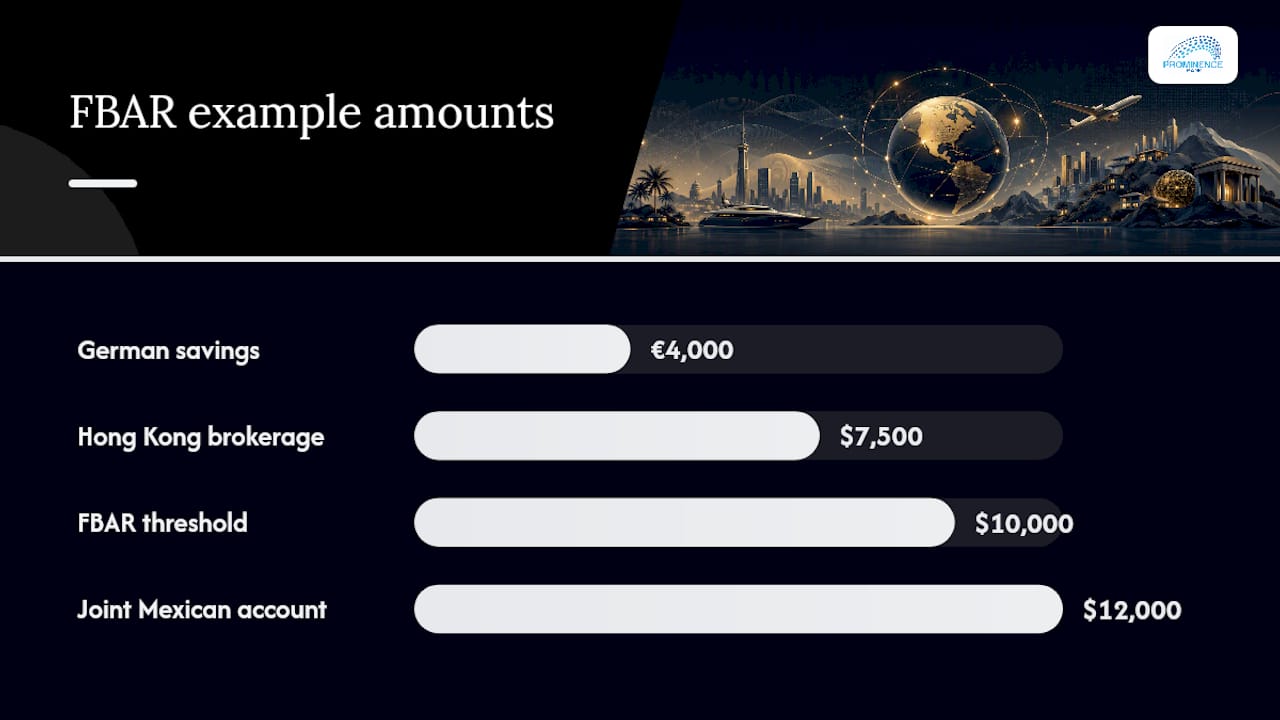
Valuation runs on the account’s maximum value during the year, translated to U.S. dollars using the Treasury’s year-end exchange rate, even if the peak balance occurred mid-year in a different currency. Say you hold €4,000 in a German savings account and $7,500 in a Hong Kong brokerage account. Neither alone hits $10,000, but combined they clear the threshold, and both accounts must appear on the same FBAR. Joint ownership doesn’t split the calculation either. If you and your sibling jointly hold a Mexican account worth $12,000, both of you individually report the full $12,000, not $6,000 each.
How Do You File FinCEN Form 114?
FBAR filing happens entirely outside the tax return process. This trips up more people than any other part of the rule: attaching account disclosures to a Form 1040 accomplishes nothing. The FBAR is a standalone electronic submission to FinCEN, filed through the BSA E-Filing System. Individuals can file directly without registering as an institution; paid preparers filing on behalf of clients must register as BSA e-filers first.
For each account, gather:
- Name on the account and account number
- Foreign bank’s name and complete address
- Account type (deposit, custodial, brokerage, or other)
- Maximum value reached during the calendar year
FinCEN’s line item filing instructions spell out exactly how each field should be completed, down to formatting foreign addresses correctly. Amended FBARs use the same BSA E-Filing System; check the amended box and explain what changed.
Pro Tip: Pull twelve months of statements before you start the form, not just the year-end balance. Missing a mid-year spike in an account you thought stayed low is the single most common reason FBARs get amended later.
When Is the FBAR Due?
The FBAR deadline is April 15, matching the individual tax return date, but FinCEN grants an automatic extension to October 15 with no application required. You don’t file Form 4868 or send FinCEN a request. The extension applies automatically to everyone.
If records are still incomplete as October 15 approaches, don’t wait for perfect information:
- File the most complete report possible by the deadline using your best available data
- Amend the FBAR once missing figures arrive, since amending after a good-faith initial filing supports a reasonable-cause argument if questions arise later
- Keep every record for five years from the filing date, since that window covers both routine follow-up and most remediation timelines
What Are the FBAR Penalties, and How Did Bittner Change Them?
Penalty exposure hinges entirely on one word: willful. Non-willful violations carry a civil penalty up to $16,536 per report, inflation-adjusted and assessed once per filing year rather than once per account.
The Supreme Court’s 2023 ruling in Bittner v. United States settled a circuit split by holding that non-willful penalties apply per FBAR report filed, not per individual foreign account omitted. For a taxpayer with fifteen small unreported accounts, that distinction can mean one $16,536 penalty instead of fifteen.
That single change, analyzed in detail by the University of Illinois Tax School, meaningfully reduced worst-case exposure for people who scattered small balances across multiple foreign institutions rather than consolidating them.
Willfulness itself isn’t defined by a single bright line. Examiners look at patterns: did you check “no” on the foreign account question on Schedule B for multiple years running? Did you move funds specifically to stay under reporting radar? Did a preparer ask directly about foreign accounts and get a false answer? Tax attorneys who litigate these cases describe willfulness as the central battleground in almost every contested FBAR matter, because the dollar gap between the two classifications is enormous.
One more detail matters for anyone with older unfiled years: the statute of limitations for FBAR penalty assessment runs six years from the original due date. Mapping which years remain open is usually the first practical step before choosing a remediation path.
How Do You Fix Missed FBAR Filings?
Discovering you should have filed FBARs in prior years isn’t rare, and the IRS built several structured paths for fixing it. Choosing the right one depends mostly on whether the underlying income was reported and taxed correctly.
- Delinquent FBAR Submission Procedures. Appropriate when you reported and paid tax on all foreign income correctly but simply never filed the FBAR itself. You file the missed FBARs electronically with a brief statement explaining the reason for the late filing, and typically no penalty follows if income was fully reported.
- Streamlined Filing Compliance Procedures. Designed for non-willful failures that also involve unreported foreign income. The domestic version requires a 5% miscellaneous offshore penalty on the highest aggregate account balance; the offshore version, for those living abroad, waives that penalty entirely. Both require amended returns for the covered years plus a certification of non-willful conduct.
- Voluntary Disclosure Practice (VDP). The route for situations involving potential willfulness or where criminal exposure is a real concern. VDP trades a structured penalty framework for protection against criminal referral, assuming the disclosure happens before the IRS opens its own investigation.
Whichever path fits, the sequence stays the same: assemble every account record you can find, determine which years remain open under the six-year window, select the matching procedure, then file the FBARs and any amended returns together with a clear, honest reasonable-cause statement. Tax professionals generally steer straightforward cases toward Delinquent Submission first, reserving Streamlined and VDP for cases with real income gaps.
What Records Should You Keep for FBAR Compliance?
FinCEN expects five years of supporting documentation from the FBAR filing date, and the specific paperwork matters more than people assume during an audit.
- Year-end and peak-balance statements for every foreign account
- Correspondence with the foreign institution confirming account numbers and ownership
- Records showing how you calculated each account’s maximum value in USD
- Proof that related income was reported on your tax return, where applicable
Determining maximum value takes some care. Pull monthly or quarterly statements rather than relying on memory, identify the single highest balance point in the account’s local currency, then convert using the Treasury’s year-end exchange rate for that currency. Documentation showing this math, rather than a rounded estimate, is often what separates a clean reasonable-cause defense from a contested one. Clients managing multiple entity structures should also keep parallel records tied to any offshore custody account statements, since custodial account documentation tends to be scattered across more parties than a standard deposit account.
FBAR vs Form 8938: What’s the Difference?
FBAR and Form 8938 get confused constantly, and filing one doesn’t excuse you from the other. They’re separate systems built for separate agencies. FinCEN Form 114 goes to FinCEN electronically through BSA E-Filing; Form 8938 attaches directly to your IRS tax return.
- Threshold: FBAR triggers at $10,000 aggregate for everyone; Form 8938 thresholds start at $50,000 and scale up to $600,000 depending on filing status and whether you live in the U.S. or abroad.
- Scope: Form 8938 covers a broader category called “specified foreign financial assets,” which includes certain foreign stock and interests not held in an account.
- Overlap: Many filers who clear the FBAR threshold also clear the Form 8938 threshold and must file both, each with its own line items and its own agency.
When account values sit anywhere near either threshold, check both rule sets rather than assuming one filing covers the other.
A Publisher’s Perspective on Compliance-Ready Offshore Banking
Most FBAR trouble doesn’t start with bad intentions. It starts with disorganized records: an account statement that never made it into a folder, a maximum balance nobody tracked, a joint account nobody remembered to mention to their preparer. Prominencebank builds account access around that reality, giving clients clean, exportable statements and clear ownership documentation rather than scattered paper trails…
— Harold
How Prominencebank Supports Compliant Offshore Banking
Keeping FBAR filings accurate starts with knowing your maximum balance for every account, every year, in the right currency. That’s the exact place most offshore account holders lose time: chasing down statements from an institution that isn’t built for U.S. reporting standards. Prominencebank issues clear, exportable account statements and maintains straightforward ownership documentation from day one, so pulling together what your preparer needs doesn’t turn into a research project.

Prominencebank’s multi-currency account structure also simplifies the USD valuation work FBAR requires, since balances across currencies are visible in one place rather than buried across separate institutions. None of this substitutes for tax advice. Prominencebank helps you manage documented, transparent accounts; it doesn’t file your FBAR or tell you which remediation path fits your situation; that decision belongs with a qualified tax attorney or CPA. If organized offshore banking is what you’re after, start by reviewing how account setup works step by step.
This article is general information, not a substitute for advice from a qualified financial advisor. Consult a qualified financial professional about your own circumstances before acting on anything here.
Sources
- Report of Foreign Bank and Financial Accounts (FBAR) | Internal Revenue Service
- Report Foreign Bank and Financial Accounts | Financial Crimes Enforcement Network
FAQ
Do I need to report a foreign bank account under $10,000?
Only if your combined foreign accounts exceed $10,000 at any point in the year; a single account under that amount still counts toward the aggregate total across all your foreign accounts.
What happens if I have more than $100,000 in a foreign bank account?
The FBAR filing requirement itself doesn’t change above $10,000, though larger balances often trigger Form 8938 reporting to the IRS as well, since that form’s thresholds scale up with account value and filing status.
Can the IRS see offshore accounts?
Yes. Financial institutions in most countries report U.S.-linked account information to the IRS under FATCA agreements, and many jurisdictions also exchange data through the Common Reporting Standard, so undisclosed offshore accounts are increasingly visible to U.S. tax authorities.
Which foreign accounts count for FBAR purposes?
Foreign deposit and savings accounts, brokerage and custodial accounts, certain foreign life insurance or annuity contracts with cash value, and equity or debt interests in foreign financial institutions all count toward the $10,000 threshold.
How is FBAR different from FATCA or Form 8938?
FBAR (FinCEN Form 114) is filed electronically with FinCEN and triggers at $10,000 aggregate, while FATCA’s Form 8938 is filed with your IRS tax return and uses higher thresholds starting at $50,000, meaning many filers owe both.
Recommended
- Offshore Financial Services: Your 2026 Decision Guide
- FinCEN BOI Reporting: What You Must Know in 2026
- How to open an offshore bank account: step-by-step guide
- Offshore Asset Protection Techniques: A 2026 Guide