
Source of funds proof is documentation that traces the specific money behind a transaction back to a legitimate origin, such as employment income, a property sale, or an inheritance. Most requests can be satisfied with a combination of bank statements, pay slips or tax returns, and the sale or settlement paperwork tied to the transaction. The immediate move: pull those documents together and ask the requesting institution exactly which formats and date ranges it needs before you submit anything.
TL;DR:
- Large or cross-border transactions increase the likelihood of a comprehensive source of funds request, often requiring detailed, layered documentation to prove legitimacy.
- Acceptable proof includes recent bank statements, signed sale agreements, inheritance documents, or gift letters, all connected with supporting explanation and proper notarization if needed.
- Inconsistent names, missing signatures, undated documents, or unexplained large deposits are common red flags that slow verification or cause rejection.
- Proof-of-funds letters from banks should specify exact amounts, currencies, and purposes to avoid delays, especially for high-value deals or layered ownership structures.
- Automated tools handle routine salary or savings verifications, but complex entities or cross-border deals benefit from professional review to ensure compliance and accuracy.
Table of Contents
- What Is Source of Funds (SOF)?
- Examples of Acceptable Documents That Prove Source of Funds
- Source of Funds vs Source of Wealth: What’s the Difference?
- Why Source-of-Funds Checks Matter for AML and KYC Compliance
- How to Prepare and Submit Credible Source-of-Funds Proof
- Common Red Flags and Mistakes That Slow or Fail Verification
- Best Practices for Businesses and High-Net-Worth Individuals
- Automation, Verification Tools, and When to Bring in Professional Support
- Legal Regulations and Jurisdictions Governing Source of Funds Proof
- Handling Source of Funds Proof Across Different Transaction Types
- Privacy and Data Protection When Submitting Source-of-Funds Proof
- What Happens When Source-of-Funds Documentation Is Missing or Inadequate
- How to Dispute or Resolve Discrepancies in Source-of-Funds Verification
- Publisher Perspective: How Prominence Bank Approaches Source-of-Funds Proof
- Getting Proof of Funds Right With Prominence Bank
- Sources
- FAQ
What Is Source of Funds (SOF)?
Source of funds refers to the origin of the specific money used in a particular transaction, not just proof that you currently hold cash in an account. A bank statement showing $50,000 tells a compliance officer nothing about where that $50,000 came from. SOF documentation closes that gap by connecting the deposit to a real economic event: a salary payment, a business sale, an inheritance, or investment proceeds.
This sits at the center of Know Your Customer (KYC) and Customer Due Diligence (CDD) programs, which banks and other regulated entities run to satisfy anti-money laundering (AML) obligations. When you open an account, wire a large sum, or close on a property, the institution has a legal duty to understand where your money originated, not merely that you possess it.
Financial institutions don’t apply the same scrutiny to every client. They use a risk-based approach, meaning the depth of the SOF request scales with the perceived risk of the transaction and the person involved.
Common triggers for a deeper SOF request include:
- A transaction value well above your typical account activity
- Funds arriving from a jurisdiction flagged for weak AML controls
- Cash-intensive business ownership, where income is harder to trace on paper
- Third-party payments, where the money doesn’t come from the account holder directly
- Politically exposed person (PEP) status or complex ownership structures
A first-time home buyer wiring a down payment from a single paycheck-funded savings account faces a light touch. A business owner moving proceeds from an overseas subsidiary faces a much longer document list.
Examples of Acceptable Documents That Prove Source of Funds
The right document depends entirely on how the money was earned or acquired. Acceptable evidence for verifying source of funds generally falls into a handful of categories, and most verifiers want you to layer more than one document per source.
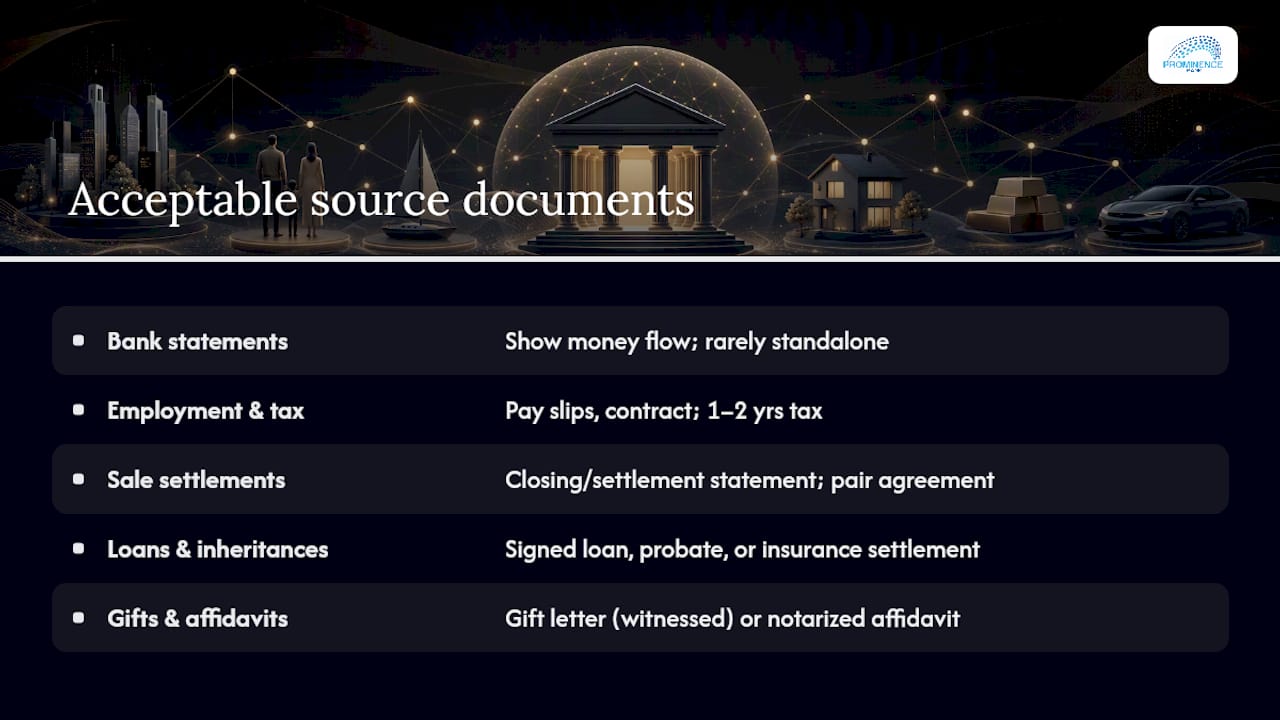
Bank statements. These show the flow of money into your account but rarely stand alone as proof of origin. Institutions typically want a few months of statements for routine transactions, with longer histories requested for larger or higher-risk transfers. Highlight or annotate the specific deposits that relate to the transaction so the reviewer doesn’t have to hunt for them.
Pay slips, employment contracts, and tax returns. For salary-funded transactions, recent pay slips paired with an employment contract and the last one to two years of tax returns build a credible income trail. Self-employed applicants should lean harder on tax filings since pay slips don’t exist in the same form.
Sale or purchase agreements and settlement statements. If the money came from selling a property, business, or investment, the closing or settlement statement showing the sale price and disbursement is the strongest single document you can provide. Pair it with the original purchase agreement if the asset was bought and later resold.
Loan agreements, inheritance paperwork, and insurance payouts. A signed loan agreement from a regulated lender, a grant of probate or will alongside an estate distribution letter, or an insurance settlement notice each work well when the underlying paperwork clearly names you as the recipient.
Gift letters with witnessing. When a relative gives you money for a down payment or large purchase, a signed gift letter stating the relationship, amount, and that no repayment is expected, ideally witnessed or notarized, is standard. Pair it with the giver’s own bank statement showing the funds leaving their account.
Notarized affidavits or statutory declarations. Some jurisdictions accept a sworn statement when documentary evidence is thin, such as cash savings accumulated over years. Verifiers usually treat this as a last resort and will still expect supporting bank activity where possible.
Pro Tip: Never submit a document in isolation. A bank statement plus the contract or letter that explains the deposit tells a complete story; the statement alone just raises more questions.
Source of Funds vs Source of Wealth: What’s the Difference?
Source of funds and source of wealth answer two different questions. SOF asks: where did the money for this specific transaction come from? Source of wealth (SOW) asks: how did you build your overall net worth over your lifetime?
You’ll be asked for SOW in a narrower set of circumstances:
- High-net-worth account opening, where the institution needs to understand your total financial profile
- Complex ownership structures involving trusts, holding companies, or multiple entities
- Enhanced due diligence (EDD) cases, typically triggered by PEP status or high-risk jurisdictions
SOF documentation tends to be transaction-specific: one contract, one set of statements, one clear trail. SOW documentation is broader and more narrative, often including career history, prior business sales, investment portfolios, and multi-year tax records. If you’re preparing a source of wealth declaration, expect the reviewer to want a coherent life story behind the money, not just a single paper trail. Verifiers usually request SOW as an addition to SOF, not a replacement for it.
Why Source-of-Funds Checks Matter for AML and KYC Compliance
Regulators require these checks because unverified money flows are how criminal proceeds get laundered into the legitimate financial system. The FATF recommendations set the international, risk-based AML standard that most national regulators build their own rules around, which is why a bank in one country asks for nearly the same categories of proof as a bank on the other side of the world.
The risk-based approach means low-risk clients face a light document request while higher-risk profiles get real scrutiny. A cash-heavy business, a client in a high-risk jurisdiction, or a transaction that doesn’t match a person’s known profile will draw more questions and more layers of proof.
Insufficient evidence rarely means an outright rejection on the first attempt. More often, it means delays. An institution flags the file for enhanced due diligence, requests additional documents, or places a temporary hold on the transaction while it works through the file. In real estate closings and large wire transfers, that delay can cost you a deal if a deadline passes while paperwork is still being chased down.
The goal isn’t to assemble a stack of paper. It’s to build an auditable chain of evidence that a compliance officer can follow from the original economic event straight through to the balance in front of them, with the granularity of that chain scaled to the transaction’s risk level.
How to Prepare and Submit Credible Source-of-Funds Proof
Getting this right the first time saves weeks. Here’s the order that works.
-
Clarify the exact request. Ask the counterparty or institution for a specific document list rather than guessing. Requirements vary by transaction type, jurisdiction, and risk tier, and submitting the wrong format wastes everyone’s time.
-
Collect primary documents first. Gather the paperwork that shows the original economic event: an employment contract, a signed sale agreement, a probate grant, a loan contract. These anchor everything else.
-
Add supporting documents that connect the dots. Bank statements, wire confirmations, and settlement statements should visibly link the primary document to the money currently in your account. If there’s a gap in the timeline, expect it to get flagged.
-
Write a short cover explanation. A one-page summary walking through the chain of funds, with transaction references and a contact person (an accountant or bank officer) who can answer follow-up questions, speeds up review considerably.
-
Translate and notarize where required. Documents not in the receiving institution’s working language typically need certified translation, and some jurisdictions require notarization for foreign-issued paperwork.
-
Redact sensitive but irrelevant data. Account numbers unrelated to the transaction, unrelated transaction history, and personal details not requested can usually be blacked out without weakening your case.
For business-derived income, reviewers want more than a company account balance. They expect documented capacity and a legal transfer path, meaning audited financial statements, invoices supporting the revenue, evidence of a formal distribution or dividend, and a clear intercompany transfer trail if the money moved between entities before reaching you personally.
If you need a formal proof of funds letter, request it directly from your bank in writing, specifying the exact balance, currency, and purpose. Processing typically takes one to several business days depending on the institution’s internal verification process, so request it well before any closing deadline.
Pro Tip: Request your proof-of-funds letter the moment you have a signed contract or accepted offer, not the week of closing. Banks that need to verify internal balances against multiple accounts can take longer than you expect.
Common Red Flags and Mistakes That Slow or Fail Verification
A handful of recurring errors account for most delayed or rejected SOF submissions.
- Bank statements with no supporting explanation. A large deposit with no contract, invoice, or letter behind it looks suspicious even when the money is perfectly legitimate.
- Temporary or third-party funding used just to pad a balance. Borrowing money briefly to show a healthier account, then repaying it right after, is a classic red flag that experienced reviewers catch quickly.
- Inconsistent names across documents. If the sale agreement names a trust, the bank account is personal, and the tax return lists a different legal entity, expect the file to get held for clarification.
- Undated or unsigned documents. A gift letter without a signature or a settlement statement missing a closing date carries little weight, regardless of how accurate the numbers are.
Most of these come down to one thing: the paper trail has a gap somewhere between the original event and the money sitting in the account today. Close that gap before you submit, not after someone asks about it.
Best Practices for Businesses and High-Net-Worth Individuals
A little structure now prevents a lot of friction later.
- Keep an ongoing, auditable trail of contracts, invoices, and receipts for any large or recurring money movement, rather than reconstructing it after the fact.
- Use a standardized template for gift letters and distribution documentation so every family transfer or business payout looks consistent and complete.
- File taxes on time and keep audited accounts current if your business is subject to audit requirements. A one-year gap in filings is one of the most common reasons a SOF file stalls.
- Loop in your bank’s relationship manager early on complex or cross-border transactions. A confidential business account manager who understands the deal before documents arrive can flag issues before they become delays.
Pro Tip: If you know a large transaction is coming in six months, start the paper trail now. Verifiers trust a document created at the time of the event far more than one assembled retroactively.
Automation, Verification Tools, and When to Bring in Professional Support
Automated bank-connection tools can speed up low-risk verifications by pulling statement data directly and flagging obvious gaps, which works fine for routine transactions with a clean, single-source income history.
- Straightforward salary-to-savings transactions are usually well suited to automated checks.
- Complex ownership structures, trusts, or cross-border business income almost always benefit from an accountant or AML specialist reviewing the file before submission.
- Formal letters and balance confirmations still require a human at the issuing bank to sign off. No automated tool replaces that.
Legal Regulations and Jurisdictions Governing Source of Funds Proof
There’s no single global law that dictates exactly which documents satisfy a SOF request. Instead, most countries build their domestic AML regulations around the FATF’s 40 Recommendations, which set out a risk-based framework rather than a rigid checklist. That’s why a bank in the United States, a notary in the United Kingdom, and a real estate agency in the United Arab Emirates ask for broadly similar categories of proof even though their specific legal codes differ.
In the United States, obligations flow through the Bank Secrecy Act and related FinCEN rules, which require financial institutions to maintain CDD programs and file reports on suspicious activity. In the European Union, the Anti-Money Laundering Directives set comparable obligations for banks, real estate professionals, and other “obliged entities.” Many offshore and international financial centers, including licensed digital banks operating under specialized regulatory frameworks, mirror these same FATF-derived standards to maintain correspondent banking relationships and cross-border credibility.
The practical takeaway: regulation sets the why and the general risk categories, but the what (which specific documents) is usually determined by the individual institution’s compliance policy, tailored to the transaction type and jurisdiction involved. When in doubt, the safest approach is asking your counterparty which framework governs their request and matching your documentation to that standard rather than assuming one country’s rules apply everywhere.
Handling Source of Funds Proof Across Different Transaction Types
The document mix that satisfies a real estate closing looks different from what an investment platform or a large purchase counterparty expects.
Real estate. Closing agents and lenders typically want a proof-of-funds letter alongside bank statements covering the deposit and down payment, plus the source documentation behind any large, unexplained deposit made in the months before closing. Lenders often review bank statements directly as part of underwriting, which is why unexplained deposits close to a mortgage application routinely trigger extra questions.

Investment accounts. Brokerages and wealth managers opening a new account for a large initial deposit generally want to see the originating account statements and, for amounts well above your typical trading activity, documentation of the underlying income or sale event.
Large purchases (yachts, aircraft, art, luxury vehicles). Sellers and their banks in these categories often request the same core package as real estate: a proof-of-funds letter, statements showing the funds sitting in the account, and the origin documentation if the money arrived recently from an external source.
Across all three, the pattern holds: the bigger and less routine the transaction, the more the verifier wants to see the full chain rather than just a snapshot balance.
Privacy and Data Protection When Submitting Source-of-Funds Proof
Source-of-funds documents are some of the most sensitive paperwork you’ll ever hand to a third party. Bank statements, tax returns, and gift letters reveal account numbers, income levels, and family financial details that have no business circulating beyond the people who legitimately need to review them.

Before submitting anything, redact information the request doesn’t actually require, such as unrelated transaction history or account numbers not tied to the transaction in question. Confirm how the receiving institution stores and eventually disposes of the documents, and ask whether the file will be shared with any third party beyond the immediate compliance team.
Reputable institutions apply strict data protection standards to KYC files precisely because the documents are so sensitive, and a bank built around discretion and confidential account structures treats that documentation with the same level of protection it applies to the account itself. If a counterparty can’t explain how it safeguards submitted documents, that’s worth pausing over before you send anything.
What Happens When Source-of-Funds Documentation Is Missing or Inadequate
Incomplete SOF paperwork rarely kills a transaction outright, but it reliably slows it down, and in time-sensitive deals that delay can be just as damaging as an outright refusal.
The most common consequence is a request for enhanced due diligence, which means more documents, more explanation, and in many cases a temporary hold on the account or transaction until the file clears. In real estate, that can mean missing a closing date. In business banking, it can mean a wire transfer sitting frozen for days while compliance officers work through the gap.
In more serious cases, especially where the funds can’t be explained at all or the explanation doesn’t hold up, institutions can decline to proceed with the transaction, close an account, or file a suspicious activity report with the relevant financial intelligence unit. None of that requires wrongdoing on your part. It simply means the paper trail wasn’t strong enough to clear the bar the institution is legally required to meet.
How to Dispute or Resolve Discrepancies in Source-of-Funds Verification
Discrepancies usually come down to one of a few fixable issues: a name mismatch across documents, a date that doesn’t line up with the transaction timeline, or a gap between two records that should connect but don’t.
Start by asking the institution exactly what triggered the flag rather than resubmitting the same file and hoping it clears. Most compliance teams will tell you which specific document or data point raised the question if you ask directly. From there, supply a targeted clarification, an updated document, a signed explanation letter, or a corrected version of the mismatched record, rather than a full resubmission of everything.
If the institution’s decision still doesn’t make sense after that exchange, ask for the matter to be escalated to a senior compliance officer or relationship manager, since front-line staff often have less flexibility to interpret borderline cases. Keep a written record of every document you submit and every response you receive. If a dispute drags on and money is at stake, involving an accountant or legal advisor who can speak the compliance team’s language often resolves things faster than continued back-and-forth on your own.
Publisher Perspective: How Prominence Bank Approaches Source-of-Funds Proof
Prominence Bank verifies account holder balances directly and issues proof-of-funds letters as part of standard client servicing, distinct from a general comfort letter that only confirms a relationship exists. Turnaround runs faster when clients supply the exact amount, currency, and purpose upfront. For layered ownership structures or cross-border transfers, our team recommends reaching out before a deadline looms.
— Harold
Getting Proof of Funds Right With Prominence Bank
Assembling a clean, verifiable source-of-funds file is a lot easier when your banking relationship is built for it from the start. Prominence Bank issues proof-of-funds letters directly tied to a specific balance and currency, not a vague relationship confirmation, and our multi-currency accounts mean cross-border clients don’t have to juggle separate banks just to show funds in the right denomination for a transaction.
For clients with layered ownership structures or frequent large transactions, our KTT-enabled accounts and document issuance services are built to keep the paper trail clean from day one rather than scrambled together under deadline pressure. If you need a proof-of-funds letter for a closing, an investment, or a large purchase, set up an international account with Prominence Bank and request your letter directly through your relationship manager, specifying the exact amount and purpose so it’s ready when you need it.
Sources
The guidance above draws on international regulatory standards and practitioner-facing resources so readers and compliance teams can verify the details independently.
- What Is Proof of Funds? How to Get a Proof of Funds Letter
- Verify source of funds & source of wealth in AML
- What Is a Bank Comfort Letter and How Does It Work?
- FATF recommendations
FAQ
How do I prove my source of funds?
Gather documents showing where the money originated (pay slips, tax returns, a sale agreement, or inheritance paperwork) and pair them with bank statements that show the money moving into your account, so the reviewer can trace the full chain.
What is source of funds proof?
It’s documentation confirming the specific origin of the money used in a transaction, rather than just showing that you currently hold the funds in an account.
What qualifies as proof of funds?
A formal proof of funds letter from your bank confirming a specific balance and currency typically qualifies, along with recent bank statements showing that balance is available and liquid.
What documents can you use as proof of funds?
Bank statements, employer pay slips, tax returns, sale or settlement statements, loan agreements, and inheritance documentation are the most commonly accepted forms, depending on the transaction and the risk profile involved.
Does a bank comfort letter count as proof of funds?
Generally, no. A bank comfort letter confirms that an account relationship exists but usually doesn’t verify a specific available balance, while a proof-of-funds letter confirms that exact amount, which most transaction counterparties require.
Recommended
- Bank Document Endorsements: A U.S. Institutional Guide
- Source of Wealth Declaration: Complete Guide for Individuals
- MSB Banking Requirements: A Bankability Checklist for 2026
- Data Residency in Banking: An Auditor-Ready Architecture Guide