
To open and keep a bank account as a money services business, you need three things in place before you ever fill out an application: FinCEN registration, a written risk-based BSA/AML program, and a documented bankability evidence pack that proves both. Skip any one of them and expect either a rejection letter or, worse, an account closure eight months in.
Start here:
- File FinCEN Form 107 if you haven’t already, within 180 days of establishing your MSB.
- Designate a BSA compliance officer by name, in writing, with documented authority.
- Draft your AML policy with thresholds tied to your actual projected transaction volume, not a generic template.
- Build a flow-of-funds diagram that shows where money enters, moves, and exits your business.
- Assemble your monitoring rule set and sample alert dispositions before a bank ever asks for them.
Registering with FinCEN is the floor, not the ceiling. Banks routinely decline MSBs that are fully registered but can’t produce a coherent control environment on paper. The forms that matter most going forward: FinCEN Form 107 (registration), FinCEN Form 112 (Currency Transaction Report), FinCEN Form 111 (Suspicious Activity Report), filed through the BSA E-Filing System, all governed by 31 CFR Part 1022.
Key Takeaways
Bankability for an MSB comes down to three things done well: FinCEN registration, a risk-based BSA/AML program, and a documented evidence pack that proves both are real.
| Point | Details |
|---|---|
| Register and renew on time | File FinCEN Form 107 promptly after establishment and renew periodically to avoid civil or criminal penalties. |
| Build a risk-based AML program | Cover all four pillars: compliance officer, written policies, training, and independent testing tied to your actual risk profile. |
| Meet CTR and SAR thresholds | File Form 112 above $10,000 in cash transactions and Form 111 for suspicious activity, both through the BSA E-Filing System. |
| Assemble a bankability evidence pack | Present licenses, a flow-of-funds diagram, monitoring rule sets, and volume forecasts before applying, not after a request. |
| Consider a compliance-aware partner | Prominencebank offers multi-currency and corporate banking solutions built for businesses with complex, regulated operating profiles. |
Table of Contents
- MSB Banking Requirements: FinCEN Registration, Renewals, and Penalties
- What Are the BSA/AML Program Requirements for MSBs?
- What Are the CTR and SAR Reporting Requirements for MSBs?
- The MSB Bankability Checklist: What Banks Actually Want to See
- Why Do Banks Decline or Close MSB Accounts?
- Keeping the Relationship: Monitoring, Renewals, and Bank Communication
- How Prominencebank Supports Compliance-Ready MSBs
- Where to Find the Forms and Guidance You’ll Need
- Sources
- FAQ
MSB Banking Requirements: FinCEN Registration, Renewals, and Penalties
Most money services businesses must file FinCEN Form 107 within 180 days of the date they’re established. That includes money transmitters, check cashers, currency dealers or exchangers, issuers or sellers of traveler’s checks or money orders, and providers of prepaid access, with narrow carve outs for certain agents.
Registration isn’t a one-time event. You have to renew it every 24 months, and the renewal window sneaks up faster than most operators expect. A lot of MSBs treat the first registration as the finish line, then miss the renewal because nobody owns the calendar reminder. Build that date into your compliance calendar the day you file, not the month before it’s due.
The penalties for skipping registration aren’t theoretical. Civil penalties run up to $5,000 per violation per day, and criminal exposure exists for willful noncompliance. That’s a running clock, not a flat fine, so a missed registration that sits unresolved for months compounds fast.
If you operate strictly as an agent of another registered MSB, you may be exempt from independently registering. That exception gets misapplied constantly, usually by businesses that assume a loose partnership counts as an agent relationship. Document any exemption claim with a written legal opinion, because a bank’s compliance team will ask for one, and “we assumed we didn’t need to register” is not an answer that keeps an account open.
Pro Tip: Keep a signed copy of your Form 107 confirmation and your renewal history in the same folder as your AML policy. When a bank’s onboarding team asks for proof of registration, response speed matters almost as much as the answer itself.
For a broader look at how federal registration obligations intersect with entity structure, see this breakdown of FinCEN BOI reporting requirements.
What Are the BSA/AML Program Requirements for MSBs?
Every MSB must build its compliance program around four pillars, spelled out in 31 CFR §1022.210: a designated compliance officer, written policies and internal controls, ongoing employee training, and independent testing. The program has to be risk-based, meaning its intensity scales with your transaction volume, product mix, and geographic exposure, not a copy-pasted template pulled off a compliance vendor’s website.
Banks reviewing your file will drill into specific control areas, including:
- Customer due diligence and beneficial ownership identification
- Sanctions and politically exposed person (PEP) screening
- Transaction monitoring rules calibrated to your actual corridors
- Vendor oversight for any third-party screening or processing tools
- Record retention practices covering both customer files and transaction logs
Scoping this correctly means matching your control intensity to your risk profile. A check casher processing a few hundred transactions a month doesn’t need the same monitoring architecture as a money transmitter running high-volume corridors into higher-risk jurisdictions. The MSB Association’s best practices guidance recommends treating these four pillars as your baseline, then layering additional controls where your specific risk profile demands them.
For each pillar, document who owns it, how often it’s reviewed, and what evidence proves it’s functioning, not just that it exists on paper.
Pro Tip: Make your AML policy “bank-grade” by tying every monitoring threshold to a number a reviewer can sanity-check against your projected volumes and corridors. A threshold with no math behind it reads as a placeholder, and experienced underwriters spot placeholders instantly.
What Are the CTR and SAR Reporting Requirements for MSBs?
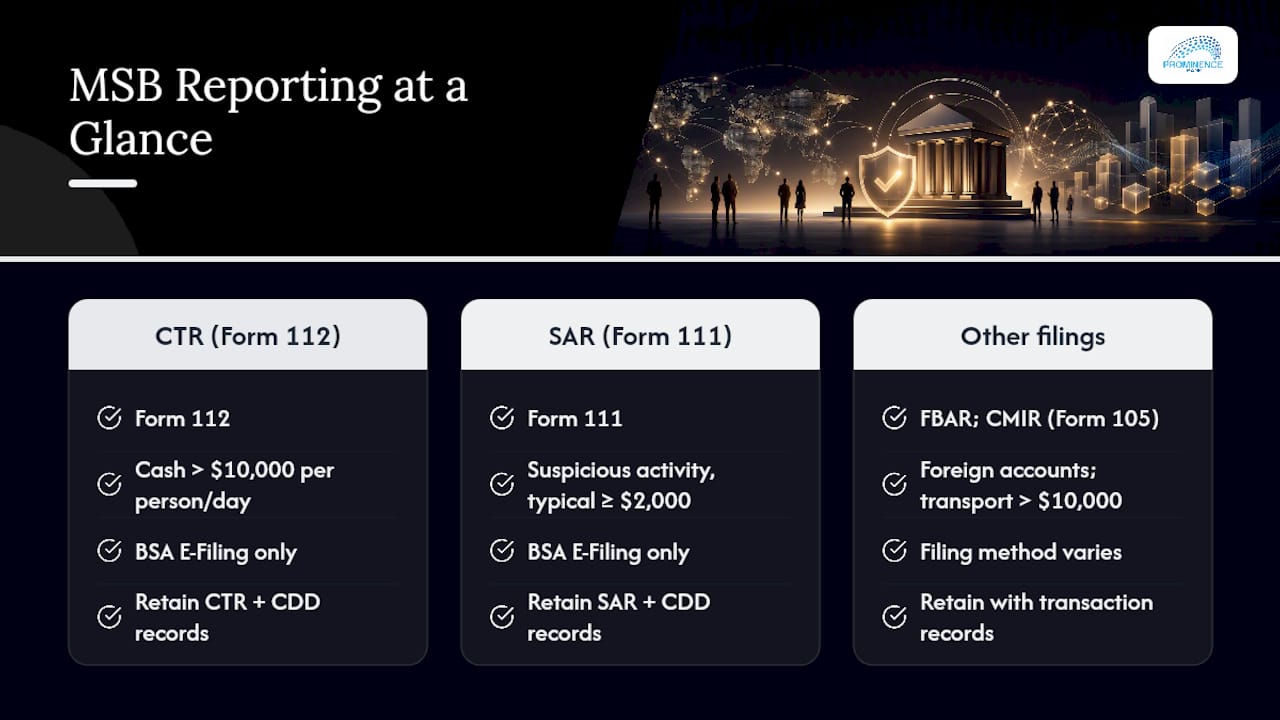
Two forms drive most MSB reporting obligations. You must file a Currency Transaction Report (FinCEN Form 112) for any cash-in or cash-out transaction exceeding $10,000 by one person in a single business day. You must file a Suspicious Activity Report (FinCEN Form 111) for transactions or patterns of activity that raise red flags, generally at or above $2,000 for MSBs, though the threshold and triggers vary by activity type under FinCEN’s SAR guidance.
Every one of these filings has to go through the BSA E-Filing System. There’s no paper alternative and no workaround, so if your team isn’t already set up with e-filing credentials, that’s a same-week task, not a someday task.
Depending on your operations, you may also face additional obligations: an FBAR for foreign financial accounts, or a Currency and Monetary Instrument Report (Form 105) if you’re physically transporting more than $10,000 in currency across U.S. borders. The IRS MSB information center walks through how these obligations stack depending on your specific business model.
Recordkeeping matters just as much as the filings themselves. Keep CTR and SAR records, along with the underlying customer due diligence documentation, organized in a repository that can serve two audiences at once: your bank’s due diligence questionnaire and a regulator’s examination request. Structure that repository by transaction type and date range from day one, because rebuilding it retroactively under exam pressure is where most compliance teams lose weeks.
The MSB Bankability Checklist: What Banks Actually Want to See
Regulatory compliance gets you in the room. A complete evidence pack gets you an approved account. Here’s the order most banks work through during onboarding:
- Licenses and registrations — your state money transmitter licenses (if applicable) and FinCEN Form 107 confirmation.
- AML program summary — a document a non-specialist reviewer can read in ten minutes and understand your control structure.
- Flow-of-funds diagram — a visual map of how money enters, moves through, and exits your business.
- Monitoring rule sets and sample alert dispositions — proof your system generates alerts and someone actually reviews them.
- Projected volumes and average ticket sizes — the numbers your thresholds are supposed to be built around.
- Beneficial ownership statements — who actually controls the business, not just who’s listed on the license.
- Vendor and screening contracts — evidence your sanctions and PEP screening tools are licensed and active.
- Independent audit report and training logs — proof the program has been tested and staff have been trained.
Your flow-of-funds diagram deserves particular attention. Annotate every control point: where KYC happens, where screening triggers, where monitoring flags activity, and where a human reviews an alert before funds move. A diagram without annotated control points reads as a marketing graphic, not a compliance artifact, and bank reviewers know the difference immediately.
Banks typically formalize this request through a due diligence questionnaire (DDQ) or request for information (RFI), and the documents they ask for during onboarding rarely deviate much from the list above.
Pro Tip: Sequence your outreach deliberately. Start with community banks or providers with existing MSB experience, and arrive with a completed evidence pack rather than a promise to send documents later, leveraging AI outbound for financial services strategies to enhance your outreach effectiveness. Reviewers move faster on a complete file than a partial one they have to chase.
Why Do Banks Decline or Close MSB Accounts?
Most account declines and closures trace back to a small set of recurring problems, and each one has a fix.
Inconsistent documentation across your license filings, AML policy, and bank application signals disorganization before a reviewer even reaches your risk profile. Fix it by running every document through a single owner before submission.
Unexplained corridor flows (transactions to jurisdictions or counterparties your stated business model doesn’t account for) are one of the fastest paths to a closure notice. Document the business justification for every corridor you operate in.
Weak or unjustified monitoring thresholds are, according to implementation guidance from the CSBS, the single most common onboarding failure. Rebuild thresholds using actual projected volume data, not round numbers pulled from a template.
Missing independent testing or missing state licenses for corridors you actively serve are both immediate red flags. Get the audit done, get the license filed, before you apply, not after.
The underlying issue in most declines is a bankability narrative that doesn’t hold together. Every document you submit should tell the same story about your business. When your license says one thing, your AML policy implies another, and your flow-of-funds diagram shows a third, reviewers stop trusting the whole file.
Keeping the Relationship: Monitoring, Renewals, and Bank Communication
Getting the account open is half the job. Keeping it requires the same discipline on an ongoing schedule:
- Review transaction-monitoring rules regularly and adjust as volume or corridors shift.
- Run independent testing at least annually, more often if your risk profile is elevated.
- Refresh staff training on a recurring cadence, not just at hire.
- Track your FinCEN renewal date and file well before the 24-month mark closes.
Banks expect periodic check-ins even after approval: updated volume forecasts, notice of material changes like a new corridor or a new business partner, recent audit summaries, and evidence that any prior remediation items were actually closed out.
- Assign one internal owner for all bank communications, so requests don’t fall through the cracks between departments.
- Prepare a quarterly summary pack covering volume trends, monitoring outcomes, and any policy updates.
- Escalate to senior management immediately if a bank flags a material concern. Silence reads worse than an imperfect answer.
The CSBS self-assessment framework treats independent review as a continuous cycle rather than a once-a-year checkbox, and that framing holds up in practice. The MSBs that keep their accounts are the ones that never let their file go stale between exams.
Practitioner note: making the file bank-ready
. What separates the MSBs that keep their bank accounts from the ones that lose them isn’t the size of their compliance budget, it’s consistency: the same numbers, the same narrative, the same evidence, every time a bank asks…
How Prominencebank Supports Compliance-Ready MSBs
Money services businesses face a narrower field of banking partners than most industries, and the ones that get approved tend to be the ones that show up with their compliance file already built. Prominencebank works with international businesses and institutional clients who need multi-currency business accounts built for exactly this kind of operational complexity, rather than a generic small-business account stretched to fit a regulated financial services model.
If your MSB operates across multiple currencies or jurisdictions, a single account that can handle that flow without repeated manual conversions solves a real operational headache, not just a compliance one. Prominencebank’s corporate banking solutions are structured for businesses with complex ownership or transaction patterns, the exact profile that gets flagged for extra scrutiny at conventional banks. For MSBs specifically, having your evidence pack (licenses, flow-of-funds diagram, monitoring rule sets) ready before you reach out shortens the review considerably. Reach out to discuss what your account setup would look like, and bring your registration and AML documentation to that first conversation.
Where to Find the Forms and Guidance You’ll Need
- FinCEN MSB Registration for Form 107 filing instructions and deadlines.
- FinCEN SAR guidance covering Form 111 thresholds and filing rules.
- 31 CFR Part 1022 for the full regulatory text governing MSB programs.
- IRS MSB Information Center for tax-adjacent obligations like FBAR and CMIR.
- FDIC MSB guidance for how banks evaluate MSB risk profiles.
This article is general information, not a substitute for advice from a qualified financial advisor. Consult a qualified financial professional about your own circumstances before acting on anything here.
Sources
- Money Services Business (MSB) Registration
- SECTION 1022.210—Anti-Money Laundering Programs for Money Services Businesses
- Money Services Business (MSB): Suspicious Activity Reporting guidance
- Money Services Business (MSB) information center
- MSB Best Practices for US Money Services Businesses (MSB Association)
FAQ
What does MSB mean in banking?
MSB stands for money services business, a category covering money transmitters, check cashers, currency exchangers, and prepaid access providers regulated under the Bank Secrecy Act and 31 CFR Part 1022.
What are the BSA requirements for MSBs?
MSBs must register with FinCEN, maintain a written AML program with a designated compliance officer, policies, training, and independent testing, and file CTRs and SARs as required.
What is the $3,000 bank rule?
This generally refers to recordkeeping requirements for funds transfers and monetary instrument sales above a lower dollar amount, distinct from the $10,000 CTR threshold and the roughly $2,000 SAR trigger for MSBs.
What are the SAR requirements for MSBs?
MSBs must file a Suspicious Activity Report using FinCEN Form 111 for transactions or patterns generally involving $2,000 or more that appear suspicious, filed electronically through the BSA E-Filing System.
Does Prominencebank work with money services businesses?
Prominencebank supports international businesses and institutional clients with complex operating structures, including multi-currency and corporate banking solutions suited to regulated financial services operators with a documented compliance program.