
TL;DR:
- Trade finance enables secure cross-border transactions by distributing risk, bridging liquidity gaps, and improving balance sheets. Despite a $1.7 trillion global gap mainly affecting small businesses, technological advances alone cannot solve the core issues of legal harmonization and trust.
Trade finance is defined as the set of financial instruments and services that enable secure cross-border transactions between buyers and sellers who have no direct relationship or established trust. The role of trade finance in global commerce extends well beyond simple payment facilitation. It manages credit risk, bridges liquidity gaps, and gives companies the financial footing to transact across borders with confidence. The market operates at a scale of $5–6 trillion annually, with U.S. banks alone holding approximately $100 billion in trade finance loans as of Q4 2024. That figure signals how deeply embedded these instruments are in the global financial system, and why financial executives treat trade finance as a core operational discipline rather than a back-office function.
What is the role of trade finance in risk mitigation?
International trade carries risks that domestic transactions simply do not. Credit risk, currency fluctuation, and political instability all threaten the completion of a deal once goods leave one country and before payment arrives from another. Trade finance does not eliminate these risks. It distributes them efficiently among the parties best positioned to absorb each type.
The primary instruments for risk mitigation include:
- Letters of credit (LCs): A bank guarantees payment to the seller once shipment documentation is verified. The buyer’s creditworthiness is replaced by the bank’s, removing the seller’s exposure to an unknown counterparty.
- Bank guarantees: A financial institution promises to cover a specified obligation if the buyer defaults, protecting the seller from non-payment.
- Trade credit insurance: Covers the seller against buyer insolvency or political events that prevent payment, transferring that exposure to an insurer.
- Documentary collections: A bank acts as intermediary, releasing shipping documents to the buyer only upon payment or acceptance of a bill of exchange.
Letters of credit and trade credit insurance transfer currency and political risk to institutions equipped with the capital and expertise to manage them. That substitution is the core mechanic of trade finance: it replaces bilateral trust with institutional guarantees. A manufacturer in Vietnam shipping to a buyer in Germany does not need a decade-long relationship to complete the deal safely. The banks on both sides carry the risk.
Pro Tip: When structuring a letter of credit, specify the Uniform Customs and Practice for Documentary Credits (UCP 600) rules published by the International Chamber of Commerce (ICC). UCP 600 is the globally recognized standard that governs LC disputes and reduces ambiguity in documentation requirements.
How does trade finance solve liquidity problems for businesses?
Liquidity is the most immediate operational challenge in cross-border trade. A seller ships goods today but may not receive payment for 60 to 90 days. A buyer needs inventory now but cannot pay until the goods are sold. This timing mismatch creates a working capital gap that can stall growth or, in severe cases, threaten solvency.

The global trade finance gap currently stands at approximately $1.7 trillion. That figure represents unmet demand, primarily from small and medium-sized enterprises (SMEs) that cannot access the instruments larger corporations use routinely. The gap is not a supply problem alone. It reflects compliance barriers, insufficient credit history, and the difficulty smaller firms face in meeting bank documentation requirements.
Trade finance products that address liquidity directly include:
- Import and export loans: Short-term credit lines tied to specific shipments, repaid when the buyer pays.
- Receivables finance and factoring: A business sells its outstanding invoices to a financier at a discount, receiving immediate cash rather than waiting for payment.
- Supply chain finance: Buyers approve invoices early, allowing suppliers to draw down funds from a bank at a rate reflecting the buyer’s stronger credit profile.
- Payables finance: Buyers extend their payment terms while suppliers receive early payment through a third-party financier.
Transaction-linked financing is cheaper than general borrowing because it is secured against specific goods or receivables rather than the company’s general creditworthiness. That distinction matters enormously for a mid-sized exporter with limited collateral. The trade asset itself backs the loan, which lowers the lender’s risk and reduces the cost of capital for the borrower.
Pro Tip: When evaluating FX exposure in trade transactions, pairing trade finance instruments with foreign exchange solutions reduces currency risk on both the financing and the underlying payment simultaneously.
How does trade finance optimize a company’s balance sheet?
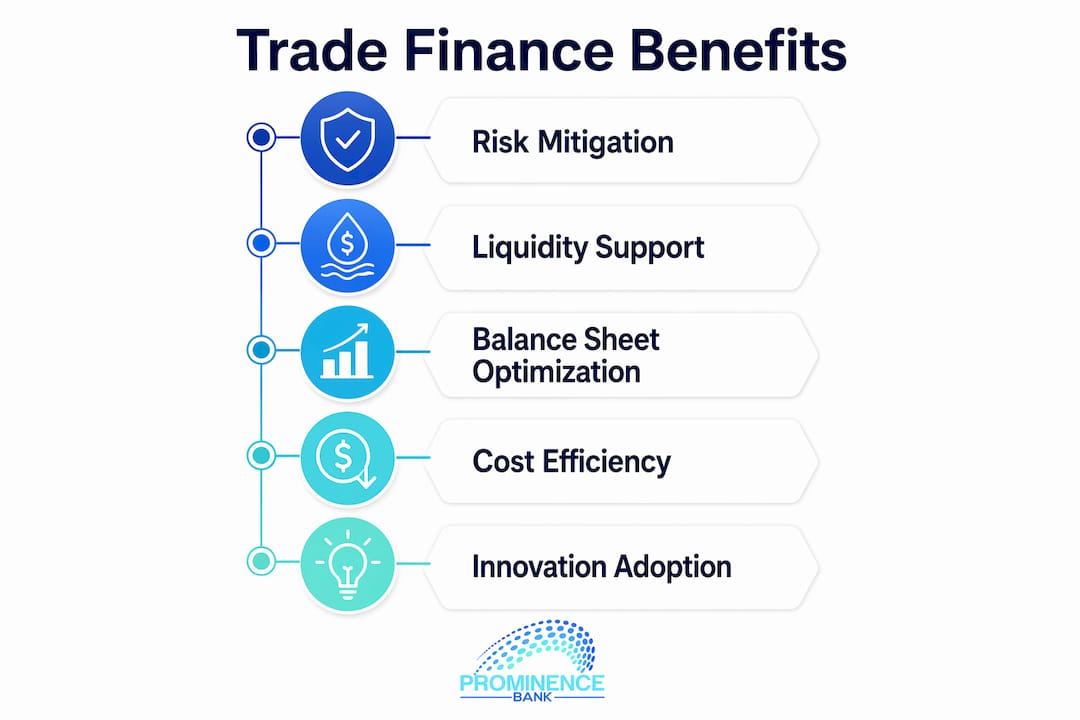
Beyond risk and liquidity, trade finance delivers a structural financial benefit that treasury executives and CFOs prioritize: balance sheet optimization. Traditional debt sits on a company’s balance sheet and affects its credit ratios. Trade finance instruments, when structured correctly, can shift liabilities off the primary balance sheet entirely.

Transaction-linked instruments allow companies to move trade-related debt onto financing structures secured against specific receivables or goods. The result is a cleaner balance sheet, a lower debt-to-equity ratio, and a stronger credit profile when approaching lenders or investors. Companies that use supply chain finance programs, for example, can extend payment terms to suppliers without recording additional debt on their own books.
The cost-of-capital advantage is equally significant. A company accessing trade finance at rates tied to its bank’s credit rating rather than its own pays less for short-term working capital. Firms optimize working capital and shift liabilities off their general credit lines, freeing those lines for strategic investments rather than routine trade cycles. For multinationals running hundreds of transactions per month, that efficiency compounds quickly.
Pro Tip: Treasury teams managing high-volume trade flows should integrate international treasury management frameworks that track off-balance-sheet trade instruments separately from general debt facilities. Mixing the two distorts your true credit exposure.
What challenges and innovations are shaping trade finance today?
Trade finance faces a structural tension between its critical importance and its operational inefficiency. The industry still relies heavily on paper-based processes, physical document exchange, and bilateral bank relationships built over decades. That legacy infrastructure creates friction, delays, and cost that digital alternatives promise to resolve.
The key challenges and developments shaping the field include:
- The $1.7 trillion gap: SMEs bear the brunt of unmet trade finance demand. High rejection rates stem from compliance burdens, lack of auditable financial history, and the cost of due diligence relative to small transaction sizes.
- ISO 20022 migration: This messaging standard carries richer transaction data than legacy SWIFT formats. Transitioning to ISO 20022 holds real promise for faster, more transparent trade, but cross-border legal harmonization remains an unsolved prerequisite.
- Fintech limitations: Digital platforms can automate document checking and credit scoring, but they cannot replace banking licenses, regulatory capital, or the legal enforceability that traditional instruments carry.
- Supply chain realignment: Shifting manufacturing patterns and geopolitical pressures are creating more complex supplier-buyer networks. The Asian Development Bank reports growing bank demand for trade finance as these networks multiply timing mismatches and counterparty relationships.
Closing the trade finance gap requires more than technology. It needs banking licenses, legal frameworks, and trust built across multiple jurisdictions simultaneously. Fintech firms can reduce friction at the edges, but the core infrastructure of trade finance remains anchored in regulated banking institutions. The companies that benefit most from modernization are those already embedded in that infrastructure and positioned to adopt new standards as they mature.
Key Takeaways
Trade finance is the foundational infrastructure that enables secure, liquid, and financially efficient cross-border commerce by distributing risk, bridging working capital gaps, and improving balance sheet structure.
| Point | Details |
|---|---|
| Risk distribution | Letters of credit and trade credit insurance shift credit, currency, and political risk to institutions equipped to manage them. |
| Liquidity provision | Transaction-linked products like factoring and supply chain finance bridge the payment timing gap at a lower cost than general borrowing. |
| Balance sheet efficiency | Off-balance-sheet trade instruments improve credit ratios and free general credit lines for strategic use. |
| The $1.7 trillion gap | SMEs face the highest rejection rates due to compliance barriers and insufficient financial documentation. |
| Modernization requires more than tech | ISO 20022 and fintech tools improve efficiency, but legal harmonization across jurisdictions remains the critical bottleneck. |
Trade finance complexity is the point, not the problem
After years of working with international businesses on cross-border financial structures, one pattern stands out clearly: executives who treat trade finance as a compliance checkbox consistently underperform those who treat it as a strategic tool.
The instruments are genuinely complex. A confirmed letter of credit under UCP 600 involves the issuing bank, the confirming bank, the beneficiary, and the applicant, each with distinct obligations and timelines. Supply chain finance programs require buyer and supplier alignment, legal documentation, and ongoing relationship management with the financing institution. That complexity is not a design flaw. It reflects the real-world difficulty of moving goods and money across borders where legal systems, currencies, and counterparty trust all vary.
What I have found consistently is that businesses which invest in understanding the mechanics of trade finance, rather than simply outsourcing it to their bank, negotiate better terms and structure deals more efficiently. Knowing the difference between a standby letter of credit and a performance guarantee, or understanding when factoring beats an export loan, gives treasury teams real negotiating leverage.
The $1.7 trillion gap is not primarily a technology problem. It is a trust and compliance problem. Fintech platforms that promise to close it without addressing legal harmonization and regulatory capital requirements are solving the wrong constraint. The firms that will benefit most from the next wave of trade finance modernization are those building institutional relationships now, not waiting for a digital shortcut that may never fully arrive.
— Harold
Prominencebank’s approach to trade finance for global businesses
International businesses need more than a bank account to execute trade finance effectively. They need a financial institution that understands multi-currency exposure, cross-border compliance, and the specific instruments that protect transactions at scale.
Prominencebank provides corporate banking solutions built for the complexity of international trade, including multi-currency accounts that reduce FX friction across transactions. The bank’s multi-currency account infrastructure supports businesses managing simultaneous trade flows across multiple jurisdictions, giving treasury teams direct access to global financial infrastructure without the delays of correspondent banking chains. For executives managing trade finance at volume, Prominencebank offers the institutional depth and digital access that modern cross-border commerce demands.
FAQ
What is the primary role of trade finance?
Trade finance provides the financial instruments and guarantees that enable buyers and sellers in different countries to transact securely without prior trust. Its three core functions are risk mitigation, liquidity provision, and balance sheet optimization.
How does a letter of credit work in trade finance?
A letter of credit is a bank guarantee that pays the seller once shipment documents meet agreed conditions. It substitutes the bank’s creditworthiness for the buyer’s, removing the seller’s exposure to an unknown counterparty.
Why do SMEs struggle to access trade finance?
SMEs face high rejection rates because banks require auditable financial history and compliance documentation that smaller firms often cannot provide. The global trade finance gap of $1.7 trillion reflects this unmet demand concentrated among smaller businesses.
What is the trade finance gap?
The trade finance gap is the difference between the demand for trade finance and the supply actually provided by financial institutions. It currently stands at approximately $1.7 trillion, with SMEs accounting for the largest share of unmet need.
How is technology changing trade finance?
ISO 20022 messaging standards and fintech platforms are improving data quality and document automation in trade finance. However, closing the efficiency gap fully requires cross-border legal harmonization, not technology alone.