Resumen:
- Institutional banking in 2026 will focus on AI-native orchestration, converged security, and tokenized rails. Banks must prioritize custody APIs, security protocols, and real-time data governance to meet evolving client and regulatory demands. Prominencebank aligns its services with these trends by offering multi-currency accounts, digital currency solutions, and privacy-first structures.
Institutional banking in 2026 is defined by AI-native orchestration, converged security, and the practical arrival of tokenized rails. Accenture’s Banking 2026 report frames this moment as “unconstrained banking,” where agentic AI and digital assets remove limits that have constrained the industry for decades. For institutional clients and HNWIs, the single highest-priority action right now is confirming that your banking partner has defined custody APIs, AgentOps policy guardrails, and OFAC-compliant screening before the end of Q3. Prominencebank’s multi-currency and institutional services are built for exactly this environment.
Key signals to track immediately:
- Deloitte projects AI-native products could represent a significant portion of institutional banking revenues among the top 50 U.S. banks by 2030.
- KPMG finds 61% of institutions rank GenAI among their top investment priorities.
- Capgemini reports Fewer than one in four corporate and financial clients believe their bank delivers integrated, real-time, personalized service as standard.
Consejo profesional: Start your AgentOps pilot with a treasury use case. Treasury combines high data volume, repeatable decisions, and measurable outcomes, which makes it the fastest path to demonstrable ROI before broader deployment.
Cuadro de contenidos
- What are the eight institutional banking trends shaping 2026?
- What do these trends mean in practice for institutional clients?
- U.S. regulatory and compliance checklist for institutional clients in 2026
- How should you build your technology roadmap for 2026?
- How do you evaluate an institutional or offshore banking partner in 2026?
- How Prominencebank maps its services to the 2026 trends
- What do these trends cost, and what ROI should institutions expect?
- How is ESG reshaping institutional lending and investment decisions?
- How are emerging markets influencing institutional banking strategies?
- What role does blockchain play beyond digital assets?
- How are banks and fintech/RegTech firms collaborating in 2026?
- What does a strong cyber resilience framework look like for institutions?
- Puntos clave
- What leaders must own in 2026
- Prominencebank is built for the institutional demands of 2026
- Useful sources and further reading
- FAQ
What are the eight institutional banking trends shaping 2026?
-
AI-native orchestration and AgentOps — Banks are moving from AI as a productivity tool to AI embedded in core product workflows. Treasury-orchestration platforms, intraday liquidity optimizers, and trade-documentation agents are live or in pilot at leading institutions. Timeline: now for pilots, 6–12 months for production.
-
Converged security: fraud, financial crime, and cyber — SAS identifies the merger of these three threat streams as a defining 2026 shift. Siloed teams cannot respond at the speed of AI-driven attacks. Timeline: now.
-
Tokenization and institutional digital assets — Oliver Wyman estimates institutional crypto-related activity could add up to $16.4 billion by 2030, while migration to digital rails puts over $200 billion in wholesale revenues in play, with roughly $46 billion at risk to margin compression. Timeline: 6–18 months for custody readiness.
-
Real-time treasury, multi-currency flows, and instant rails — ISO 20022 adoption and tokenized-deposit networks are reshaping settlement. SWIFT’s shared ledger, built on Hyperledger Besu with 17 major banks, targets 24/7 cross-border settlement. Timeline: 6–12 months.
-
Data governance as the AI foundation — SAS places data governance as the prerequisite for AI at scale. Without clean, owned, governed data, AgentOps produces liability, not value. Timeline: now.
-
API-first composability and custody integrations — Modern institutional banking features require open APIs connecting custody, payments, and reporting into a single operational layer. Timeline: 12–18 months for full integration.
-
Client experience redefined for HNWIs — Privacy, discretion, and instant access are no longer differentiators; they are table stakes. Only 23% of clients currently receive integrated, real-time service from their bank, per Capgemini. Timeline: now.
-
Geopolitical and regulatory fragmentation — Tariff shifts, sanctions volatility, and diverging digital-asset rules across jurisdictions are forcing institutions to build multi-jurisdiction compliance stacks. Timeline: ongoing.
What do these trends mean in practice for institutional clients?
The table below surfaces three metrics that illustrate the scale and urgency of the shift.
| Metric | Figure | Source |
|---|---|---|
| GenAI top investment priority | 61% of institutions | KPMG |
| CIB revenue CAGR deceleration | 6.5% (2022–2024) → 5.4% (2025–2029 forecast) | Capgemini |
| Institutions reporting more cyberattacks | 75% | KPMG |
The CIB revenue slowdown from 6.5% to a forecast 5.4% CAGR is not a crisis; it is a signal that undifferentiated product providers will compress margins while capability orchestrators gain share. For institutional clients, that means your bank’s ability to integrate AI, custody, and real-time liquidity directly affects your own cost of capital and execution quality.
Tokenization changes custody in a specific way: collateral can move in near-real time on permissioned ledgers, reducing the friction of margin calls and cross-border collateral transfers. Clients should ask their custodian whether they support tokenized collateral mobility today or have a dated roadmap.

On security, 75% of institutions report increased cyberattack frequency, and 89% report rising security budgets. The practical implication for HNWIs is straightforward: demand a written SLA covering detection-to-containment time, not just perimeter defenses. Explore banking security features for high-value clients to understand what best-in-class looks like.
U.S. regulatory and compliance checklist for institutional clients in 2026
Cross-border and offshore banking relationships carry specific U.S. compliance obligations. Verify each item with your banking partner before onboarding.
- OFAC/SDN screening: Confirm real-time screening against the Specially Designated Nationals list, with documented latency SLAs. Ask: “What is your average time from a new SDN designation to active screening?”
- FinCEN reporting: Verify the bank’s Suspicious Activity Report workflow, including escalation timelines and your notification rights as a client.
- FATCA/CRS: Confirm the bank’s classification under FATCA (Foreign Financial Institution or Deemed-Compliant), its CRS reporting jurisdiction, and how it handles dual-reporting obligations for multi-jurisdiction structures.
- AML controls and KYC refresh cadence: Ask for the bank’s KYC refresh schedule for institutional accounts (typically annual for high-risk profiles) and its transaction-monitoring model documentation.
- SEC custody considerations: For accounts holding securities or digital assets, confirm whether the custodian meets SEC Rule 17f-5 or equivalent standards and whether assets are held in segregated accounts.
- Cross-border reporting risk: Offshore structures that involve U.S. persons trigger Form 8938, FBAR (FinCEN 114), and potentially Form 5471 or 8865 obligations. Confirm your bank provides the documentation needed to support these filings. Review the guía internacional de cumplimiento bancario for a full walkthrough.
Statistic to note: More than 70% of business leaders expect AI-driven fraud to be a major challenge by 2026, according to BAI research, which makes AML/KYC controls that incorporate AI detection a compliance floor, not a premium feature.
This article provides general information, not legal or tax advice. Confirm current obligations with a qualified U.S. tax attorney or compliance professional for your specific structure.
How should you build your technology roadmap for 2026?
| Capability | Minimum technical requirement | Business metric to track |
|---|---|---|
| Data governance | Unified data ownership policy, API-accessible data catalog | Decision quality, reconciliation error rate |
| AgentOps | Explicit policy guardrails, audit log, client override rights | Capacity creation, escalation rate |
| API composability | REST/ISO 20022-compliant endpoints, custody integration | Time-to-settle, straight-through processing rate |
| Real-time payments | ISO 20022 message support, 24/7 settlement window | Settlement latency, FX slippage |
| Integrated security | Unified fraud/AML/cyber detection stack, SIEM integration | Mean time to detect, false-positive rate |
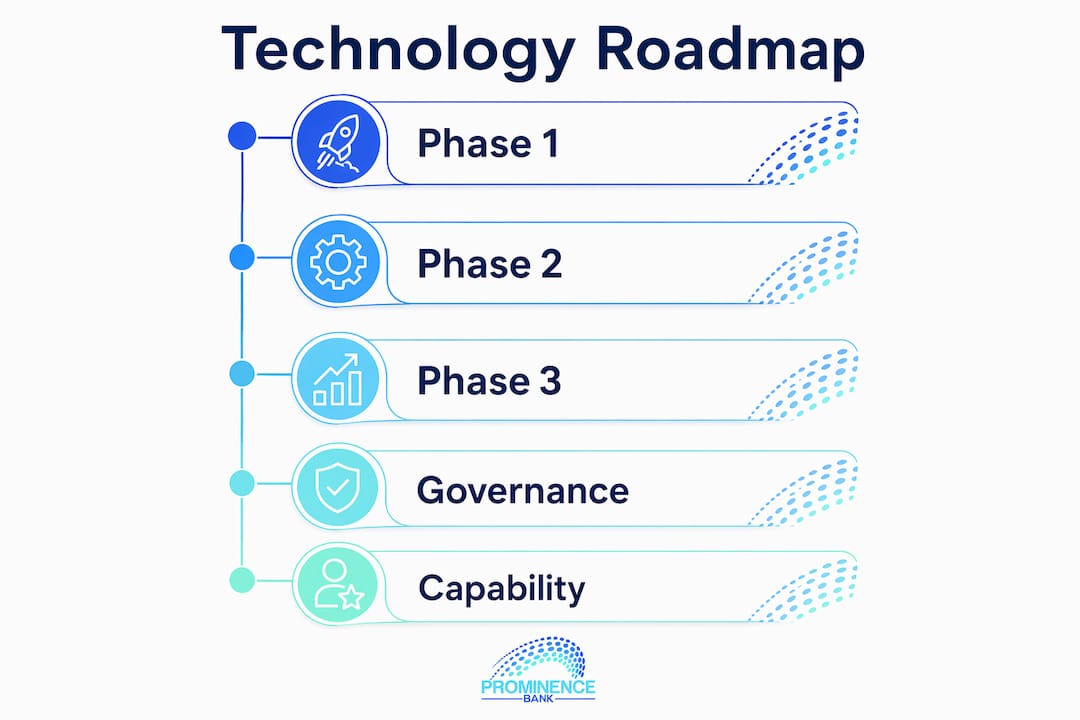
Phase 1 (0–6 months): Audit data ownership and governance gaps. No AgentOps deployment is safe without this foundation. Acceptance criterion: every data domain has a named owner and a documented lineage policy.
Phase 2 (6–18 months): Deploy AgentOps in treasury and payments with explicit guardrails. Require your banking partner to demonstrate client override rights and full audit trails. Acceptance criterion: agents operate within defined policy boundaries with zero unauthorized monetary actions.
Phase 3 (18–36 months): Integrate custody, tokenized collateral, and real-time liquidity into a single composable layer. Acceptance criterion: straight-through processing rate above 95% for standard institutional transactions.
Consejo profesional: Expect a J-curve. Costs and complexity rise before productivity gains appear. Sequence investments by measuring speed, accuracy, risk reduction, capacity creation, and decision quality — not just cost savings — so the board sees real progress during the difficult middle phase.
How do you evaluate an institutional or offshore banking partner in 2026?
- Confirm regulatory footprint and licensing. Ask for the bank’s license documentation, governing jurisdiction, and any third-party audit reports. Unverified licensing claims are a hard stop.
- Test custody and digital-asset support. Request proof of segregated custody, tokenized-asset capability, and collateral mobility. Ask: “Can you demonstrate a live tokenized collateral transfer?”
- Probe AgentOps and AI governance. Ask: “How do you isolate and govern enterprise agents that can take monetary action?” A bank without a clear answer has not solved this yet.
- Require SLA and settlement guarantees in writing. Verbal commitments on settlement windows and uptime are worthless. Get them in the contract.
- Verify privacy and discretion mechanisms. For HNWIs, confirm account-structure confidentiality, data-residency policies, and staff access controls. See estrategias avanzadas de privacidad bancaria for a detailed framework.
- Evaluate integration and API depth. Request API documentation before signing. A bank that cannot provide it is not API-first regardless of what its marketing says.
Red flags: opaque custody chains, no independent audit in the past 12 months, sanctions-screening SLA measured in days rather than minutes, and agentic AI deployed without documented policy guardrails.
How Prominencebank maps its services to the 2026 trends
Prominencebank, operating under ETMO sovereignty, maps directly to four of the eight trends above:
- Multi-currency accounts and real-time liquidity: Institutional clients get direct access to global financial infrastructure with instant online access across currencies.
- Privacy-first account structures: Confidentiality and discretion are built into the account architecture, not added as a feature.
- AML/KYC compliance: International AML/KYC standards are embedded in onboarding and ongoing monitoring, supporting FATCA/CRS documentation needs.
- Digital currency services: Prominencebank’s digital currency capabilities support custody and tokenized-asset requirements for institutional clients moving into digital rails.
What do these trends cost, and what ROI should institutions expect?
Technology modernization in institutional banking follows a predictable cost curve: initial investment in data infrastructure and API integration is high, and productivity gains lag by 12–18 months. PwC’s analysis of U.S. bank earnings calls confirms that investors now demand evidence that modernization spending converts into operating leverage, not just revenue growth.
The practical ROI case for AI-native treasury is measurable: improved cash visibility, reduced days sales outstanding, and lower reconciliation error rates are all attributable outcomes. For converged security, the ROI is asymmetric. The cost of a major fraud or cyber incident far exceeds the cost of integrated detection infrastructure, particularly for institutions managing cross-border flows where OFAC violations carry civil penalties that can reach tens of millions of dollars.
For HNWIs, the cost calculus is different. The value of a privacy-preserving, multi-currency offshore structure is not measured in basis points saved but in optionality preserved and reporting risk avoided.
How is ESG reshaping institutional lending and investment decisions?
ESG integration has moved from voluntary reporting to a structural factor in credit pricing and capital allocation. U.S. institutional lenders are increasingly incorporating climate-risk stress tests into loan underwriting, particularly for commercial real estate and energy-sector exposures. The SEC’s climate-disclosure rules, though subject to ongoing legal challenge, have already shifted internal reporting practices at major institutions.
For HNWIs and institutional investors, the practical implication is that ESG data quality now affects deal access. Counterparties running Sustainability Accounting Standards Board (SASB) or Task Force on Climate-related Financial Disclosures (TCFD) frameworks are receiving preferential terms from a growing number of institutional lenders. If your portfolio companies cannot produce credible ESG metrics, expect that gap to show up in pricing.
How are emerging markets influencing institutional banking strategies?
APAC leads CIB revenue growth in Capgemini’s 2026 forecast, and the Middle East and Africa show the highest stablecoin adoption relative to GDP per IBM’s global survey. For U.S.-based institutional clients, this creates two concrete pressures: correspondent banking relationships in high-growth corridors are becoming strategically valuable, and multi-currency infrastructure that covers non-G10 currencies is no longer optional for institutions with APAC or MENA exposure.
The fragmentation risk is real. Diverging digital-asset regulations across Southeast Asia, the Gulf Cooperation Council, and the EU mean that a single tokenization strategy will not work globally. Institutions need jurisdiction-specific custody and compliance layers, which is precisely why API-first banking partners with multi-currency depth matter more in 2026 than in any prior cycle.
What role does blockchain play beyond digital assets?
Blockchain’s most durable institutional applications are not in retail crypto but in post-trade infrastructure. SWIFT’s shared ledger, built on Hyperledger Besu with 17 major banks including Citi, HSBC, and UBS, targets 24/7 cross-border settlement using tokenized deposits rather than stablecoins. The distinction matters: tokenized bank deposits preserve deposit insurance, regulatory protections, and the bank’s intermediary role.
Syndicated loans are the next frontier. Blockchain-based syndication platforms reduce the settlement cycle from the current T+20 or longer to near-real time, cutting administrative costs and counterparty risk simultaneously. For institutional clients participating in syndicated facilities, ask your agent bank whether their documentation and settlement workflow is blockchain-ready or still paper-dependent.
How are banks and fintech/RegTech firms collaborating in 2026?
The dominant model has shifted from acquisition to embedded partnership. Banks are licensing RegTech capabilities for AML, KYC, and sanctions screening rather than building them internally, because the velocity of regulatory change exceeds most internal development cycles. Fintech firms, in turn, are accessing bank balance sheets and distribution through API partnerships rather than competing for banking licenses.
For institutional clients, this means your bank’s compliance quality is partly a function of which RegTech vendors it has integrated. Ask specifically which third-party providers handle sanctions screening, transaction monitoring, and KYC refresh. A bank that cannot name its RegTech stack is either running legacy in-house systems or has not thought carefully about the question.
What does a strong cyber resilience framework look like for institutions?
Institutional cyber resilience in 2026 requires three integrated layers: prevention (access controls, zero-trust architecture), detection (unified SIEM covering fraud, AML, and cyber signals), and recovery (tested runbooks with documented recovery time objectives). The convergence of fraud, financial crime, and cyber into a single threat environment, as SAS describes, means that a bank with three separate teams and three separate data systems will always be slower than an attacker who sees all three vectors simultaneously.
For institutional clients, the minimum acceptable standard is a bank that can demonstrate mean time to detect under four hours for a credential-compromise event and a tested business-continuity plan that covers both cyber and operational failures. Anything less is a concentration risk for your treasury and custody relationships.
Puntos clave
The defining reality of institutional banking trends in 2026 is that AI-native orchestration, converged security, and tokenized rails are no longer future-state concepts — they are the criteria by which banking partners should be evaluated today.
| Punto | Detalles |
|---|---|
| AI-native revenue potential | Deloitte projects AI-native products could reach up to 25% of institutional banking revenues among the top 50 U.S. banks by 2030. |
| Client experience gap | Only 23% of corporate and financial clients say their bank delivers integrated, real-time, personalized service as standard, per Capgemini. |
| Cyber pressure is universal | 75% of institutions report more cyberattacks; demand a written detection-to-containment SLA from any banking partner. |
| Tokenization timeline | Oliver Wyman places $46 billion of wholesale banking revenue at risk from digital-rail migration; custody readiness is a 6–18 month priority. |
| Prominencebank alignment | Prominencebank’s multi-currency accounts, privacy-first structures, and digital currency services map directly to the top 2026 institutional banking requirements. |
What leaders must own in 2026
The sequencing question is where most institutions get it wrong. Leadership teams want to deploy AgentOps before they have governed their data, and they want to launch tokenization before they have confirmed custody. The result is a J-curve with no exit ramp: costs rise, complexity compounds, and the board loses confidence before the productivity gains arrive.
The right order is data foundations first, governance guardrails second, and capability deployment third. That sequence is not cautious; it is the only one that produces durable ROI. Executives who treat AI governance as a compliance checkbox rather than a product feature will find their agents creating liability faster than they create value.
Senior leaders should schedule a capability audit in the next 30 days. Map your current data ownership, custody API status, and sanctions-screening SLA against the checklist in this article. The gaps will tell you exactly where to invest.
Prominencebank is built for the institutional demands of 2026
The gap between what institutional clients need in 2026 and what most banks currently deliver is measurable: Only a minority of clients receive the integrated, real-time service they require. Prominencebank closes that gap with multi-currency accounts designed for complex cross-border flows, privacy-first account structures for HNWIs and institutional clients, and digital currency services that support custody and tokenized-asset requirements from day one.
Whether you are structuring a new offshore relationship, evaluating custody for digital assets, or building a multi-currency treasury operation, Prominencebank’s institutional team can map its capabilities directly to your requirements. Start with a Cuenta multicurrencia or explore the full range of Soluciones bancarias corporativas. To speak with an institutional relationship lead, visit Prominencebank Institutional Sales and request a capability conversation today.
Useful sources and further reading
- Accenture Banking Top Trends 2026 — The primary source for the “unconstrained banking” framing and AgentOps analysis; essential reading for any institutional strategy team.
- Capgemini Corporate and Investment Banking Report 2026 — CIB revenue forecasts, regional divergence data, and the client-experience gap metric.
- Oliver Wyman: Digital Assets Reshaping Wholesale Banking — The $16.4 billion and $46 billion revenue-at-risk figures for tokenization; the most rigorous quantitative case available.
- SAS Banking Trends 2026 — Converged security and data governance analysis; useful for compliance and technology teams.
- KPMG 2026 Banking Trends — GenAI investment priorities and cyber-pressure statistics for U.S. institutions.
- Deloitte: AI-Native Products in Institutional Banking — The $66 billion AI-native revenue projection and permissioned-autonomy governance framework.
- IBM 2026 Global Outlook for Banking and Financial Markets — Tokenization readiness data, executive survey findings, and the on-chain economy analysis.
- OFAC — Primary source for SDN list updates and sanctions compliance requirements.
- FinCEN — SAR filing requirements, AML guidance, and BSA compliance resources.
- SEC — Custody rule standards and climate-disclosure guidance relevant to institutional accounts.
- Prominencebank Institutional Services — Request a capability-mapping brief tailored to your institutional or HNWI structure.
FAQ
What defines institutional banking trends in 2026?
AI-native orchestration, converged fraud and cyber security, tokenized settlement rails, and real-time multi-currency liquidity are the four forces reshaping institutional banking in 2026, per Accenture, Capgemini, Oliver Wyman, and SAS.
How much revenue could AI-native banking products generate by 2030?
Deloitte projects AI-native products could account for up to 25% of institutional banking revenues among the top 50 U.S. banks by 2030, approximately $66 billion in the base case.
What U.S. compliance obligations apply to offshore institutional accounts?
U.S. persons with offshore institutional accounts face FATCA reporting (Form 8938), FBAR filing (FinCEN 114), OFAC sanctions screening obligations, and potentially Form 5471 or 8865 depending on entity structure. Confirm current requirements with a qualified U.S. tax attorney.
How does tokenization affect custody for institutional clients?
Tokenized assets on permissioned ledgers enable near-real-time collateral mobility and reduce settlement friction. Oliver Wyman estimates digital-rail migration puts over $200 billion in wholesale banking revenues in play, making custody readiness a near-term priority.
How does Prominencebank address the top 2026 institutional banking requirements?
Prominencebank offers multi-currency accounts, privacy-first account structures, digital currency custody services, and AML/KYC-compliant onboarding, directly mapping to the AI-native, tokenization, and converged-security trends that define 2026 institutional banking.