
Resumen:
- Institutional banking delivers comprehensive financial services to large organizations, requiring advanced platform capabilities. A feature compilation catalogs essential functions like real-time processing, AI credit scoring, and open APIs to meet complex operational demands. Prioritizing native features, compliance automation, and migration tools is key for selecting scalable, future-proof platforms.
Institutional banking is defined as the full suite of financial services delivered to corporations, governments, pension funds, and other large organizations that require capabilities far beyond what retail banking offers. An institutional banking feature compilation is the industry practice of cataloging and evaluating these capabilities against a recognized baseline. As of 2026, that baseline includes ten critical platform features covering everything from real-time transaction processing to AI-powered credit risk scoring. Prominencebank operates within this framework, serving institutional clients who demand multi-currency account management, compliance automation, and direct access to global financial infrastructure. This guide breaks down each feature category so you can evaluate platforms with precision.

1. What is an institutional banking feature compilation?
An institutional banking feature compilation is a structured catalog of the core capabilities a banking platform must deliver to serve corporate, investment, and institutional clients at scale. The term is descriptive rather than a formal industry standard. The recognized industry term for the underlying discipline is core banking evaluation o platform feature assessment, and both terms appear throughout procurement and vendor selection processes.
Understanding what belongs in this catalog matters because institutional clients operate at a level of complexity that exposes every gap in a platform’s design. A missing feature in a retail bank is an inconvenience. A missing feature in an institutional platform can disrupt treasury operations, delay capital raises, or trigger a compliance failure.
2. Top 10 features every institutional banking platform must have
Ten features define the competitive baseline for institutional core banking platforms in 2026. Each one addresses a specific operational or regulatory demand that institutional clients face daily.
-
Real-time transaction processing. Institutional clients execute high volumes of payments, settlements, and transfers simultaneously. Platforms that batch-process transactions create reconciliation delays that compound across multi-entity structures.
-
Cloud-native architecture. Cloud-native deployment options, including SaaS with in-country hosting, provide the scalability and resilience that institutional operations require. Legacy on-premise systems cannot match this flexibility.
-
Open API layers. API-first design lets platforms connect to trading systems, ERP software, and third-party data providers without custom development for every integration.
-
Automated regulatory compliance. Manual compliance processes introduce human error at exactly the point where errors are most costly. Platforms with built-in compliance automation reduce that risk structurally.
-
AI-powered credit risk scoring. AI models assess creditworthiness faster and more consistently than analyst-driven processes, especially for high-volume credit decisions across multiple markets.
-
Multi-product, multi-currency support. Global institutional clients hold assets and liabilities across currencies and product types. Platforms that cannot reflect this in a single ledger force workarounds that create reconciliation risk.
-
Integrated AML and fraud detection. Automation in AML, fraud detection, and sanctions screening improves compliance reliability and reduces manual errors. This is now considered a baseline requirement, not a premium feature.
-
Digital self-service channels. Corporate treasurers and finance teams need direct access to account data, payment initiation, and reporting without routing every request through a relationship manager.
-
Analytics and business intelligence. Platforms must surface transaction data, exposure summaries, and liquidity positions in real time. Static monthly reports do not support institutional decision-making cycles.
-
Modular microservices architecture. Modular design lets institutions add or replace individual capabilities without rebuilding the entire platform. This prevents the technical debt that accumulates in monolithic systems.
Consejo profesional: When evaluating platforms, ask vendors to demonstrate each feature in a live environment rather than a slide deck. Many platforms claim capabilities that require costly third-party integrations to actually deliver.
3. How institutional platforms support corporate and investment banking
Institutional banking serves two distinct functions: corporate banking manages liquidity and day-to-day operations, while investment banking handles strategic, transaction-based services like mergers, capital raising, and structured finance. This dual purpose requires platforms to handle both steady operational workflows and high-velocity transactional events without degradation in either mode.
The features that support corporate banking functions include:
- Liquidity management tools that provide real-time cash positions across accounts, entities, and currencies
- Credit facility management for revolving credit lines, term loans, and overdraft structures
- Payment rail connectivity covering SWIFT, SEPA, ACH, and domestic clearing networks
- Account sweeping and notional pooling to optimize cash across subsidiaries
The features that support investment banking functions include:
- Transaction workflow management for deal execution, document management, and approval chains
- Capital markets connectivity for bond issuance, syndicated lending, and equity placement support
- Configurable product engines that can model bespoke financial instruments without custom code
- High-velocity transaction processing that handles settlement spikes during capital market events
The dual-purpose nature of institutional banking means a platform optimized only for operational banking will fail during a capital raise. Platforms must be evaluated against both use cases before selection.
4. Technical capabilities that separate top platforms in migration and integration
Migration tooling and product engine flexibility together represent nearly 50% of the evaluation criteria for institutional banking platforms. That figure reflects a hard reality: most institutional clients cannot switch platforms overnight. They need coexistence, meaning the new platform runs alongside legacy systems during a phased rollout.
The technical capabilities that matter most in this context are:
| Capability | Por qué importa |
|---|---|
| Migration accelerators | Reduce time and risk during phased platform transitions |
| Ledger architecture flexibility | Supports multi-entity, multi-currency structures without custom builds |
| Open API availability | Connects new platforms to legacy back-office systems without full replacement |
| In-country cloud hosting | Satisfies data residency requirements across jurisdictions |
| Vendor ecosystem depth | Ensures regional implementation support and platform skill availability |
API-first architecture is not a preference for advanced institutions. It is a requirement for orchestrating across fragmented legacy back-offices and modern digital channels while avoiding vendor lock-in. Platforms that rely on proprietary integration layers create dependency that limits future flexibility.
Consejo profesional: Request a detailed migration roadmap from any vendor before signing. Platforms that cannot show a phased coexistence plan are likely to require a full cutover, which carries significant operational risk for institutional clients.
Equity crowdfunding platforms face similar integration challenges when connecting to banking infrastructure, which illustrates why API-first design matters across the financial services sector, not just in core banking.
5. How compliance automation and AI-driven risk scoring enhance platforms
Compliance automation is the single highest-impact feature category for institutional clients operating across multiple jurisdictions. Platforms with out-of-the-box compliance controls, policy management, and audit-ready transaction trails reduce operational risk in ways that manual processes cannot replicate at scale.
The specific compliance capabilities that define leading platforms include:
- Real-time AML screening against global sanctions lists, updated continuously rather than in batch cycles
- Automated regulatory reporting that generates filings for multiple jurisdictions from a single data source
- Policy enforcement engines that apply institution-defined rules to every transaction at the point of initiation
- Audit trail generation that produces complete, timestamped records for regulatory examination without manual assembly
AI-driven credit risk scoring adds a second layer of operational improvement. AI models process more variables than analyst-driven scoring, update in real time as market conditions change, and apply consistent criteria across every credit decision. This consistency matters for institutions managing large loan books across multiple markets.
Institutional financial platforms that implement automation across compliance and operational workflows can yield up to a 188% ROI and a 30% reduction in operating costs. That return reflects the compounding effect of removing manual processes from high-frequency, high-stakes workflows.
El international banking compliance landscape in 2026 requires platforms to handle AML, KYC, and sanctions screening as integrated functions rather than bolt-on modules. Platforms that treat compliance as an add-on create gaps that regulators will find.
6. Features that support multi-currency and multi-product account management
Multi-currency and multi-product account management is the feature category most directly tied to the operational complexity of global institutional clients. Real-time balance updates and cross-border payment connectivity enable global treasury and cash management operations that would otherwise require multiple banking relationships and manual reconciliation.
The features that define strong multi-currency and multi-product support include:
- Unified multi-currency ledger that reflects positions across all currencies in real time without manual conversion entries
- Cross-border payment rail integration covering SWIFT MT and MX messaging, SEPA Instant, and domestic clearing networks in key markets
- Product configurability that supports deposits, loans, trade finance, and derivatives within a single account structure
- Real-time FX rate feeds integrated directly into payment and settlement workflows
- Subsidiary account hierarchies that allow parent entities to view and manage balances across all related accounts
Global treasury teams managing operations across multiple time zones need this data available continuously, not at end-of-day. Platforms that provide Gestión de las cuentas multicurrencia with real-time visibility eliminate the reconciliation lag that creates exposure risk in volatile currency environments.
Puntos clave
The most effective institutional banking platforms combine real-time processing, API-first architecture, and integrated compliance automation because these three capabilities address the operational, technical, and regulatory demands that institutional clients face simultaneously.
| Punto | Detalles |
|---|---|
| Feature baseline is defined | Ten core features set the competitive standard for institutional platforms in 2026. |
| Dual-purpose design is required | Platforms must support both operational corporate banking and high-velocity investment banking workflows. |
| Migration tooling is critical | Coexistence capability and product engine flexibility represent nearly 50% of platform evaluation criteria. |
| Compliance automation delivers ROI | Automation across AML, reporting, and audit trails can reduce operating costs by up to 30%. |
| Multi-currency support is non-negotiable | Real-time multi-currency ledgers and cross-border payment connectivity are baseline requirements for global clients. |
Why feature prioritization is the decision most institutions get wrong
Most institutions approach platform selection by building a feature checklist and scoring vendors against it. That method sounds rigorous. In practice, it produces a tie between platforms that all claim the same capabilities on paper.
The real differentiator is not which features a platform lists. It is which features are native to the platform versus which require third-party integrations or custom development to actually work. Many core banking platforms require costly integrations to fully realize capabilities like real-time multi-ledger synchronization. That distinction does not show up in a feature matrix.
My view is that institutions should weight three criteria above all others: API-first architecture, native compliance automation, and proven migration tooling. These three determine whether a platform can grow with your organization or will become a constraint within three years. A platform with a shorter feature list but genuine API-first design will outperform a feature-rich monolith every time you need to integrate a new data source, regulatory requirement, or business line.
The compliance automation point deserves particular emphasis. Regulatory requirements across AML, KYC, and sanctions screening are tightening across every major jurisdiction. Institutions that rely on manual compliance processes are not just inefficient. They are accumulating regulatory risk that will eventually materialize as a fine, a remediation program, or a reputational event. Platforms with built-in compliance controls and audit-ready transaction trails remove that risk structurally rather than managing it operationally.
AI-driven risk scoring is the feature category most likely to create competitive separation over the next three years. Institutions that adopt adaptive AI credit models now will build scoring datasets that improve continuously. Those that wait will face a gap that is difficult to close quickly.
- Harold
Prominencebank’s institutional banking solutions
Prominencebank delivers the features that institutional clients require most, built into a fully licensed digital banking platform designed for global operations.
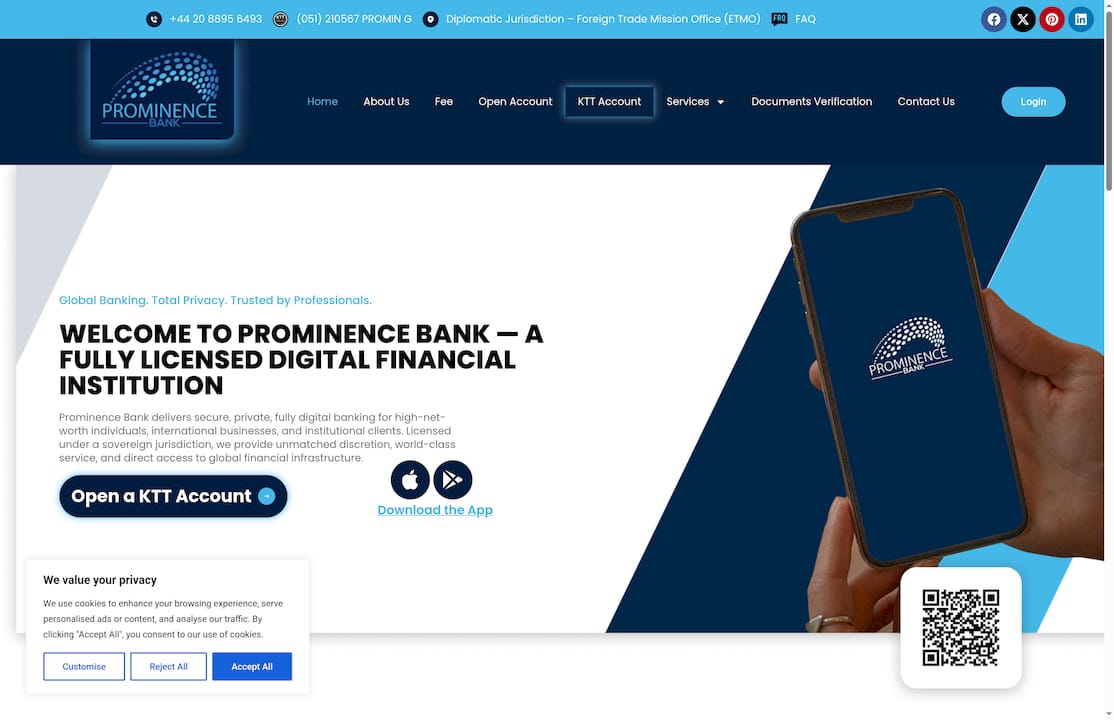
The platform supports multi-currency corporate account management with real-time balance visibility across currencies and entities. Compliance is handled through integrated AML and KYC controls aligned with international standards, including ETMO regulatory oversight. Institutional clients access the platform through direct digital channels with no requirement to route requests through intermediaries. For organizations evaluating institutional banking services that combine privacy, global connectivity, and compliance automation, Prominencebank provides a fully operational solution with documented onboarding processes and direct access to global payment infrastructure.
FAQ
What is an institutional banking feature compilation?
An institutional banking feature compilation is a structured catalog of the core capabilities a banking platform must deliver to serve corporate, investment, and institutional clients. It is used during platform evaluation and procurement to compare offerings against an industry baseline.
What are the most critical features of institutional banking platforms?
The ten most critical features include real-time transaction processing, cloud-native architecture, open API layers, automated regulatory compliance, and AI-powered credit risk scoring. These define the competitive baseline for 2026.
How does compliance automation benefit institutional banking clients?
Compliance automation reduces manual errors in AML screening, sanctions checks, and regulatory reporting. Platforms with integrated compliance controls can deliver up to a 30% reduction in operating costs compared to manual processes.
Why does API-first design matter for institutional banking platforms?
API-first architecture allows institutions to connect new platforms to legacy systems and digital channels without vendor lock-in. It is the primary technical requirement for institutions managing complex, multi-system environments.
What is the difference between corporate banking and investment banking features?
Corporate banking features support liquidity management, credit facilities, and daily payment operations. Investment banking features support high-velocity transaction workflows, capital markets connectivity, and configurable product engines for structured finance.