
Resumen:
- Trust banking involves a licensed institution acting as a fiduciary to manage assets entirely for the benefit of the beneficiary.
- It is regulated chiefly by the OCC and state banking departments, with assets legally segregated from the bank’s own assets to protect beneficiaries.
What trust banking actually means for your assets
Trust banking is fiduciary asset management. A licensed institution holds, manages, and administers assets on behalf of a beneficiary, bound by a legally enforceable trust instrument. The bank does not own those assets. It acts as trustee, obligated by law to prioritize the beneficiary’s interests above its own.
Three parties define every trust arrangement:
- Grantor (settlor): transfers assets into the trust
- Trustee: the trust bank, legally bound to manage assets per the trust instrument
- Beneficiary: receives the benefit of those managed assets
Key distinctions from conventional banking:
- Trust banks earn fees for fiduciary administration, not from lending spreads
- Trust assets are legally segregated from the bank’s balance sheet, shielded from bank creditors even in insolvency
- A trust bank acts as fiduciary managing assets strictly according to the trust instrument
Cuadro de contenidos
- How U.S. law governs trust banks
- Services trust banks provide beyond holding assets
- How to choose a trust bank as a high-net-worth client
- What trust banking services typically cost
- Prominencebank: private digital trust banking for global clients
- FAQ
- Puntos clave
How U.S. law governs trust banks
The Office of the Comptroller of the Currency supervises approximately 60 national trust banks in the United States as of April 2026. State-chartered trust banks fall under their respective state banking departments, such as Nebraska’s Department of Banking and Finance, with federal regulators overseeing trust departments of national banks.
| Característica | Trust Bank | Commercial Bank |
|---|---|---|
| Primary revenue | Fiduciary fees | Lending spreads |
| Propiedad del activo | Held for beneficiaries | Bank’s own balance sheet |
| Regulatory standard | Fiduciary duty (loyalty, prudence) | Safety and soundness |
| Segregación de activos | Legally required | No aplicable |
| OCC supervision | dozens of national trust banks | Thousands of national banks |
FDIC trust examination manuals require trust banks to identify, monitor, and control fiduciary risks proactively. Self-dealing is prohibited. Every action must conform to the trust instrument’s terms. Opening a U.S. trust account typically requires formal trust documents and in-person verification; fully online openings remain uncommon at traditional institutions.
Services trust banks provide beyond holding assets
Estate planning and administration is the most visible service. Trust banks execute wills, manage estate liquidation, and handle inheritance asset lists. For high-net-worth families, this means a professional trustee navigating probate, tax filings, and distribution to heirs without family conflict.

Investment management under the Prudent Investor Rule is equally central. Trustees must balance income generation against long-term growth, diversifying portfolios according to each beneficiary’s needs and the trust instrument’s instructions. Bespoke fiduciary services depend entirely on the powers granted in that document.
Corporate clients use trust banks for pension plan design and administration, shareholder registry management, and bond trustee services. When a company issues bonds, a corporate trust bank monitors covenant compliance and represents bondholders in the event of default. Real estate brokerage, property appraisal, and asset securitization round out the offering for institutional clients. For businesses exploring non-bank financing structures, understanding where trust banking ends and alternative capital begins is worth clarifying early.
How to choose a trust bank as a high-net-worth client
Regulatory standing comes first. Confirm OCC or state charter status and check for any enforcement actions. Then assess whether the institution separates its fiduciary arm from commercial operations — that structural wall is what keeps your assets off the bank’s balance sheet.
Specialization matters more than size. A trust bank with deep experience in corporate trust accounts and cross-border structures will serve international clients better than a generalist. Ask specifically about multi-currency capabilities, offshore trust administration, and digital access. For clients who need global reach without a physical branch visit, fully online onboarding and AML/KYC-compliant digital verification are non-negotiable.
What trust banking services typically cost
Trust banks charge annual fees calculated as a percentage of assets under administration, varying depending on asset complexity and service scope. Minimum asset thresholds vary and can be substantial depending on the institution. Estate administration fees are often charged separately, either as a flat rate or a percentage of the estate’s gross value.
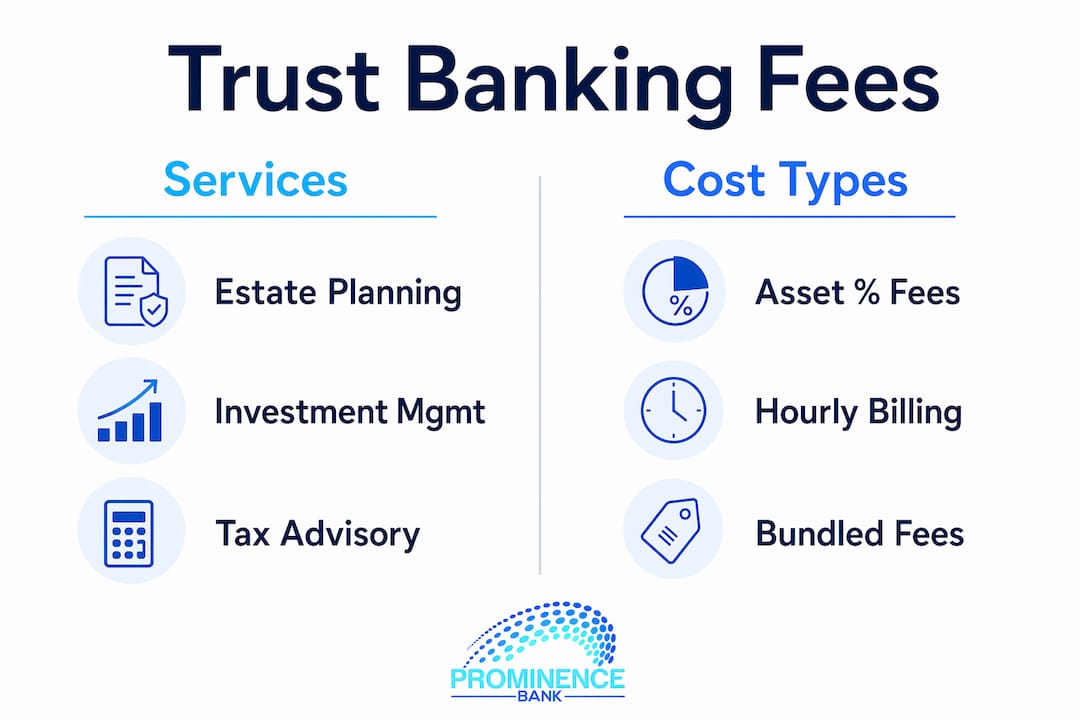
Tax advisory and investment management may be bundled or billed hourly. Always request a full fee schedule before signing a trust instrument, and confirm whether the trustee charges separately for extraordinary services such as litigation or real estate transactions.
Prominencebank: private digital trust banking for global clients
Prominencebank is built for clients who need the substance of trust banking without the friction of traditional institutions. As a fully licensed digital banking institution operating under ETMO sovereignty, Prominencebank offers multi-currency accounts, corporate banking for complex structures, and institutional investment services with full AML/KYC compliance. Account opening is online, KTT-enabled, and designed for high-net-worth individuals and international businesses who cannot afford delays. If you are structuring assets across jurisdictions or need a discreet, secure banking relationship with global reach, set up your international account with Prominencebank today.
FAQ
What is trust banking in simple terms?
Trust banking is when a licensed bank acts as trustee, managing assets on behalf of a beneficiary according to a legally binding trust agreement, with a fiduciary duty to prioritize the beneficiary’s interests.
How does a trust bank differ from a commercial bank?
Trust banks earn fees for fiduciary administration rather than lending spreads, and trust assets are legally segregated from the bank’s balance sheet, protecting them from bank creditors.
What types of trusts do trust banks manage?
Trust banks manage revocable trusts, irrevocable trusts, charitable trusts, and corporate trusts, each governed by FDIC regulations and the specific terms of the trust instrument.
How many national trust banks does the OCC supervise?
The OCC supervises approximately 60 national trust banks in the United States as of April 2026.
Can Prominencebank handle trust banking for international clients?
Prominencebank offers digital, multi-currency banking and corporate trust solutions for high-net-worth individuals and international businesses, with fully online onboarding and institutional-grade compliance.
Puntos clave
Trust banking places a legally binding fiduciary duty on the trustee to manage assets solely for the beneficiary’s benefit, segregated from the bank’s own balance sheet.
| Punto | Detalles |
|---|---|
| Fiduciary duty is absolute | Trust banks must prioritize beneficiary interests; self-dealing is prohibited under U.S. law. |
| Asset segregation protects you | Trust assets are legally separate from the bank’s balance sheet, safe even in bank insolvency. |
| OCC oversight is the benchmark | Approximately 60 national trust banks operate under OCC supervision in the United States as of April 2026. |
| Fees run 0.5%–2% annually | Annual administration fees vary by asset complexity; estate and advisory services may be billed separately. |
| Prominencebank for global clients | Prominencebank provides digital, multi-currency trust and corporate banking with online onboarding for HNWIs worldwide. |