
Resumen:
- True bank account anonymization is effectively forbidden under U.S. and international AML laws.
- Legal privacy is achieved through structures like trusts or corporate entities that limit internal disclosures.
True bank account anonymization, where a financial institution cannot identify who actually owns or controls an account, is effectively prohibited under modern anti-money laundering frameworks in the United States and most regulated jurisdictions worldwide. What’s achievable, and entirely legal, is discreción: a bank that knows your identity but limits internal access, restricts third-party disclosure, and structures your account through a verified legal entity.
The distinction matters enormously in practice. FATF guidance treats anonymous accounts as a core AML risk, and U.S. law reinforces this through the PATRIOT Act’s Customer Due Diligence rules, the Gramm-Leach-Bliley Act’s nonpublic personal information protections, and Automatic Exchange of Information reporting obligations. None of these frameworks allow you to hide from your bank. They do, however, create a defined space for privacy, and that space is where sophisticated HNWIs and international businesses operate.
- True anonymity: prohibited under AML/KYC in the U.S. and most FATF-member countries
- Bank-held privacy: legal when the bank knows the ultimate beneficial owner (UBO) but limits disclosure
- Structural privacy: trusts, foundations, and corporate layers that place a verified legal entity between you and the account
Cuadro de contenidos
- What U.S. and international law actually say about anonymous accounts
- What happens when you try to obtain an anonymous account
- Compliant ways to get real privacy without illegal anonymization
- How to open a discreet, fully compliant account: a practical checklist
- How to share financial documents without leaking sensitive data
- How to report suspicious activity without compromising your own privacy
- How U.S. banking privacy compares to other jurisdictions
- What anonymization attempts do to bank monitoring systems
- Common scenarios and what actually happens
- Prominencebank: private banking built on compliance, not concealment
- Puntos clave
- Why privacy and compliance are the same goal
- Authoritative sources and further reading
- FAQ
What U.S. and international law actually say about anonymous accounts
FATF and most national AML frameworks define an anonymous account as one where the financial institution cannot identify the beneficial owner, and they treat such arrangements as prohibited or categorically high-risk. That standard has been adopted across FATF’s 40 Recommendations and implemented into U.S. law through the Bank Secrecy Act, the PATRIOT Act’s CDD rule, and FinCEN’s beneficial ownership regulations.
“Anonymous accounts and accounts in obviously fictitious names are prohibited.” This principle, embedded in FATF’s core recommendations, is the foundation on which every regulated bank’s onboarding process is built.
El Gramm-Leach-Bliley Act is frequently misread as a privacy shield that lets clients stay anonymous. It is not. GLBA requires banks to protect nonpublic personal information from disclosure to nonaffiliated third parties and to provide initial and annual privacy notices, but it says nothing about allowing clients to avoid identification by the bank itself. The FDIC’s consumer guidance is explicit: you receive privacy protections as a customer, not anonymity from your bank.
Cuentas numeradas are a related concept worth clarifying. Historically associated with Swiss private banking, they replace a client’s name with an identifier for day-to-day operational use, limiting how many staff see the account holder’s name. The bank still holds full UBO records and reports when required. A numbered account is a privacy tool, not an anonymity tool.
What happens when you try to obtain an anonymous account
The risks are concrete and serious, not theoretical.
- Criminal exposure: Structuring accounts to conceal beneficial ownership can constitute money laundering under 18 U.S.C. § 1956, regardless of whether the underlying funds are legitimate.
- Tax-evasion liability: AEOI frameworks and FATCA require foreign financial institutions to report U.S. persons’ accounts to the IRS. Attempting to hide ownership through false identifiers creates criminal tax exposure.
- Sanctions violations: OFAC’s SDN list applies to beneficial owners, not just account names. Obscuring ownership does not insulate you from sanctions liability.
- Account closure and forfeiture: Banks that discover anonymization attempts typically close accounts immediately, forfeit non-refundable fees, and file Suspicious Activity Reports (SARs).
Using nominee structures or false identifiers to obscure beneficial ownership does not create privacy. It creates a paper trail of deception that regulators are specifically trained to find.
Nominee and shell-company arrangements that obscure beneficial ownership trigger enhanced due diligence or outright account refusal under U.S. AML rules. Correspondent banks apply the same scrutiny, meaning a flagged account can lose access to the dollar clearing system entirely.
Compliant ways to get real privacy without illegal anonymization
The lawful route to financial discretion runs through structure, not concealment. Here is how it works in practice.

Consejo profesional: Before choosing any privacy structure, confirm with qualified legal counsel that it satisfies both your home-country reporting obligations and those of the jurisdiction where the account is held. A trust that works for estate planning may still require disclosure under FATCA or CRS.
| Privacy method | Compliance status | Who the bank knows | Privacy vs. anonymity | Typical use case |
|---|---|---|---|---|
| Cuenta personal | Fully compliant | Individual directly | Low privacy | Everyday banking |
| Cuenta numerada | Fully compliant | UBO on file, limited staff access | Moderate privacy | Private banking clients |
| Corporate account (disclosed UBO) | Fully compliant | UBO verified and filed | Moderate-high privacy | Comercio internacional |
| Trust or foundation | Fully compliant | Trustee + UBO disclosed | High privacy | Estate planning, asset protection |
| Anonymous account | Prohibited | Bank cannot identify UBO | Anonymity (illegal) | Not a lawful option |
Offshore asset protection structures such as Cayman or BVI private investment companies, Liechtenstein foundations, or Cook Islands trusts place a verified legal entity between you and the account. The bank knows the trustee or corporate director, verifies the UBO behind them, and holds that information under strict confidentiality obligations. Third parties, including marketers, litigants, and the general public, see only the entity name.
Service-level privacy adds another layer: restricted internal bank access, dedicated relationship managers, confidentiality agreements, and private-banking teams with limited file access. These are operational controls, not legal structures, but they matter.
How to open a discreet, fully compliant account: a practical checklist
Preparation supports a complete review, while enhanced due diligence may require additional time beyond the estimate. Assemble these before you approach any private bank.
- ID emitido por el Gobierno for all UBOs (certified copy, apostilled if required by the bank’s jurisdiction)
- Documentos institucionales if opening through an entity: certificate of incorporation, memorandum and articles, register of directors and shareholders
- Trust deed or foundation charter if the account holder is a trust or foundation
- Declaración de UBO signed by all beneficial owners holding 25% or more
- Source-of-funds documentation: audited financials, sale agreements, inheritance records, or investment statements
- Prueba de dirección for all UBOs and authorized signatories (utility bill or bank statement, dated within 90 days)
- Corporate minutes authorizing account opening and naming authorized signatories
Prominence Bank normally completes account opening within 48 to 72 hours after all required KYC/AML procedures have been completed and all requested information and documentation have been received, verified, and accepted. This is an estimated processing period, not a guaranteed deadline. Additional time may be required if further compliance, verification, or due-diligence review is necessary. Submitting an enquiry, application, or payment does not start the estimated processing period and does not guarantee account approval or activation. Cost buckets to expect: due-diligence fees, account-opening fees, and monthly custody or maintenance charges. Confirm exact figures directly with your bank, as they vary significantly by institution and account type.
Questions to ask your prospective private bank: Who internally can access my account name? What are your FATCA/CRS reporting obligations for my jurisdiction? Do you have correspondent banking relationships that could restrict my transactions? What is your SAR filing threshold?
How to share financial documents without leaking sensitive data
Visual masking, placing a black box over text in a PDF editor, is not true redaction. U.S. courts’ redaction guidance is clear: effective redaction requires removing the underlying searchable text layer, not just covering it visually. A recipient with basic PDF tools can often recover masked text.
Consejo profesional: Retain one unredacted master copy in a secure, access-logged vault. Share only redacted versions with time-limited access links, and revoke access once the recipient has confirmed receipt.
- Use OCR-aware redaction tools that permanently delete the text layer, not just overlay it
- Flatten the PDF after redaction to prevent layer extraction
- Strip all metadata: author name, creation date, software version, and embedded comments
- Re-save as an image-based PDF when the highest security is required
- Use secure document portals with watermarking and access logs rather than email attachments
A redacted PDF that still contains the original text in its data layer is not a redacted document. It is an unredacted document with a black rectangle on top.
How to report suspicious activity without compromising your own privacy
Reporting obligations and privacy are not mutually exclusive. If you observe suspicious activity in your accounts or among counterparties, U.S. law requires financial institutions (not individual clients) to file SARs with FinCEN. As a client, you are not legally required to file a SAR yourself, but you should notify your relationship manager or compliance officer promptly.
The critical rule: SAR filings are confidential by law. Neither the bank nor you may tip off the subject of a SAR. Your report does not become a public record, and your identity as the reporting party is protected within the SAR framework. For clients who discover that a counterparty may be using their account for suspicious purposes, the right move is immediate notification to your bank’s compliance team, not independent action.
How U.S. banking privacy compares to other jurisdictions
The U.S. sits at the stricter end of the global spectrum. Switzerland, once synonymous with banking secrecy, now participates in the Common Reporting Standard and exchanges account information automatically with over 100 jurisdictions. The Cayman Islands, British Virgin Islands, and Singapore all maintain strong confidentiality laws but require full UBO disclosure to the bank and report under CRS or bilateral agreements.
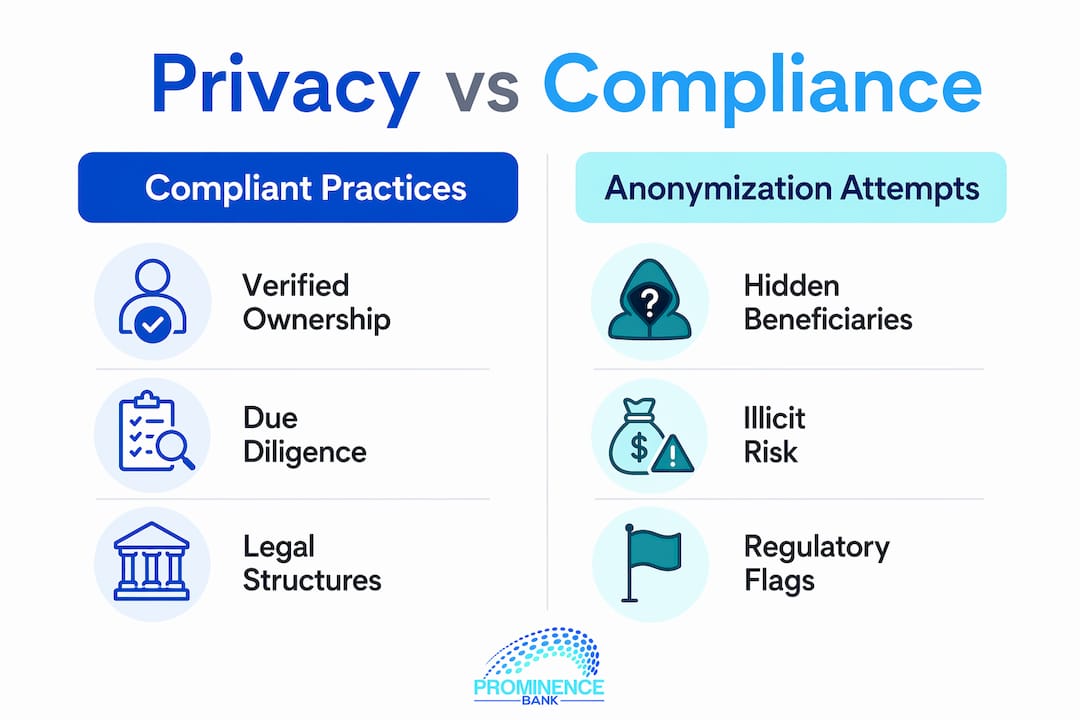
The practical difference between jurisdictions is not whether the bank knows you, it always does, but how tightly that information is held internally, how broadly it is shared with foreign tax authorities, and what legal protections exist against civil discovery. Offshore jurisdictions with strong confidentiality statutes offer meaningful protection against private litigants and creditors, even while complying with regulatory reporting. That is the real value proposition of offshore private banking, not anonymity.
What anonymization attempts do to bank monitoring systems
When a client’s behavior suggests an attempt to obscure beneficial ownership, it does not create a blind spot in the bank’s systems. It creates a red flag. Transaction monitoring algorithms flag structuring patterns, unusual nominee relationships, and mismatches between stated business purpose and actual transaction flows.
Banks subject flagged accounts to intensified monitoring, manual review, and often a formal EDD process. The KYC process becomes more intrusive, not less, once a client triggers a risk escalation. Correspondent banks receive risk ratings from their partners, so a flagged account at one institution can affect your ability to transact through the global dollar clearing network. The attempt to disappear makes you more visible, not less.
Common scenarios and what actually happens
Scenario 1: The nominee director arrangement. A client opens a corporate account using a professional nominee director without disclosing the actual UBO. The bank’s CDD process requests a UBO declaration. The client provides a nominee shareholder agreement instead. The bank escalates to EDD, requests source-of-funds documentation, and ultimately declines the account when the real UBO cannot be verified. Non-refundable fees are retained.
Scenario 2: The numbered account misunderstanding. A client requests a “numbered account” expecting complete anonymity. The bank explains that a numbered account limits internal staff access to the client’s name but requires full KYC documentation, UBO verification, and standard reporting obligations. The client proceeds, receives a private-banking relationship with restricted internal access, and achieves meaningful operational privacy within a fully compliant structure.
Scenario 3: The trust structure done correctly. An HNWI establishes a Cayman Islands discretionary trust with a licensed trustee, names family members as beneficiaries, and opens a multi-currency account in the trust’s name. The bank verifies the trustee’s identity, the trust deed, and the UBO behind the trust. The individual’s name does not appear on the account in day-to-day operations. The structure is fully compliant, reportable under CRS to the relevant tax authority, and provides strong protection against civil creditors.
Prominencebank: private banking built on compliance, not concealment
Prominencebank offers something more durable than anonymity: a fully licensed private-banking infrastructure where discretion is an institutional commitment, not a workaround.
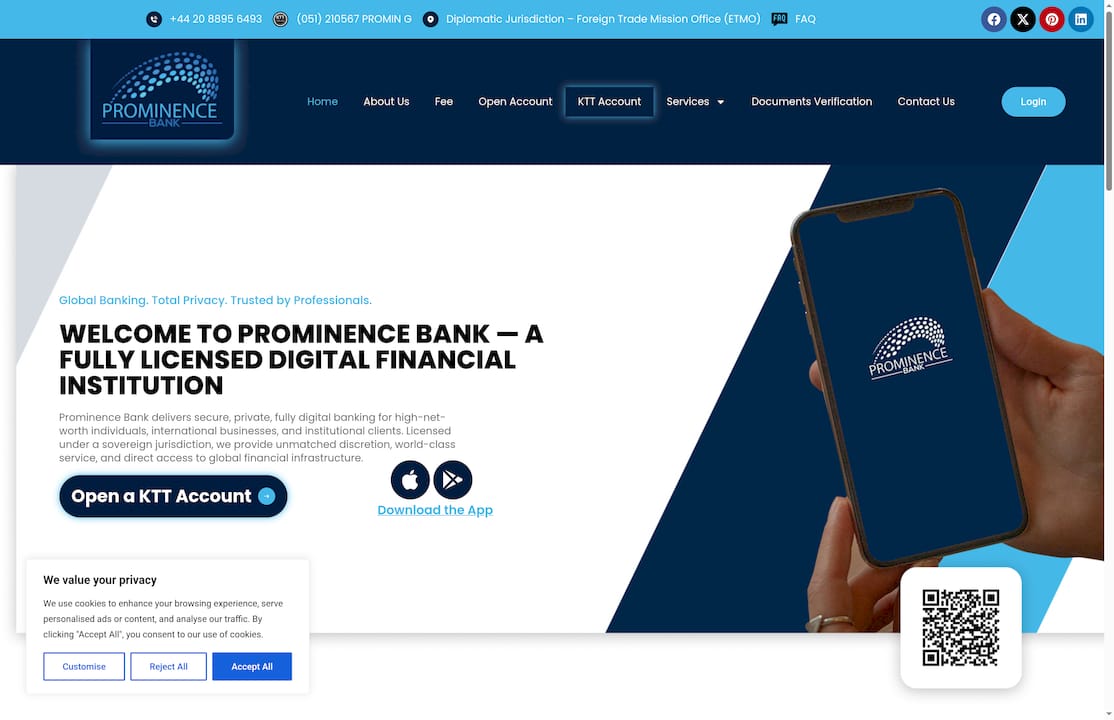
For HNWIs and international businesses, Prominencebank’s servicios bancarios privados include multi-currency business accounts, private numbered accounts (with full UBO verification held under strict confidentiality), KTT-enabled accounts, safekeeping receipts, trade finance, and institutional asset management. Every account is opened under AML/KYC standards, with restricted internal access controls and dedicated relationship management. Prominencebank operates under the sovereignty of the Extraterritorial Trade Mission Office (ETMO) and maintains compliance with international reporting obligations, so you get genuine discretion without the legal exposure that comes from attempting true anonymization. To begin, prepare your UBO documentation, entity structure, and source-of-funds records, then contact Prominencebank’s secure digital banking team to start the account-opening conversation.
Puntos clave
True anonymous bank accounts are prohibited under AML/KYC law; compliant privacy requires verified UBO disclosure to the bank combined with structural and operational controls that limit third-party access.
| Punto | Detalles |
|---|---|
| Anonymity is prohibited | FATF and U.S. AML rules ban accounts where the bank cannot identify the beneficial owner. |
| GLBA protects NPI, not identity | The Gramm-Leach-Bliley Act restricts third-party disclosure, not bank-side identification of clients. |
| Numbered accounts are not anonymous | The bank retains full UBO records; numbered accounts limit internal staff access only. |
| Structural privacy is the lawful route | Trusts, foundations, and disclosed corporate structures provide strong, compliant discretion. |
| Prominencebank delivers compliant discretion | Private numbered accounts, restricted access controls, and full AML/KYC compliance in one institution. |
Why privacy and compliance are the same goal
The clients who come to Prominencebank frustrated by the term “anonymous account” usually want the same thing: control over who sees their financial information. That is a legitimate goal, and it is entirely achievable within a regulated framework. What is not achievable, and what no reputable institution should promise, is hiding the beneficial owner from the bank itself.
The compliance-first approach is not a concession to regulators. It is the only structure that actually holds up when a counterparty challenges a transaction, a court issues a discovery order, or a tax authority asks questions. A trust or private-banking relationship built on full disclosure and proper documentation survives those challenges. An anonymous account does not, because it cannot exist in the first place.
Authoritative sources and further reading
- Financial Action Task Force (FATF): Primary international standard-setter on AML; defines anonymous accounts as prohibited and sets the 40 Recommendations that U.S. law implements.
- FTC — Financial Privacy: Overview of GLBA enforcement, the Financial Privacy Rule, and the Safeguards Rule for U.S. financial institutions.
- FDIC — Privacy Rule Handbook (GLBA): Detailed GLBA guidance on NPI protection, privacy notices, and opt-out rights.
- FDIC — Financial Privacy Consumer Guide: Plain-language explanation of what bank privacy protections cover and what they do not.
- AML Network — Anonymous Accounts Glossary: Definitions of anonymous accounts, CDD triggers, and nominee-structure risk under U.S. AML frameworks.
- U.S. Courts — Redaction Guidance: Federal guidance on effective document redaction, including the requirement to remove underlying text layers.
- Prominencebank — Numbered Accounts Explained: Prominencebank’s own explanation of how numbered accounts work within a compliant private-banking framework.
FAQ
What is bank account anonymization, exactly?
Bank account anonymization refers to any arrangement where the financial institution cannot identify the beneficial owner of an account. Under FATF standards and U.S. AML law, such arrangements are prohibited in regulated banking.
Is bank account anonymization legal in the United States?
No. U.S. AML rules require banks to verify the identity of all customers and beneficial owners. Accounts where the bank cannot identify the UBO are prohibited, and attempting to create one carries criminal exposure.
What does GLBA actually protect?
The Gramm-Leach-Bliley Act protects nonpublic personal information from disclosure to nonaffiliated third parties and requires banks to maintain data safeguards. It does not allow clients to remain anonymous to their own bank.
What is the difference between a numbered account and an anonymous account?
A numbered account replaces your name with an identifier for day-to-day operations, limiting how many bank staff see your identity. The bank still holds full UBO records and reports when required. It provides operational privacy, not anonymity.
How can HNWIs achieve strong financial privacy legally?
The most effective route combines a verified legal structure (trust, foundation, or disclosed corporate entity) with a private-banking relationship that includes restricted internal access controls, confidentiality agreements, and a dedicated relationship manager.