
Data residency in banking means one thing to an examiner: regulated data stays inside the legal and geographic boundaries your regulators approved, and you can prove it on demand. Proving it, not just claiming it, is where most banks get audited findings.
Meeting that bar requires four things working together: verified jurisdictional storage, keys you control rather than your cloud vendor, an immutable audit trail, and a documented legal basis for every cross-border transfer. Miss any one of these and an examiner has grounds to flag the program, regardless of how good your data map looks on paper.
The minimum control set auditors expect to see:
- Jurisdictional storage confirmed by region-tagged infrastructure reports, not vendor marketing claims
- Customer-managed encryption (BYOK or BYOE) so the provider cannot decrypt data even under a foreign compulsion order
- Tamper-evident, WORM-equivalent audit trails covering every access type: views, downloads, edits
- Documented transfer legal basis — Standard Contractual Clauses, Binding Corporate Rules, a completed Transfer Impact Assessment, or DORA Article 30 style contract language
- Vendor audit rights written into the contract, not assumed as a courtesy
Examiners rarely accept a policy document alone. They want system-generated evidence: key management system attestations showing who holds custody, region-tagged storage reports, and third-party attestations like SOC 2 or ISO 27001 confirming the controls actually operate as described.
Puntos clave
Data residency in banking succeeds only when jurisdictional storage, customer-held encryption keys, immutable audit trails, and documented transfer legal basis all operate together and are provable on demand.
| Punto | Detalles |
|---|---|
| Control your own keys | BYOK/BYOE with in-jurisdiction HSM custody is the single strongest control against foreign compulsion orders. |
| Map the full data lifecycle | Backups, analytics pipelines, and AI training data are more common residency failures than primary storage. |
| Contracts must name specifics | DORA Article 30 requires vendor contracts to state exact data location, key management, and audit rights. |
| Build one retention calendar | Combine FINRA, SOX, and KYC retention windows into a single schedule instead of tracking them separately. |
| Collect evidence continuously | KMS logs, region-tagged reports, and vendor SOC 2/ISO 27001 attestations should be ready before an exam, not assembled during one. |
This article is general information, not a substitute for advice from a qualified financial advisor. Consult a qualified financial professional about your own circumstances before acting on anything here.
Cuadro de contenidos
- Why Data Residency Is a Bank-Level Risk, Not an IT Checkbox
- Which Regulatory Frameworks Govern Data Residency for Banks?
- What Architecture Actually Proves Data Residency?
- How Should Banks Structure Vendor Contracts for Data Residency?
- How Long Must Banks Retain Data, and How Should Deletion Work?
- How Do You Turn Data Residency Policy Into an Audit-Ready Program?
- Sources
- FAQ
Why Data Residency Is a Bank-Level Risk, Not an IT Checkbox
A residency gap is not a technical footnote. It shows up as an exam finding, a blocked market entry, or in jurisdictions with banking secrecy statutes, personal criminal exposure for executives who signed off on the architecture.
The operational fallout is often worse than the fine. A bank that fails a cross-border data review can lose the ability to onboard clients in that jurisdiction until remediation is verified, sometimes for months. Procurement teams increasingly build residency attestations into RFPs, so a vendor’s inability to prove regional data control can eliminate them from a deal before pricing even comes up.
Residency also intersects with obligations banks tend to treat as separate workstreams. AML and KYC data often crosses borders through correspondent banking relationships, and each hop needs its own transfer justification. Model risk teams running CCAR stress tests frequently pull production data into shared analytics environments that were never mapped for residency. Generative AI tools compound this: training pipelines and RAG systems pull customer data into temporary processing environments that primary storage inventories completely miss, which is exactly why supervisors are paying closer attention to AI data provenance and third-party dependencies in BIS FSI’s review of AI data use in financial services.
Examiners have learned where the gaps usually hide, and their questions reflect it:
- Where do your backups and disaster recovery snapshots physically live, and does that match your primary storage jurisdiction?
- Can vendor support engineers access production data from outside the approved region, even temporarily?
- Does your DR failover plan preserve residency, or does failing over during an outage silently move data across a border?
A bank that cannot answer these three questions with system evidence, not a policy statement, is the bank that gets a follow-up letter.
Which Regulatory Frameworks Govern Data Residency for Banks?
No single law defines data residency in banking. Compliance means reconciling several overlapping regimes, and the strictest one in play sets your actual floor.
GDPR governs any bank touching EU customer data, regardless of where the bank is headquartered. Chapter V restricts transfers outside the EU/EEA unless a valid mechanism, adequacy decision, SCCs, or BCRs, is in place, and Article 33 requires notifying the supervisory authority within 72 hours of a breach.
DORA, in force since January 2025, adds a distinctly technical layer. Article 30 requires ICT contracts to specify exact data locations, key management arrangements, audit rights, and exit strategies. This turns architecture decisions into enforceable contractual obligations rather than internal IT preferences.
GLBA and the FFIEC handbooks set the US baseline for safeguarding customer financial information and expect banks to demonstrate vendor oversight over where and how data is processed. FINRA Rule 17a-4 y SOX retention requirements demand records be preserved in a non-rewriteable, non-erasable format, which directly shapes what counts as acceptable cloud storage. CFTC rules layer on similar retention expectations for derivatives-related recordkeeping. In Asia-Pacific, MAS Technology Risk Management guidelines in Singapore and APRA CPS 234 in Australia impose comparable third-party and data-control expectations for banks operating there.
| Framework | Core residency obligation | Evidence examiners expect |
|---|---|---|
| GDPR (EU/EEA) | Restrict transfers outside EU/EEA absent a valid mechanism; 72-hour breach notice | Executed SCCs/BCRs, transfer impact assessments, breach log |
| DORA (EU) | Article 30 contract terms on location, keys, audit rights, exit | ICT contracts naming location and key custody |
| GLBA/FFIEC (US) | Safeguard customer data; oversee vendor data handling | Vendor risk assessments, safeguards program documentation |
| FINRA 17a-4 / SOX (US) | Immutable, non-rewriteable recordkeeping | WORM-equivalent storage exports, third-party attestation |
| MAS TRM / APRA CPS 234 (APAC) | Third-party risk oversight, data control demonstration | Vendor due diligence reports, control testing evidence |
The hardest conflict for global banks is the US CLOUD Act versus GDPR Article 48: a US-headquartered cloud provider can be compelled to produce data stored in the EU, which directly undercuts an EU residency guarantee. The technical fix regulators now expect is customer-held encryption keys in an in-jurisdiction HSM, so a compelled provider hands over data it cannot actually decrypt. Overlapping US rules on retention windows also stack, and firms operating across multiple regimes must satisfy whichever obligation is most stringent, not the easiest one to meet. Prominencebank’s guía internacional de cumplimiento bancario walks through how these frameworks apply when a bank is running cloud infrastructure across several jurisdictions at once.
What Architecture Actually Proves Data Residency?
Three architecture patterns cover most banking use cases, and picking the right one depends on how international your client base is and how much control you need over the infrastructure itself.
A regional data plane with a hybrid control plane keeps all customer data processing within one jurisdiction while allowing a centralized management layer, monitoring, orchestration, non-sensitive metadata, to operate globally. This suits banks with distinct regional subsidiaries that each need clean data separation.
A jurisdiction-configurable private cloud or on-premises deployment gives the most direct control and the cleanest audit story, at the cost of higher operating overhead. It fits banks handling especially sensitive structures: private numbered accounts, custody, or trade finance instruments where a client’s expectation of discretion is part of the product itself.
A pseudonymization gateway pattern sits in front of analytics and machine learning pipelines, stripping or tokenizing identifiers before data leaves its home jurisdiction for centralized model training. This is increasingly the only workable option for banks running fraud models or credit scoring across multiple regions without duplicating infrastructure everywhere.

| Architecture pattern | Control of location and keys | Auditability for examiners | Best deployment mode | Mejor ajuste |
|---|---|---|---|---|
| Regional data plane, hybrid control | High, region-tagged with centralized oversight | Strong, unified logging across regions | Regional public cloud | Cross-border bank |
| Jurisdiction-configurable private cloud | Highest, full customer key custody | Strongest, direct infrastructure access | On-premises or private cloud | Domestic bank, high-discretion products |
| Pseudonymization gateway | Moderate, depends on tokenization strength | Good, but requires re-identification logs | Regional public cloud or hybrid | Large enterprise running cross-border analytics |
Providers like Oracle Cloud Infrastructure (OCI) offer region-specific sovereign cloud configurations that let banks pin workloads to a named jurisdiction with customer-controlled key management, useful for the regional-data-plane pattern above. For document-level protection, Kiteworks focuses on encrypted content governance with granular access logging, which fits well into the pseudonymization gateway approach when banks need auditable control over who touched a specific file and from where.
Whichever pattern you choose, the same controls have to be present:
- Customer-managed encryption (BYOK/BYOE) so your bank, not the cloud provider, holds decryption authority
- In-jurisdiction HSMs for key storage, physically located inside the approved region
- Geofencing and region tagging on every storage bucket, database, and compute instance
- Immutable audit logs in WORM-equivalent storage, covering access, edits, and deletions
- Tokenization or pseudonymization for any dataset feeding cross-border analytics or model training
- Disaster recovery configured to fail over within the same jurisdiction, not to the nearest available region
Residency failures rarely happen in primary storage. They happen in the places nobody inventories: backups, snapshots, analytics warehouses, monitoring exports, and temporary AI training environments that quietly replicate data outside the approved boundary. Third-party access points, vendor support staff logging in remotely for maintenance, are another common blind spot examiners specifically probe. Prominencebank’s security features guide for high-value clients covers how KMS and HSM controls get built into account infrastructure from the start rather than bolted on later.
Consejo profesional: Combine pseudonymization with strict key custody so your analytics team can still work: run models against tokenized data in a shared environment, but keep the re-identification key, and the ability to map a token back to a real customer, locked inside an HSM in the home jurisdiction. This lets you get cross-border insight without ever moving identifiable data across a border.
How Should Banks Structure Vendor Contracts for Data Residency?
Vendor architecture is now a legal compliance question, not just a procurement decision. A cloud contract that doesn’t name a data location or specify key custody is a liability, not a technical detail you can patch later.
A vendor assessment should cover, at minimum:
- Data location guarantees, named jurisdictions, not vague regional commitments
- Key management model, confirming whether the bank or the vendor holds decryption authority
- Audit rights, written into the contract, including the right to request evidence on demand
- Exit and portability terms, defining how data gets returned or destroyed if the relationship ends
- Subprocessor disclosure, since a vendor’s own subcontractors can quietly introduce a new jurisdiction
- Incident response timelines, matching or exceeding the 30-day maximum customer notification window US regulators now require
- Third-party attestations, SOC 2, ISO 27001, or equivalent WORM-storage certifications, current and renewable annually
Contract language should name these as explicit clause topics: a data location clause naming the jurisdiction, a key custody clause confirming BYOK obligations, an audit and regulatory access clause guaranteeing examiner access to vendor systems, an exit assistance clause covering transition timelines, and a penalty clause for unauthorized disclosure.
On transfer mechanisms: adequacy decisions work cleanly between approved jurisdiction pairs, but SCCs and BCRs remain the default for most cross-border banking relationships. A Transfer Impact Assessment should accompany every SCC to document the actual risk, particularly where the receiving country has broad government access laws. National handbooks recommend building a country-pair checklist that identifies data categories, localization requirements, and required approvals before any new cross-border flow goes live, rather than discovering the gap during an exam.
Consejo profesional: To satisfy DORA Article 30 and GDPR Chapter V in one motion, demand a single contract clause requiring the vendor to name the exact data location, confirm your bank holds the encryption keys, and grant your regulators direct audit access to the underlying infrastructure. One clause, three regulatory boxes checked.
Prominencebank’s approach to global business banking standards reflects this same logic in how it structures its own vendor relationships for institutional clients.
How Long Must Banks Retain Data, and How Should Deletion Work?
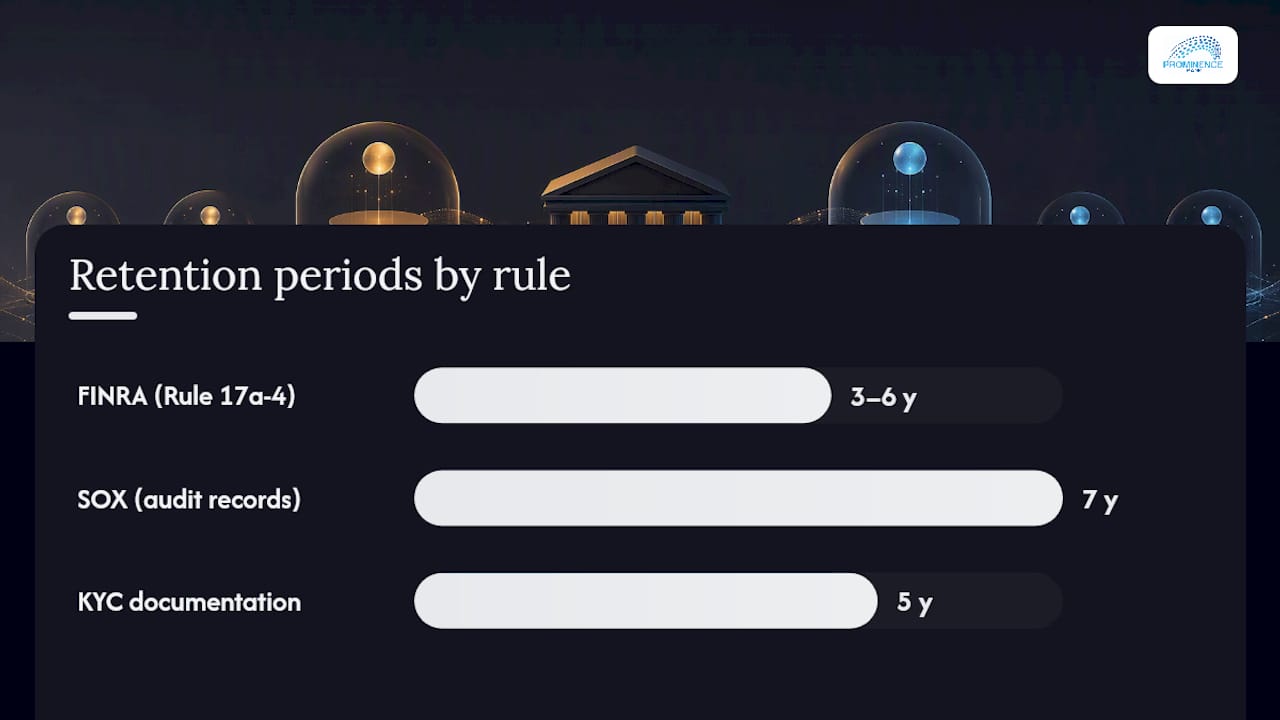
Retention rules stack rather than replace each other, so overlapping obligations need to be documented as a single combined schedule, not tracked separately by department. FINRA Rule 17a-4 typically requires three to six years depending on the record type, SOX requires seven years for audit-related financial records, and KYC documentation is commonly retained for five years after the relationship ends, based on overlapping US retention standards.
Meeting these retention windows while still honoring GDPR deletion requests requires immutable storage that still allows lawful erasure. In practice, that means:
- Write-once storage or append-only ledgers for anything covered by FINRA or SOX retention
- Tamper-evident logging that records every access, view, download, and edit, in a format examiners can pull on demand
- Third-party attestation confirming the storage genuinely meets WORM-equivalent standards, since self-certified compliance is the most common examiner objection
- A disposition queue where records flagged for deletion sit under compliance review before permanent removal
- Logged deletion evidence showing what was deleted, when, under whose authorization, and under which legal basis
Partial logging is the failure mode examiners flag most often: a system that logs downloads but not views, or edits but not access attempts, does not satisfy the audit trail requirement even if the storage itself is technically immutable.
The operational flow that satisfies most examiners: ingestion, classification against retention rules, enforcement through immutable storage, review in a disposition queue once the retention window closes, then deletion with a logged, timestamped evidence trail. Prominencebank’s guide to offshore custody accounts covers how this recordkeeping discipline applies specifically to custody and safekeeping receipt documentation.
How Do You Turn Data Residency Policy Into an Audit-Ready Program?
Translating architecture into an operational program needs named owners and a realistic sequence, not a single all-hands mandate.
- Legal completes the data mapping and identifies every cross-border flow, including backups and analytics pipelines
- Procurement adds residency gating to vendor RFPs, rejecting bids that can’t confirm data location and key custody
- InfoSec rolls out BYOK/BYOE across production systems and deploys in-jurisdiction HSMs
- Cloud Ops applies geofencing and region tagging to every storage bucket and compute resource, not just primary databases
- Cumplimiento collects vendor SOC 2 or ISO 27001 reports and confirms they cover the specific systems in use, not just the vendor’s general infrastructure
The evidence pack an examiner will actually ask for includes: completed Transfer Impact Assessments, KMS key custody logs showing who holds decryption authority, region-tagged storage reports, immutable audit exports, current vendor attestation reports, and signed contracts showing key custody clauses in writing.
Watch for these red flags before an examiner finds them first:
- Audit logs that can’t be exported or are missing entire access categories
- Vendor-held encryption keys with no documented BYOK arrangement
- Backups or DR snapshots sitting in an undocumented region
- Failover configurations that move data across a border during an outage, with no residency control applied
Recent Regulatory Signals Worth Citing in Your Policy
The SEC’s 2024 rule amendments require a written incident response program and set a hard ceiling: financial institutions must notify affected customers within 30 days of determining unauthorized access occurred, not 30 days from discovery.
That single deadline, 30 days maximum post-determination, has become a baseline that examiners now expect banks to cite by name in their own incident response documentation, alongside FINRA and FFIEC expectations for third-party attestation of cloud WORM-equivalent storage. Since DORA came into force, EU banking supervisors have also sharpened focus on Article 30’s key management language, treating vendor contracts that lack explicit key custody terms as a standalone finding, independent of whether an actual breach occurred.
Citing these sources by name in your residency policy, rather than paraphrasing them generically, gives examiners a direct line to verify your program against the actual regulatory text.
A Practitioner’s Note on Where Banks Actually Fail
Most residency programs fail in the same two places: nobody mapped where backups physically live, and nobody checked whether vendor support staff can access production data from outside the approved jurisdiction. Both are cheap to fix once identified and expensive to discover during an exam.
If you’re starting from scratch, map those two items first before touching architecture diagrams or contract language. Attach the actual regulatory citations, SEC, DORA Article 30, FINRA 17a-4, directly to your residency policy document rather than summarizing them in your own words. Examiners move faster, and trust the program more, when they can verify a claim against the primary source in seconds.
Data residency programs stall for a predictable reason: banks build the architecture before they’ve locked down the contracts that make the architecture legally enforceable. A regional data plane with customer-managed encryption means nothing if your vendor contract still lets a subprocessor route data through an unapproved jurisdiction. Get the contractual language and the technical controls moving in parallel, not sequentially. For banks building multi-currency operations across several regulatory regimes, that alignment between contract and architecture is the actual differentiator, not the cloud platform you picked. Prominencebank’s multi-currency account services are built around this same principle: jurisdiction-aware infrastructure paired with contractual clarity for institutional and high-net-worth clients who need both flexibility and demonstrable control over where their data and funds actually sit. If your institution is evaluating how to structure accounts across multiple jurisdictions without sacrificing auditability, Prominencebank’s Soluciones bancarias corporativas are built for exactly that kind of complexity.
Sources
- SEC press release 2024-58 (incident response rule amendments)
- In data we trust? Emerging policy and supervisory approaches to AI data use in financial services | BIS FSI
- Financial data compliance for financial services | Egnyte
- Data Sovereignty Handbook for Banks | ABS
- Data Sovereignty for Financial Services: Multi-Jurisdiction Guide | Kiteworks
FAQ
What does data residency mean in banking?
Data residency means regulated banking data is stored and processed only within the specific legal and geographic jurisdiction a regulator has approved, with technical and contractual evidence proving that boundary holds.
How is data residency different from data sovereignty and localization?
Residency is about where data physically sits; sovereignty covers which country’s laws govern that data regardless of location; localization is the strictest of the three, requiring data to never leave the country of origin at all.
What is the $3,000 rule in banking?
That rule refers to Bank Secrecy Act recordkeeping requirements for funds transfers and monetary instruments subject to retention and audit trail obligations covered in FINRA and SOX rules, not to data residency directly, though those records fall under the same retention and audit trail obligations covered in FINRA and SOX rules.
What’s the “Big Four” in banking?
In global finance, the “Big Four” typically refers to the four largest US banks by assets; the term has no direct bearing on data residency requirements, which apply to banks of every size operating across jurisdictions.
What are the “seven P’s” of banking?
There’s no single regulator-recognized “seven P’s” framework for banking; the phrase appears mostly in marketing and service-quality contexts rather than in compliance or data residency guidance, so treat any specific list you see with caution.