
Resumen:
- No American bank can provide complete anonymity due to strict KYC and AML regulations.
- However, structuring using LLCs, trusts, and operational discipline can limit public exposure of your identity.
No bank in the United States can offer you total anonymity. That is the short answer, and it matters. Under KYC and AML requirements, every financial institution must verify the identity of beneficial owners before opening an account. What you can control is how much of that identity becomes visible to the public, your competitors, or anyone who runs a search on your business.
Lawful privacy in business banking works through three realistic levers:
- Entity separation: Form an LLC, trust, or holding company that holds the account in its own name, keeping your personal name off public-facing records.
- Internal bank confidentiality: Work with a private bank that treats your information with discretion, uses encryption and access controls, and does not share data beyond regulatory requirements.
- Operational discipline: Route all payouts through the business account, pay yourself from the company, and never link personal payment rails to business billing.
The Corporate Transparency Act (CTA) added a layer in 2024: most U.S. entities must now report beneficial ownership information to FinCEN. That data goes to the government, not a public registry. Your name stays off Google; it does not stay off federal records.
Cuadro de contenidos
- What does “anonymity” actually mean in business banking?
- Why do HNWIs and international businesses seek banking privacy?
- How can you achieve lawful privacy through entity structures and banking practices?
- What must banks collect, and how do private banks protect your confidentiality?
- What does opening a private business account actually require?
- What compliance pitfalls can destroy your privacy protections?
- Puntos clave
- Privacy in banking is structural, not magical
- Prominencebank offers private banking built for complex structures
- Useful sources
- FAQ
What does “anonymity” actually mean in business banking?
There are two separate concepts most people collapse into one. The first is what the bank knows: your full legal identity, source of funds, and beneficial ownership. That is never optional. The second is what the public can discover: whether your name appears in state formation filings, court records, or commercial databases. That second layer is where structural privacy lives.
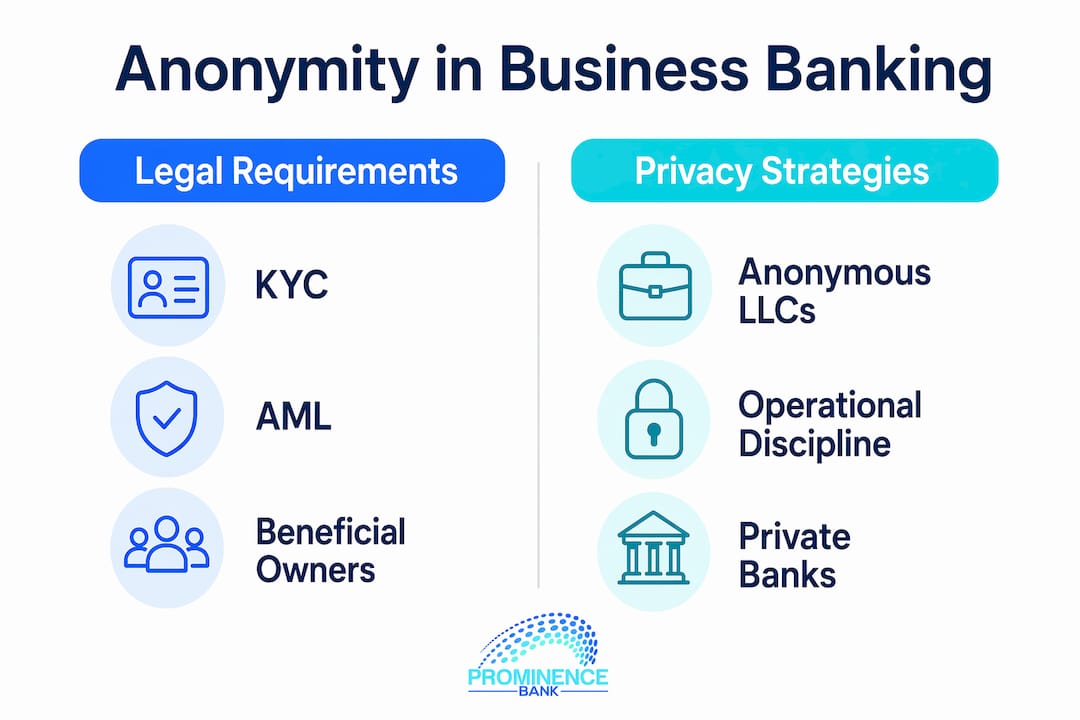
KYC and AML obligations under the Bank Secrecy Act require banks to collect and verify identity, screen against sanctions lists, and monitor transactions. None of that is negotiable. What a well-structured entity does is create a legal buffer between your personal identity and the public-facing business name, so that a creditor, competitor, or journalist searching public records finds the entity, not you.
The CTA changed the calculus for small entities. Beneficial ownership reports filed with FinCEN are accessible to law enforcement and certain financial institutions, but not to the general public. That distinction matters: government access and public access are not the same thing.
Consejo profesional: The weakest link in any privacy structure is operational, not legal. A single personal debit card charged to a business billing account, or a personal PayPal linked to company payouts, can unravel months of careful entity work. Maintain strict separation from day one.
Why do HNWIs and international businesses seek banking privacy?
The reasons are more varied than regulators sometimes acknowledge. Academic research frames identity shielding as a legitimate function of business entities, one that protects safety, preserves reputations, and encourages capital formation. It is not just a tool for the wealthy to hide assets.

Consider the documented cases: anonymous corporate vehicles were used to bring the first abortion drug to the U.S. market when no named pharmaceutical company would touch it. Columbia Law School analysis documents how Black entrepreneurs have used anonymous entities to compete more equitably in markets affected by systemic bias. Survivors of intimate partner violence have used business anonymity to build financial independence without exposing their location.
For high-net-worth individuals and international businesses, the motivations typically include personal physical safety, protection from targeted fraud, competitive confidentiality, investor privacy, and the ability to pursue politically or socially sensitive ventures without forced public disclosure.
Research insight: Scholarly analysis finds that identity shielding can encourage capital flow to enterprises that might otherwise never launch, functioning as a form of limited reputational liability alongside the more familiar limited financial liability.
How can you achieve lawful privacy through entity structures and banking practices?
Entity design is the foundation. Anonymous LLC formations in states like Wyoming, New Mexico, and Delaware can keep member names off public filing records entirely, provided you use a registered agent and file correctly. The bank still performs KYC on the beneficial owner. The public just does not see that name in the state database.
Layering a holding company above an operating LLC adds another degree of separation. Trusts can hold LLC membership interests, with a trustee appearing in records instead of the individual beneficiary. Nominee and trustee arrangements can provide public privacy when contracts and powers are correctly drafted, but banks will require beneficial owner disclosures and may ask for trustee resolutions, letters of direction, and full KYC on the underlying beneficiary.
Practical banking steps that preserve public separation:
- Open the account in the entity’s name using the entity’s EIN, not your Social Security number.
- Route all platform payouts (Stripe, PayPal, wire receipts) to the business account only.
- Pay yourself a formal salary or distribution from the company account, never direct from a client payment.
- Use a corporate card for all business expenses; never use a personal card on a business billing account.
- Keep formal corporate minutes and document source-of-funds evidence for significant deposits.
- Avoid using personal counterparty references on invoices or contracts tied to the business.
Consejo profesional: Offshore jurisdiction alone does not guarantee privacy. The effectiveness of any structure depends on entity design, where ownership is reported, and the bank’s own compliance procedures. A Wyoming LLC with sloppy transaction habits offers less real privacy than a straightforward domestic account with strict operational discipline.
For a deeper look at estrategias avanzadas de privacidad bancaria, the operational layer deserves as much attention as the legal layer.
What must banks collect, and how do private banks protect your confidentiality?
Banks are not optional participants in your privacy plan. They are required by law to gather specific information and act on it. Understanding what they collect, and why, helps you work with them rather than against them.
| Requisitos | What the bank collects | Why it is mandatory |
|---|---|---|
| Propiedad beneficiosa | Full legal identity of all owners above ownership threshold | BSA / FinCEN CDD Rule |
| Fuente de fondos | Business revenue documentation, bank statements | AML risk assessment |
| Sanctions screening | Name, nationality, jurisdiction checked against OFAC lists | U.S. sanctions compliance |
| Supervisión de las transacciones | Ongoing review of account activity for suspicious patterns | SAR filing obligations |
| Document certification | Certified copies of formation docs, passports, utility bills | KYC onboarding standard |
Suspicious activity reporting obligations mean a bank can file a SAR without notifying you, and account action can follow. That is not a failure of the bank’s confidentiality promise; it is a legal override that applies to every institution. What reputable private banks protect is your information from commercial disclosure, data brokers, and unauthorized internal access.
Trust signals to request from any private bank before opening an account:
- Published licensing and charter documentation (jurisdiction, regulator name)
- Written AML/KYC policy available on request
- Evidence of independent audits or third-party attestations
- Encryption standards and access control documentation
- Documented onboarding due diligence process
- Clear data retention and breach notification policy
For a full breakdown of what KYC and AML requirements mean for high-net-worth clients specifically, the compliance obligations differ in scope from retail banking.
What does opening a private business account actually require?
Preparation supports a complete review but does not start or guarantee the estimated processing period. Here is what to have ready before you contact a private bank:
- Certified Articles of Organization or Incorporation
- Operating Agreement or Shareholder Agreement (showing ownership structure)
- EIN confirmation letter from the IRS
- Beneficial owner affidavits with government-issued ID
- Source-of-funds documentation (audited financials, tax returns, or investment statements)
- Certified translations of any non-English documents
- Registered agent confirmation and state filing receipts
Timeline: Entity formation takes 1–4 weeks depending on state and expedite options. Document certification and apostilles add another 1–3 weeks. Those pre-application steps are separate from Prominence Bank’s account-opening estimate. Prominence Bank normally completes account opening within 48 to 72 hours after all required KYC/AML procedures have been completed and all requested information and documentation have been received, verified, and accepted. This is an estimated processing period, not a guaranteed deadline. Additional time may be required if further compliance, verification, or due-diligence review is necessary. Submitting an enquiry, application, or payment does not start the estimated processing period and does not guarantee account approval or activation.
Costs: Privacy-oriented banking providers commonly charge non-refundable onboarding and due diligence fees, ongoing monthly service fees, and transactional fees that vary by client profile and services used. These costs reflect the additional compliance work involved. A payment does not start the estimated processing period and does not guarantee account approval or activation.
| Fee category | Notas |
|---|---|
| Account opening / due diligence | Fees vary based on entity complexity and jurisdiction, often non-refundable |
| Monthly service / custody fee | Ongoing fees that depend on account type and services |
| Tasas de transacción | Charged per transaction including wires and currency conversions |
| Document issuance (SKR, KTT) | Specialty services that may incur separate charges |
Questions to ask the bank before committing: What jurisdiction are you licensed in, and who is your regulator? What is your AML program and how are SARs handled? How is client data stored and who has internal access? Do you offer nominee or numbered account services, and what documentation do they require? What is your account closure and fund repatriation process?
What compliance pitfalls can destroy your privacy protections?
The most common errors are not exotic. They are mundane operational failures that trigger scrutiny.
- Commingling funds: Using a business account for personal expenses, or vice versa, is the fastest way to collapse the legal separation your entity structure created.
- Unvetted intermediaries: Using formation agents or payment processors without verifying their own compliance posture can introduce AML risk into your structure. AML enforcement in high-risk sectors, including commodities and cross-border flows, has intensified significantly.
- Ignoring tax obligations: Privacy does not mean tax invisibility. FBAR, FATCA, and GILTI rules apply to U.S. persons regardless of entity structure or offshore account location.
- Routing through high-risk jurisdictions without disclosure: Banks will flag undisclosed connections to sanctioned or high-risk jurisdictions. Disclose proactively; surprises during monitoring are worse than upfront complexity.
- Lack of source-of-funds documentation: Large deposits without supporting documentation are a primary SAR trigger.
Consequences for intentional evasion are severe: account freezes, civil penalties, criminal referral, and reputational damage that follows the individual, not just the entity. The goal of privacy structures is lawful separation, not concealment from regulators.
Puntos clave
Lawful business banking privacy in the United States requires entity separation, operational discipline, and a bank that treats compliance and confidentiality as complementary, not competing, obligations.
| Punto | Detalles |
|---|---|
| No total anonymity exists | Banks must verify beneficial owners under BSA/KYC rules; the bank always knows who you are. |
| Public privacy is achievable | Anonymous LLCs in select states and trust structures keep your name off public records while satisfying KYC. |
| Operational discipline is critical | Linking personal payment rails to a business account is the most common way privacy structures fail in practice. |
| Compliance is non-optional | SARs, OFAC screening, and CTA reporting apply regardless of entity structure or offshore jurisdiction. |
| Prominencebank serves this need | Prominencebank offers multi-currency business accounts, private/numbered accounts, and KYC-compliant onboarding for HNWIs and international businesses. |
Privacy in banking is structural, not magical
The framing I see most often get this wrong: people treat banking privacy as something a bank grants you, like a feature you can toggle on. It is not. Privacy is something you build into your structure before you walk through the bank’s door, and then maintain through every transaction afterward.
What actually works is the combination: a properly formed entity in a privacy-friendly state, a bank that understands complex structures and does not treat every HNW client as a compliance liability, and transaction habits that never blur the line between personal and business. The legal structure is the skeleton. The operational habits are what keep it standing.
The other thing worth saying plainly: the Corporate Transparency Act did not end business privacy. It moved beneficial ownership disclosure from state public registries to a federal government database. That is a meaningful distinction for most legitimate privacy use cases. Your competitors, journalists, and data brokers still cannot access FinCEN’s beneficial ownership database. Law enforcement can.
Prominencebank’s approach reflects this reality. The bank performs full KYC and AML compliance on every client. What it protects is your information from commercial exposure, unauthorized internal access, and data aggregators, not from regulators. That is the honest version of what private banking confidentiality means, and it is the only version worth trusting.
Prominencebank offers private banking built for complex structures
For high-net-worth individuals and international businesses that have done the entity work, the next challenge is finding a bank that can actually handle the structure. Most retail and commercial banks are not equipped for multi-layered holding companies, offshore corporate accounts, or KTT-enabled onboarding. Prominencebank is.
Prominencebank ofrece Cuentas comerciales multicurrencia, private and numbered account options, offshore corporate account workflows, and custody and treasury services designed for clients who need both discretion and global reach. The bank operates under full licensing with published AML/KYC policies, independent compliance oversight, and end-to-end encryption on client data. Onboarding is KYC-rigorous by design, not despite the privacy focus but because of it. Clients who want a bank that treats compliance and confidentiality as the same goal, not opposing ones, will find that Prominencebank’s Soluciones bancarias corporativas are built for exactly that. To start the account inquiry process, visit Prominencebank’s account setup page and have your entity documentation ready before the first call.
Useful sources
The following authoritative sources informed this article and are recommended for further reading:
- FDIC Bank Secrecy Act resources: Primary U.S. regulatory guidance on KYC, AML, SAR obligations, and bank compliance programs.
- Duke Law Journal: Identity shielding in business entities: Peer-reviewed academic analysis of the legitimate privacy functions of anonymous companies.
- Columbia Law School: The virtues of anonymous ownership: Case studies and policy analysis on legitimate uses of business anonymity.
- Wolters Kluwer: Anonymous LLCs: State-by-state guidance on anonymous LLC formation requirements.
- LLCAttorney: Anonymous LLC bank accounts: Practical explanation of nominee services and their limits in banking.
- Prominencebank: Confidentiality in private banking: Prominencebank’s published approach to client confidentiality and security controls.
- SSRN: Anonymous companies (academic paper): Scholarly framework for balancing the harms and benefits of business anonymity in policy.
FAQ
Can a U.S. business bank account be truly anonymous?
No. U.S. banks must verify the identity of all beneficial owners under the Bank Secrecy Act and FinCEN’s Customer Due Diligence Rule. Public anonymity through entity structures is achievable; bank-level anonymity is not.
Does the Corporate Transparency Act eliminate business privacy?
Not for most legitimate use cases. The CTA requires beneficial ownership reporting to FinCEN, a federal government database, but that information is not accessible to the public, competitors, or commercial data brokers.
What states allow anonymous LLC formation?
Wyoming, New Mexico, and Delaware are the most commonly used states for anonymous LLC formation, where member names can be kept off public filing records when a registered agent is used correctly.
What documents does a private bank typically require at onboarding?
Expect to provide certified Articles of Organization, an operating agreement, an EIN confirmation letter, government-issued ID for all beneficial owners, and source-of-funds documentation such as audited financials or tax returns.
Does Prominencebank offer private accounts for international businesses?
Yes. Prominencebank provides multi-currency business accounts, private and numbered account options, and offshore corporate account workflows with full KYC-compliant onboarding for high-net-worth individuals and international corporate clients.