
Resumen:
- Setting up international bank accounts involves choosing the right account types and completing mandatory documentation accurately. A proper sequence includes establishing a fintech account first, registering residence, obtaining a tax ID, and then applying for a traditional local account. Ongoing compliance with U.S. and international reporting rules remains essential, with severe penalties for non-compliance.
International account setup is the process of opening and managing bank accounts across foreign jurisdictions to facilitate cross-border transactions, currency management, and asset diversification. Whether you are an expat relocating abroad or a corporation expanding into new markets, the process requires navigating Know Your Customer (KYC) and Anti-Money Laundering (AML) compliance frameworks, along with reporting obligations like FBAR and FATCA. This guide to international account setup covers every stage: account types, documentation requirements, step-by-step procedures, and ongoing compliance duties that apply in 2026’s tightening regulatory environment.
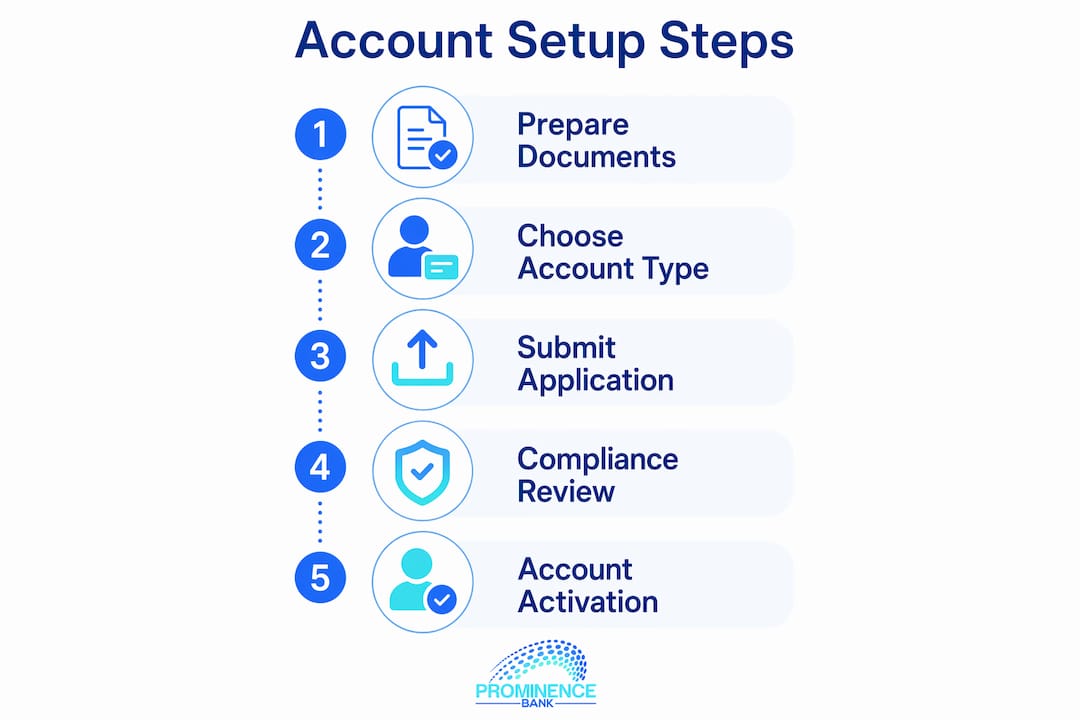
What types of international accounts exist?
International banking setup begins with choosing the right account category. The wrong choice creates friction from day one.

Personal foreign bank accounts serve expatriates, non-residents, and high-net-worth individuals who need to hold assets, receive income, or pay expenses in a foreign currency. These accounts typically require proof of local residence and a tax identification number in the target country.
Corporate international accounts support global business operations, payroll in multiple currencies, and cross-border supplier payments. They carry stricter compliance requirements, including ownership transparency and documented business rationale.
Fintech borderless accounts provide multi-currency wallets and digital convenience. Prominence Bank normally completes account opening within 48 to 72 hours after all required KYC/AML procedures have been completed and all requested information and documentation have been received, verified, and accepted. This is an estimated processing period, not a guaranteed deadline. Additional time may be required if further compliance, verification, or due-diligence review is necessary. Submitting an enquiry, application, or payment does not start the estimated processing period and does not guarantee account approval or activation. They are ideal for managing currency movement before a traditional account is established, though they often lack local IBANs needed for domestic direct debits.
Traditional local accounts remain necessary for paying rent, utilities, and local salaries. They also provide access to credit facilities that fintech accounts cannot offer. Understanding fintech’s role in offshore accounts helps clarify when each account type adds the most value.
What are the requirements for international accounts?
The documentation requirements for opening a foreign account are non-negotiable. Incomplete paperwork means the estimated processing period has not started and may require follow-up without a formal rejection.
For individual applicants
- Valid government-issued photo ID (passport preferred for international applications)
- Proof of address dated within the last three months (utility bill, bank statement, or lease agreement)
- Local tax identification number from the target jurisdiction
- Source of funds declaration and, in some cases, a reference letter from your current bank
For corporate applicants
- Certificado de constitución y artículos de asociación
- Beneficial ownership register showing all shareholders above a defined threshold
- Audited financial statements or management accounts
- Detailed business plan explaining the account’s purpose in that jurisdiction
- Proof of economic substance such as a local office address, employees, or active business operations
Individual initial deposits range from $0 to $1,000, while corporate accounts typically require between $1,000 and $50,000 depending on the jurisdiction and institution. That gap reflects the higher compliance cost banks absorb when onboarding business clients. Professional services to obtain a local tax identification number cost between $50 and $150 per application, a modest expense that can reduce missing-prerequisite issues.
Consejo profesional: Gather every document in certified English translation before you begin any application. Banks in non-English-speaking jurisdictions may require English translations for AML review; missing translations mean the estimate has not started and may require follow-up.
How do you open an international account step by step?
The correct sequence for steps to set up a foreign account matters as much as the documents themselves. Applying out of order causes the most common and most avoidable rejections.
For individuals and expats
- Open a fintech borderless account first. Before you relocate, set up a multi-currency account with a digital provider. This gives you access to foreign currency once the account is approved and a place to receive funds while you complete local registration.
- Register your residence. Most countries require formal address registration with a municipal authority. This step generates the documentation banks need to verify your local ties.
- Obtain your local tax identification number. This follows residence registration and is a prerequisite for most traditional bank applications.
- Apply for a traditional local account. With residence proof, a tax ID, and your fintech account already operational, the application is better prepared for review, without changing or guaranteeing the estimate.
For corporations
- Select your jurisdiction carefully. The jurisdiction determines your tax obligations, reporting requirements, and the level of scrutiny your account will face.
- Prepare a detailed business plan. Banks require documented justification for why the account is needed in that specific country. Vague answers fail compliance interviews.
- Demonstrate economic substance. Corporate accounts require proof of genuine local activity. A registered address alone is insufficient. Banks want to see employees, contracts, or active operations.
- Submit the application and attend compliance interviews. Prominence Bank normally completes account opening within 48 to 72 hours after all required KYC/AML procedures have been completed and all requested information and documentation have been received, verified, and accepted. This is an estimated processing period, not a guaranteed deadline. Additional time may be required if further compliance, verification, or due-diligence review is necessary. Submitting an enquiry, application, or payment does not start the estimated processing period and does not guarantee account approval or activation. Plan your cash flow accordingly.
- Maintain ongoing documentation. Banks conduct periodic reviews. Keep your business plan, financials, and ownership structure current.
Consejo profesional: For corporate applicants, treat the compliance interview as a business presentation. Prepare a one-page summary of your company’s activities, revenue sources, and reason for banking in that jurisdiction. Banks respond well to clients who arrive prepared.
El international business account workflow for complex structures often requires additional steps around beneficial ownership disclosure, particularly for holding companies and trusts.
How should you combine fintech and traditional accounts?
A two-account strategy is the expert-recommended approach for both expats and international businesses. Fintech accounts handle currency movement; traditional local accounts handle domestic financial life.
| Tipo de cuenta | Best use | Key limitation |
|---|---|---|
| Fintech borderless account | Multi-currency transfers, international payments, bridge liquidity | Often lacks a local IBAN; may face “IBAN discrimination” from domestic payees |
| Traditional local bank account | Rent, utilities, local salaries, credit access | Stricter documentation; limited multi-currency capability |
“IBAN discrimination” is a real operational problem. Some landlords, utility providers, and payroll systems reject payments from non-local IBANs. A local bank account eliminates that friction entirely. The fintech account remains the workhorse for cross-border currency moves, while the local account handles everything that requires a domestic banking relationship.
You can track multiple bank accounts across jurisdictions using tools designed for multi-account management, which reduces the administrative burden of running parallel accounts. The key discipline is keeping the two accounts clearly separated by function. Mixing them creates confusion during tax reporting and complicates AML reviews.
What ongoing compliance obligations do account holders face?
Opening the account is the beginning, not the end, of your compliance responsibilities. AML and KYC requirements apply continuously, not just at onboarding.
For U.S. persons, the reporting obligations are specific and carry severe penalties:
- FBAR (FinCEN Form 114): Required annually if the aggregate value of all foreign financial accounts exceeds $10,000 at any point during the calendar year.
- FATCA (IRS Form 8938): Applies to U.S. taxpayers with higher thresholds of foreign financial assets. Thresholds vary by filing status and residency.
- Penalties: FBAR and FATCA non-compliance carries civil penalties that can reach tens of thousands of dollars per violation. Criminal penalties apply for willful violations.
Internationally, the Common Reporting Standard (CRS) governs automatic information exchange between over 100 participating countries. If you hold accounts in a CRS jurisdiction, your account information is reported to your home country’s tax authority automatically. There is no opt-out.
Best practices for staying compliant include maintaining a dedicated folder for each foreign account with annual statements, transaction records, and correspondence. File FBAR and FATCA reports by their respective deadlines. Review your account structures annually, particularly if ownership or residency status changes. The Necesidades de apertura de cuentas mundiales for high-net-worth clients add another layer of due diligence that applies throughout the account’s life, not just at opening.
Puntos clave
Successful international account setup requires the correct sequence of steps, complete documentation, and continuous compliance, not just a one-time application.
| Punto | Detalles |
|---|---|
| Sequence matters | Register residence and obtain a tax ID before applying for a traditional local account. |
| Two-account strategy | Use fintech accounts for currency movement and local bank accounts for domestic payments and credit. |
| Corporate substance is mandatory | Banks reject corporate accounts without proof of genuine local business activity. |
| U.S. reporting is non-negotiable | FBAR triggers at $10,000 in aggregate foreign account balances; penalties for non-compliance are severe. |
| Prominence Bank account-opening policy | Prominence Bank normalmente completa la apertura de la cuenta dentro 48 a 72 horas después de todo lo necesario KYC/AML se han completado los procedimientos y se ha recibido, verificado y aceptado toda la información y documentación solicitadas. Este es un período de procesamiento estimado, no un plazo garantizado. Es posible que se requiera tiempo adicional si es necesario realizar un nuevo examen de cumplimiento, verificación o debida diligencia. La presentación de una consulta, aplicación o pago no inicia el período de procesamiento estimado y no garantiza la aprobación o activación de la cuenta. |
What I’ve learned from watching international account setups succeed and fail
The single most consistent mistake I see is sequence failure. Clients arrive at a traditional bank application without a local tax ID, without residence registration, and without a fintech account to bridge the gap. The bank may decline the application or require additional information. The fix is simple: treat the fintech account as your operational base while you build the local infrastructure that traditional banks require.
For corporate clients, the compliance interview is where deals are won or lost. Banks are not trying to reject you. They are trying to understand your business. Clients who walk in with a clear, documented explanation of their operations, their revenue sources, and their reason for banking in that jurisdiction pass. Clients who treat it as a formality fail. Offshore structures without genuine economic substance face near-certain rejection in 2026’s environment. That is not a trend. It is the new baseline.
The guide for expat banking that actually works is not about finding the easiest bank. It is about building the right foundation: fintech first, residence registration second, tax ID third, traditional account fourth. Every shortcut in that sequence costs more time than it saves.
Ongoing compliance is where I see the most dangerous complacency. The digital convenience of modern banking creates a false sense that reporting obligations are someone else’s problem. They are not. FBAR and FATCA apply regardless of how the account was opened or how easy it is to access. Set a calendar reminder for annual filings before you open the first account.
- Harold
Prominencebank’s multi-currency accounts for global clients
Managing accounts across multiple jurisdictions requires a banking partner that understands both the compliance requirements and the operational demands of global finance.
Prominencebank ofrece Soluciones de cuenta multicurrencia built for high-net-worth individuals and international businesses that need more than a basic foreign account. The bank operates under full AML/KYC compliance standards and provides direct access to global financial infrastructure, including KTT-enabled account structures for clients with complex cross-border needs. For corporations, Prominencebank’s Soluciones bancarias corporativas support multi-entity structures with the documentation and compliance support that traditional banks rarely provide at this level of service.
FAQ
What documents do I need to open a foreign bank account?
Individual applicants need a valid passport, proof of address, a local tax identification number, and a source of funds declaration. Corporate applicants additionally need incorporation documents, a beneficial ownership register, financial statements, and a documented business rationale.
How long does international account setup take?
Prominence Bank normalmente completa la apertura de la cuenta dentro 48 a 72 horas después de todo lo necesario KYC/AML se han completado los procedimientos y se ha recibido, verificado y aceptado toda la información y documentación solicitadas. Este es un período de procesamiento estimado, no un plazo garantizado. Es posible que se requiera tiempo adicional si es necesario realizar un nuevo examen de cumplimiento, verificación o debida diligencia. La presentación de una consulta, aplicación o pago no inicia el período de procesamiento estimado y no garantiza la aprobación o activación de la cuenta.
Do U.S. citizens have to report foreign bank accounts?
Yes. U.S. persons must file FBAR (FinCEN Form 114) annually if total foreign account balances exceed $10,000 at any point during the year. FATCA reporting under IRS Form 8938 applies at higher asset thresholds.
Can I open an international account without visiting the bank in person?
Many fintech borderless accounts and digital banking institutions allow fully remote onboarding. Traditional local banks in most jurisdictions still require in-person identity verification at some stage of the process.
What is the minimum deposit for a corporate international account?
Corporate account minimum deposits typically range from $1,000 to $50,000 depending on the jurisdiction and the institution’s client tier requirements.