Resumen:
- An effective international business account workflow requires proper entity formation, comprehensive KYC, AML, and FBAR compliance. It also depends on well-integrated technology, automated approval processes, and clear governance structures to prevent operational delays and governance gaps. Building this foundation before scaling ensures efficient cross-border financial management and regulatory compliance.
An international business account workflow is the structured process corporations use to open, manage, and maintain global financial accounts while meeting compliance obligations across multiple jurisdictions. For decision-makers running multi-entity operations, this process covers everything from entity formation and KYC documentation to payment approval matrices and ERP integration. Getting it right from the start separates companies that scale efficiently from those that spend years fixing governance gaps. The core standards governing this workflow include AML (Anti-Money Laundering), KYC (Know Your Customer), and FBAR reporting requirements.
What does an effective international business account workflow require?
The foundation of any cross-border account workflow is the right corporate structure. Before a bank will open an account for a foreign entity, it needs proof that the legal entity exists, is properly governed, and meets local regulatory requirements. Formación de Entidades typically takes 6–12 months for a full legal subsidiary, while using an Employer of Record (EOR) for initial operational presence takes 8–16 weeks. That timeline difference matters when you are planning market entry against a budget cycle.

Compliance requirements you cannot skip
Three regulatory frameworks apply to virtually every international account setup:
- KYC (Conoce a tu cliente): Banks require verified identification for all beneficial owners, directors, and authorized signatories. This includes government-issued IDs, proof of address, and corporate registration documents.
- AML (Lavado Anti-Money): Corporations must demonstrate the source of funds and provide a clear business purpose for the account. Ongoing transaction monitoring is required post-opening.
- FBAR (Foreign Bank Account Report): U.S. persons and entities must file FBAR when aggregate foreign account balances exceed $10,000 at any point during the year. Missing this filing carries severe civil and criminal penalties.
Documentation checklist
Every international account opening requires a core document set. Prepare these before approaching any bank:
| Document | Purpose |
|---|---|
| Certificate of incorporation | Proves legal entity existence |
| Articles of association | Defines corporate governance structure |
| Beneficial ownership register | Satisfies KYC for all owners above threshold |
| Resolución de la Junta | Authorizes account opening and signatories |
| Proof of business address | Confirms operational presence |
| Fuente de la declaración de fondos | Meets AML requirements |
Technology and governance infrastructure
Integrating international bank accounts with ERP or accounting software via API or native connectors is critical for efficiency. Manual file uploads create reconciliation errors and audit delays. Assign clear stakeholder roles before account opening: a treasury manager owns banking relationships, a compliance officer owns KYC/AML documentation, and a CFO or controller approves the governance framework.
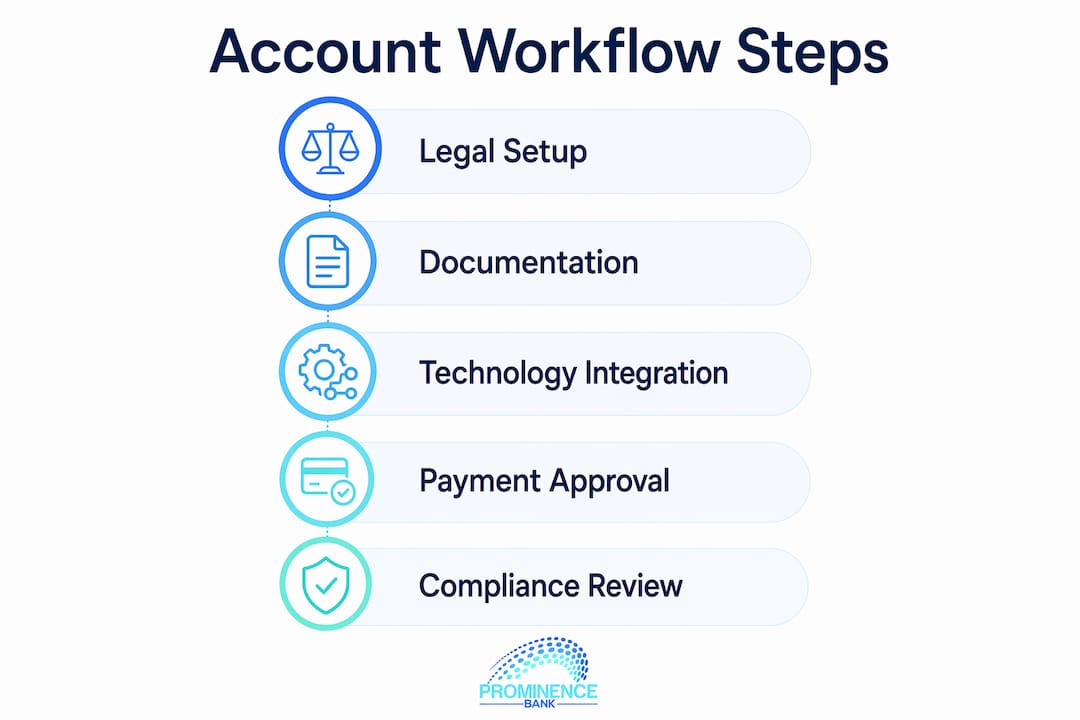
How to open and set up international business accounts
A step-by-step approach prevents the most common failure mode: starting the banking process before the legal entity is ready.
- Form the legal entity or engage an EOR. Confirm the corporate structure matches the banking jurisdiction’s requirements. Some countries require a local director or minimum share capital.
- Prepare the full KYC/AML document package. Gather all beneficial ownership information, board resolutions, and source of funds documentation before contacting any bank. Submitting an incomplete application does not start the estimated processing period; it begins only after all required KYC/AML procedures are complete and all requested information and documentation have been received, verified, and accepted.
- Select the right banking partner. Choose a bank that supports multi-currency account setup and offers API connectivity to your ERP. Verify that the bank operates under a recognized regulatory framework.
- Submit the application and complete due diligence. Prominence Bank normalmente completa la apertura de la cuenta dentro 48 a 72 horas después de todo lo necesario KYC/AML se han completado los procedimientos y se ha recibido, verificado y aceptado toda la información y documentación solicitadas. Este es un período de procesamiento estimado, no un plazo garantizado. Es posible que se requiera tiempo adicional si es necesario realizar un nuevo examen de cumplimiento, verificación o debida diligencia. La presentación de una consulta, aplicación o pago no inicia el período de procesamiento estimado y no garantiza la aprobación o activación de la cuenta.
- Configure multi-currency capabilities and payment rails. Set up the currencies you need from day one. Activating SWIFT, SEPA, or local payment rails after the fact adds delays.
- Integrate with your accounting or ERP system. Use API or native connectors to enable real-time, bidirectional transaction syncs. This eliminates manual ledger entries and supports audit-ready reconciliation.
- Fund the account and run a test transaction. Confirm that payment routing, currency conversion, and transaction notifications work correctly before routing live business payments.
Consejo profesional: Before submitting your KYC package, have your compliance officer run a pre-submission checklist against the specific bank’s requirements. Banks in different jurisdictions have different thresholds for beneficial ownership disclosure, often 10% or 25%. Submitting the wrong threshold triggers a request for additional information and may require review beyond the estimate.
Localization goes beyond product and pricing. Full financial backend localization, including payments, local tax IDs, and support currency, directly affects the speed and cost of cross-border operations. Build this into the account setup phase, not after go-live.
How to design a payment approval and transaction workflow
A payment approval workflow is the governance layer that sits between a payment request and actual fund movement. Without it, multi-entity organizations face either bottlenecks at headquarters or unauthorized payments at the local level.
The core design principle is a centralized approval matrix with automated controls. Relying on email chains for payment approvals is the most common pitfall in multi-entity finance. It creates audit gaps, slows payments, and makes it impossible to enforce segregation of duties consistently.
Key elements of a payment approval matrix
- Threshold tiers: Define approval authority by payment amount. Payments under $5,000 may require one approver; payments above $50,000 require CFO sign-off. Set these thresholds per entity, not just globally.
- Role segregation: The person who creates a payment must not be the person who approves it. This is a basic internal control requirement under most audit frameworks.
- Automated routing: Use your treasury management system or AP automation platform to route payments to the correct approver based on amount, entity, currency, and payment type. Manual routing creates delays and errors.
- Audit trail: Every approval action must be logged with a timestamp, user ID, and IP address. This is non-negotiable for AML compliance and external audits.
- Escalation protocols: Define what happens when an approver is unavailable. Unresolved escalations are a leading cause of payment delays in international operations.
Consejo profesional: Build your approval matrix in a dedicated expense approval platform rather than inside your ERP. ERP approval workflows are often rigid and difficult to audit. Dedicated platforms give you configurable rules, real-time visibility, and cleaner audit logs.
Payment status tracking is the final piece. Every payment should have a visible status from submission through settlement. Teams managing overseas business processes need to know whether a payment is pending approval, in transit, or settled, without calling the bank or checking email.
What are common challenges in international account workflows?
The most damaging problems in cross-border business operations are not technical. They are governance failures that compound over time.
The “governance gap” is the most common root cause of workflow failure. It arises when decision rights and approval workflows are undefined before market entry. Local teams either wait on headquarters for every decision or make unilateral calls that bypass compliance controls. Both outcomes are expensive.
Common challenges and their fixes:
- Incomplete KYC documentation: Assign a single compliance owner per entity. That person is responsible for maintaining current documentation, including updated beneficial ownership records when shareholders change.
- Manual reconciliation errors: API integrations between your bank and ERP eliminate the manual import/export cycle. If your bank does not offer API connectivity, that is a signal to reconsider the banking relationship.
- Inconsistent approval enforcement: Automated approval matrices remove the human variable. If approvals still run through email, the matrix exists on paper only.
- Scaling too fast: Testing workflows in one market before expanding globally reduces operational risk significantly. Stress-test your payment workflow, reconciliation process, and compliance reporting in a single entity before replicating it across ten.
“International expansion is a permanent commitment, not a project. Treat the workflow infrastructure the same way.”
International account tracking across multiple entities requires a single source of truth. Whether that is a treasury management system or a well-configured ERP, every entity’s account balances, pending payments, and compliance status should be visible in one place.
Escapadas clave
A well-designed international business account workflow combines compliant entity setup, automated payment controls, and real-time ERP integration to eliminate governance gaps before they become operational failures.
| Punto | Detalles |
|---|---|
| Build the legal entity first | Entity formation takes 6–12 months; start before approaching any bank. |
| Complete KYC/AML upfront | Incomplete documentation does not start the estimated processing period; it begins only after KYC/AML is complete and all requested information and documentation have been received, verified, and accepted. |
| Automate payment approvals | Centralized approval matrices with threshold tiers prevent audit gaps and delays. |
| Integrate via API | Real-time ERP syncs eliminate manual reconciliation errors and support clean audits. |
| Test before scaling | Validate your full workflow in one market before replicating across multiple jurisdictions. |
What I’ve learned about workflow governance the hard way
The conventional advice on international account workflows focuses on documentation and technology. Both matter. But the piece that actually breaks organizations is governance design, and almost nobody addresses it before the first hire lands in a new market.
I have seen well-capitalized companies spend months untangling payment approvals that ran through a regional manager’s personal email because nobody defined the approval matrix before go-live. The fix was not a new platform. It was a one-page governance document that should have existed on day one.
The other lesson: start small and prove the workflow before scaling. One entity, one market, one complete cycle from account opening through reconciliation and compliance reporting. If that cycle runs cleanly, you have a template. If it does not, you find out before the problem exists in ten countries simultaneously.
The tension between local autonomy and enterprise oversight is real. Local finance teams need the authority to move fast. Headquarters needs visibility and control. The answer is not to centralize everything or to delegate everything. It is to define exactly which decisions require central approval and automate the routing for everything else. That design work takes a few days. Fixing the absence of it takes years.
- Harold
How Prominencebank supports global banking workflows
Prominencebank is built for the exact operational complexity described in this article. Its multi-currency corporate accounts support real-time cross-border payments with API connectivity for ERP integration, removing the manual reconciliation cycle entirely. The digital onboarding process is designed to meet AML and KYC standards, with account openings completed fully online.
For corporations managing multi-entity structures, Prominencebank’s Soluciones bancarias corporativas cover everything from account setup and payment execution to treasury management and compliance reporting. If your current banking infrastructure is creating workflow bottlenecks, Prominencebank offers a direct path to a more efficient global finance operation.
FAQ
What is an international business account workflow?
An international business account workflow is the end-to-end process for opening, managing, and maintaining business bank accounts across multiple jurisdictions, including compliance, payment approvals, and ERP integration.
How long does it take to open an international business account?
Prominence Bank normalmente completa la apertura de la cuenta dentro 48 a 72 horas después de todo lo necesario KYC/AML se han completado los procedimientos y se ha recibido, verificado y aceptado toda la información y documentación solicitadas. Este es un período de procesamiento estimado, no un plazo garantizado. Es posible que se requiera tiempo adicional si es necesario realizar un nuevo examen de cumplimiento, verificación o debida diligencia. La presentación de una consulta, aplicación o pago no inicia el período de procesamiento estimado y no garantiza la aprobación o activación de la cuenta.
What is FBAR and who must file it?
FBAR is the Foreign Bank Account Report required by U.S. law. U.S. persons and entities must file when aggregate foreign account balances exceed $10,000 at any point during the calendar year.
How do you prevent payment approval bottlenecks in multi-entity operations?
Replace email-based approvals with a centralized approval matrix that routes payments automatically by threshold, entity, and payment type. Segregation of duties must be enforced at the system level, not through manual process.
Why is ERP integration critical for international account tracking?
API-based ERP integration provides real-time, bidirectional transaction data, eliminating manual imports and reconciliation errors. It also creates the audit trail required for AML compliance and external audits.