Resumen:
- Sovereign digital banking involves full control over a bank’s data, hardware, software, and vendor relationships. It allows institutions to operate independently of third-party vendors, ensuring greater privacy, compliance, and resilience. This model is increasingly critical due to regulatory demands and the risks of vendor lock-in and service disruptions.
Sovereign digital banking is defined as an institution’s full control over its data, hardware, software, operations, and vendor governance to prevent outside parties from dictating how its financial infrastructure runs. The term is sometimes used interchangeably with “tech sovereignty in banking,” which is the recognized industry phrase for this strategic posture. Unlike conventional digital banking solutions, sovereign banking places the institution, not the vendor, at the center of every architectural and operational decision. For high-net-worth individuals and international businesses, this distinction determines who actually controls your financial data, your uptime, and your compliance posture.

What is sovereign digital banking and how does it differ from traditional models?
Sovereign digital banking is the practice of owning and controlling the full technology stack that powers a bank’s operations. According to Red Hat and the World Economic Forum, sovereignty in banking extends well beyond data residency to cover hardware, software, and critical vendor governance. That scope matters because a bank that stores data locally but runs on a foreign vendor’s platform still faces the risk of that vendor changing terms, going offline, or complying with a foreign government’s demands.
Traditional digital banking typically relies on monolithic platforms sold by large technology vendors. The bank buys access, configures what the vendor permits, and waits for the vendor’s release cycle to get new features. Sovereign digital banking flips that model. The institution controls the platform, sets its own innovation timeline, and integrates new capabilities without asking permission.
The practical difference shows up in three areas: who controls the data, who controls the code, and who controls the contracts. In a sovereign model, the answer to all three is the institution itself. In a conventional model, the answer is usually split between the bank and one or more third parties, often located in different jurisdictions.
Consejo profesional: When evaluating any digital banking provider, ask specifically which components of the technology stack are owned by the bank versus licensed from a third party. The answer reveals the real sovereignty level.
Core components of a sovereign banking architecture
A sovereign banking platform rests on five pillars: data residency and control, hardware independence, software ownership, operational autonomy, and vendor governance. Cloud sovereignty is a subset of this, focused on reducing dependency on global cloud vendors while meeting compliance and resilience objectives. Each pillar addresses a specific failure mode that conventional banking architectures leave exposed.
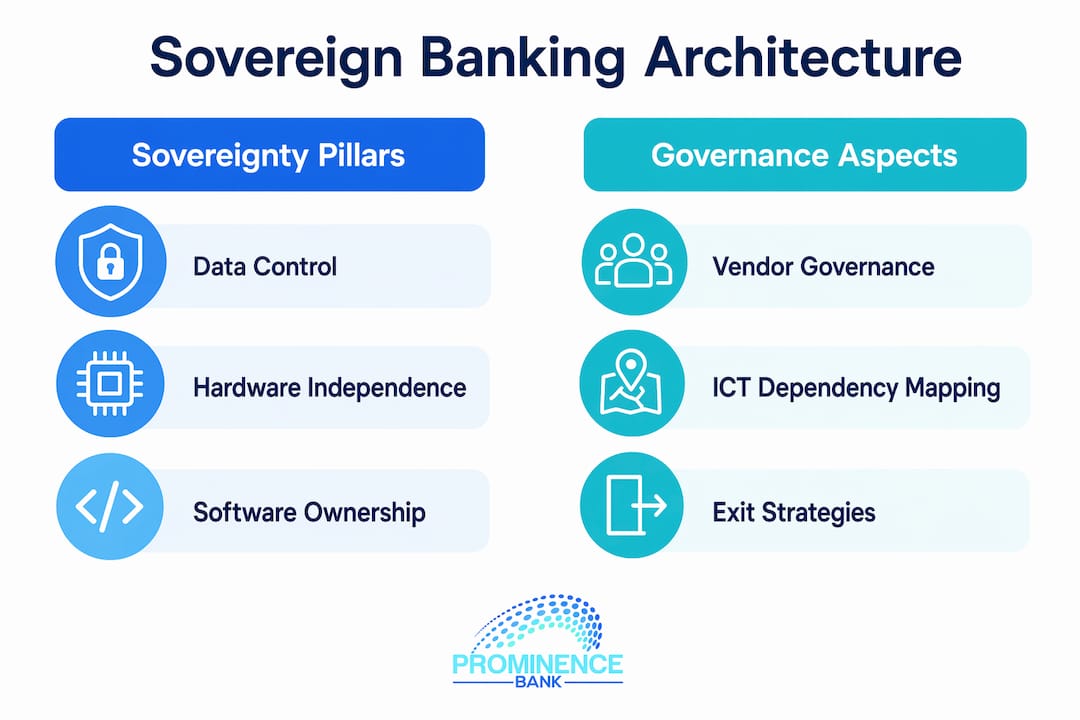
Vendor governance deserves special attention. Dependency governance requires comprehensive mapping of critical ICT dependencies, concentration risks, and exit strategies for every outsourcing relationship. Most banks underinvest here until a vendor outage or acquisition forces the issue.
Why is sovereign digital banking critical in global finance today?
The demand for sovereign banking solutions has grown sharply because the risks of non-sovereignty have become concrete and costly. Sovereignty failures often appear not as obvious system crashes but as forced migrations, vendor lock-in, or outages triggered by decisions made in another country’s boardroom. Those events are not hypothetical. Global cloud outages have disrupted banking services across multiple continents in recent years.
Regulatory pressure is the second major driver. Governments and financial regulators increasingly require banks to demonstrate control over their data and operations within specific jurisdictions. A bank that cannot prove that control faces fines, license restrictions, and reputational damage. Sovereignty is no longer a technical preference. It is a compliance requirement in many markets.
The benefits of sovereign banking for clients and shareholders include:
- Resiliencia operacional: Service continuity is not dependent on a vendor’s uptime or a foreign government’s policy decision.
- Cumplimiento normativo: Demonstrable control over data and processes satisfies national data mandates and reduces exposure to extraterritorial laws.
- Customer trust: Clients can verify that their financial data stays within agreed jurisdictions and is not accessible to unauthorized third parties.
- Strategic independence: The institution can adopt new technologies, including AI-driven financial tools, on its own schedule without waiting for vendor approval.
- Risk reduction: Reduced vendor risk protects against regulatory fines and global instability affecting core operations.
The AI dimension is worth highlighting separately. Banks deploying AI for fraud detection, credit scoring, or client analytics need to control the data those models train on. A sovereign architecture makes that control possible. A non-sovereign architecture makes it legally and technically complicated.
How are sovereign banking platforms architected?
Sovereign banking platforms use composable, data-centric architectures. Composable architectures distribute capability into modular components with defined interfaces, allowing banks to coordinate services dynamically without binding the entire system to a single vendor’s constraints. Each module can be updated, replaced, or extended independently. The rest of the platform keeps running.
The data-centric layer is equally important. It creates a unified, real-time view of all financial information across the institution. That layer is owned and operated by the bank, not by a third-party data warehouse vendor. The distinction matters because the data layer is where compliance states, ledger records, and client profiles live.
Here is how composable sovereign platforms compare to monolithic vendor platforms across key dimensions:
| Dimensión | Composable sovereign platform | Monolithic vendor platform |
|---|---|---|
| Innovation timeline | Institution-controlled | Vendor release cycle |
| Vendor dependency | Low, modular exits possible | High, full migration required |
| Data control | Full institutional ownership | Shared or vendor-managed |
| Regulatory adaptability | Fast, targeted module updates | Slow, full platform updates |
| Integration flexibility | Open interfaces, any capable partner | Vendor-approved integrations only |
The numbered steps below describe how a bank transitions from a monolithic to a sovereign composable architecture:
- Map the current stack. Identify every component, vendor, and data flow in the existing platform.
- Separate authoritative data. Sovereign architectures isolate ledgers, compliance states, and client records from third-party execution agents.
- Define modular boundaries. Break the platform into components with clear interfaces so each can evolve independently.
- Establish governance contracts. Document exit strategies and concentration risk assessments for every vendor relationship.
- Iterate and integrate. Add new capabilities, such as AI tools or new payment rails, through the modular layer without disrupting core operations.
Tech sovereignty requires not only ownership but also the ability to act, adapt, and integrate capabilities on the institution’s own terms. Ownership without actionable control is a liability, not an asset.
What practical advantages does sovereign digital banking offer?
For individuals and businesses operating across borders, sovereign digital banking delivers advantages that conventional banking cannot match on structural grounds. The benefits fall into five clear categories:
- Data privacy aligned to your jurisdiction: Your financial data stays where you and your bank agree it should stay, governed by the laws you have chosen, not by the laws of wherever a vendor’s servers happen to be located.
- Continuity under disruption: Because the platform is not dependent on a single global vendor, service continues even when large cloud providers experience outages or when geopolitical events restrict cross-border data flows.
- Transparent compliance: Demonstrable control over data and processes gives clients and regulators verifiable proof that the bank meets national data mandates, reducing the risk of surprise regulatory actions.
- Multi-jurisdictional flexibility: Businesses with operations in multiple countries can manage compliance requirements for each jurisdiction through a single sovereign platform that adapts to local rules without a full system overhaul.
- Controlled innovation: The institution adopts new financial tools, products, and integrations on its own schedule, which means faster product launches and lower costs compared to waiting for a vendor’s roadmap.
Sovereign banks differentiate by owning the platform that supports their strategy, innovating on their own timeline, and integrating capabilities independently of vendor-imposed constraints. That differentiation translates directly into better service, lower operational risk, and stronger client relationships.
Consejo profesional: When assessing a bank’s sovereignty claims, ask for its data residency documentation, its vendor exit strategy, and its incident response plan. A genuinely sovereign institution can produce all three quickly.
For high-net-worth clients and international corporations, the digital banking jurisdiction your bank operates under is as important as the interest rates it offers. Jurisdiction determines which laws govern your data, which courts have authority over disputes, and which regulators can demand access to your records.
Puntos clave
Sovereign digital banking is the most structurally sound approach to international finance because it places control over data, operations, and vendor relationships entirely within the institution and its clients’ agreed jurisdictions.
| Punto | Detalles |
|---|---|
| Sovereignty covers the full stack | Control must extend to data, hardware, software, operations, and vendor contracts, not just data storage location. |
| Composable architecture is the foundation | Modular platforms let banks innovate independently and replace components without full system migrations. |
| Regulatory compliance is a direct benefit | Demonstrable institutional control satisfies national data mandates and reduces exposure to foreign extraterritorial laws. |
| Vendor governance is non-negotiable | Mapping ICT dependencies and maintaining exit strategies protects against forced migrations and concentration risk. |
| Sovereignty enables faster innovation | Institutions on sovereign platforms adopt new tools and products on their own timeline, not a vendor’s release schedule. |
Why I think sovereignty is the defining banking question of this decade
The financial services industry has spent years debating cloud adoption, open banking, and API standards. Those debates matter. But they all assume a prior question has been answered: who actually controls the platform? Most institutions have not answered that question honestly.
I have watched banks invest heavily in digital transformation while remaining entirely dependent on two or three global technology vendors for their core operations. That is not transformation. That is a more expensive version of the same dependency. The first time one of those vendors changes its pricing, gets acquired, or faces a regulatory action in its home country, the bank discovers how little control it actually has.
The shift toward sovereign architectures is not about isolationism. Tech sovereignty does not imply cutting off partnerships or refusing cloud services. It means retaining the authority to make decisions about your platform, your data, and your vendor relationships. You can still use a global cloud provider’s infrastructure. The question is whether you can leave if you need to, and whether a foreign government can compel that provider to act against your interests.
For individuals and businesses choosing where to bank internationally, this matters directly. A bank that cannot demonstrate sovereignty over its own platform cannot credibly promise you control over your financial data. The governance framework the bank operates under is the product, not just the account features.
- Harold
Prominencebank’s approach to sovereign global banking
Prominencebank operates under the sovereignty of the Extraterritorial Trade Mission Office (ETMO), giving clients a structurally independent banking environment designed for privacy, compliance, and global reach.
For international businesses and high-net-worth individuals, Prominencebank offers cuentas corporativas multicurrencia that support multi-jurisdictional operations without exposing client data to third-party vendor risk. The bank’s Soluciones bancarias corporativas are built for complex structures that require both discretion and full AML/KYC compliance. Every account is backed by direct access to global financial infrastructure, with security and client control at the center of every product decision.
FAQ
What is sovereign digital banking in simple terms?
Sovereign digital banking is a model where a bank owns and controls its entire technology stack, including data, software, and vendor relationships, so no outside party can dictate how its operations run.
How does sovereign banking protect my financial data?
Sovereign banking keeps your data within agreed jurisdictions and under institutional control, preventing foreign governments or third-party vendors from accessing it without your bank’s consent.
What is the difference between cloud sovereignty and full digital sovereignty?
Cloud sovereignty focuses specifically on jurisdictional control over cloud services, while full digital sovereignty covers the entire stack: hardware, software, data, operations, and vendor governance.
Why does vendor governance matter in sovereign banking?
Vendor governance maps every critical technology dependency and maintains exit strategies, protecting the bank and its clients from forced migrations, vendor lock-in, or service disruptions caused by third-party decisions.
Is sovereign digital banking relevant for individual clients, not just institutions?
Sovereign banking directly affects individual clients because the bank’s control over its platform determines where your data lives, which laws govern it, and how reliably your services run during global disruptions.