Resumen:
- A privacy banking workflow is a set of processes, controls, and policies designed to protect sensitive financial data during banking operations. Implementing technical pillars like modular privacy layers, split-knowledge architecture, role-based access, and pseudonymization ensures compliance with regulations and safeguards client information. Continuous governance, data classification, and redaction before AI use are essential to maintaining confidentiality and operational integrity.
A privacy banking workflow is the structured set of processes, technical controls, and governance policies that protect sensitive financial data throughout every stage of banking operations. Financial professionals managing international accounts face mounting pressure from GDPR, PCI DSS, and the Sixth Anti-Money Laundering Directive (AMLD6), all of which impose strict requirements on how client data is collected, stored, processed, and deleted. Getting this right is not a one-time compliance exercise. It is a continuous operational discipline that determines whether a financial institution can operate across borders without exposing client information or triggering regulatory penalties. For high-net-worth individuals and institutional clients, the quality of a bank’s privacy management in finance directly affects the safety of their assets and the confidentiality of their financial relationships.
What are the core components of a privacy banking workflow?
A well-built privacy banking workflow rests on four technical pillars: modular privacy layers, split-knowledge architecture, role-based access control, and pseudonymization. Each pillar addresses a distinct exposure risk in the data lifecycle.

Modular privacy layers apply encryption and detection at the point of data entry. Format-Preserving Encryption combined with lightweight local detector models improves privacy hiding rates from 14.4% to 87.3%, while safety classification accuracy reaches 99.9%. That improvement means the vast majority of sensitive fields, such as account numbers, tax identifiers, and transaction amounts, are protected before they ever enter a processing pipeline.
Split-knowledge architecture separates identity data from transaction data at the cryptographic level. Isolated KYC and transaction data sit in separate cryptographic enclaves, so AI models process only tokens that carry no raw identity or account number. This limits the blast radius of any breach to a fraction of the total data set.
Role-based access control (RBAC) governs who sees what. Relationship managers see client profiles. Risk analysts see behavioral scoring outputs. Compliance officers see flagged transaction patterns. Auditors see logs. No role sees everything.
Pseudonymization replaces direct identifiers with tokens that have no mathematical relationship to the original identity. Purpose-scoped tokens used in AML workflows are single-purpose and carry no linkage to the underlying identity, which enforces least-privilege access at the data level.
- Modular privacy layers: Format-Preserving Encryption, local PII detectors
- Split-knowledge: cryptographic separation of KYC and transaction records
- RBAC: role-specific data views for relationship managers, analysts, officers, and auditors
- Pseudonymization: single-purpose tokens with no identity linkage
- Regulatory alignment: GDPR Article 25 (data protection by design), PCI DSS Requirement 3, AMLD6 transaction monitoring
Consejo profesional: Map each data category to the specific regulation that governs it before selecting a technical control. GDPR governs personal data broadly, PCI DSS governs cardholder data specifically, and AMLD6 governs transaction monitoring records. Mixing up the applicable standard leads to control gaps.
Which tools and technologies enable secure banking processes?
The technology stack for a privacy-focused financial services operation covers four functional areas: data classification, pseudonymization engines, RBAC pipelines, and AI redaction layers.
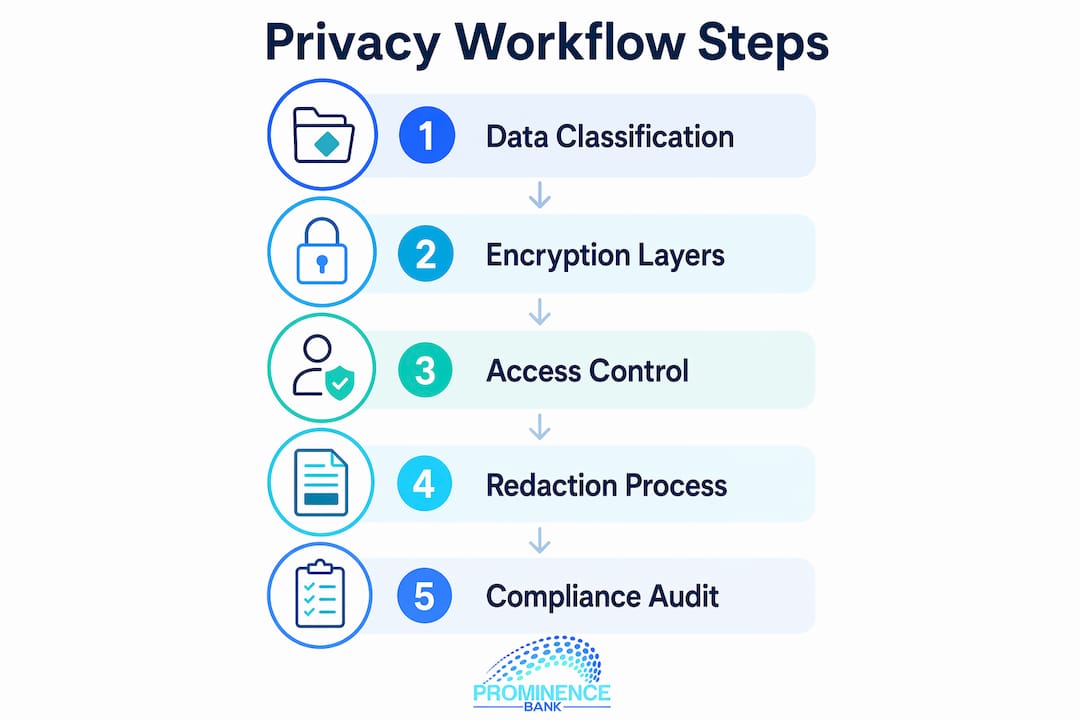
Role-based PII control in financial data retrieval pipelines can be configured in approximately 20 minutes, enforcing tailored data views aligned with PCI DSS and GDPR requirements while maintaining audit trails. That speed matters because financial institutions frequently onboard new roles or restructure teams, and access policies must keep pace.
AI redaction is the least understood but most critical layer. Redaction must be integrated into the document lifecycle before sensitive data reaches any AI ingestion point. Treating redaction as a pre-processing step, rather than a post-processing review, prevents raw PII from ever entering a model’s training or inference context.
| Tecnología | Función | Regulatory relevance |
|---|---|---|
| Format-Preserving Encryption | Encrypts data while preserving field format | PCI DSS Requirement 3 |
| Purpose-scoped tokens | Replaces identities with single-use tokens | GDPR Article 5 (data minimization) |
| Role-based PII pipelines | Filters data views by user role | GDPR Article 25, PCI DSS |
| AI redaction layers | Removes PII before AI ingestion | AMLD6, GDPR Article 22 |
| Audit log systems | Records access without exposing PII | All major frameworks |
For financial professionals working with AI-driven analytics, platforms like FilingsIQ.ai apply modular privacy layers including Format-Preserving Encryption within financial data workflows, which illustrates how privacy-preserving AI can operate inside compliance boundaries without sacrificing analytical depth.
Consejo profesional: Audit your AI vendor’s data ingestion pipeline before signing any contract. Ask specifically whether redaction occurs before or after data enters the model. “After” is not acceptable for regulated financial data.
How to implement a privacy banking workflow step by step
Building a secure banking workflow for international operations requires a sequenced approach. Skipping steps creates gaps that regulators and attackers both exploit.
-
Inventory and classify all banking data assets. Identify every data store, including CRM systems, transaction databases, document repositories, and API endpoints. Classify each asset by sensitivity level: public, internal, confidential, and restricted. This inventory becomes the foundation for every subsequent control decision.
-
Define role-based access policies. Map each banking role to the minimum data set required for that role’s function. A compliance officer filing a Suspicious Activity Report needs identity linkage for a limited window. Purpose-scoped tokens limit that identity disclosure to a 30-minute window for authorized analysts only. That window closes automatically, eliminating residual exposure.
-
Deploy split-knowledge architecture for AML and KYC workflows. Separate identity records from transaction records at the database level. Use cryptographic enclaves to process behavioral scoring on pseudonymized tokens. This means a compromised analytics layer cannot reconstruct a client’s identity from the data it processes.
-
Integrate redaction into the document lifecycle. Every document containing PII, including onboarding forms, wire transfer instructions, and compliance filings, must pass through an automated redaction layer before it reaches any AI model or analytics tool. Redaction is an operational workflow, not a one-off task. Build it into the document management system as a mandatory processing step.
-
Establish audit logging and compliance monitoring. Role-based privacy layering sits between data retrieval and AI inference, maintaining audit logs without revealing PII. Configure logs to capture who accessed what data, at what time, and under which role. Store logs in a write-once environment to prevent tampering.
The following elements must be present in every monitoring setup:
- Immutable audit logs with timestamps and role identifiers
- Automated alerts for access outside defined role parameters
- Scheduled data lifecycle reviews to trigger anonymization or deletion
- Vendor access logs covering all third-party integrations
- Quarterly access policy reviews aligned with staff role changes
For a detailed walkthrough of secure online banking processes tailored to high-net-worth individuals, Prominencebank publishes a step-by-step guide that covers both technical controls and operational governance.
What are common challenges in maintaining banking confidentiality best practices?
The most persistent challenge in privacy management in finance is compliance drift. Policies set at implementation gradually fall out of alignment with actual data flows as systems evolve, staff change, and new integrations are added. Effective privacy governance requires accountability structures, data inventory, risk assessment, vendor oversight, and ongoing monitoring. A governance framework that covers all five areas prevents drift from becoming a regulatory exposure.
A second challenge is protecting audit trails without leaking PII into the logs themselves. Logs that capture raw client names or account numbers to document access events create a secondary exposure risk. The solution is to log role identifiers and pseudonymized record references, never raw identifiers.
A third challenge is vendor risk. Third-party analytics providers, AI vendors, and cloud storage partners all touch financial data. Each vendor relationship requires a data processing agreement, a technical audit of their privacy controls, and a defined data retention limit.
Data governance in banking requires shifting from open-ended data retention to purpose-bound lifecycles with immediate anonymization or secure deletion when data is no longer needed. Continuous operational privacy is not optional. It is the only defensible posture under GDPR, PCI DSS, and AMLD6.
The practical implication is that purpose-bound data lifecycles must replace the default practice of retaining data indefinitely. Every data asset needs a defined expiration trigger, whether that is the end of a client relationship, the completion of a regulatory review period, or a fixed calendar interval.
For professionals building out estrategias avanzadas de privacidad bancaria, the key is treating privacy as a living operational system rather than a project with a completion date.
Puntos clave
A privacy banking workflow requires split-knowledge architecture, role-based access control, purpose-scoped tokenization, and integrated redaction to protect client data across every stage of international banking operations.
| Punto | Detalles |
|---|---|
| Start with data inventory | Classify every data asset before selecting any technical control. |
| Deploy split-knowledge architecture | Cryptographically separate KYC and transaction data to limit breach impact. |
| Enforce role-based access | Configure data views by role in under 20 minutes using RBAC pipelines. |
| Redact before AI ingestion | Integrate redaction into the document lifecycle as a mandatory processing step. |
| Govern continuously | Use purpose-bound data lifecycles and scheduled audits to prevent compliance drift. |
Why privacy workflows demand more than a compliance checklist
The financial professionals I respect most treat privacy as an engineering problem, not a legal one. The legal team sets the boundaries. The engineers decide whether those boundaries actually hold under operational conditions. That gap between policy and practice is where most breaches originate.
Split-knowledge architecture is the single most underused control in international banking. I have seen institutions invest heavily in encryption at rest and in transit, then leave KYC and transaction data sitting in the same queryable database. A compromised analytics credential exposes everything. Separating those data sets cryptographically is not complex. It is a design decision that most teams skip because it requires upfront architectural work.
The redaction point also deserves more attention than it gets. Financial institutions rush to adopt AI-driven document analysis without asking a basic question: what data does the model see during inference? If the answer is “whatever is in the document,” the institution has created a new exposure channel. Redaction before ingestion is the only answer that holds up under regulatory scrutiny.
El technology behind secure private banking has matured to the point where these controls are deployable without sacrificing operational speed. The barrier is organizational will, not technical capability. Institutions that treat privacy as a continuous operational discipline rather than a quarterly audit will be the ones that retain client trust when the next regulatory cycle tightens the rules further.
- Harold
Prominencebank’s multi-currency accounts for privacy-first international banking
Financial professionals who have built a privacy banking workflow need a banking partner whose infrastructure matches that standard.
Prominencebank is built for high-net-worth individuals and international businesses that require both multi-currency flexibility and institutional-grade confidentiality. Its multi-currency global banking accounts are designed with AML/KYC compliance and data protection built into the account structure, not added as an afterthought. Clients get direct access to global financial infrastructure, discreet account management, and the compliance documentation required for cross-border operations. For institutions and individuals who have invested in building a privacy-first financial operation, Prominencebank provides the banking layer that completes it.
FAQ
What is a privacy banking workflow?
A privacy banking workflow is the structured combination of technical controls, access policies, and governance procedures that protect sensitive financial data throughout banking operations. It covers data classification, pseudonymization, role-based access, redaction, and audit logging.
How does split-knowledge architecture protect banking data?
Split-knowledge architecture cryptographically separates KYC identity records from transaction data, so AI models and analytics tools process only pseudonymized tokens with no mathematical link to raw identities. This limits the impact of any single breach to a fraction of the total data set.
What regulations govern a privacy banking workflow?
GDPR, PCI DSS, and AMLD6 are the three primary frameworks. GDPR governs personal data processing and deletion, PCI DSS governs cardholder data security, and AMLD6 governs transaction monitoring and suspicious activity reporting.
How quickly can role-based access controls be configured?
Role-based PII control in financial data retrieval pipelines can be configured in about 20 minutes, enforcing tailored data views aligned with PCI DSS and GDPR while maintaining compliant audit trails.
Why is redaction required before AI ingestion in banking?
AI models that ingest unredacted documents can retain or expose PII through inference outputs or training data. Integrating redaction into the document lifecycle before AI ingestion is the only method that satisfies GDPR Article 22 and AMLD6 audit requirements for regulated financial data.