
Resumen:
- Offshore asset allocation involves investing outside your home country to reduce geographic and legal risks. It uses structures like bonds, trusts, and corporate entities to protect assets and improve wealth management. Proper planning ensures legal compliance, transparency, and long-term resilience against political and economic instability.
Offshore asset allocation is defined as the deliberate distribution of investments across jurisdictions outside your home country to reduce geographic concentration risk, access international markets, and improve tax efficiency. The industry term for this practice is “international portfolio diversification,” though offshore asset allocation describes the structural intent more precisely for high-net-worth investors. This guide covers the core mechanics, the most effective legal structures, and the practical steps to build a resilient offshore portfolio. Whether you are exploring offshore investment strategies for the first time or refining an existing approach, the frameworks here apply directly to your situation.
What is offshore asset allocation and why does it matter?
Offshore asset allocation reduces geographic concentration risk by spreading capital across multiple countries, legal systems, and currencies. A portfolio concentrated entirely in one country carries compounded exposure: your employment income, property value, pension, and investments all move with the same domestic economy. When that economy contracts or faces political instability, every layer of your wealth suffers simultaneously.

High-net-worth investors face a specific version of this problem. Home-country bias compounds through employment, property, and pension exposure, making offshore investments a structural necessity rather than an optional enhancement. The goal is not to abandon domestic assets but to balance them with holdings that respond to different economic forces.
Jurisdictional diversification adds a legal dimension that pure financial diversification cannot replicate. Offshore trusts place legal ownership under foreign law, creating procedural barriers against domestic creditor claims and political risk. This does not reduce your tax obligations, but it does protect asset ownership from systemic domestic threats.
Jurisdictional diversification in legal ownership mirrors financial portfolio diversification. Placing assets under foreign legal frameworks mitigates systemic political and financial risks that no domestic instrument can address. The protection is structural, not speculative.
The practical benefits of offshore asset diversification include:
- Geographic risk reduction: Assets in multiple jurisdictions do not all decline together during a domestic crisis.
- Diversificación de la moneda: Holdings in USD, EUR, GBP, or CHF protect against home-currency devaluation.
- Legal protection: Foreign trusts and corporate structures impose barriers to domestic claims.
- Access to global markets: International equities, bonds, and real assets unavailable domestically become accessible.
- Tax planning opportunities: Certain structures defer or reduce tax events, subject to your country of residence.
Common offshore asset allocation structures and vehicles
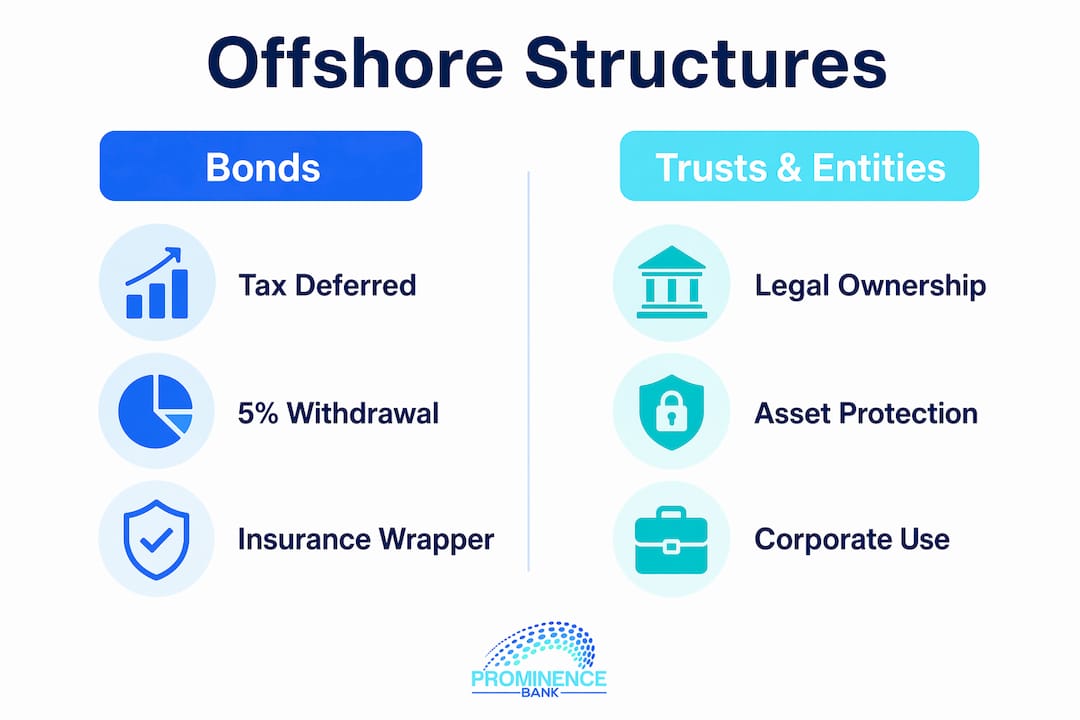
The three primary structures for offshore allocation are offshore bonds, offshore trusts, and offshore corporate entities. Each serves a different purpose, and most sophisticated portfolios use a combination.
Offshore bonds
Offshore bonds are insurance-based investment wrappers issued by life companies in low-tax jurisdictions such as the Isle of Man, Luxembourg, or Ireland. Their defining advantage is tax deferral. Offshore wrappers function as tax-transparent shells that allow fund managers to switch holdings and harvest gains internally without triggering a taxable event. A standard brokerage account generates a tax liability every time you rebalance. An offshore bond does not.
The 5% withdrawal rule allows investors to withdraw up to 5% of the original investment annually on a tax-deferred basis, with unused allowances accumulating year over year. Over 20 years, this mechanism can return 100% of original capital without triggering an immediate tax charge. That is a material cash flow advantage for investors managing liquidity across multiple jurisdictions.
Consejo profesional: If you have not used your 5% withdrawal allowance in prior years, the accumulated amount carries forward. An investor who skips withdrawals for five years can take 25% of original capital in year six with no immediate tax charge, subject to their country of residence rules.
Offshore trusts and corporate structures
Offshore trusts transfer legal ownership to foreign trustees, removing assets from your personal estate and placing them under foreign law. This serves two purposes: estate planning and asset protection. For cross-border wealth transfer, trusts simplify succession by bypassing domestic probate processes entirely.
Offshore corporate structures, such as international business companies or holding companies registered in low-tax jurisdictions, consolidate international holdings under a single legal entity. They are particularly useful when you hold real estate, operating businesses, or financial assets across multiple countries. A well-structured offshore corporate entity reduces administrative complexity and can provide a tax-efficient holding layer, depending on your residence.
| Estructura | Prestación primaria | Mejor traje para |
|---|---|---|
| Offshore bond | Tax-deferred growth and rebalancing | Investors with long time horizons |
| Offshore trust | Asset protection and estate planning | Families with cross-border succession needs |
| Offshore corporate entity | Consolidated international holdings | Investors with multi-country real assets |
| Cuenta multicurrencia | Currency diversification and liquidity | Active international investors |
How to develop an effective offshore allocation strategy
Building an offshore portfolio requires a framework, not a product list. The most effective approach balances three asset categories across jurisdictions:
- Staple assets provide capital preservation. These include government bonds, money market instruments, and cash held in stable currencies. They anchor the portfolio during periods of volatility.
- Growth assets generate long-term returns. International equities, private equity, and real estate in high-growth markets belong here. Offshore access opens markets that domestic brokerage accounts cannot reach.
- Hedging assets protect against specific risks. Gold, commodity funds, and currency positions hedge against inflation, currency devaluation, and geopolitical shocks.
The weighting across these three categories depends on your time horizon and loss capacity, not on regional familiarity. Asset weighting should reflect time horizon and loss tolerance rather than comfort with familiar markets. Overweighting domestic assets because they feel familiar is one of the most common and costly value investing mistakes high-net-worth investors make.
Jurisdictional selection matters as much as asset selection. Different jurisdictions offer different legal protections, tax treaties, and regulatory environments. Singapore, the Cayman Islands, Luxembourg, and the Isle of Man each serve different structural purposes. Your choice of jurisdiction should align with your country of residence and the specific tax treaties your home country maintains.
Consejo profesional: Offshore investing is a structural decision, not a market-timing one. Investors who wait for the “right moment” to move assets offshore consistently underperform those who establish the structure early and rebalance systematically within it.
Offshore investing is a structural decision that must integrate with your tax and estate planning. What qualifies as tax-efficient in one jurisdiction can be punitive in another. A US citizen using an offshore bond, for example, faces different tax treatment than a UK resident using the same product. Always align your offshore strategy with a tax advisor who understands your specific residency status.
Disciplined rebalancing within your offshore structure prevents drift. An offshore bond wrapper allows you to rebalance between asset classes without triggering tax, which means you can maintain target allocations far more efficiently than through a standard taxable account. Use this advantage consistently.
What are the biggest misconceptions about offshore allocation?
Offshore asset allocation carries significant misunderstanding, even among experienced investors. Clarifying these misconceptions is not optional. Acting on a false premise in this area carries legal and financial consequences.
- Offshore allocation is not tax evasion. Legitimate offshore structures comply fully with international AML and KYC standards. Reporting obligations under frameworks such as FATCA and the Common Reporting Standard (CRS) apply to all offshore accounts. Offshore planning reduces tax through legal structures, not concealment.
- Offshore bonds are not simple products. They carry charges including establishment fees, annual management fees, and surrender penalties. The tax deferral benefit must exceed these costs over the investment horizon to justify the structure. Model the total cost before committing.
- Offshore investing is not a timing strategy. Investors who move assets offshore in response to a specific political event or market condition typically do so too late and with the wrong structure. The decision to allocate offshore should precede the risk, not react to it.
- Offshore structures do not eliminate domestic tax obligations. Offshore trusts create procedural barriers against domestic claims but do not remove your personal tax liability. Tax events occur on withdrawal, assignment, or distribution, depending on the structure and your residence.
- Regulatory complexity is real. Offshore financial planning requires coordination between legal, tax, and banking advisors across multiple jurisdictions. Investors who treat it as a simple account-opening exercise consistently encounter compliance problems.
The structural case for offshore allocation in 2026
Offshore asset allocation is not a trend. It is a structural response to a structural problem: the concentration of wealth within a single legal, economic, and political system.
I have watched investors delay offshore planning for years, waiting for clarity on tax law, political stability, or market conditions. That clarity rarely arrives. The investors who build offshore structures during stable periods are the ones who benefit when instability hits. The structure is already in place. The assets are already protected.
The compliance environment has tightened significantly over the past decade. FATCA, CRS, and domestic reporting requirements mean that offshore planning now demands more documentation and coordination than it did in 2010. That is not a reason to avoid it. It is a reason to do it properly, with qualified advisors and a licensed banking partner who understands international compliance.
The ethical dimension matters too. Offshore allocation done correctly is transparent, reported, and fully compliant. The goal is tax efficiency within the law, not concealment. Investors who conflate the two expose themselves to penalties that dwarf any tax saving. Treat offshore allocation as a foundation for resilient, long-term wealth growth, not as a shortcut.
- Harold
How Prominencebank supports your offshore allocation
Prominencebank operates as a fully licensed digital banking institution under the sovereignty of the Extraterritorial Trade Mission Office (ETMO), providing multi-currency accounts and corporate banking solutions designed for high-net-worth investors managing assets across multiple jurisdictions.

For investors building or restructuring an offshore portfolio, Prominencebank’s banca global multicurrencia infrastructure provides the account layer that connects offshore structures to real-world liquidity. Multi-currency accounts hold assets in USD, EUR, GBP, and other major currencies within a single institution, reducing friction across jurisdictions. Prominencebank’s Soluciones bancarias corporativas support complex holding structures, including international business companies and trust-linked accounts, with full AML/KYC compliance and institutional-grade security. For investors ready to formalize their offshore allocation, Prominencebank offers a direct path to the banking infrastructure that serious international wealth management requires.
Escapadas clave
Offshore asset allocation is the most effective structural tool for reducing home-country concentration risk while accessing global tax-efficient growth across multiple jurisdictions.
| Punto | Detalles |
|---|---|
| Core definition | Offshore allocation distributes investments across foreign jurisdictions to reduce geographic and legal concentration risk. |
| Primary structures | Offshore bonds, trusts, and corporate entities each serve distinct tax, estate, and protection purposes. |
| 5% withdrawal rule | Offshore bonds allow annual tax-deferred withdrawals of up to 5% of original capital, accumulating if unused. |
| Structural, not tactical | Offshore allocation is a long-term structural decision, not a market-timing response to political or economic events. |
| El cumplimiento no es negociable | FATCA and CRS reporting requirements apply to all offshore accounts; legal offshore planning is fully transparent. |
FAQ
What is offshore asset allocation in simple terms?
Offshore asset allocation is the practice of investing capital outside your home country to reduce geographic concentration risk and access international markets. It balances safety, growth, and hedging assets across multiple jurisdictions.
How does offshore allocation differ from tax evasion?
Offshore allocation uses legal structures such as bonds, trusts, and corporate entities to defer or reduce tax within the law. Tax evasion involves concealment, which offshore structures under FATCA and CRS reporting do not permit.
What is the 5% withdrawal rule in offshore bonds?
The 5% rule allows investors to withdraw up to 5% of the original bond investment each year on a tax-deferred basis. Unused allowances accumulate, so an investor can take a larger deferred withdrawal in later years.
Do offshore structures eliminate my domestic tax obligations?
Offshore structures do not eliminate personal tax obligations. Tax events occur on withdrawal, assignment, or distribution, and reporting requirements under FATCA and CRS apply regardless of where assets are held.
What jurisdictions are most commonly used for offshore allocation?
Singapore, Luxembourg, the Isle of Man, the Cayman Islands, and Ireland are among the most widely used jurisdictions. The right choice depends on your country of residence and the specific tax treaties your home country maintains.