
An MT103 is the SWIFT message a bank generates to prove it sent an international wire, and it’s the document you request whenever you need to prove, trace, or reconcile a cross-border payment. The single most useful thing inside it is the UETR in field 121, a unique 36-character code that lets you track the payment’s status across every bank it touches. Note that banks are shifting to a newer format called pacs.008, though the same tracking logic still applies.
Resumen:
- An MT103 confirms the dispatch of funds, not their final receipt, so additional confirmation from the beneficiary bank is often necessary to prove delivery.
- Banks typically charge a fee of $20 to $50 and deliver the requested MT103 within a few hours to days, requiring specific transaction details for a request.
- The five key fields for tracing payments are the UETR, sender’s reference, value date and amount, sender, and beneficiary, which most banks can quickly access using those identifiers.
Cuadro de contenidos
- What an MT103 Does and When You Need One
- Key MT103 Fields and What Each One Means
- How to Request an MT103 and What to Expect
- MT103 Variants and the Shift to ISO 20022
- Reading a Sample MT103: The Tags Worth Copying
- How Banks Authenticate and Track These Payments
- When We Tell Clients to Request an MT103
- Sources
- FAQ
What an MT103 Does and When You Need One
The sending bank issues the MT103 the moment it dispatches your international wire, not when the money lands. That timing distinction trips up more people than anything else about this document. It confirms the instruction left the bank; it doesn’t confirm the beneficiary’s bank posted the funds.
That gap matters because most disputes over “missing” international transfers aren’t actually missing money, they’re delays somewhere in the correspondent chain. An MT103 gives you the paper trail to start tracing where the payment sits.
You’d typically request one for:
- Proving to a counterparty or auditor that you actually sent a payment
- Resolving a dispute with a supplier who claims non-receipt
- Reconciling your books when incoming or outgoing wires don’t match expected timing
- Supporting a compliance or regulatory inquiry into a specific transaction
- Chasing a transfer that’s taken longer than the SWIFT gpi-standard settlement window
Keep the limitation in mind: an MT103 is evidence of dispatch, not evidence of final credit. If a beneficiary insists funds never arrived, the MT103 is your starting point for a trace, not the final word. You’ll usually need the beneficiary bank to confirm receipt or provide a status update through the same tracking chain.
Key MT103 Fields and What Each One Means
SWIFT’s own format specification defines every tag in an MT103, and a handful of them do almost all the heavy lifting when you’re trying to trace or reconcile a payment. Learn these and you can read any MT103 in about thirty seconds.
| Field | Nombre | What it tells you |
|---|---|---|
| 121 | UETR | 36-character unique end-to-end reference, the primary tracking key |
| 20 | Sender’s reference | The bank’s internal transaction ID |
| 32A | Value date, currency, amount | When it was sent, in what currency, for how much |
| 50a | Ordering customer | Who sent the money |
| 59 | Beneficiary | Who was supposed to receive it |
| 71A | Details of charges | Who pays intermediary bank fees |
| 56/57 | Intermediary/receiving correspondent | Which correspondent banks handled the transfer |
Field 121, the UETR, is arguably the most important addition to the modern MT103. It’s a standardized tracking identifier that stays constant across every bank in the payment chain, even when the message format changes midstream.
Field 71A deserves special attention because it directly affects how much money the beneficiary actually receives:
- NUESTRO: the sender pays all fees; the beneficiary gets the full amount
- SHA (shared): each party covers their own bank’s fees, the most common default
- BEN: the beneficiary absorbs all fees, including intermediary charges
Fields 56 and 57 list the correspondent banks that routed the payment. If money seems stuck, these are the institutions you or your bank will need to contact next.
How to Request an MT103 and What to Expect
Only the sending bank can issue an MT103. If you’re the beneficiary and funds haven’t arrived, you can’t request it directly; you need to ask the person or company that sent you the money to pull it from their bank.
- Gather your transaction reference, the exact date sent, the amount and currency, and the beneficiary’s full details.
- Contact your bank through whichever channel handles wire inquiries, an online banking portal, a branch, or a relationship manager for larger accounts.
- Formally request a copy of the SWIFT MT103 (or its pacs.008 equivalent) for that specific transaction.
- Confirm how the document will be delivered, since sensitive banking details shouldn’t travel over unencrypted email.
Expect a fee in most cases, commonly in a moderate fee range, and a turnaround of a few hours to a few business days depending on the bank’s back office. Institutions handling direct SWIFT transfers at scale often process these requests faster than smaller retail banks.
Consejo profesional: Ask your bank for the UETR specifically, even before the full MT103 document arrives. Many banks can look it up faster than pulling the full confirmation, and that single code is enough to start a gpi trace immediately.

MT103 Variants and the Shift to ISO 20022
Not every MT103 is built the same way. MT103 STP (straight-through processing) restricts certain fields to BIC-only formatting, which lets the message move through the correspondent chain with minimal manual intervention. Payments sent this way tend to settle faster and with fewer errors. MT103 REMIT does the opposite: it extends the remittance information field to carry more detail, useful when a payment needs to reference an invoice number or contract terms the standard format can’t fit.
Layered on top of either variant, SWIFT gpi assigns every payment a UETR and authenticates the message through SWIFT’s public key infrastructure, giving both banks and customers near real-time status visibility instead of the days-long silence that used to define international wires.
The bigger structural change is the industry’s move to ISO 20022. Pacs.008 messages officially replaced MT103 as the SWIFT standard for cross-border payments by late 2025. Practically, this means:
- Many banks still generate MT103-style PDF confirmations for customers, since the format is familiar
- Pacs.008 carries richer structured data and higher character limits for remittance information
- The core fields you care about, UETR, amount, beneficiary, map directly across both formats
If your bank hands you a document labeled pacs.008 instead of MT103, you’re not missing anything, you’re looking at the same proof of payment in its newer format.
Reading a Sample MT103: The Tags Worth Copying
You don’t need to understand every line of an MT103 to use it. When you’re asking a bank to trace a payment, these five fields do the actual work:
| Tag | Sample value | Why it matters for tracing |
|---|---|---|
| :121: | 3a2f1c9e-4b7d… | The UETR, the single ID that follows the payment everywhere |
| :20: | REFX | Sender’s internal transaction reference |
| :32A: | DATEUSDCURRENCY, | Date, currency, and amount sent |
| :50K: | ordering customer name/account | Who initiated the transfer |
| :59: | beneficiary name/account | Who was meant to receive it |
Copy the UETR and field 20 first. Those two alone let most banks pull up the transaction instantly. Redact account numbers and personal details before forwarding any confirmation by email, and if you need broader guidance on handling sensitive wire documentation, see this practical security guide for offshore wire transfers.
How Banks Authenticate and Track These Payments
SWIFT messages, whether MT103 or pacs.008, are authenticated through SWIFT’s public key infrastructure, which prevents tampering as the message passes between institutions. The UETR ties directly into gpi, giving both sending and receiving banks visibility into where a payment sits at any given moment. Prominence Bank issues traceable, multi-currency transfer confirmations built around this same infrastructure for clients who need documented proof at every step.
When We Tell Clients to Request an MT103
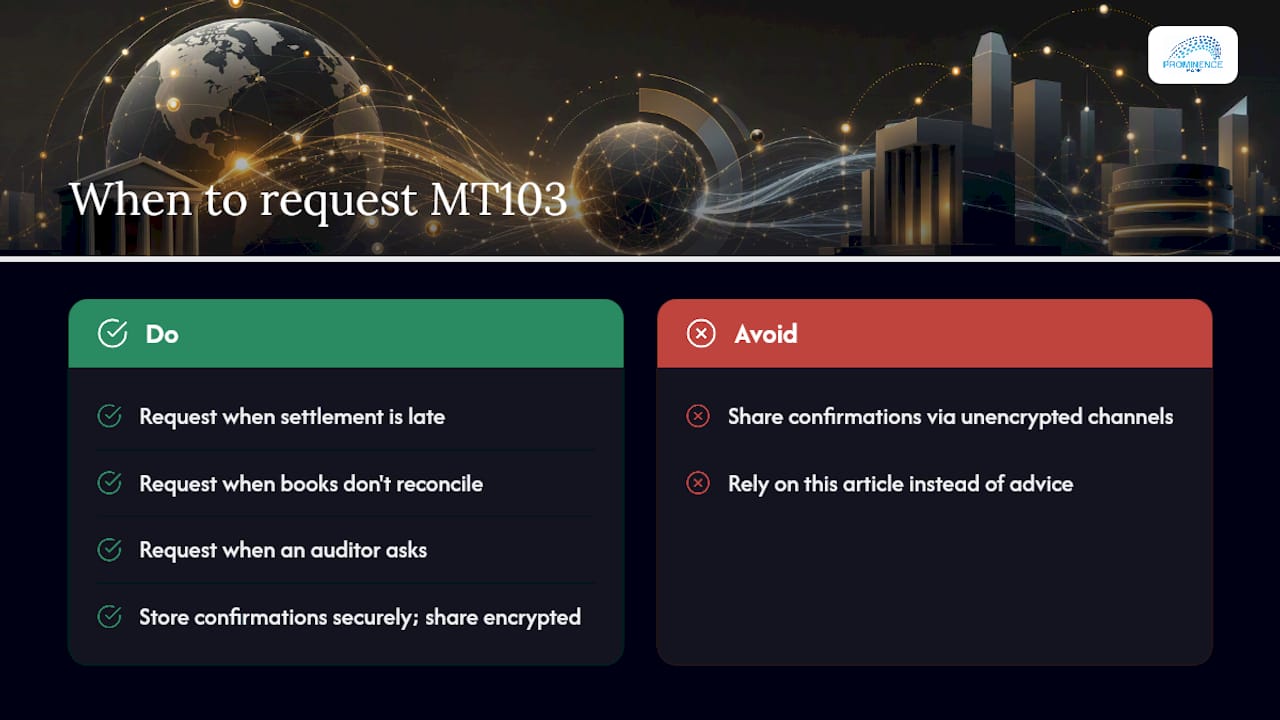
Request one when funds run past the expected settlement window, when your books don’t reconcile with a counterparty’s records, or when an auditor asks for proof. Keep any confirmation you receive stored securely and share it only through encrypted channels. If you need our team to issue or interpret one, set up a multi-currency account built for traceable transfers from day one.
This article is general information, not a substitute for advice from a qualified financial advisor. Consult a qualified financial professional about your own circumstances before acting on anything here.
Sources
- Message Reference Guide — MT103 format specifications
- What is MT103 SWIFT Confirmation? Your Essential Guide for International Payments
- SWIFT MT103 (developer documentation) — Huntington
FAQ
What Does an MT103 SWIFT Message Actually Do?
It’s the standardized message a sending bank generates confirming it dispatched a single customer international credit transfer, serving as the industry’s default proof-of-payment document.
How Do I Get an MT103 From My Bank?
Contact your bank’s wire transfer department with the transaction reference, date, and amount, and request a copy of the MT103 or its pacs.008 equivalent; expect a fee around $20 to $50 and delivery within a few hours to a couple of business days.
Can You Show an Example of What’s in an MT103?
A typical MT103 includes tag :121: for the UETR, :20: for the sender’s reference, :32A: for date/currency/amount, :50K: for the ordering customer, and :59: for the beneficiary, all in a structured, machine-readable format.
What’s the Difference Between a Regular SWIFT Message and an MT103?
SWIFT carries dozens of message types for everything from securities settlement to interbank reporting; MT103 is specifically the type used for single customer credit transfers, making it the one relevant to standard wire transfer proof. For a broader look at how people track international payments after they’ve been sent, this guide to tracking money sent abroad covers the process from the receiving end.
Is MT103 Still Used Now That Pacs.008 Exists?
Yes. Pacs.008 replaced MT103 as SWIFT’s technical standard for cross-border payments in late 2025, but banks still issue MT103-style confirmations to customers, and the core data fields map directly between the two formats.