
A proper bank reference letter format is a formal, one-page letter on bank letterhead that names the account holder, states the account opening date and account types, describes the balance range or standing in general terms, and closes with an authorized signer’s name, title, and verifiable contact information. Copy the templates below, attach a signed authorization, and send a short written request to your bank naming the recipient and your deadline.
Resumen:
- Most banks process reference letter requests quickly when provided with a clear, signed authorization and detailed account information.
- The letter should specify the account opening date, types, and a general balance range, avoiding exact figures unless explicitly required.
- Digital banks like Prominencebank streamline issuance through secure portals, typically providing confirmation within a standard processing window.
- Reference letters are valid for 30 to 90 days, with a preference for recent documentation to prevent rejection.
- Avoid subjective language or vague balance categories; stick to checkable facts and a formal, neutral tone for credibility.
Cuadro de contenidos
- What Is a Bank Reference Letter (And When Do You Need One)?
- What Goes Into the Standard Bank Reference Letter Format?
- Bank Reference Letter Sample Templates You Can Copy
- How to Get a Bank Reference Letter From Your Bank
- Language That Builds Credibility (And Phrasing That Undermines It)
- How Fresh Does the Letter Need to Be?
- How Prominence Bank Issues Confirmations for Clients
- The Three Things to Get Right (A Note From Harold)
- Prominence Bank: Corporate Confirmations and Account Setup
- Sources
- FAQ
What Is a Bank Reference Letter (And When Do You Need One)?
A bank reference letter confirms that you hold an active, well-managed account without disclosing your full transaction history or exact balance. It answers one question for a third party: “Can this bank vouch for this person or company financially?” The letter confirms account history and general financial reliability without exposing sensitive detail, which is exactly the balance most recipients want.
You’ll typically need one for:
- Signing a commercial or residential lease, especially for landlords who want financial assurance beyond a credit check
- Applying for supplier credit or a trade line with a new vendor
- Opening a foreign bank account or satisfying a visa/immigration financial-proof requirement
- Backing up a loan or mortgage application alongside other documentation
A bank reference letter is not the same thing as a bank statement, a balance certificate, or a letter of credit. A statement lists actual transactions. A balance certificate confirms a specific figure on a specific date. A letter of credit is a payment guarantee tied to a transaction, not a character reference for the account holder. Mixing these up with a recipient is a common reason requests get bounced back for clarification.
What Goes Into the Standard Bank Reference Letter Format?
Recipients scan a bank reference letter for the same handful of elements every time. Miss one, and you’ll likely get a request to resubmit. Here’s the checklist, in the order it typically appears on the page:
- Bank letterhead with the institution’s name, logo, and address at the top
- Fecha the letter is issued, placed directly under the letterhead
- Recipient’s name and address (or “To Whom It May Concern” only if no specific recipient is available)
- Opening line stating the letter’s purpose: confirming the banking relationship with a named account holder
- Account opening date, showing how long the relationship has existed
- Account types held (checking, savings, business, multi-currency, and so on)
- Balance-range or standing language, not an exact figure, unless the recipient explicitly requires one
- A note on account standing, confirming the account is active and in good order, plus any credit facility status if relevant
- Signature block: the authorized signer’s printed name, title, signature, and bank seal or stamp where the bank uses one
- Verification contact: a direct phone number or email the recipient can use to confirm authenticity
Typical letter contents include account tenure, account types, balance-range wording, and account standing, all under an authorized signature. Keep the format in formal block style, left-aligned, single-spaced paragraphs, no bullet points inside the actual letter (the list above is for your reference, not the bank’s). Never ask a bank to print a full account number on a letter meant for a third party unless that recipient has specifically requested it in writing.
Consejo profesional: Draft the letter yourself first, using the template in the next section, and send it to your bank as a starting point rather than a blank request. Banks often work faster from a customer-supplied draft than from scratch.

Bank Reference Letter Sample Templates You Can Copy
Below are three short templates. Fill in the bracketed placeholders, then send the draft to your bank as an attachment to your request letter.
Personal account confirmation:
“This letter confirms that [Full Name] has maintained a personal checking account with [Bank Name] since [Month, Year]. The account has been maintained in good standing throughout this period, with an average balance in the [dollar range] over the past [number] months. Please direct any verification inquiries to [Signer Name, Title] at [phone/email].”
Small business supplier or credit application:
“This letter confirms that [Business Name] has held a business checking account with [Bank Name] since [Month, Year]. The account remains active and in good standing, with balances typically in the [dollar range]. [Business Name] has no history of returned items or overdrafts on file with this institution. For verification, contact [Signer Name, Title] at [phone/email].”
Corporate vendor or lease reference:
“This letter confirms that [Company Name] maintains a business account, opened on [date], with [Bank Name]. Account types held include [checking/savings/multi-currency]. All credit facilities extended to [Company Name] are current as of [date]. This confirmation is provided for [lease/vendor onboarding] purposes at the client’s request.”
Banks commonly replace the balance-range language and account-standing wording with their own compliance-approved phrasing, so don’t be surprised if the final version differs slightly from your draft. Keep every template factual and neutral. Avoid subjective language like “excellent customer” or “highly valued client,” which raises more questions than it answers for a lender or landlord reviewing the document.
How to Get a Bank Reference Letter From Your Bank
Requesting the letter is usually faster than people expect if you send everything the bank needs in one message. Here’s the sequence:
- Write a short request letter naming the recipient (company and contact, or “To Whom It May Concern”), the purpose of the letter, and your deadline.
- Attach signed authorization, especially for business accounts, where the bank may require a corporate resolution or signed letter from an authorized officer.
- Provide identifying account information: account numbers, account holder legal name, and the account types you want mentioned.
- Confirm your identity with a government ID for personal accounts, or corporate documents (articles of incorporation, resolution, officer ID) for business accounts.
- Choose a delivery method: direct mail or encrypted email to the recipient is generally seen as more credible than a copy handed to you, since it removes any question of alteration.
Timing varies by institution, and some banks charge a flat issuance fee. Ask about both up front so you’re not caught off guard near a deadline. If your deadline is tight, say so explicitly in your request rather than assuming urgency will be understood.
Language That Builds Credibility (And Phrasing That Undermines It)
Recipients read bank reference letters looking for specifics, not enthusiasm. Phrases like “accounts maintained in good standing,” “account opened on [date],” “average balance in the [range] over the past [months],” and “credit facilities are current as of [date]” carry weight because they’re checkable facts. Banks lean on vague balance categories like “low five figures” instead of exact numbers specifically to protect client privacy while still giving a useful signal.
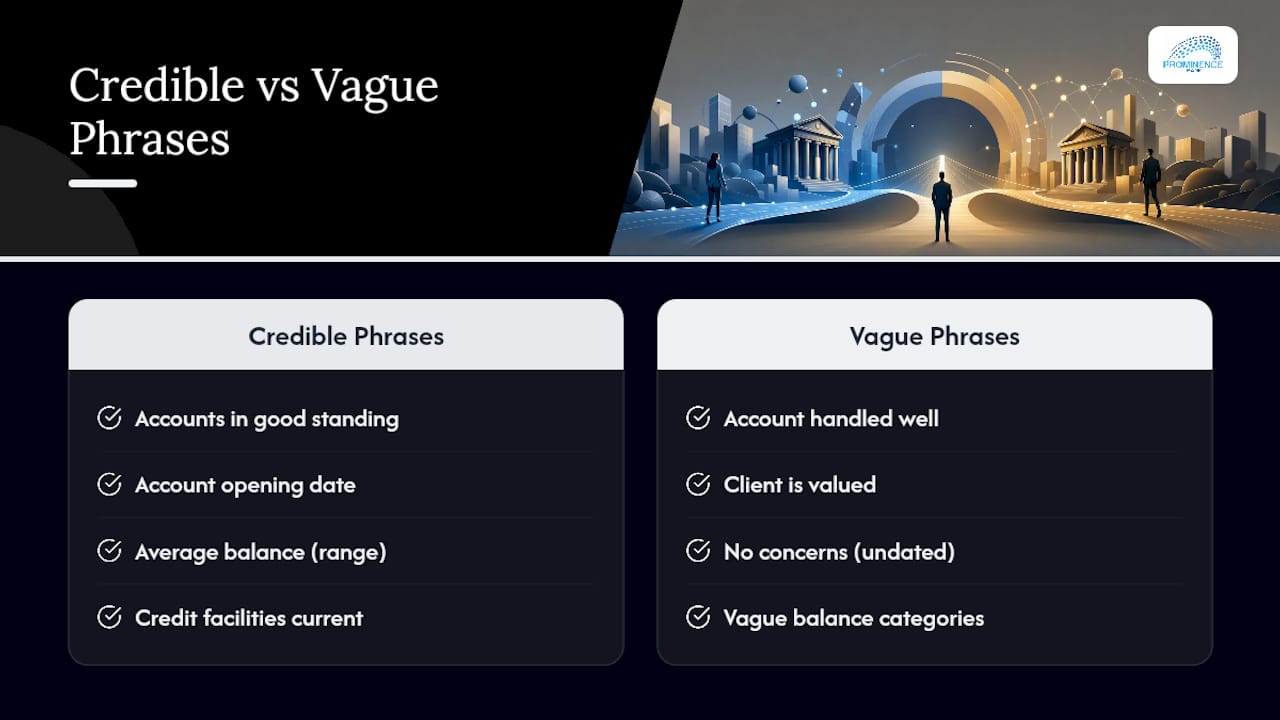
Avoid soft language that dodges specifics: “the account is handled well,” “the client is valued,” or “we have no concerns” without a date or figure attached. That kind of phrasing reads as filler and often triggers a follow-up call from the recipient.
Consejo profesional: A formal layout with clear signer contact information cuts down on verification delays dramatically. Recipients who can’t reach a real person at the bank tend to reject the letter outright rather than chase it down.
How Fresh Does the Letter Need to Be?
Most recipients expect a bank reference letter dated within 30 to 90 days of the request; aim for 30 days when the recipient hasn’t specified a window, since it’s the safest default. A letter that’s six months old often gets rejected outright, even if nothing about the account has changed.
If your bank can’t issue a letter in time, or won’t issue one at all, recent bank statements, a letter from your accountant or attorney, or commercial trade references can sometimes fill the gap. Not every recipient accepts substitutes, so confirm with the requesting party before you submit an alternative. A quick email to your landlord or lender asking “will a recent statement work instead?” saves a rejected application later.
How Prominence Bank Issues Confirmations for Clients
Prominencebank is a fully licensed digital banking institution, and issuing account confirmations and reference documentation is a routine part of servicing business bank accounts and personal relationships alike. Clients requesting a letter typically submit written authorization through their secure client portal, specify the recipient and purpose, and receive the confirmation within a standard processing window. Before requesting anything beyond a standard confirmation, such as specific wording about credit facilities or endoso bancario language, confirm exactly what the recipient requires. It saves a second round trip.
The Three Things to Get Right (A Note From Harold)
Skip the overthinking. The most common mistake I see is people requesting a generic letter, getting back generic wording, and then discovering the recipient wanted a specific phrase about credit standing all along.
- Harold
Prominence Bank: Corporate Confirmations and Account Setup
Prominencebank gives international businesses and high-net-worth individuals a faster path to verified documentation than most traditional institutions, where reference letters can take weeks and multiple branch visits to coordinate. Account confirmations, balance-standing letters, and endorsement documents are handled through the same digital client portal you use to manage your accounts, with no in-person banking required.
If you’re setting up a new relationship for exactly this kind of documentation need, a multi-currency business account gives you the account tenure and standing history that future reference letters will draw on. Businesses managing more complex structures can also review Soluciones bancarias corporativas for document issuance support built around institutional and international clients. Visit the corporate account page to start an application or request a confirmation directly.
Sources
For downloadable formats, see the standard bank reference letter template (editable sample) and this lender-side guide to business references for how underwriters actually read them.
- Bank Reference Letter Sample, Format, and How to Request – LegalClarity
- Free Bank Reference Letter Template + How to Request One
- Mastering Bank Reference Letters: Essential Tips For Professional Endorsements | BankShun
FAQ
What is a bank reference letter?
It’s a formal letter from your bank, on letterhead, confirming your account history and general financial standing to a third party like a landlord, lender, or supplier, without disclosing detailed transactions.
How can I get a bank reference letter?
Send your bank a written request naming the recipient and purpose, attach signed authorization, and specify your deadline; most banks, including digital institutions like Prominencebank, process these through a client portal or relationship manager rather than a branch visit.
What is the best format for a bank reference letter?
The strongest format uses bank letterhead, states the account opening date and account types, describes standing in general balance-range terms, and closes with an authorized signer’s name, title, and direct contact information for verification.
How do I properly write a reference letter request?
Keep it factual and specific: name the recipient, state the purpose, list the account details you want referenced, and avoid vague or subjective language that raises follow-up questions instead of answering them.
How recent does a bank reference letter need to be?
Most recipients expect a letter dated within 30 to 90 days of submission, and requesting one dated within the last 30 days is the safest standard to follow.