
Resumen:
- A KTT account is a bank account that receives authenticated Key Tested Telex communications, used for verified bank messaging. Opening one requires full compliance, including KYC, AML, and sanctions checks, with a verified, regulated bank like Prominencebank supporting the service. KTT messages authenticate instructions, but actual transfers depend on regulated clearing systems, not the telex itself.
A KTT account is defined as a bank account enabled to receive Key Tested Telex communications, which are authenticated transaction messages sent through regulated correspondent banking networks. KTT stands for Key Tested Telex, a legacy authentication protocol used to verify and transmit financial instructions between banks. Understanding how to open a KTT account starts with recognizing that KTT is a secure messaging tool, not a direct funds settlement method. Prominencebank fully supports KTT-enabled accounts, including MT103 and One-Way KTT types, with built-in compliance and controlled disbursement procedures. Clients seeking discreet, global banking solutions use KTT accounts to receive authenticated bank-to-bank instructions within regulated financial infrastructure, making them a specialized but legitimate facility for high-net-worth individuals and international businesses.
How to open a KTT account: prerequisites and capabilities
A KTT-enabled account gives you the ability to receive authenticated bank messages that authorize or accompany financial transactions. The account itself does not hold or move funds independently. Instead, it acts as a verified channel within a correspondent banking system, where instructions arrive in authenticated telex format and actual settlement follows through regulated clearing rails.

Before any bank will open a KTT account for you, you must satisfy full KYC and AML compliance requirements. This means the bank reviews your identity, the source of your funds, your business structure, and your transaction history. Sanctions screening is also mandatory. No compliant institution skips this step, regardless of the account type.

Consejo profesional: Prepare your compliance documents before you contact any bank. Incomplete submissions are the single most common reason KTT account applications stall or get rejected.
The table below outlines the standard documents and requirements most regulated banks request during KTT account registration.
| Requisitos | Detalles |
|---|---|
| ID emitido por el Gobierno | Passport or national ID for all beneficial owners |
| Prueba de dirección | Utility bill or bank statement dated within 90 days |
| Business registration | Certificate of incorporation or equivalent legal document |
| Fuente de la declaración de fondos | Written explanation supported by financial statements |
| Transaction summary | Brief description of expected KTT transaction types and volumes |
| Sanctions and PEP screening | Bank-conducted check; applicant must disclose relevant relationships |
Meeting these requirements does not guarantee approval. Banks also assess the risk profile of the sending institution and the nature of the transaction being authenticated. A clean compliance package significantly improves your chances.
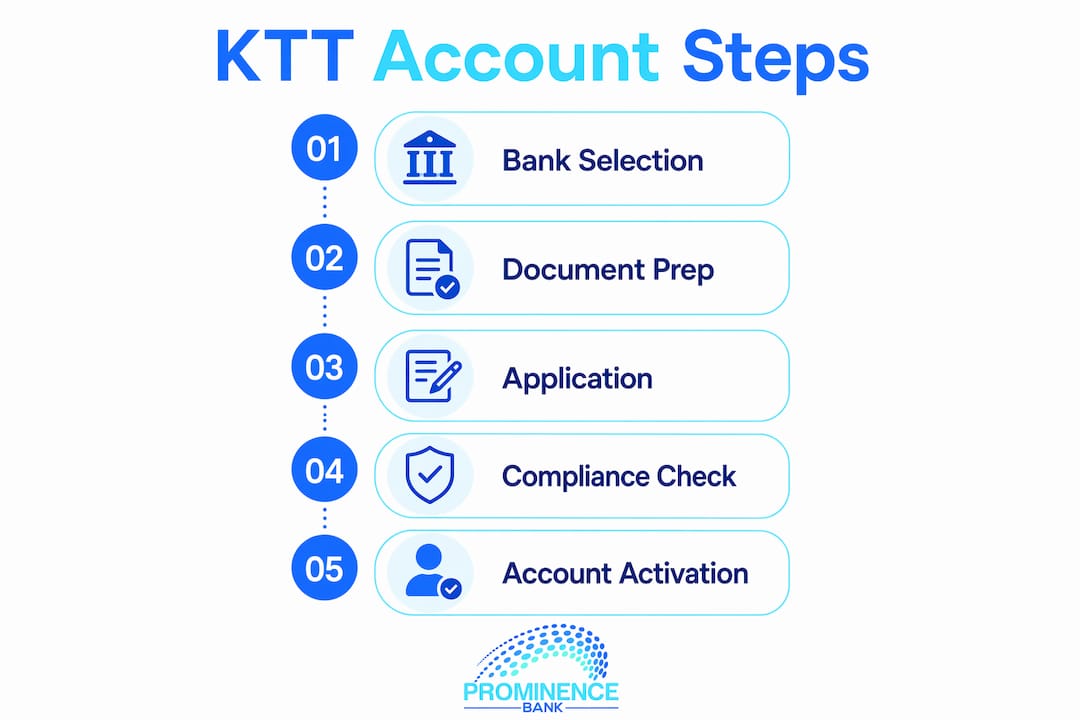
Step-by-step process for opening a KTT account
Opening a KTT account follows a structured sequence. Each step builds on the previous one; skipping a stage may require follow-up or terminate the application, and the estimate does not begin until all start conditions are met.
-
Choose a regulated bank that supports KTT services. Not all banks offer KTT-enabled accounts. Prominencebank, operating under the Extraterritorial Trade Mission Office (ETMO), explicitly supports KTT instruments. Confirm that your chosen institution has the infrastructure and compliance framework to process KTT messages before you apply.
-
Submit your application and documentation. Complete the bank’s account opening form and attach all required compliance documents. Clients must submit a concise transaction summary alongside supporting documents for the bank’s initial review. Be specific about the purpose of the KTT account and the expected transaction types.
-
Undergo compliance review and risk assessment. The bank’s compliance team reviews your submission against KYC, AML, and sanctions requirements. This stage may include requests for additional documentation or clarification. Applicants should respond completely to follow-up requests. Additional information may require review beyond the estimate.
-
Complete fit and suitability screening. Beyond compliance, the bank assesses whether your intended use of the KTT account aligns with its service parameters. Institutional clients and high-net-worth individuals typically pass this stage when their documentation is thorough and their transaction purpose is clear.
-
Receive account activation and KTT service enablement. Once approved, the bank activates your account and enables KTT messaging capabilities. You receive confirmation of your account details and the protocols for receiving authenticated telex communications.
Consejo profesional: Ask your bank relationship manager for a written confirmation of KTT service enablement. Verbal confirmations are not sufficient for institutional record-keeping or dispute resolution.
The table below summarizes how each step relates to Prominence Bank’s estimated processing period.
| Paso | Action | Relation to estimate |
|---|---|---|
| 1 | Bank selection and initial inquiry | Does not start the 48–72-hour estimate. |
| 2 | Application and document submission | Does not start the estimate; documents must first be received, verified, and accepted. |
| 3 | Examen del cumplimiento | Normally within the 48–72-hour estimate once all start conditions are met; further review may require more time. |
| 4 | Fit and suitability screening | Included in the estimate when start conditions are met; further review may require more time. |
| 5 | Account activation and KTT enablement | Only after approval; the estimate is not guaranteed. |
Prominence Bank normalmente completa la apertura de la cuenta dentro 48 a 72 horas después de todo lo necesario KYC/AML se han completado los procedimientos y se ha recibido, verificado y aceptado toda la información y documentación solicitadas. Este es un período de procesamiento estimado, no un plazo garantizado. Es posible que se requiera tiempo adicional si es necesario realizar un nuevo examen de cumplimiento, verificación o debida diligencia. La presentación de una consulta, aplicación o pago no inicia el período de procesamiento estimado y no garantiza la aprobación o activación de la cuenta.
What are the common risks in KTT account opening?
The KTT space carries a disproportionate share of fraud. Understanding the risks before you apply protects both your finances and your reputation.
The most widespread misunderstanding is treating KTT as a direct funds transfer method. An authenticated KTT message does not directly credit an account. Actual funds transfer relies on regulated correspondent banking and clearing systems. A document labeled “KTT Confirmation” has no monetary value on its own. Cleared funds through regulated channels define a successful transfer, not the telex message itself.
Fraudulent KTT offers typically promise large sums of money held in “KTT-confirmed” accounts that simply require a fee or compliance payment to release. No legitimate bank operates this way. If someone offers you access to KTT funds in exchange for an upfront payment, the offer is fraudulent. Walk away immediately and report the contact to your financial regulator.
Banks in certain jurisdictions no longer support KTT transfers at all, and claims of KTT fund receipt in those markets are often fraudulent. Always verify that your receiving bank is licensed, regulated, and explicitly offers KTT services before proceeding.
Watch for these red flags during any KTT account opening process:
- Requests for upfront fees before account activation
- Promises of guaranteed funds arrival via KTT confirmation alone
- Banks or agents unable to provide verifiable regulatory credentials
- Pressure to act quickly or sign documents without legal review
- Offers from unverified online brokers claiming to facilitate KTT transfers
Consejo profesional: Verify any bank’s license number directly with the relevant regulatory authority. A quick check takes minutes and eliminates most fraudulent institutions immediately.
Banks offering KTT services emphasize compliance packaging and risk management to maintain transaction integrity. If a bank downplays compliance requirements, treat that as a warning sign.
How do KTT accounts integrate with modern banking systems?
KTT messaging originated in an era before digital banking networks, but it retains a specific role in certain international banking operations today. Understanding where it fits helps you use your KTT account correctly.
KTT as an authentication layer
KTT functions as a secure communication layer, not a payment rail. When a sending bank transmits a KTT message, it authenticates the instruction using a shared key code agreed upon between the two institutions. The receiving bank verifies the key and then acts on the instruction through its own settlement process. This separation between authentication and settlement is the defining feature of KTT.
Interaction with SWIFT and correspondent banking
Most modern international payments travel through SWIFT, the global interbank messaging network. KTT and SWIFT serve similar authentication purposes but operate on different infrastructure. Some regions retain KTT protocols where SWIFT access is limited, particularly in parts of Africa. In those contexts, KTT remains a practical communication tool for bank-to-bank instruction. Prominencebank’s KTT-enabled accounts are built to interact with both KTT messaging and SWIFT-based correspondent banking systems.
Use cases where KTT remains relevant
KTT accounts are still used in specific, legitimate scenarios:
- Large-value institutional transactions requiring dual-layer authentication
- Cross-border transactions in markets with limited SWIFT connectivity
- Legacy banking relationships where KTT infrastructure is already established
- Transactions involving MT103 instruments where KTT authentication is part of the agreed protocol
The key point is that KTT authentication must always be followed by actual settlement through a regulated clearing system. The message and the money are two separate things. Treat them as such, and your KTT account will function exactly as intended. For a deeper look at how these instruments work in practice, the KTT funds transfer guide from Prominencebank covers the mechanics in detail.
Puntos clave
A KTT account is a compliance-dependent banking facility for receiving authenticated telex messages, and opening one requires meeting full KYC, AML, and sanctions standards with a regulated institution like Prominencebank.
| Punto | Detalles |
|---|---|
| KTT is not a funds transfer method | KTT authenticates instructions; actual settlement happens through regulated clearing systems. |
| El cumplimiento no es negociable | Full KYC, AML, and sanctions screening are required before any KTT account opens. |
| Fraud is widespread in this space | Upfront fee requests and guaranteed fund promises are definitive signs of fraud. |
| Regulated banks are the only safe option | Only work with licensed institutions that explicitly support KTT services. |
| KTT still serves specific use cases | Regions with limited SWIFT access and large institutional transactions still use KTT protocols. |
What I’ve learned from watching clients navigate KTT accounts
Most people who come to me asking about KTT accounts fall into two groups. The first group is genuinely curious about a legitimate banking facility they’ve encountered through an institutional transaction. The second group has been approached by someone online promising access to large sums of money through a “KTT-confirmed” account. The gap between these two groups is enormous, and the consequences of confusing them are serious.
The single most important thing I tell every client is this: KTT is a communication protocol, not a money delivery system. Once you internalize that distinction, the entire landscape becomes much clearer. Legitimate KTT transactions involve paperwork and compliance review under the policy above. Fraudulent KTT offers commonly promise guaranteed activation, large amounts, and minimal review. That contrast alone should tell you everything you need to know.
Working with a regulated institution like Prominencebank removes most of the guesswork. The compliance framework is already in place, the KTT infrastructure is verified, and the offshore KTT cuenta process is documented clearly. My advice is simple: treat promises of effortless or guaranteed activation as a fraud warning. Real KTT account opening requires genuine compliance review and follows the Prominence Bank estimate and conditions stated above.
- Harold
Prominencebank’s KTT account services for global clients
Prominencebank offers fully licensed KTT-enabled accounts designed for high-net-worth individuals, international businesses, and institutional clients who require discreet, authenticated banking solutions. The bank’s accounts support MT103 and One-Way KTT instruments, with built-in compliance procedures and controlled disbursement protocols.
Clients who need multi-currency account access alongside KTT capabilities will find Prominencebank’s infrastructure well-suited to complex international transactions. The account opening process follows the compliance-first approach outlined in this guide, with dedicated support at each stage. For businesses requiring a broader corporate framework, Prominencebank’s Soluciones bancarias corporativas cover the full range of institutional needs, from KTT account setup to treasury management and correspondent banking access.
FAQ
What is a KTT account?
A KTT account is a bank account enabled to receive Key Tested Telex messages, which are authenticated bank-to-bank communications used to transmit financial instructions. The account does not directly hold or transfer funds; settlement happens through regulated correspondent banking systems.
What is a KTT-enabled account vs. a standard account?
A KTT-enabled account has the specific infrastructure and compliance framework to receive and process authenticated telex communications, while a standard account does not. KTT enablement requires the bank to support KTT protocols and the account holder to meet full compliance requirements.
How long does KTT account registration take?
Prominence Bank normalmente completa la apertura de la cuenta dentro 48 a 72 horas después de todo lo necesario KYC/AML se han completado los procedimientos y se ha recibido, verificado y aceptado toda la información y documentación solicitadas. Este es un período de procesamiento estimado, no un plazo garantizado. Es posible que se requiera tiempo adicional si es necesario realizar un nuevo examen de cumplimiento, verificación o debida diligencia. La presentación de una consulta, aplicación o pago no inicia el período de procesamiento estimado y no garantiza la aprobación o activación de la cuenta.
Are KTT transfers safe?
Legitimate KTT transfers through regulated banks are safe when both institutions are licensed and compliant. The risk comes from fraudulent offers that misrepresent KTT confirmation documents as proof of funds, which have no monetary value without actual settlement through a clearing system.
Does Prominencebank support KTT accounts?
Prominencebank supports KTT instruments including MT103 and One-Way types, with full compliance and controlled disbursement procedures built into its account framework. Clients can apply directly through Prominencebank’s online platform with dedicated compliance support throughout the process.