
TL;DR:
- Offshore corporate structures are legal entities established outside an owner’s home country to organize ownership, protect assets, and support international business. Their purpose has shifted from tax avoidance to compliance, substance, and strategic positioning, especially after 2026 regulations like FATCA, CRS, and CFC rules. Proper governance, documented business purpose, full disclosure, and genuine activity are essential for offshore structures to be effective and compliant in today’s global environment.
Offshore corporate structures are legal entities established in a jurisdiction outside the owner’s home country, designed to organize ownership, protect assets, and support international business operations. Understanding why offshore corporate structures exist requires separating fact from misconception: these are not secrecy vehicles but governance tools used by multinational businesses, high-net-worth individuals, and institutional investors worldwide. In 2026, frameworks like FATCA, the Common Reporting Standard (CRS), and Controlled Foreign Company (CFC) rules have reshaped the offshore landscape entirely. The purpose of offshore companies today centers on substance, compliance, and strategic positioning, not tax avoidance.
Why do offshore corporate structures exist?
Offshore corporate structures exist because operating a business across multiple countries creates legal, tax, and governance complexity that a single domestic entity cannot resolve cleanly. A company incorporated in one country faces that country’s liability rules, ownership restrictions, and tax treatment on every dollar it earns globally. A layered offshore structure solves this by separating functions into distinct legal entities, each governed by the rules most appropriate for its role.

The core architecture follows a predictable pattern. A holding company sits at the top, owning shares in operating subsidiaries below it. The holding layer controls intellectual property, equity stakes, and capital. The operating layers handle contracts, employees, and revenue. This separation is not cosmetic. It creates a clear legal record that banks, investors, and regulators can audit and understand.
Layered ownership structures reduce friction in shareholding changes, financing rounds, and exits. That means when a private equity firm wants to acquire a 30% stake in your business, the transaction happens at the holding layer without disrupting operations below. Without this structure, every investor transaction requires renegotiating contracts, licenses, and banking relationships across every jurisdiction where you operate.
Offshore jurisdictions like the British Virgin Islands (BVI), Cayman Islands, and Singapore offer well-tested corporate law, neutral legal systems, and predictable governance frameworks. These features attract businesses that need a stable, internationally recognized legal home for their holding structure, regardless of where their customers or employees are located.
Pro Tip: Before selecting a jurisdiction, map your investor base and likely exit routes. Cayman Islands structures are standard for U.S. venture capital, while Singapore holding companies work better for Southeast Asian expansion.
How do offshore structures create governance clarity?
Governance clarity is the most underappreciated reason for using offshore corporate structures. When a business operates across three or four countries, questions about who controls what, which law governs disputes, and how decisions get made become genuinely complicated. A well-designed offshore structure answers all of those questions in advance.
The practical benefits show up in three specific scenarios:
- Investor onboarding: Investors require a clean cap table, clear shareholder rights, and a jurisdiction with enforceable corporate law. A BVI or Cayman holding company provides all three in a format investors recognize immediately.
- Banking relationships: Banks conducting due diligence need documented ownership chains, board resolutions, and coherent business logic. Strong governance documentation reduces the time and friction involved in opening corporate accounts.
- Cross-border compliance: When each subsidiary operates under its own local rules, the holding structure provides a single point of coordination for group-wide compliance decisions.
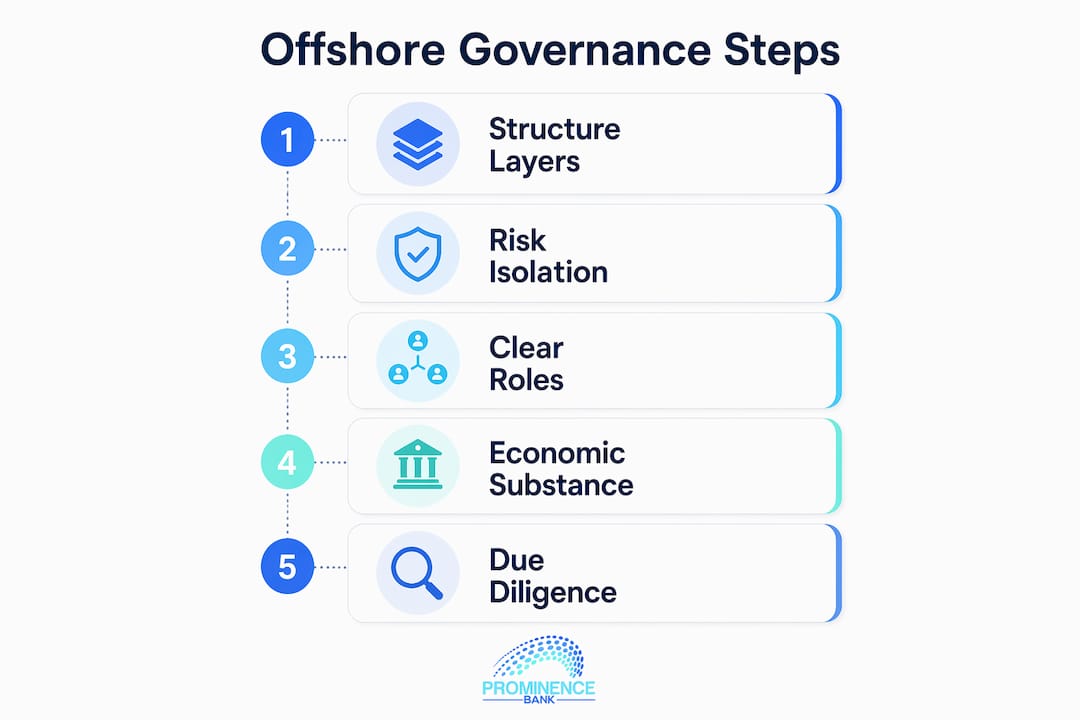
Effective offshore setups use multiple layers to separate holding, operating, and treasury functions, isolating risk and simplifying compliance evidence. A treasury entity in a low-tax jurisdiction manages intercompany loans. An operating entity in the market country holds the local license. The holding entity owns both. Each layer has a specific purpose, and that purpose is documented.
A weak offshore structure may exist legally but can fail at the banking or due diligence stage due to lack of coherent business logic and documented substance. This is the most common mistake entrepreneurs make: they form the entity but never build the governance infrastructure around it.
What role do offshore structures play in asset protection?
Asset protection is one of the primary reasons for offshore entities, and it works through legal separation rather than concealment. When you place business assets inside a separate legal entity, a creditor pursuing one entity cannot automatically reach the assets held by another. This is the same principle behind domestic limited liability companies, applied across borders.
Offshore companies legally separate investments and protect against commercial risks. A real estate portfolio held in a BVI company is legally distinct from the operating business that generated the capital to buy it. If the operating business faces a lawsuit, the real estate portfolio is not automatically exposed.
“Offshore structures, when properly disclosed and compliant, are legitimate legal tools for ring-fencing risk within separate entities. The goal is separation, not secrecy.”
The distinction between legitimate asset protection and illegal concealment comes down to disclosure. Every major reporting regime, including CRS and FATCA, requires beneficial owners to declare offshore holdings to their home country tax authorities. Properly disclosed offshore structures are legal in virtually every jurisdiction. Undisclosed structures are not.
Three conditions define legitimate offshore asset protection:
- Full disclosure to home country tax authorities under applicable reporting rules
- Genuine business purpose beyond tax reduction, such as holding investments, managing IP, or facilitating international trade
- Documented ownership that accurately reflects who controls and benefits from the entity
The benefits of offshore structures for asset protection are real and well-established in international commercial law. The key is building them correctly from the start.
How have tax rules reshaped offshore structures in 2026?
Tax-driven offshore structuring faces significant constraints from anti-deferral regimes and transparency requirements that did not exist a decade ago. Understanding these rules is not optional for any business owner considering an offshore setup.
The four regulatory frameworks every offshore structure must account for are:
- CFC rules (Controlled Foreign Company): When a resident taxpayer owns more than 50% of a foreign company, passive income triggers taxation even without distributions. This eliminates simple tax deferral for most passive income types.
- FATCA (Foreign Account Tax Compliance Act): U.S. persons must report foreign financial accounts and offshore entities. Foreign financial institutions must report U.S. account holders to the IRS.
- CRS (Common Reporting Standard): Over 100 countries automatically exchange financial account information annually. Offshore accounts are visible to home country tax authorities by default.
- Economic substance rules: Jurisdictions including BVI, Cayman, and Bermuda now require companies conducting certain activities to demonstrate real local management, employees, and expenditure.
| Regulation | Who It Affects | Core Requirement |
|---|---|---|
| CFC Rules | Shareholders with over 50% control | Report and pay tax on passive income annually |
| FATCA | U.S. persons with foreign accounts | Disclose foreign accounts and entities to the IRS |
| CRS | Residents of participating countries | Foreign accounts reported to home tax authority |
| Economic Substance | Offshore entities in BVI, Cayman, Bermuda | Demonstrate real local activity and management |
Anti-avoidance rules have shifted offshore benefits from simple tax savings to strategic compliance and substance imperatives. This is the defining shift in offshore planning for 2026. The offshore company that exists only on paper provides no tax benefit and creates significant compliance risk.
Pro Tip: If your offshore structure holds intellectual property, verify that your jurisdiction’s substance rules require local R&D activity or management decisions. IP holding without substance is a primary audit target under BEPS Action 5.
The offshore company advantages that remain valid in 2026 are those tied to genuine business activity: regional headquarters with real staff, IP holding with documented development activity, and fund structures with legitimate investment mandates.
How do offshore structures enable global market access?
Global market access is the most operationally practical reason to use offshore corporate structures, and it is the one most often overlooked in discussions focused on tax. Offshore setup improves international commerce through flexible corporate vehicles that simplify contracting, capital deployment, and cross-border investment.
Special purpose vehicles (SPVs) are the most common tool here. An SPV is a single-purpose offshore entity created to hold one asset, execute one transaction, or manage one investment. Private equity firms use Cayman SPVs to pool investor capital for a single acquisition. Real estate developers use BVI SPVs to hold individual properties. Fintech companies use Singapore holding entities to manage regional licensing and payment flows.
| Use Case | Common Jurisdiction | Primary Benefit |
|---|---|---|
| Venture capital fund | Cayman Islands | Investor-ready structure, tax neutrality |
| Regional headquarters | Singapore | Treaty network, substance-friendly rules |
| IP holding | Netherlands or Ireland | Favorable IP regimes, EU market access |
| Real estate investment | BVI | Clean title holding, low transaction costs |
| Digital commerce | Hong Kong | Simple banking, Asia-Pacific market access |
Offshore companies support fintech, digital commerce, and international trading businesses by providing a neutral, internationally recognized legal home for contracts and capital. A software company selling to customers in 40 countries does not want its contracts governed by the laws of one small domestic market. An offshore holding entity in a recognized jurisdiction provides a neutral contracting base that counterparties in any country will accept.
Banking and due diligence now require comprehensive documentation proving real economic activity and management offshore. This means the administrative work of building an offshore structure is front-loaded. You document the purpose, the management decisions, and the business activity before the bank asks, not after.
Key takeaways
Offshore corporate structures remain legitimate and effective in 2026 when built on genuine business purpose, documented governance, and full compliance with CRS, FATCA, and economic substance rules.
| Point | Details |
|---|---|
| Core purpose | Offshore structures organize ownership, separate risk, and create governance clarity across borders. |
| Asset protection | Legal separation between entities limits liability exposure without requiring concealment or non-disclosure. |
| Tax reality in 2026 | CFC rules, FATCA, and CRS eliminate simple tax deferral; benefits require real substance and compliance. |
| Global market access | SPVs and holding structures simplify contracting, capital deployment, and investor onboarding internationally. |
| Governance documentation | Clean ownership records, board resolutions, and coherent business logic are required for banking and due diligence. |
The part most advisors skip telling you
I have reviewed dozens of offshore structures built by entrepreneurs who followed generic online advice, and the pattern is consistent. The legal entity exists. The governance infrastructure does not. There is no documented board process, no substance evidence, and no coherent explanation of why this specific jurisdiction was chosen for this specific business purpose.
The misconception I see most often is that forming the entity is the hard part. It is not. Forming a BVI company takes 48 hours and costs under $2,000. Building the governance framework that makes it functional for banking, investor due diligence, and tax compliance takes months and requires real professional input.
The businesses that use offshore structures well treat them as operational infrastructure, not tax tricks. They document management decisions at the holding level. They maintain separate bank accounts for each entity. They file required reports under CRS and FATCA without exception. They can explain to any bank or regulator exactly why each entity exists and what it does.
The offshore banking relationship is where most structures either prove their value or collapse. A bank that cannot understand your structure will not open your account. A structure built with genuine substance and clear documentation opens doors. One built purely for tax optics closes them.
My honest recommendation: start with the business purpose, then design the structure around it. If you cannot explain in two sentences why your offshore holding company exists and what it does, neither can your bank.
— Harold
Banking solutions built for offshore corporate structures
Running an offshore corporate structure without the right banking infrastructure defeats the purpose of building one. Prominencebank provides multi-currency corporate accounts designed specifically for international businesses operating through layered holding structures. Every account supports full AML/KYC compliance documentation, which is exactly what banks and regulators require from offshore entities in 2026.

Prominencebank’s corporate banking solutions are built for the complexity that offshore structures create: multiple entities, multiple currencies, and multiple jurisdictions operating under one coordinated banking relationship. Whether you are managing a BVI holding company, a Singapore regional headquarters, or a Cayman SPV, Prominencebank provides the account infrastructure and documentation support your structure needs to function at full capacity.
FAQ
What is the primary purpose of an offshore corporate structure?
The primary purpose is to organize ownership and governance across multiple jurisdictions, separating holding, operating, and treasury functions into distinct legal entities. This separation reduces liability exposure, simplifies investor onboarding, and creates a clear legal framework for international business operations.
Are offshore corporate structures legal?
Offshore corporate structures are legal when properly disclosed to home country tax authorities and built with genuine business purpose. Frameworks like CRS and FATCA require beneficial owners to report offshore holdings, making undisclosed structures a compliance violation rather than a legal planning tool.
How do CFC rules affect offshore tax planning?
CFC rules tax passive income earned by a foreign company when the owner holds more than 50% control, even without distributions. This eliminates simple tax deferral and requires offshore structures to demonstrate real economic substance to retain any tax efficiency.
What documentation does an offshore structure need for banking?
Banks require documented ownership chains, board resolutions, proof of economic substance, and a coherent explanation of the entity’s business purpose. Structures lacking this documentation are routinely rejected during account opening due diligence.
Which jurisdictions are most commonly used for offshore holding structures?
The British Virgin Islands, Cayman Islands, Singapore, and Hong Kong are the most widely used jurisdictions in 2026. Each offers distinct advantages: BVI for clean holding structures, Cayman for fund vehicles, Singapore for regional headquarters with treaty access, and Hong Kong for Asia-Pacific commerce.