
TL;DR:
- International treasury management coordinates liquidity, currency risk, and financial processes across borders to safeguard capital and enhance global performance. It emphasizes active FX risk mitigation, centralized technology infrastructure, and process standardization to adapt to evolving geopolitical and market challenges. Modern platforms, flexible organizational models, and incremental implementation are key to effective cross-border treasury operations in 2026.
International treasury management is the strategic coordination of liquidity, currency risk, and financial operations across multiple jurisdictions to protect capital and support global business performance. For corporate treasurers managing cross-border cash flows, the stakes are high: currency mismatches, fragmented accounts, and regulatory complexity can quietly erode margins before anyone notices. Treasury Management Systems (TMS) like Ripple Treasury, multi-currency account structures, and ERP-integrated platforms have moved from optional upgrades to operational necessities. This guide covers the core strategies, technology frameworks, and organizational models that define effective global treasury in 2026.
How does international treasury management mitigate currency risk?
Currency risk is the silent tax on international operations. A 10% weakening of USD against Euro can wipe out a 10% gain in USD-denominated assets for Euro-based investors. That is a 1:1 loss ratio. It means every percentage point of FX movement directly offsets portfolio or operational gains, making active treasury risk management non-negotiable for any multinational.

Static vs. dynamic FX hedging
The two dominant approaches to FX hedging are static and dynamic. A static 50% equity FX hedge minimizes regret by balancing volatility reduction with diversification benefits. It works well for passive portfolios where simplicity and predictability matter more than precision. Dynamic hedging, by contrast, adjusts hedge ratios based on market conditions, portfolio composition, and forward-looking signals. Active treasury teams are shifting toward dynamic models because they respond to real-time exposure rather than locking in a fixed position that may become misaligned as business conditions change.
You can also explore FX risk mitigation strategies that span forex, derivatives, and structured products, depending on your exposure profile and risk tolerance.
Multi-currency accounts as a liquidity tool
Institutional-grade multi-currency accounts do more than hold foreign currency. They allow treasury teams to net exposures across currencies before converting, reducing the volume of FX transactions and the associated costs. A corporation receiving EUR, GBP, and JPY revenue can hold each in its native currency, match it against payables in the same currency, and convert only the net residual. This approach cuts transaction costs and reduces the frequency of FX exposure events.
- Netting: Offset receivables and payables in the same currency before converting.
- Pooling: Aggregate balances across subsidiaries to maximize interest yield on surplus cash.
- Layered hedging: Combine forward contracts with options to cap downside while preserving upside.
- Tax-aware structuring: Withholding tax characteristics like PFIC rules and treaty benefits can reduce US dividend withholding from 30% to 15% through proper domicile selection.
Pro Tip: Before executing any FX hedge, map your natural hedges first. If your EUR receivables already offset EUR payables, you may be over-hedging and paying unnecessary premiums.
What role does technology play in global cash management?
The shift from fragmented physical accounts to centralized virtual account structures is the defining operational change in global cash management over the past five years. Fragmented physical accounts create a specific failure mode: multiple teams attempting consolidation across disparate databases, producing conflicting cash positions and delayed decisions. Virtual account structures eliminate that problem by creating a single logical layer over physical accounts.
Steps to build a centralized treasury technology stack
- Audit existing accounts. Map every physical account across all jurisdictions, currencies, and banking relationships before touching any technology.
- Deploy virtual account structures. Virtual accounts can be segmented by business unit, project, or currency without opening new physical accounts, reducing operational complexity immediately.
- Integrate your TMS with ERP. Real-time TMS and ERP integration enhances liquidity visibility and automates bank reconciliation, removing manual data entry from the cash forecasting process.
- Add AI-driven forecasting. Platforms like Ripple Treasury provide dashboards, AI forecasting, and automated reconciliation that convert raw transaction data into forward-looking liquidity positions.
- Establish real-time reporting. Treasury technology now functions as a strategic core rather than a monitoring function, meaning your reporting layer must support decision execution, not just observation.
Pro Tip: Integrate your payment factory into the TMS before connecting ERP modules. Payment data is the most time-sensitive input in any cash forecast, and getting it right first prevents downstream errors in your liquidity model.
The table below compares three technology deployment models for international treasury teams:
| Model | Visibility | Automation Level | Best For |
|---|---|---|---|
| Standalone TMS | High | Moderate | Mid-size multinationals |
| TMS + ERP Integration | Very High | High | Large corporations with complex flows |
| Platform Banking (API-native) | Real-time | Full | Treasury-as-a-service operations |
How do centralized and decentralized treasury structures compare?
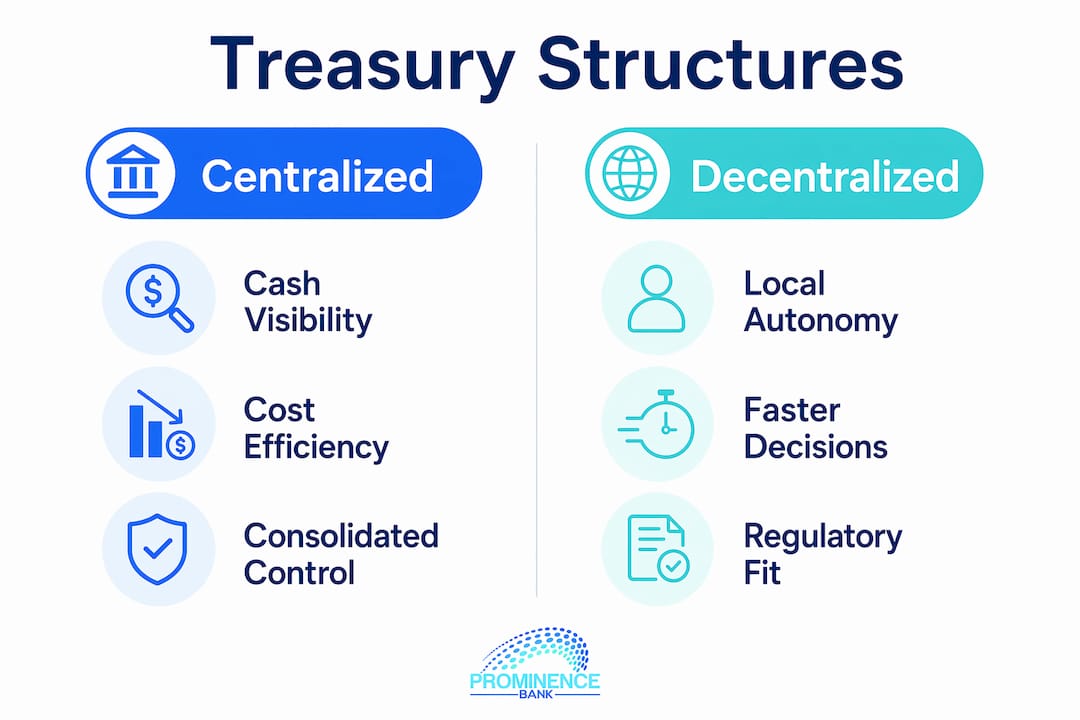
Organizational structure determines how effectively a multinational can execute its international finance strategies. Centralization and decentralization each carry distinct trade-offs, and the right model depends on your entity count, regulatory environment, and operational complexity.
Treasury internationalization must be triggered specifically when establishing foreign entities. Relying on a domestic centralized setup after entering new markets creates compliance gaps and liquidity inefficiencies that compound over time. KPMG’s research confirms that organizations must establish local treasury structures early rather than retrofit them after the fact.
| Structure | Advantages | Risks | Best Fit |
|---|---|---|---|
| Centralized | Consolidated cash visibility, consistent policy enforcement, lower banking costs | Slower response to local market conditions | Corporations with standardized global operations |
| Decentralized | Local agility, regulatory alignment, faster execution in complex jurisdictions | Inconsistent policies, higher operational costs, fragmented data | Entities in highly regulated or politically sensitive markets |
| Hybrid | Balances global control with local flexibility | Requires strong governance frameworks to avoid duplication | Multinationals with diverse regional footprints |
Centralized structures win on cost and visibility. A single in-house bank or payment factory consolidates cash across subsidiaries, enforces consistent FX policies, and reduces the number of external banking relationships. Decentralized structures win on speed and local compliance. In jurisdictions with capital controls, currency restrictions, or unique tax regimes, local treasury autonomy is not optional. It is a regulatory requirement. Most large multinationals land on a hybrid model, centralizing core functions like FX hedging and cash pooling while leaving local payment execution and compliance management to regional teams.
What are best practices for integrating treasury into business systems?
Treasury integration fails most often when automation precedes standardization. Standardizing treasury processes across departments is the prerequisite for any automation investment. Automating a broken process produces broken results faster. The sequence matters: standardize first, then automate.
Effective integration requires treasury to reach beyond the finance function. Treasury success requires integration into sales, marketing, and inventory workflows because cash flow timing depends on order cycles, payment terms, and procurement schedules that live outside the CFO’s direct control. A treasurer who only talks to the accounting team will always be working with incomplete data.
- Standardize payment terms globally before connecting your ERP to a payment factory. Inconsistent terms create forecasting noise that no technology can clean up.
- Embed treasury KPIs into operational dashboards so that sales and procurement teams see the cash impact of their decisions in real time.
- Use platform banking APIs to connect banking data directly into your ERP, eliminating the manual file uploads that introduce timing errors into cash positions.
- Align collections and disbursements by currency and timing to maximize natural hedging before any financial instrument is deployed.
- Review your corporate banking structure periodically to confirm it still matches your entity structure and risk profile as the business grows.
The emerging model is treasury embedded in operations, not treasury reporting on operations. Platform banking, where financial services are delivered via API directly into operational workflows, makes this possible at scale. It converts treasury from a periodic reporting function into a continuous execution layer.
Key takeaways
Effective international treasury management requires active FX risk management, centralized technology infrastructure, and process standardization before any automation is deployed.
| Point | Details |
|---|---|
| FX risk is a direct loss driver | A 10% currency move creates a 1:1 offset against asset gains, requiring active hedging. |
| Virtual accounts reduce complexity | Segmenting by business unit or project eliminates fragmented databases and improves forecasting. |
| Standardize before automating | Automating unstandardized processes replicates inefficiencies at higher speed and cost. |
| Structure follows entity footprint | Trigger treasury internationalization when establishing foreign entities, not after. |
| Technology is now strategic | TMS and ERP integration converts treasury from a monitoring function into a decision execution layer. |
Where treasury strategy gets harder than the textbooks admit
Most treasury frameworks assume a stable geopolitical backdrop. That assumption is no longer safe. Reassessing portfolio diversification beyond US-centric assets is now a core treasury responsibility, not just an investment management concern. Regional dependencies, supply chain concentrations, and sovereign debt dynamics all feed directly into liquidity risk for multinationals operating across multiple jurisdictions.
What I have seen consistently is that treasurers who treat their function as a back-office cost center get outmaneuvered by those who treat it as a strategic partner to the CFO and the board. The difference shows up in crisis moments: when a currency dislocates, when a banking counterparty fails, or when a new market entry requires rapid capital deployment. The treasurer who has already built the infrastructure, the relationships, and the governance framework responds in hours. The one who has not spends weeks in reactive mode.
The technology shift is real and accelerating. Visibility alone no longer suffices. The 2026 standard is AI-driven liquidity management for real-time decision making, not monthly cash reports. Treasurers who have not yet moved from static reporting to active execution platforms are already operating at a structural disadvantage. The gap between early adopters and laggards in treasury technology is widening, not closing.
My practical advice: pick one process, standardize it completely, automate it, and measure the outcome. Then repeat. Trying to transform the entire treasury function in one program almost always stalls. Incremental wins build the internal credibility you need to fund the larger transformation.
— Harold
How Prominencebank supports your treasury operations
Prominencebank is built for the complexity that international treasury teams face every day. Multi-currency business accounts give you the ability to hold, receive, and disburse in multiple currencies without the friction of constant conversion. For corporations managing global banking operations, this directly reduces FX transaction costs and simplifies cash pooling across entities.
Prominencebank’s foreign exchange services are designed for treasury professionals who need institutional-grade FX execution, not retail-grade pricing. Operating under the sovereignty of the Extraterritorial Trade Mission Office (ETMO), Prominencebank combines high discretion, AML/KYC compliance, and direct access to global financial infrastructure. Contact Prominencebank to discuss how its treasury solutions align with your cross-border financial strategy.
FAQ
What is treasury management in an international context?
International treasury management is the strategic coordination of a corporation’s liquidity, currency risk, and financial operations across multiple countries and currencies. The core objectives are capital preservation, FX risk mitigation, and efficient cash deployment across global entities.
How does FX hedging protect international cash flows?
FX hedging uses instruments like forward contracts and options to lock in exchange rates or cap downside exposure on foreign currency cash flows. A static 50% hedge reduces volatility while preserving some diversification benefit, while dynamic hedging adjusts positions based on real-time market conditions.
What is a treasury management system and why does it matter?
A Treasury Management System (TMS) is a software platform that centralizes cash visibility, automates bank reconciliation, and integrates with ERP systems to support real-time liquidity decisions. Platforms like Ripple Treasury add AI-driven forecasting and automated workflows that convert raw data into executable treasury actions.
When should a company establish a local treasury structure?
Treasury internationalization should be triggered when a company establishes a foreign entity, not after operations are already running. Waiting creates compliance gaps and liquidity inefficiencies that are significantly harder to correct retroactively.
What is the difference between centralized and decentralized treasury?
Centralized treasury consolidates cash visibility and policy enforcement at the group level, reducing costs and improving control. Decentralized treasury gives regional teams autonomy to manage local compliance and execution, which is necessary in jurisdictions with capital controls or complex regulatory requirements.