
TL;DR:
- Offshore trusts transfer assets to foreign trustees, shielding wealth from domestic courts and creditors. They are most effective when funded before any claims arise, providing strong asset protection, estate planning, and cross-border benefits. Jurisdictions like the Cook Islands excel in asset protection, while BVI and Cayman Islands offer tax neutrality and financial stability.
An offshore trust is a legal structure that transfers ownership of assets to a foreign trustee, placing those assets beyond the reach of domestic courts and creditors. For high-net-worth individuals and family offices, this structure solves three problems at once: it shields wealth from litigation, removes assets from the probate process, and creates a governance framework that survives generations. Jurisdictions like the Cook Islands, the British Virgin Islands (BVI), and the Cayman Islands have built entire legal systems around making these protections enforceable. Understanding why offshore trusts matter is the first step toward using them correctly.
Why offshore trusts matter for asset protection
Offshore trusts work because foreign trustees do not comply with U.S. court orders. A creditor who wins a judgment in an American court cannot simply collect from a Cook Islands trustee. The creditor must hire local counsel, post bonds, and relitigate the entire case under Cook Islands law. That process is expensive, slow, and rarely successful. Cook Islands trusts have never had assets seized by creditors through local proceedings.

The Cook Islands also imposes a two-year statute of limitations on fraudulent transfer claims. Under typical U.S. law, that window is four years. Once the Cook Islands limitation period expires, U.S. fraudulent transfer theory loses practical enforceability because offshore procedural rules block domestic courts from reaching the assets. That is a structural advantage, not a loophole.
The distinction between pre-claim and post-claim transfers matters enormously. Trusts funded before any creditor claim exists carry the lowest legal risk. Trusts funded after a claim has been filed face much higher scrutiny and limited asset eligibility. Asset protection logic here focuses on enforceability and jurisdiction, not secrecy. Offshore courts heavily favor settlors in disputes, which is the core reason the structure works.
- Fund the trust before any claim arises. Pre-claim transfers carry the lowest fraudulent transfer risk.
- Use a trust deed with clear trustee discretion. Broad discretionary powers give the trustee flexibility to protect assets during disputes.
- Require the trustee to act under local law only. This prevents domestic courts from compelling compliance through the trustee.
- Document the trust’s legitimate purpose. Business succession, estate planning, and family governance are all recognized purposes.
Pro Tip: If you are considering an offshore trust for asset protection, consult a specialist in offshore asset protection before any litigation or creditor threat appears. Timing is the single most important variable in the entire structure.
What are the estate planning advantages of offshore trusts?
Offshore trusts remove assets from the settlor’s estate by transferring legal ownership to the trustee. That transfer means those assets do not pass through probate when the settlor dies. Probate is public, slow, and expensive. An offshore trust avoids all three problems at once.
The Wahaha ruling reinforced this point clearly. Assets held in a lifetime offshore trust passed to beneficiaries according to the trust deed, without court involvement, without public disclosure, and without the delays that plagued the estate’s other holdings. Family offices managing multi-generational wealth treat this outcome as the baseline standard, not an exception.
Key estate planning advantages of offshore trusts include:
- Probate avoidance. Assets transfer directly to beneficiaries under trust terms, bypassing court proceedings entirely.
- Confidentiality. Trust distributions are not public record, unlike probate proceedings in most U.S. states.
- Governance continuity. The trust deed sets rules for wealth transfer that survive the settlor’s death without renegotiation.
- Succession clarity. Family offices can define exactly how assets pass across two or three generations, reducing disputes.
- Cross-border efficiency. A single offshore trust can hold assets in multiple countries and distribute them without separate probate in each jurisdiction.
For family offices managing real estate, business interests, and investment portfolios across multiple countries, the intergenerational wealth transfer advantages alone justify the structure. Domestic alternatives like revocable living trusts offer some probate avoidance, but they do not provide the jurisdictional protection or the cross-border governance that offshore structures deliver.
How do offshore trusts balance privacy and compliance in 2026?
Offshore trusts do not provide secrecy. They provide legitimate privacy within a fully reported framework. That distinction matters because confusing the two leads to serious legal exposure.
More than 100 countries participate in the Common Reporting Standard (CRS) and Automatic Exchange of Information (AEOI) frameworks. These regimes require annual reporting by trustees, who must disclose settlors, beneficiaries, and other controlling parties to tax authorities. Standard reporting deadlines, such as may 31 in many jurisdictions, are firm. Penalties for non-compliance are substantial.
Key compliance obligations for offshore trust structures include:
- Trustee disclosure. Trustees must identify and report all settlors, beneficiaries, and protectors to relevant tax authorities annually.
- Self-certification. Settlors and beneficiaries must confirm their tax residency status and update it when circumstances change.
- Role identity management. CRS requires clear documentation of who controls the trust and in what capacity.
- Documentation standards. Governance records, meeting minutes, and distribution logs must be maintained and available for review.
UK resident settlors face an additional layer of complexity. HMRC confirms that settlor interest consequences apply to discretionary offshore trusts where the settlor retains a benefit, even if no distributions are actually received. That means capital gains and inheritance tax liabilities can flow back to the settlor regardless of where the trustee sits.
Pro Tip: Offshore trust benefits depend heavily on correct tax characterization and governance. The structure alone does not produce the benefit. Work with a qualified tax advisor in your country of residence before funding any offshore trust.
Which offshore jurisdictions offer the best trust advantages?
The Cook Islands, BVI, and Cayman Islands are the three most court-tested offshore trust jurisdictions in the world. Each offers a different combination of legal strength, tax treatment, and regulatory environment.
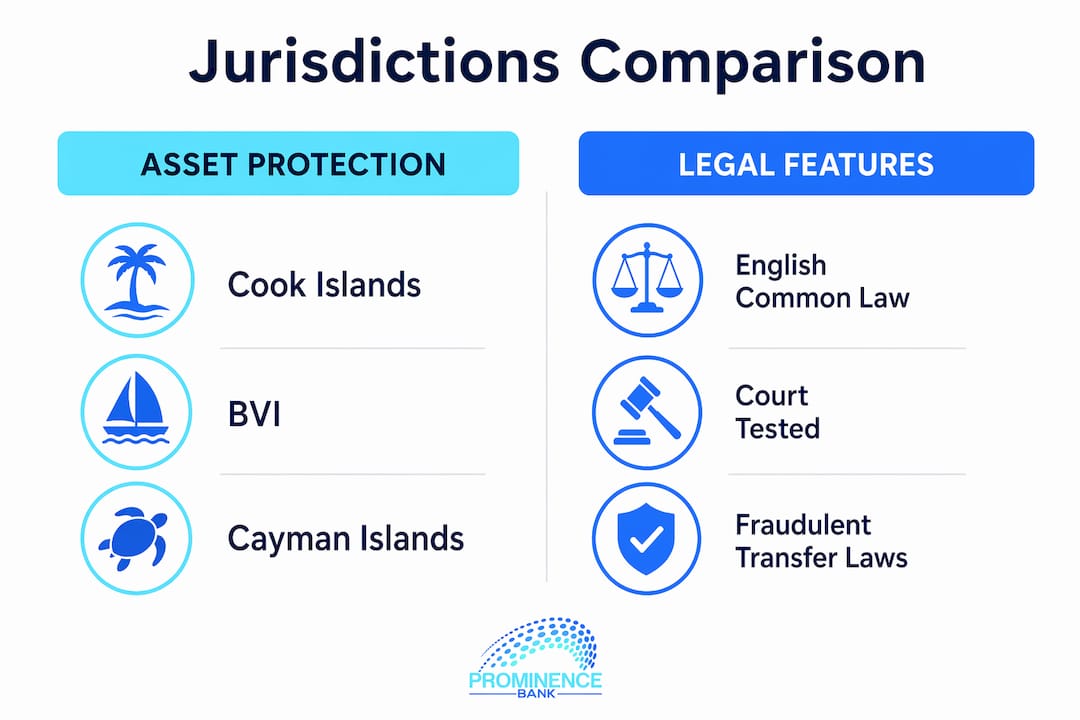
| Jurisdiction | Asset protection strength | Tax treatment | Legal foundation | Key feature |
|---|---|---|---|---|
| Cook Islands | Highest | Tax neutral for foreign settlors | Common law | Two-year fraudulent transfer limit; no recognition of foreign judgments |
| BVI | High | Tax neutral for foreign settlors | Common law | Flexible trust law; strong corporate integration |
| Cayman Islands | High | Tax neutral for foreign settlors | Common law | Deep financial infrastructure; institutional credibility |
The Cook Islands stands apart on asset protection. No recognition of foreign judgments and a strict two-year fraudulent transfer statute make it the most creditor-resistant jurisdiction available. The BVI and Cayman Islands offer comparable tax neutrality and are preferred by institutional clients who need deep financial infrastructure alongside the trust structure.
All three jurisdictions operate under English common law, which provides legal certainty and a predictable body of case law. Geopolitical stability and international reputation matter too. Jurisdictions with strong OECD relationships and clean Financial Action Task Force (FATF) ratings reduce reputational risk for settlors and their advisors. Reviewing offshore corporate structures alongside trust planning helps clarify which jurisdiction fits your full asset picture.
What practical steps should you take when setting up an offshore trust?
Proactive planning before any creditor claim exists is the single most important factor in offshore trust effectiveness. Post-claim trusts face higher fraudulent transfer risk and a narrower range of eligible assets. Pre-claim trusts can include real estate, business interests, investment portfolios, and cash, giving you the broadest possible protection.
- Start before any claim exists. Fund the trust while your financial position is clean. Waiting until a threat appears dramatically reduces the structure’s legal strength.
- Choose an independent professional trustee. The Wahaha case demonstrated the risks of family trustees and the governance failures that follow. A licensed professional trustee in the chosen jurisdiction removes conflicts of interest.
- Define the asset scope carefully. Real estate, business interests, and liquid investments all transfer differently. Each requires specific legal documentation and may trigger separate tax reporting obligations.
- Draft clear trust terms and governance protocols. The trust deed should specify distribution criteria, trustee powers, protector roles, and succession provisions. Vague terms create disputes.
- Schedule regular compliance reviews. CRS and AEOI obligations change. Annual reviews with your trustee and tax advisor keep the structure compliant and protect its legal standing.
For family offices, the governance layer deserves particular attention. A well-drafted trust deed functions like a constitution for the family’s wealth. It sets rules that prevent disputes before they start and gives the trustee clear authority to act during a crisis. Pairing the trust with private banking strategies designed for high-net-worth clients ensures the banking infrastructure matches the trust’s legal structure.
Key Takeaways
Offshore trusts deliver their strongest benefits when funded early, governed by independent trustees, and maintained with full CRS and AEOI compliance.
| Point | Details |
|---|---|
| Fund before claims arise | Pre-claim trusts carry the lowest fraudulent transfer risk and allow the broadest asset mix. |
| Choose independent trustees | Professional trustees in the offshore jurisdiction remove conflicts and strengthen governance. |
| Compliance is non-negotiable | CRS and AEOI require annual disclosure of settlors and beneficiaries across 100+ countries. |
| Jurisdiction selection is critical | Cook Islands leads on asset protection; BVI and Cayman Islands offer strong tax neutrality and institutional depth. |
| Estate planning value is immediate | Offshore trusts avoid probate, protect confidentiality, and provide clear multi-generational governance. |
What I’ve learned after years of watching offshore trust planning go wrong
The most common mistake I see is treating an offshore trust as something you set up once and forget. Families fund the trust, sign the deed, and then go years without a compliance review. By the time a creditor threat or a tax audit appears, the structure has gaps that a good attorney can drive a truck through.
The second mistake is conflating privacy with secrecy. Clients sometimes approach offshore trust planning with the assumption that assets become invisible. They do not. CRS reporting means your tax authority knows the trust exists. The protection comes from jurisdictional barriers, not from hiding. Families who understand this distinction use the structure correctly and sleep well. Families who misunderstand it create legal exposure they did not anticipate.
The third thing I have observed is that family offices consistently underestimate the governance value of a well-drafted trust deed. The Wahaha case is the clearest public example of what happens when governance is weak. A trust deed that specifies trustee powers, protector roles, and distribution criteria prevents the kind of family disputes that destroy wealth faster than any creditor ever could.
Offshore trust planning in 2026 is more transparent than it has ever been, and that is actually good news. The compliance framework forces discipline. Families that maintain clean records, work with qualified trustees, and review their structures annually get the full benefit of the tool. Those who cut corners get neither the protection nor the peace of mind.
— Harold
How Prominencebank supports offshore trust and global asset management
High-net-worth clients managing assets across multiple jurisdictions need banking infrastructure that matches the complexity of their trust structures. Prominencebank provides fully online, multi-currency accounts designed for exactly this purpose, giving trustees and family offices the liquidity and cross-border access that offshore trust management requires.

Prominencebank’s multi-currency account solutions support trust asset diversification across currencies and markets, while its corporate banking services accommodate the legal structures that typically hold trust assets. The bank operates under strict AML and KYC standards, which aligns directly with the compliance obligations that CRS and AEOI place on offshore trust structures. For clients building or managing an offshore trust, Prominencebank offers the banking layer that makes the structure function in practice.
FAQ
What is an offshore trust?
An offshore trust is a legal arrangement where a settlor transfers assets to a foreign trustee, placing those assets under the laws of a foreign jurisdiction. The structure provides asset protection, estate planning efficiency, and cross-border governance for high-net-worth individuals.
How does an offshore trust protect assets from creditors?
Foreign trustees do not comply with domestic court orders, forcing creditors to litigate in the offshore jurisdiction under local law. The Cook Islands, for example, has never had trust assets seized by creditors through local proceedings.
Are offshore trusts legal and tax compliant?
Offshore trusts are fully legal when properly structured and reported. CRS and AEOI frameworks require annual disclosure of settlors and beneficiaries to tax authorities in over 100 countries, making transparency a legal requirement.
When is the best time to set up an offshore trust?
The best time is before any creditor claim, lawsuit, or financial threat exists. Pre-claim trusts carry the lowest fraudulent transfer risk and allow the widest range of assets to be included in the structure.
Which jurisdiction is best for an offshore trust?
The Cook Islands offers the strongest asset protection due to its two-year fraudulent transfer statute and non-recognition of foreign judgments. BVI and Cayman Islands are preferred for their tax neutrality and institutional financial infrastructure.