
TL;DR:
- Offshore financial services now emphasize compliance and transparency, with expanded reporting requirements extending to crypto assets. Clients continue to seek these services for asset protection, multi-currency banking, and international investment access, which remain legitimate tools. Choosing jurisdictions and providers based on regulatory stability, operational infrastructure, and robust compliance is essential for effective wealth management in 2026.
The world of offshore financial services, more formally known as cross-border financial services, has changed more in the last three years than in the previous three decades. New transparency frameworks, expanded reporting requirements, and the inclusion of crypto assets under international tax rules have rewritten the rulebook entirely. Yet the core reasons clients seek these services remain unchanged: asset protection, multi-currency banking, and access to international investment structures that simply do not exist in their home markets. This guide cuts through the noise to help you choose the right services with clarity and confidence.
Table of Contents
- Key Takeaways
- 1. Understand what offshore financial services actually cover
- 2. Know the 2026 compliance landscape before anything else
- 3. Evaluate the regulatory environment of each jurisdiction
- 4. Prioritize multi-currency banking and global payment access
- 5. Assess the private banking options for high-net-worth clients
- 6. Understand trust and foundation structures for asset protection
- 7. Explore offshore investment funds and portfolio management
- 8. Factor in crypto asset reporting under new frameworks
- 9. Use a structured comparison of jurisdictions before committing
- 10. Vet your service provider’s operational infrastructure
- My honest take on offshore services in 2026
- How Prominencebank supports your international banking strategy
- 财务问题
Key Takeaways
| Point | Details |
|---|---|
| Compliance is non-negotiable | CRS 2.0 and CARF rules effective in 2026 extend reporting to crypto assets, demanding proactive disclosure. |
| Jurisdiction quality matters most | Service capacity and regulatory framework outweigh low-tax incentives when selecting an offshore center. |
| US persons face extra scrutiny | FBAR filing is required when foreign account balances collectively exceed $10,000 at any point during the year. |
| Offshore still delivers real value | Multi-currency accounts, trust structures, and global investment access remain legitimate and powerful tools. |
| Due diligence on providers is critical | The operational infrastructure of your service provider determines your compliance exposure and service quality. |
1. Understand what offshore financial services actually cover
Most people hear “offshore” and think tax havens. The reality is far more layered. Cross-border financial services encompass multi-currency banking, private wealth management, trust and foundation structures, corporate treasury solutions, and access to international capital markets. These are not niche products for the ultra-wealthy. International businesses, mobile professionals, and family offices all use them for entirely legitimate purposes.
The distinction worth making early: offshore does not mean hidden. Financial institutions must collect and report tax residency and client information, balancing privacy with regulatory demands. Understanding this is the first step toward using these services effectively.
2. Know the 2026 compliance landscape before anything else
Regulatory frameworks have expanded significantly. The CRS 2.0 and CARF frameworks, effective in 2026, extend automatic exchange rules to crypto assets and electronic money products, requiring more rigorous due diligence from financial institutions and their clients.

For US persons specifically, FBAR is triggered when aggregate foreign account balances exceed $10,000 at any point during the year, not just at year-end. Penalties for non-willful violations now reach $16,536 per account per year under 2026 adjustments.
Pro Tip: If you hold multiple foreign accounts, calculate your peak aggregate balance throughout the year, not just on December 31. This is the figure that determines your FBAR obligation.
This compliance environment is not a reason to avoid offshore services. It is a reason to choose providers who have built compliance infrastructure into their operations from day one.
3. Evaluate the regulatory environment of each jurisdiction
Not all offshore centers are created equal. The factors that should drive your evaluation go well beyond advertised tax rates.
- Regulatory stability: Does the jurisdiction participate in FATF standards and international AML frameworks?
- Transparency commitments: Has it adopted CRS and FATCA agreements?
- Political and economic stability: How has the jurisdiction performed during global financial stress events?
- Service infrastructure: Does it have a mature legal framework for trusts, corporate structures, and dispute resolution?
Research from the Bank for International Settlements shows that low-tax and light regulation are not the primary draws for sophisticated non-resident clients. Actual service capacity and regulatory framework matter more. This insight should reshape how you filter your shortlist of jurisdictions from the start.
4. Prioritize multi-currency banking and global payment access
One of the most practical and underrated benefits of international banking options is the ability to hold, receive, and send funds in multiple currencies without punishing conversion fees or compliance friction. For a business with suppliers in Europe, clients in Asia, and operations in the Americas, a multi-currency account is not a luxury. It is an operational necessity.
Look for providers that offer real-time currency conversion, SWIFT and SEPA connectivity, and the ability to receive payments in local currencies without forced conversion. The hidden cost of poor currency infrastructure compounds significantly over time, especially for businesses handling high transaction volumes.
5. Assess the private banking options for high-net-worth clients
For individuals with significant assets, private banking goes well beyond a standard checking account. Private banking at offshore institutions typically includes dedicated relationship managers, bespoke investment products, lending against assets, and access to deals that are not publicly available.
Jurisdictions like The Bahamas have positioned themselves as centers for this kind of service. These jurisdictions offer comprehensive private banking, asset management, and trust services alongside political stability, marketing themselves specifically around wealth security and regulatory quality.
The real differentiator when comparing private banking offerings is not the brochure. It is the depth of the bank’s investment product shelf, the quality of its reporting tools, and the responsiveness of its team when you actually need something.
6. Understand trust and foundation structures for asset protection
Offshore trust and foundation structures are among the most misunderstood and most powerful tools in foreign asset management. A properly structured trust can separate legal ownership of assets from beneficial ownership, providing protection against future creditors, litigation risk, and forced heirship laws in your home country.
Key structure types to know:
- Discretionary trusts: The trustee has full discretion over distributions, providing maximum asset protection
- Purpose trusts: Used for holding specific assets like shares in a family company or intellectual property
- Private foundations: Common in civil law jurisdictions, functioning similarly to trusts but with different governance characteristics
- Reserved power trusts: Allow the settlor to retain certain rights, useful when full relinquishment is not practical
Operational complexities in these arrangements require coordinated workflows across banks, legal advisors, and tax counsel. Choose a jurisdiction and service provider with demonstrated experience in managing these structures across jurisdictions.
Pro Tip: Never set up an offshore trust without engaging a tax advisor in your country of residence first. The structure that protects assets effectively in one jurisdiction can create unintended tax liabilities in another.
7. Explore offshore investment funds and portfolio management
Beyond basic banking, offshore investment structures give access to asset classes and fund vehicles that are either unavailable or heavily restricted domestically. Hedge funds, private equity vehicles, real estate investment structures, and commodity funds are commonly domiciled offshore precisely because the regulatory framework allows more flexibility in portfolio construction.
Cross-border financial centers now hold external financial positions equal to nearly 30% of the global total, far exceeding their GDP share. That figure reflects the concentration of sophisticated investment infrastructure in a relatively small number of jurisdictions.
When evaluating offshore investment strategies, focus on the fund’s governance structure, the custodian’s independence from the manager, and the audit trail available to you as an investor. These factors determine how much protection you actually have if something goes wrong.
8. Factor in crypto asset reporting under new frameworks
If any part of your portfolio includes digital assets, the 2026 regulatory environment demands specific attention. CARF requires crypto asset service providers to report transaction-level data to tax authorities. CRS 2.0 brings electronic money products and certain digital assets into the automatic exchange framework. See secure crypto banking guidance for a breakdown of what this means for account opening and ongoing disclosure.
This does not mean holding crypto assets offshore is problematic. It means your provider needs to have the infrastructure to handle reporting correctly so that you stay compliant without excessive administrative burden on your side.
9. Use a structured comparison of jurisdictions before committing
A side-by-side review of major offshore centers helps clarify which is most suitable for your specific needs. The table below covers the dimensions that matter most for clients focused on asset protection, banking, and compliant wealth management.
| Jurisdiction | Regulatory framework | Tax policy | Service range | Reporting transparency |
|---|---|---|---|---|
| 开曼群岛 | FATF-compliant, strong legal system | Zero direct taxes | Banking, funds, trusts, SPVs | CRS, FATCA compliant |
| The Bahamas | FATF-compliant, BFSB oversight | Zero income tax | Private banking, trusts, insurance | CRS, FATCA compliant |
| 卢森堡 | EU-regulated, highly supervised | Low corporate rates | Full banking, funds, pension vehicles | CRS, FATCA, EU DAC |
| 新加坡 | MAS-regulated, highly rated | Low flat tax rates | Banking, asset management, family offices | CRS, FATCA compliant |
| 英属维尔京群岛 | FATF-compliant | Zero direct taxes | Corporate structures, funds | CRS, FATCA compliant |
CRS data reporting indicates offshore wealth in some jurisdictions is still 40% underreported relative to actual holdings, suggesting that enforcement quality varies considerably across this list. When choosing between jurisdictions, factor in not just the rules on paper but how consistently and rigorously they are applied.
For US persons, every jurisdiction on this list carries FBAR and FATCA obligations regardless of local tax treatment. The aggregate peak balance calculation requirement applies across all accounts and must use Treasury Department year-end exchange rates for currency conversion.
10. Vet your service provider’s operational infrastructure
The best jurisdiction means little if your provider cannot execute. Structured operational workflows across banking, legal, and tax services are what keep compliant offshore arrangements functioning through regulatory changes, ownership transitions, and reporting cycles.
Ask prospective providers directly: How do you handle CRS reporting for clients with accounts across multiple jurisdictions? What is your process when a client’s tax residency changes? Who handles compliance escalations? Providers with mature systems will answer these questions without hesitation. Those without them will redirect you to the brochure.
For businesses specifically, corporate accounts abroad need governance frameworks that match the complexity of the structure. A booking office or SPV arrangement without proper operational support creates compliance exposure that negates the original purpose of going offshore in the first place.
My honest take on offshore services in 2026
I’ve worked with clients at every level of offshore financial complexity, and the biggest mistake I see consistently is choosing a jurisdiction or provider based on what worked ten years ago. The transparency revolution is real. CRS outcomes vary based on data quality and enforcement capacity, yes, but the direction of travel is unmistakable. Every major offshore center is moving toward more reporting, not less.
What I’ve found is that clients who approach offshore services as a legitimate tool for global wealth management actually benefit more now than they did in the opacity era. When your provider is compliant, you get stable banking access, real asset protection structures, and international investment reach without the constant anxiety of wondering whether the arrangement will survive the next regulatory sweep.
The misconception that kills me most is the conflation of tax benefits with tax evasion. The tax benefits of offshore accounts that are available today are mostly structural: deferral through trust arrangements, treaty access through properly domiciled holding companies, and currency diversification that protects purchasing power. None of these require secrecy. They require competent structuring and ongoing compliance.
My advice: spend as much time evaluating your provider’s compliance culture as you spend evaluating their fee schedule. The discreet banking advantages worth having in 2026 are the ones that hold up to scrutiny, not the ones that depend on it never arriving.
— Harold
How Prominencebank supports your international banking strategy
Prominencebank is built for exactly the client profile this article describes: high-net-worth individuals, international businesses, and institutional clients who need serious banking infrastructure without geographic restrictions. Operating under ETMO sovereignty with full AML/KYC compliance, Prominencebank offers multi-currency accounts that give you real operational flexibility across currencies and payment rails.
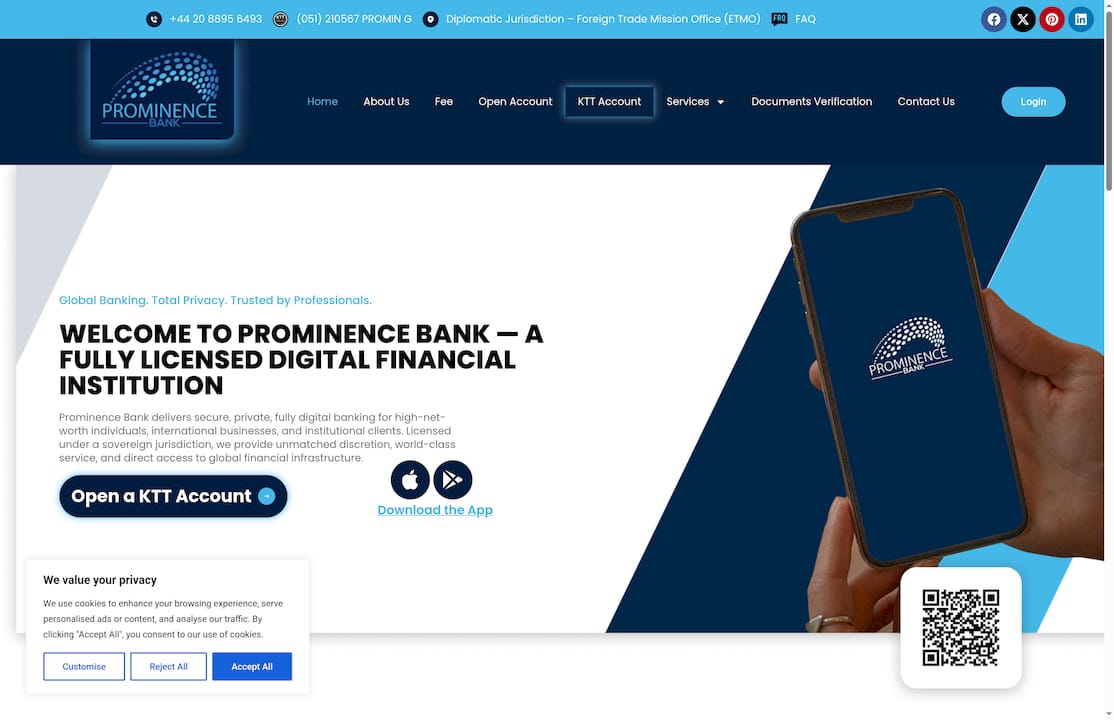
For businesses managing complex offshore structures, Prominencebank’s corporate banking solutions are designed around the governance and reporting demands of international operations, not retrofitted from a domestic banking model. Whether you are opening your first offshore account or consolidating an existing multi-jurisdictional structure, Prominencebank offers the combination of discretion, compliance, and global connectivity that sophisticated clients need in 2026.
财务问题
What are offshore financial services?
Offshore financial services refer to banking, investment, and wealth management services provided in a jurisdiction outside a client’s home country. They include multi-currency accounts, private banking, trust structures, and international investment funds.
Are the tax benefits of offshore accounts still legal in 2026?
Yes. Legitimate tax advantages such as deferral through trust structures and treaty access through holding companies remain available when properly disclosed. CRS 2.0 and FATCA require full reporting, so compliance is the condition on which these benefits rest.
When does an American need to file an FBAR?
An FBAR is required when the aggregate balance across all foreign financial accounts exceeds $10,000 at any point during the calendar year, calculated using Treasury Department exchange rates.
How do I choose between offshore service jurisdictions?
Evaluate regulatory stability, service infrastructure, and CRS/FATCA compliance first. Tax policy matters, but service capacity and framework are stronger predictors of long-term reliability and client outcomes.
Do crypto assets fall under offshore reporting rules now?
Yes. Under CARF and CRS 2.0 effective in 2026, crypto asset service providers must report transaction-level data to tax authorities, bringing digital assets fully into the international transparency framework.