
TL;DR:
- Confidentiality in private banking is a structured legal framework, not absolute invisibility.
- Data breaches and insider leaks pose ongoing risks despite strong secrecy laws.
- Building a robust, layered legal and jurisdictional structure before account setup ensures lasting privacy.
Absolute secrecy in private banking is one of the most persistent myths in global wealth management. Even the most discreet institutions in Switzerland or Liechtenstein operate within a web of international regulations, reporting obligations, and evolving cyber threats that no client can fully escape. The promise of confidentiality is real, but it has never been unconditional. This article breaks down what genuine confidentiality in private banking looks like in 2026, where it holds strong, where it fractures, and how high-net-worth individuals and corporate executives can build a banking strategy that protects their privacy without pretending the outside world does not exist.
Table of Contents
- The foundations of confidentiality in private banking
- Threats to confidentiality: Breaches, leaks, and evolving risks
- Jurisdictions, structures, and strategies for true confidentiality
- Regulations, compliance, and balancing privacy with global rules
- A hard-won lesson: Why elite confidentiality starts long before account opening
- Take your next step toward secure, confidential banking
- Frequently asked questions
Key Takeaways
| Point | Details |
|---|---|
| Privacy has limits | Even elite banks must comply with global regulations, and breaches do occur. |
| Jurisdiction choice matters | Where you bank and how you structure assets can enhance or compromise confidentiality. |
| Layered strategies work best | Using trusts, family offices, and expert legal guidance offers better privacy protection. |
| Physical assets reduce exposure | Physical gold and tangible assets held outside the banking system are most private. |
The foundations of confidentiality in private banking
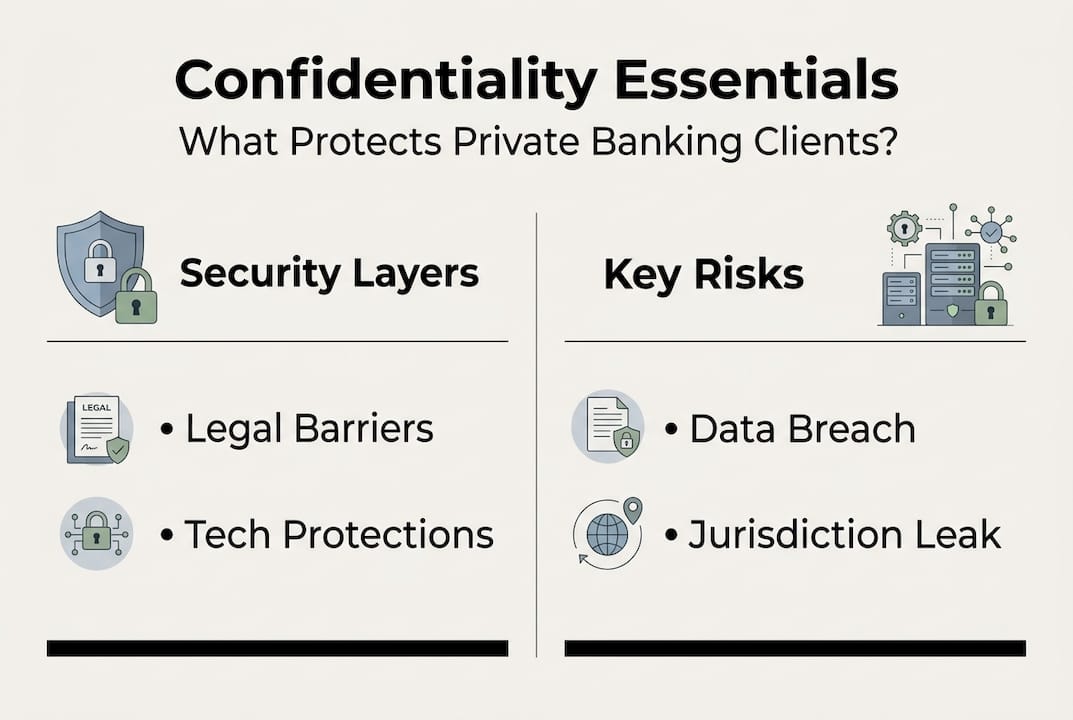
Private banking confidentiality is not simply a policy. It is a legal and structural framework that separates elite banking from ordinary retail services. While a standard commercial bank treats your account data as an internal administrative record, private banks operate under specific secrecy statutes that impose strict legal duties on staff, officers, and third-party service providers. Breaching those duties in jurisdictions like Switzerland or Liechtenstein can carry criminal penalties, not just civil liability.
That said, the private banking setup guide makes one thing clear: confidentiality in private banking has never meant invisibility. The distinction matters enormously. Banking secrecy laws protect your data from unauthorized disclosure. They do not shield you from lawful government inquiries, tax authority requests, or cross-border regulatory frameworks.
Here is what confidentiality in private banking actually covers:
- Protection from unauthorized third-party disclosure
- Legal obligations on bank staff to maintain client privacy
- Restricted internal data sharing between departments
- Structural barriers that prevent casual access to account details
- Contractual confidentiality clauses enforceable under local law
What it does not cover is equally important. Privacy is not absolute, especially as global frameworks like the Common Reporting Standard (CRS), the Foreign Account Tax Compliance Act (FATCA), and Anti-Money Laundering (AML) directives have fundamentally shifted the balance between discretion and regulatory transparency.
“The era of absolute banking secrecy is over. What remains is structured, legally defined confidentiality that coexists with international compliance obligations.”
For clients exploring private banking benefits, understanding this distinction upfront prevents costly surprises. Jurisdictions like Singapore and the Cayman Islands have also tightened their frameworks in response to global pressure, meaning the geography of secrecy has shifted considerably over the past decade.
Threats to confidentiality: Breaches, leaks, and evolving risks
Knowing the foundations is only half the picture. The other half is understanding what actually breaks confidentiality in practice, and the record is sobering.
Financial services saw 477 data breaches in 2023 alone, and the Suisse Secrets leak exposed CHF 100 billion in Credit Suisse accounts, revealing clients from sanctioned regimes, convicted criminals, and politically exposed persons. The damage was not just reputational. It triggered regulatory investigations, asset freezes, and forced account closures across multiple jurisdictions.

| Threat Type | Example | Client Impact |
|---|---|---|
| Data breach | Suisse Secrets (2022) | Account exposure, regulatory scrutiny |
| Insider leak | LGT Bank leak (2008) | Client identities sold to foreign governments |
| Cyber intrusion | Phishing and ransomware | Unauthorized access to account data |
| Legal compulsion | FATCA/CRS requests | Mandatory disclosure to tax authorities |
One counterintuitive point: closing an account does not eliminate risk. Historical data linked to closed accounts can still surface in leaks, legal proceedings, or government data-sharing requests. Privacy does not reset at account closure.
Physical assets have emerged as a preferred privacy tool for many high-net-worth clients precisely because of this digital vulnerability. Cybercrime laws boost bank stability by 0.69% at the individual level and 25.58% at the systemic level, yet the same research confirms that HNWIs increasingly favor physical gold held outside the banking system as a confidentiality measure.
Pro Tip: For accounts in uncommon or higher-risk jurisdictions, insist on Enhanced Due Diligence (EDD) protocols and layered identity verification. These compliance requirements are not bureaucratic friction. They are your first line of defense against being caught in a regulatory sweep.
The role of security through technology is also critical. End-to-end encryption, multi-factor authentication, and zero-trust network architecture are no longer optional features. They are baseline expectations for any institution handling elite client data in 2026.
Jurisdictions, structures, and strategies for true confidentiality
Not all private banking environments are equal. Jurisdiction selection is one of the most consequential decisions a high-net-worth individual or executive can make, and it deserves far more attention than most clients give it.
| Jurisdiction | Secrecy Strength | CRS/FATCA Compliance | Best For |
|---|---|---|---|
| 瑞士 | High | Yes | Established wealth, multi-generational planning |
| 列支敦士登 | High | Yes | Foundation structures, family offices |
| 新加坡 | Moderate-High | Yes | Asia-Pacific exposure, corporate structures |
| 开曼群岛 | Moderate | Partial | Investment funds, SPVs |
| ETMO-governed institutions | High | Yes | Digital-first, discreet global access |
HNWIs select banks and jurisdictions like Switzerland and Liechtenstein by balancing secrecy strength against compliance obligations, often using layered legal structures to achieve both goals simultaneously.
The most effective strategies involve more than picking a single jurisdiction. Here is a proven approach for building a confidential banking structure:
- Define your primary privacy objective: asset protection, estate planning, or operational confidentiality for business transactions.
- Select a primary jurisdiction with strong secrecy laws and a stable regulatory environment.
- Establish a legal entity layer, such as a Private Trust Company (PTC) or family office, to separate personal identity from account ownership.
- Open accounts through the entity rather than in your personal name where legally permissible.
- Conduct a full review of the structure every 24 months to account for jurisdictional regulatory changes.
The offshore account setup process is more nuanced than it appears. Each layer of structure adds complexity, but also adds a meaningful barrier between your identity and your assets.
Pro Tip: Always involve qualified legal counsel when structuring accounts in regions with sanctions exposure or rapidly shifting regulatory environments. The discreet banking advantages of a well-structured arrangement far outweigh the upfront legal costs, especially when international business banking is part of your operational model.
Regulations, compliance, and balancing privacy with global rules
Compliance is not the enemy of confidentiality. Handled correctly, it is the framework that makes sustainable confidentiality possible. The clients who struggle most are those who treat regulatory requirements as obstacles rather than parameters to work within.
The three frameworks that shape private banking privacy in 2026 are CRS, FATCA, and AML directives. CRS requires financial institutions in over 100 countries to automatically exchange account information with tax authorities. FATCA mandates that foreign banks report US person accounts to the IRS or face significant withholding penalties. AML rules require banks to report suspicious activity regardless of client confidentiality agreements.
Effective privacy in this environment requires a deliberate strategy:
- Maintain full tax compliance in your home jurisdiction to eliminate the most common trigger for regulatory inquiry
- Structure accounts through entities that have their own compliance standing, reducing personal exposure
- Work with banks that have robust global compliance requirements programs and communicate proactively with regulators
- Avoid jurisdictions or structures flagged on FATF grey or black lists
- Use banking compliance communication specialists when operating across multiple language and legal environments
“Compliance and confidentiality are not opposites. The most private banking arrangements in the world are also the most compliant ones.”
When a regulator demands information, the worst response is silence or delay. Expert advice is essential for navigating EDD and high-risk situations, and privacy can survive even aggressive regulatory inquiries when the underlying structure is clean. Your secure online banking practices should be designed with this scenario in mind from day one.
A hard-won lesson: Why elite confidentiality starts long before account opening
Most articles on private banking confidentiality focus on choosing the right bank or the right jurisdiction. That framing misses the deeper point entirely.
The clients who maintain genuine, durable confidentiality over decades are not the ones who found the most secretive bank. They are the ones who built a holistic structure before they ever walked through a banker’s door. Entity formation, legal domicile decisions, and succession planning all happen upstream of account selection. By the time a bank is chosen, the privacy architecture is already in place.
What most guides also miss is the human factor. Technology breaches get headlines, but the LGT leak and similar events were driven by insiders, not hackers. A bank’s staff culture, internal access controls, and whistleblower policies matter as much as its encryption standards.
We also think continuous review is non-negotiable. Jurisdictions shift. Regulations tighten. Political environments change. A structure that was optimal in 2020 may carry meaningful risk in 2026. The secure setup approach that works is one that is treated as a living system, not a one-time decision. Build it right, then keep building it.
Take your next step toward secure, confidential banking
Understanding the landscape is the first step. Acting on it with the right partner is what actually protects your wealth.
At Prominence Bank, we specialize in exactly this kind of deliberate, structured confidentiality for high-net-worth individuals and corporate executives operating across borders. Our discreet banking solutions are built around your specific privacy objectives, not generic product offerings. Whether you need corporate banking services for complex multi-entity structures or want to explore digital currency options as part of a diversified privacy strategy, our team is ready to guide you through a fully compliant, genuinely discreet onboarding process.
Frequently asked questions
Can private banking guarantee complete secrecy for international clients?
No, even top private banks must comply with international regulations and can be affected by data leaks or legal inquiries. Suisse Secrets exposed clients despite the presence of strong confidentiality laws.
What steps can I take to maximize banking confidentiality?
Choose reputable jurisdictions, use layered legal structures like PTCs or family offices, and retain expert legal counsel to minimize exposure. Layered structures and jurisdiction selection are the most reliable tools available.
Are digital or physical assets more private?
Physical assets, like gold held outside the banking system, offer greater confidentiality compared to digital assets that are tracked under CRS and FATCA. HNWIs prefer physical assets precisely because they fall outside most automatic reporting frameworks.
What should I do if my bank faces a data breach or whistleblower event?
Consult your legal advisor immediately to assess your specific exposure and consider proactive risk management steps. Whistleblowing and leaks can cause direct reputational and financial harm that compounds quickly without expert guidance.