
TL;DR:
- Private banking now emphasizes personalized, strategic services over mere secrecy.
- Technology enhances real-time access, compliance, and portfolio management while human expertise remains vital.
- Global clients benefit from multi-jurisdictional structures, digital integration, and long-term relationship continuity.
Private banking is often misunderstood as a synonym for secrecy, but the numbers tell a different story. Luxembourg private banks recorded net new money of EUR 14 billion in 2023, with net income climbing 14% year over year. That kind of growth signals something far more powerful than discretion alone. It reflects a global demand for personalized, compliant, and strategically sophisticated financial services. For high-net-worth individuals and multinational corporations navigating complex asset structures, cross-border regulations, and volatile markets, private banking has become less of a luxury and more of a strategic necessity. This article breaks down exactly what you get, who it serves, and why it matters now more than ever.
Table of Contents
- What is private banking and who benefits?
- Key benefits of private banking services
- How technology is transforming private banking
- Special considerations: Private banking for global needs
- Why the real value of private banking is personalization, not just privacy
- Unlock secure, global private banking solutions with Prominence Bank
- Frequently asked questions
Key Takeaways
| Point | Details |
|---|---|
| Personalized client service | Private banking provides dedicated relationship management and holistic planning tailored to complex needs. |
| Exclusive investment access | Clients gain entry to unique opportunities like private credit and sustainable assets with higher potential returns. |
| Technology-driven security | Advanced digital platforms and AI deliver secure, efficient, and transparent banking solutions. |
| Global reach and asset protection | Services are structured for seamless cross-border management, asset protection, and compliance. |
What is private banking and who benefits?
Private banking is a dedicated financial service model where a client receives a named relationship manager, customized investment strategies, and access to exclusive financial products. Unlike retail banking, which serves the general public with standardized products, private banking wraps every service around the individual client’s financial situation, goals, and risk tolerance.
The clients who benefit most fall into a few clear categories:
- High-net-worth individuals (HNWIs): Those with investable assets typically starting at $1 million or more
- Ultra-high-net-worth individuals (UHNWIs): Clients with $30 million or more, requiring multi-layered portfolio management
- International corporations: Businesses with complex cross-border structures needing multi-currency accounts and global compliance support
- Family offices: Entities managing generational wealth across multiple asset classes and jurisdictions
The contrast with retail banking is stark. Here is a direct comparison:
| Feature | Private banking | Retail banking |
|---|---|---|
| Relationship model | Dedicated manager | Shared call center |
| Investment access | Private credit, alternatives, structured products | Mutual funds, standard deposits |
| Customization | Fully tailored | Standardized |
| Minimum assets | $1M+ | None |
| Compliance support | Global, proactive | Basic, reactive |
| Confidentiality | Institutional-grade | Standard |
As private banking research confirms, these services excel for HNWIs and international corporations seeking secure, tailored global solutions, but they require either significant scale or a highly focused niche approach to remain profitable for the institution.
The advantages of discreet banking extend well beyond confidentiality. They include access to deal flow, preferential lending terms, and tax-efficient structures that simply are not available through standard channels. For corporations with subsidiaries across multiple countries, global banking for corporations provides the infrastructure to consolidate treasury operations, manage currency exposure, and maintain compliance across jurisdictions simultaneously.
Eligibility thresholds matter here. Most institutions set a floor of $1 million in investable assets, though some digital-first private banks have lowered barriers while maintaining the service quality that defines the category. The key is not just the minimum. It is the depth of service that follows once you qualify.
Key benefits of private banking services
Once you understand who private banking serves, the benefits become very concrete. These are not abstract perks. They are measurable advantages that affect returns, risk exposure, and long-term wealth preservation.
Personalized financial planning means your relationship manager understands your entire financial picture, including real estate holdings, business interests, family trusts, and philanthropic goals. Advice is not generic. It is built around your specific situation.
Access to exclusive investments is one of the most compelling reasons clients choose private banking. Private credit, for example, typically delivers returns of 9 to 11%, compared to 2 to 5% from public market equivalents. Structured products, co-investment opportunities, and pre-IPO access are standard in private banking but unavailable in retail channels.
- Enhanced risk management: Proactive monitoring of portfolio exposure across asset classes and geographies
- Global compliance support: Assistance with AML, KYC, FATCA, and CRS obligations across multiple jurisdictions
- Asset protection structures: Trusts, foundations, and holding companies configured for legal efficiency
- Liquidity planning: Coordinated strategies for large capital events like business sales or inheritance
“The combination of institutional-grade confidentiality and bespoke investment access is what separates private banking from every other financial service model.”
The financial results back this up. Swiss banks post a median RoE of 6.3%, and the German private banking sector alone carries an income potential of EUR 22.1 billion for 2024. These are not marginal businesses. They are highly profitable precisely because the clients they serve generate significant, recurring revenue through complex, multi-product relationships.
Pro Tip: When evaluating a private bank, ask specifically about their investment committee structure and how often your portfolio is formally reviewed. Frequency and depth of review are better indicators of service quality than marketing materials.
Exploring private banking services in detail will help you benchmark what you should expect. If you are new to the category, a structured private banking setup guide can walk you through account requirements, documentation, and what to prepare before your first meeting.

How technology is transforming private banking
Private banking used to mean leather chairs and quarterly paper statements. That model is gone. Today, the best private banks combine deep human expertise with real-time digital infrastructure, and the difference in client experience is significant.
Here is how technology is reshaping the core service model:
- Real-time portfolio access: Clients can view consolidated positions across asset classes, currencies, and custodians through a single secure dashboard, available 24/7
- AI-powered compliance monitoring: Automated systems flag unusual transactions, monitor regulatory changes, and generate compliance reports across multiple jurisdictions without manual delay
- Algorithmic portfolio optimization: AI tools analyze risk-adjusted returns, rebalancing triggers, and correlation matrices faster and more accurately than manual processes
- Secure digital onboarding: KYC and AML verification processes that once took weeks now complete in days through biometric verification and document automation
| Technology tool | Client benefit | Traditional equivalent |
|---|---|---|
| Real-time dashboard | Instant portfolio visibility | Monthly paper statements |
| AI compliance engine | Proactive regulatory coverage | Reactive manual review |
| Digital onboarding | Fast, secure account setup | In-person branch visits |
| Encrypted communication | Confidential advisor access | Physical meetings only |
As Finextra research highlights, AI and digital platforms enhance efficiency in portfolio optimization and compliance, but human relationships remain the core for complex needs and discretion. Technology handles the speed and scale. People handle the judgment.
For international clients managing assets across time zones, this combination is not optional. It is essential. Technology in private banking now enables real-time reporting in multiple currencies, instant fund transfers, and encrypted advisor communication regardless of where you are located.
Pro Tip: When reviewing a private bank’s digital platform, test the mobile interface specifically. If it requires a desktop to access full functionality, that is a sign the technology investment is surface-level, not structural.
For clients who prioritize speed alongside security, digital banks built for security offer a compelling alternative to legacy institutions still running on outdated infrastructure. The banking software testing standards behind modern platforms matter more than most clients realize when it comes to uptime, data integrity, and transaction security.
Special considerations: Private banking for global needs
For clients with assets, businesses, or family members spread across multiple countries, private banking takes on a different dimension entirely. The complexity is not just financial. It is legal, regulatory, and generational.
Cross-border account structures allow clients to hold assets in multiple currencies, route income through tax-efficient jurisdictions, and maintain liquidity in markets where they operate. This is not about avoidance. It is about structuring wealth legally and efficiently across the systems that govern it.
Key considerations for global private banking clients include:
- Multi-jurisdiction compliance: Coordinating reporting obligations under FATCA, CRS, and local tax law across every country where assets are held
- Asset protection: Using trusts, foundations, and holding structures to insulate wealth from political risk, litigation, or currency instability
- Family office integration: Consolidating investment management, estate planning, and philanthropic giving under a single coordinated framework
- Digital asset access: Increasingly, private banks are integrating regulated crypto custody and tokenized asset exposure into client portfolios
The next generation of wealthy clients is reshaping priorities. Younger UHNWIs strongly favor sustainable investments, but face real supply gaps in ESG-aligned private market products. Meanwhile, private credit continues to attract significant allocations, delivering returns of 9 to 11% compared to 2 to 5% in public markets, with minimum entry points of $1M or more at most institutions.
Pro Tip: If you are structuring wealth across more than two jurisdictions, ask your private bank whether they have in-house legal counsel or rely on third-party referrals. In-house expertise means faster, more integrated advice when regulatory changes affect your structure.
Understanding the benefits of international banking helps frame what to look for when selecting an institution. For clients evaluating their options, reviewing alternative private banking providers can surface solutions better aligned with specific cross-border or digital asset needs.
Why the real value of private banking is personalization, not just privacy
The industry has spent decades marketing privacy as its primary value proposition. That framing is outdated and, frankly, incomplete. Privacy is a feature. Personalization is the product.
What genuinely differentiates private banking in 2026 is the depth of the relationship and the continuity of advice across market cycles, regulatory shifts, and generational transitions. A client who has worked with the same relationship manager for a decade has something no algorithm can replicate: a trusted counterpart who understands not just their portfolio, but their priorities, their family dynamics, and their long-term vision.
As research on UHNWIs confirms, sustainable and private assets are now key drivers of diversification and resilience, but accessing them effectively requires an advisor who understands both the opportunity and the client’s specific constraints. That is not a technology problem. It is a relationship problem.
Multi-generational and multinational clients do not just want a bank. They want a financial partner who grows with them. The institutions that understand this are building for continuity, not just transactions. Comparing human advice versus automation makes clear that the most valuable private banking relationships are those where technology handles the routine and humans handle the consequential.
Unlock secure, global private banking solutions with Prominence Bank
If the principles covered in this article reflect what you are looking for in a banking partner, Prominence Bank is built precisely for that standard. We offer fully licensed, digital-first private and corporate banking services designed for high-net-worth individuals and international businesses that require security, discretion, and global reach.
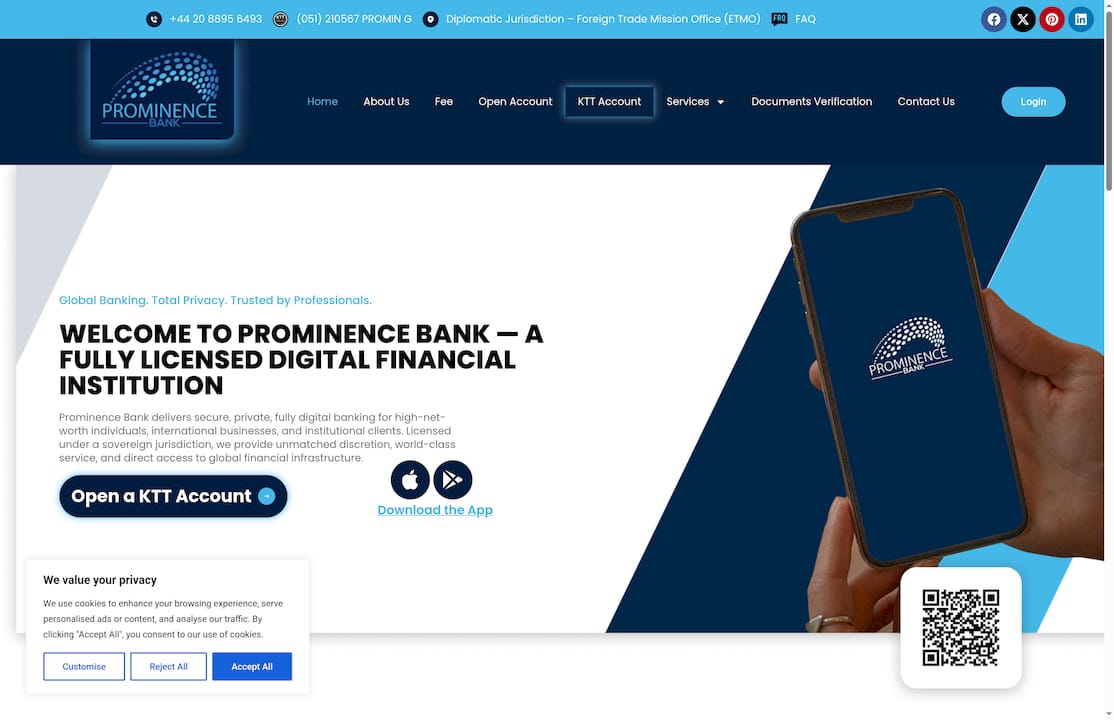
Whether you need corporate banking solutions for a complex multi-entity structure or want to explore private banking tailored to your personal wealth strategy, our team is ready to guide you through every step. We combine institutional-grade compliance with the kind of discreet global banking that sophisticated clients demand. Reach out today to discuss your specific needs and discover how Prominence Bank can serve as your long-term financial partner.
Frequently asked questions
What is the minimum investment or deposit for private banking?
Private banking typically requires $1 million or more in investable assets, though some digital-first institutions offer entry at lower thresholds with a tiered service model.
How do private banks ensure client security and confidentiality?
Private banks use encrypted digital platforms, rigorous AML and KYC protocols, and strict internal access controls to protect both client assets and sensitive information.
What kinds of investments are available through private banking?
Clients gain access to private credit, alternative assets, structured products, ESG-aligned portfolios, and co-investment opportunities that are not available through standard retail banking channels.
Why do international corporations use private banking?
Corporations use private banking for multi-currency treasury management, cross-border compliance coordination, and asset protection structures tailored to complex international business operations.
How does AI and digital technology benefit private banking clients?
AI-driven portfolio tools improve real-time oversight and compliance efficiency, while experienced relationship managers continue to handle the nuanced, high-stakes decisions that require human judgment.