
TL;DR:
- Choosing the right private bank is essential for high-net-worth individuals managing complex, cross-jurisdictional assets and finances. The best institutions offer personalized services, integrated wealth and corporate solutions, robust compliance, and global multi-currency infrastructure. Building trust through automated processes and strategic relationships is key to unlocking privacy, efficiency, and long-term growth.
When your financial life spans multiple jurisdictions, business structures, and asset classes, choosing the wrong bank doesn’t just cost you fees. It costs you time, privacy, and growth. Premium banking solutions, the industry term for this tier is private banking, give affluent individuals and corporate clients access to personalized credit, wealth management, global infrastructure, and the kind of discretion that standard retail banking simply cannot offer. This article breaks down exactly what separates a mediocre premium account from a genuinely powerful one, and how to identify the right fit for your profile in 2026.
Table of Contents
- Key Takeaways
- 1. What premium banking solutions actually mean
- 2. Key criteria for evaluating high-end banking services
- 3. Top premium banking features that distinguish leading providers
- 4. Comparison of leading private banking service models
- 5. Situational recommendations for different client profiles
- My honest perspective on premium banking in 2026
- How Prominencebank delivers on premium banking
- FAQ
Key Takeaways
| Point | Details |
|---|---|
| Eligibility is balance-driven | Perks like waived fees and dedicated bankers unlock only when you meet minimum balance and relationship thresholds. |
| Integration beats fragmentation | The best private banking models coordinate wealth, lending, and capital markets through a single relationship manager. |
| Compliance is non-negotiable | Privacy does not mean avoiding scrutiny. Top-tier banks use enhanced due diligence while protecting client confidentiality. |
| Global access requires multi-currency infrastructure | Clients operating across borders need accounts that handle multiple currencies with minimal friction. |
| Technology shapes the client experience | Automation and API-driven compliance tools reduce onboarding delays and manual burden for premium clients. |
1. What premium banking solutions actually mean
The phrase “premium banking solutions” gets used loosely. At its core, private banking is a service model built around the client’s entire financial picture rather than individual products. A retail bank sells you a checking account. A private bank assigns you a relationship manager who understands your tax exposure, your business holdings, and your liquidity needs simultaneously.
Premium banking privileges are not automatic. They are tied to balance thresholds, product usage, and the scope of your relationship with the institution. The perks, whether that is a higher APY on savings, waived transaction fees, or preferential lending rates, activate only when you meet the bank’s eligibility criteria.
For corporate clients, the structure goes further. You are not just managing personal wealth. You are coordinating payroll, cross-border payments, treasury positions, and sometimes capital market activity. A bank that handles both personal and corporate needs under one umbrella reduces the operational burden significantly.
2. Key criteria for evaluating high-end banking services
Not all premium tiers are equal. Before you commit to an institution, measure it against these specific dimensions:
- Minimum balance and eligibility thresholds. Some institutions set the floor at $250,000 in investable assets. Others require $1 million or more for their top tier. Know where you qualify and what that unlocks.
- Personalized financial services. Look for wealth management, bespoke lending, tax-efficient credit structures, and estate planning coordination under one roof.
- Privacy and compliance rigor. Discretion is not secrecy. The best institutions practice enhanced due diligence that protects both the client and the bank, with documented source-of-wealth verification handled discreetly.
- Global accessibility. Multi-currency accounts, international wire capabilities, and correspondent banking networks matter if you operate across borders.
- Digital sophistication. Digital banking growth among high-net-worth individuals is accelerating, and the strongest platforms combine mobile access with institutional-grade security.
- Dedicated relationship management. A single point of contact who knows your financial profile is one of the most underrated features in private banking.
- Fee structures and perks. Evaluate the full cost picture including monthly fees, FX margins, wire costs, and what gets waived at your relationship tier.
Pro Tip: Ask any prospective private bank to walk you through a specific scenario, such as a large cross-border wire transfer or a collateral-backed credit request. How they answer tells you more than any brochure.
3. Top premium banking features that distinguish leading providers
The best private banking services in 2026 share a common architecture. They connect wealth management, credit, and capital markets without forcing the client to manage multiple relationships.

Wells Fargo’s private banking division illustrates one model well. Their offering integrates cash management and custom credit solutions, including secured financing backed by investment portfolios and specialized lending tailored for wealth preservation goals. Clients with complex collateral structures get solutions that standard commercial banking simply cannot accommodate.
DBS Private Bank takes a different approach through what they call a “One Bank” model. About 70% of DBS Private Bank clients are business owners, and the bank connects private banking, capital markets, and institutional banking through a single touchpoint. This matters practically. When your liquidity event from a business sale needs to flow directly into a structured wealth management strategy, having one relationship manager coordinate that transition removes weeks of friction.
For clients seeking offshore private banking, the calculus shifts toward jurisdictional alignment, documentation coordination, and long-term relationship stability. It is not just about lower tax exposure. It is about finding an institution whose infrastructure matches your global footprint.
Pro Tip: Luxury perks like airport lounge access and concierge services are fine to appreciate, but weight them last. The real value of exclusive banking options lives in credit structures, yields, and relationship depth, not lifestyle add-ons.
Key features worth prioritizing across any provider:
- Waived fees and preferential rates tied to total relationship value
- Multi-currency account access with competitive FX rates
- Private lending facilities including portfolio-backed credit lines
- Coordinated estate and succession planning services
- Institutional investment access (private equity, structured products, fixed income)
4. Comparison of leading private banking service models
Understanding the trade-offs across different private banking models helps you identify where your profile fits best.
| Feature | Integrated model (e.g., DBS-style) | Product-specialist model | Digital-first private bank |
|---|---|---|---|
| Eligibility threshold | Typically $1M+ AUM | Varies by product | Often lower ($250K+) |
| Service breadth | Wealth, lending, capital markets | Deep in specific verticals | Digital-first, growing scope |
| Global reach | Strong, multi-jurisdictional | Variable | Growing through partnerships |
| Privacy and EDD | Rigorous, case-specific | Standard plus for HNW | Automated, improving |
| Relationship model | Single touchpoint | Product-based teams | Hybrid digital/human |
| Onboarding complexity | Moderate to high | Moderate | Lower, tech-driven |
| Digital features | Strong to excellent | Variable | Best-in-class |
The integrated model delivers the most value for clients whose personal and business finances are deeply interconnected. Coordinating wealth and capital markets through a single relationship manager reduces cross-team inconsistencies and keeps the client’s overall financial strategy coherent.
One friction point across all models: compliance. Fragmented compliance data creates manual work and delays, but institutions adopting open-architecture APIs and automation are compressing onboarding timelines and reducing client burden considerably. The gap between technology-forward and legacy institutions on this dimension is widening fast in 2026.
For politically exposed persons and their close associates, FATF Recommendation 12 standards require independent corroboration of wealth sources and continuous reassessment. Institutions that handle this through curated documentation and dedicated case ownership give clients a far smoother experience than those treating it as a checkbox exercise.
When analyzing cost versus value, consider the full relationship. A bank charging higher fees but offering business banking advantages across both personal and corporate structures can generate net savings that offset premium pricing entirely.
5. Situational recommendations for different client profiles
Different wealth profiles require different approaches. Here is how to think about matching the right institution to your situation.
Ultra-high-net-worth individuals with interconnected personal and business assets benefit most from integrated models. The single-touchpoint approach, where your relationship manager can access private banking, business lending, and capital markets simultaneously, keeps your strategy unified and reduces the risk of conflicting advice across teams.
Corporate clients focused on cash management and credit should prioritize banks with strong treasury solutions, multi-currency infrastructure, and established correspondent banking networks. Corporate banking solutions that handle complex entity structures across multiple jurisdictions are especially relevant if your business operates internationally.
Privacy-focused clients navigating enhanced due diligence need a bank that treats compliance as a professional service, not a gatekeeping exercise. The right institution will guide you through source-of-wealth documentation efficiently, with a dedicated compliance contact and clear timelines. Read reviews and ask directly how they handle PEP or high-risk-jurisdiction clients before committing.
Global clients requiring multi-jurisdictional banking should confirm that any prospective bank has genuine reach in the countries where you operate. Correspondent banking relationships, local regulatory licenses, and on-the-ground expertise matter more than marketing claims about “global presence.”
Pro Tip: Review your customized banking packages annually. As your wealth and business complexity grow, the tier that served you at $500,000 in assets may actively limit you at $5 million. Renegotiating your relationship scope is legitimate and expected at the private banking level.
Additional considerations for all client types:
- Evaluate the bank’s technology platform with a 30-day trial if possible before transferring primary relationships
- Confirm whether the institution offers private banking strategies for multi-generational wealth transfer
- Ask specifically about security protocols for high-net-worth banking before sharing sensitive financial documentation
My honest perspective on premium banking in 2026
I’ve spent years working alongside high-net-worth clients evaluating private banking relationships, and the single most common mistake I see is treating the decision like a product comparison. People fixate on rates and fee schedules when the actual differentiator is almost always the relationship manager and the institution’s willingness to move quickly on complex requests.
What I’ve learned is that the best extraterritorial banking benefits come from institutions that have built their infrastructure around discretion and global connectivity from the ground up, not institutions that bolted an international tier onto a retail bank. The compliance architecture is fundamentally different, and you feel it in every interaction.
The privacy-versus-compliance tension is real but not irreconcilable. Institutions that invest in compliance automation and case-specific EDD handling give clients the best of both worlds. You get rigorous protection without the feeling of being interrogated every time you move money. That balance is what separates genuinely excellent private banking from a premium-priced frustration.
My practical advice: before signing anything, ask for a reference client in a similar profile, test the onboarding process with a modest initial relationship, and assess how the bank handles your first complicated request. Everything else is branding.
— Harold
How Prominencebank delivers on premium banking
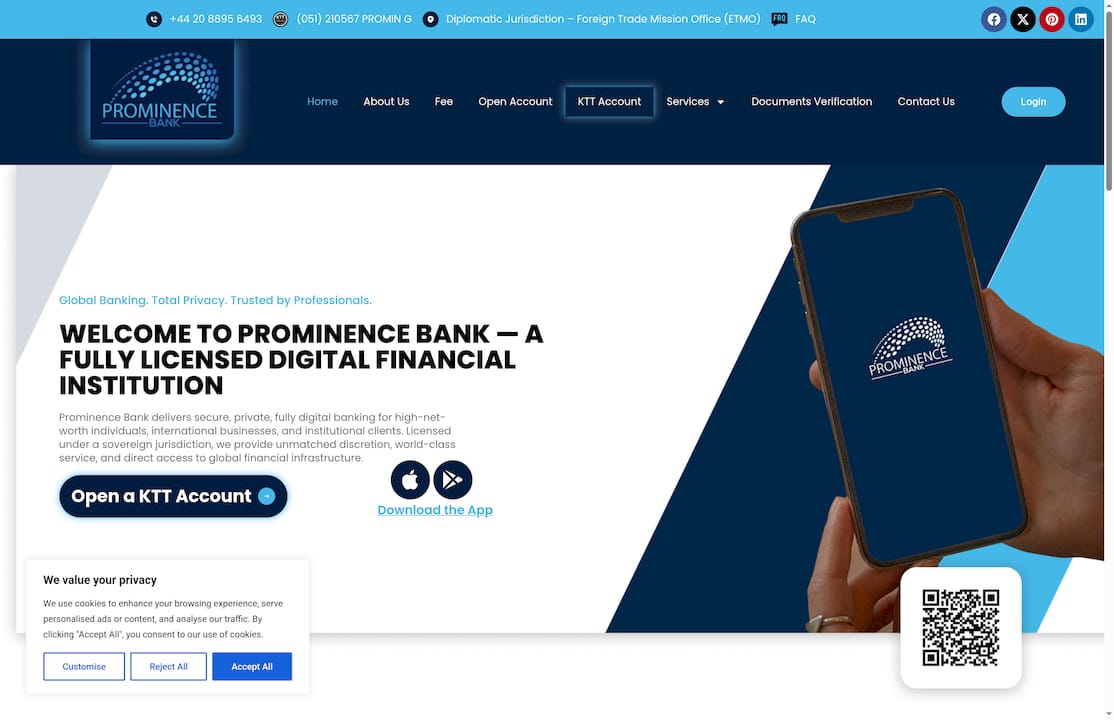
Prominencebank was built for exactly the client profile this article describes. As a fully licensed digital banking institution operating under ETMO sovereignty, it combines multi-currency global accounts with institutional-grade privacy, AML/KYC compliance, and direct access to global financial infrastructure. Whether you are managing a complex corporate structure across multiple jurisdictions or seeking a discreet, technology-forward solution for personal wealth, Prominencebank’s premium exclusive services are designed around your specific needs. Explore its corporate banking offerings and see how a fully online, privacy-focused institution handles the demands that legacy private banks frequently struggle to meet.
FAQ
What are premium banking features at the private banking level?
Premium banking features include waived fees, higher savings yields, dedicated relationship managers, preferential lending rates, and access to wealth management and capital markets services, all tied to balance thresholds and relationship scope.
How much do you need to qualify for private banking?
Entry points vary by institution, but most private banking tiers require a minimum of $250,000 to $1 million in investable assets, with the broadest service bundles unlocking at $1 million or above.
How does enhanced due diligence affect high-net-worth clients?
FATF-standard EDD requires documented source-of-wealth verification and ongoing monitoring, but institutions with dedicated compliance teams and automation tools handle this process efficiently without creating significant client friction.
What is the advantage of an integrated private banking model?
Integrated models connect wealth management, lending, and capital markets through a single relationship manager, reducing cross-team inconsistencies and ensuring your overall financial strategy remains coherent across personal and business assets.
Why do high-net-worth clients choose offshore or extraterritorial banking?
Offshore and extraterritorial banking offers jurisdictional alignment, multi-currency infrastructure, and long-term relationship stability for clients with international assets and cross-border financial needs.