TL;DR:
- Digital banking offers real-time portfolio management, faster transactions, and personalized insights for HNWIs.
- It enables borderless investments, multi-currency handling, and curated access to alternative markets.
- Security features include zero-trust architecture, AI fraud detection, and layered cybersecurity to protect wealth.
HNWI wealth grew 4.2% in 2024 largely because sophisticated digital banking tools gave wealthy clients faster access to global markets, tighter control over complex portfolios, and security frameworks that legacy banks simply could not match. Traditional banking once signaled prestige. Today, it signals friction. The shift is not gradual—it is structural. HNWIs who have moved to digital-first platforms report faster execution, lower administrative overhead, and measurably stronger asset protection. This article walks through how digital banking advances private financial management, unlocks global investment opportunities, fortifies transaction security, and positions your wealth for the generational transfer ahead.
Table of Contents
- How digital banking advances private financial management
- Global investment access and opportunities for HNWIs
- Securing transactions: Cybersecurity and privacy in digital banking
- Next-generation trends: Hybrid advice, personalization, and wealth transfer
- Our perspective: The real challenge and opportunity of digital banking for HNWIs
- Explore advanced digital banking solutions for your global wealth
- Frequently asked questions
Key Takeaways
| Point | Details |
|---|---|
| Automation boosts wealth | Digital banking platforms automate and optimize private financial management for more growth and control. |
| Global access unlocked | HNWIs benefit from borderless, multi-currency investment tools and real-time data on digital platforms. |
| Advanced security is critical | Top banks use AI, encryption, and zero-trust architectures to protect HNWI assets from sophisticated cyber threats. |
| Personalization drives satisfaction | Tailored digital solutions and hybrid advice models increase trust and meet unique HNI expectations. |
| Next-gen HNWIs lead change | Younger HNWIs demand digital-first, hybrid experiences and are driving innovation in banking and wealth transfer. |
How digital banking advances private financial management
Private financial management used to mean a relationship manager, a quarterly meeting, and a printed portfolio statement. That model worked when information moved slowly. Now, with real-time data streams, automated reconciliation, and AI-driven analytics, expecting anything less than instant visibility into your entire financial picture is leaving value on the table.
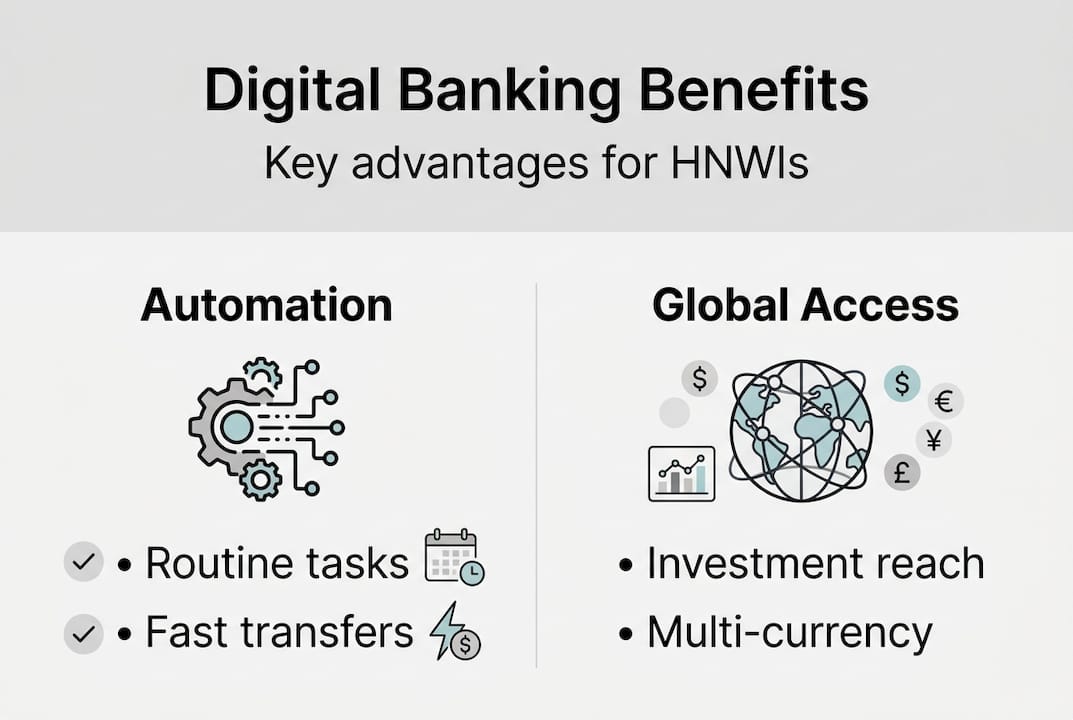
Automation is the first and most immediate gain. Routine tasks—currency conversions, scheduled transfers, compliance document submissions—run in the background without your involvement. That means fewer errors, fewer delays, and more time for decisions that actually require your judgment. Platforms built for secure, personalized private banking now offer multi-entity dashboards that consolidate holdings across jurisdictions, trust structures, and operating companies into a single view.
Advanced analytics go further. Rather than generic asset allocation reports, modern platforms deliver personalized wealth insights tied to your specific risk profile, tax residency, and liquidity needs. Custom alerts notify you the moment a threshold is crossed—whether that is a currency exposure limit, a counterparty credit rating change, or an unusual transaction pattern.
Key advantages of digital private banking platforms:
- Automated cross-border transfers and reconciliation
- Real-time multi-entity portfolio consolidation
- Personalized AI-driven wealth analytics
- Custom risk alerts and anomaly notifications
- Seamless compliance documentation workflows
Digital maturity firms grow assets under management two times faster, cut operational costs by 10 to 15 percent, and improve advisor productivity by 50 percent. Those are not marginal improvements—they compound.
| Feature | Legacy private banking | Digital-first banking |
|---|---|---|
| Portfolio visibility | Quarterly statements | Real-time dashboards |
| Transfer speed | 2 to 5 business days | Same-day or instant |
| Reporting personalization | Standardized | AI-tailored to client |
| Multi-entity consolidation | Manual | Automated |
| Risk alert capability | Manual review | Automated threshold alerts |
Understanding the private banking benefits of digital platforms helps frame the opportunity accurately. Over 80% of HNWIs now expect their banking experience to be as tailored as their investment strategy.
Pro Tip: Activate multi-currency consolidation views before expanding into a new jurisdiction. Seeing your full exposure in real time prevents costly hedging gaps that are invisible in static reports.
Global investment access and opportunities for HNWIs
Geography used to be a real constraint on private wealth investing. Accessing a private equity deal in Southeast Asia or a real estate fund denominated in Swiss francs required local legal counsel, correspondent banking relationships, and weeks of administrative groundwork. Digital banking has compressed that timeline to hours.

Cloud-native platforms built for global reach support Liberalized Remittance Scheme (LRS) frameworks and sophisticated multi-currency wallets that let you move capital across borders without the traditional friction. Real-time portfolio tracking means you can monitor a dollar-denominated bond, a euro-denominated real estate trust, and a Singapore equity position from the same screen, simultaneously.
Digital platforms facilitate borderless access, multi-currency transactions, and curated entry into alternative markets that were once restricted to institutional players. Private credit, infrastructure assets, hedge funds, and co-investment opportunities are now surfaced through curated deal flow engines built into HNWI-focused digital platforms.
Steps to maximize global investment access through digital banking:
- Establish multi-currency accounts in your primary investment jurisdictions before you need them.
- Enable real-time market data feeds for the asset classes you actively monitor.
- Use built-in LRS tools to plan and execute cross-border capital movements efficiently.
- Review curated alternative investment opportunities surfaced by your platform’s deal flow engine.
- Set currency exposure alerts to manage FX risk across your consolidated portfolio.
| Criteria | Legacy advisor model | Digital-first model |
|---|---|---|
| Investment universe | Advisor-curated, limited | Global, real-time, platform-curated |
| Execution speed | Days to weeks | Hours or less |
| Multi-currency handling | Manual conversion | Automated, real-time |
| Alternatives access | Institutional only | Broadened HNWI access |
| Portfolio transparency | Periodic reporting | Continuous visibility |
For Gen X and millennial wealth holders, the digital-first model is not a preference—it is the baseline expectation. Opening a secure global banking relationship online in a single session, rather than flying to a private banking hub, is the new standard. Platforms that offer security, speed, and global control in a unified interface are capturing the next generation of serious wealth.
Pro Tip: Crypto-backed lending lets HNWIs access liquidity against digital asset holdings without triggering a taxable sale event. It is now a mainstream treasury tool, not a speculative maneuver.
Securing transactions: Cybersecurity and privacy in digital banking
Global access creates global exposure. The more connected your financial life, the more attractive you become as a target. And the threat is not abstract.
43% of family offices reported experiencing a cyber attack, and AI-powered fraud detection now reduces attempted attacks by 40%. Those numbers reframe cybersecurity from an IT concern to a core wealth preservation strategy.
Digital banks purpose-built for HNWIs deploy layered defenses that legacy institutions have struggled to replicate. Multi-factor authentication (MFA) is table stakes. The real differentiation is at the architecture level: zero-trust network models that treat every access request as potentially hostile, end-to-end encryption on all data in transit and at rest, and behavioral anomaly detection that flags unusual login patterns before a transaction is ever initiated.
Core security features in HNWI-grade digital banking:
- Zero-trust architecture with continuous access verification
- AI-powered behavioral anomaly detection
- End-to-end encryption for all communications and transactions
- Digital footprint management to reduce spear-phishing exposure
- Dedicated family office security protocols
Spear-phishing deserves special attention. Unlike broad phishing campaigns, spear-phishing attacks are personalized using publicly available information about you—your board memberships, family connections, travel patterns. Reducing your digital footprint and using dedicated communication channels for banking matters significantly cuts this risk. Review these security tips for HNWIs to understand where your exposure points likely are.
“AI fraud detection reduces attempted attacks by 40%—making intelligent threat systems not a luxury, but a requirement for any serious private banking relationship.”
Family office structures introduce an additional layer of risk: insider threats. Employees with broad system access represent a vulnerability that technical controls alone cannot eliminate. Combining role-based access controls with regular audit trails and behavioral monitoring closes most of that gap. The secure online banking guide for HNWIs covers the full framework, and reviewing the top banking security features designed for high-value clients helps you ask the right questions of any banking partner. A secure banking checklist built around global privacy and wealth protection is a useful starting point for your annual security review.
Next-generation trends: Hybrid advice, personalization, and wealth transfer
The largest intergenerational wealth transfer in history is already underway. Over $83.5 trillion is moving from baby boomers to Gen X and millennial heirs over the next two decades. Those heirs have different expectations—and different demands—from a banking partner.
Next-gen HNWIs shun legacy advisors in favor of digital-first firms, and crypto lending for liquidity access is growing steadily among this cohort. This is not a trend to monitor from a distance. It is a behavioral shift that is actively reshaping where wealth flows.
Hybrid advisory models have emerged as the answer to a real tension: digital tools are efficient, but complex wealth situations—estate structuring, cross-border tax optimization, philanthropic strategy—still require genuine human expertise. Hybrid human-AI models dominate the leading private banks, freeing relationship managers from routine data gathering so they can focus entirely on strategic advice.
How next-gen HNWIs are reshaping banking expectations:
- Demand digital-first onboarding with no in-person requirements.
- Expect AI-curated investment recommendations, not generic model portfolios.
- Use crypto lending as a standard liquidity tool, not a speculative instrument.
- Require transparent, real-time reporting across all asset classes and structures.
- Prioritize banks with proven regulatory compliance and discreet banking benefits that protect privacy across jurisdictions.
For wealth transfer planning specifically, platform flexibility matters as much as investment capability. Heirs need to be able to onboard quickly, understand the asset picture immediately, and act decisively. Banks that maintain strict online bank compliance standards while delivering intuitive digital experiences are the ones building lasting multi-generational relationships.
Pro Tip: If your banking partner’s AI still requires a relationship manager to pull standard reports, that is not a hybrid model—that is a legacy system with a chatbot. Real hybrid advisory means AI handles the data so your manager handles the decisions.
Our perspective: The real challenge and opportunity of digital banking for HNWIs
After working closely with complex wealth structures across multiple jurisdictions, one pattern becomes impossible to ignore: the HNWIs who gain the most from digital banking are not necessarily the ones who adopt the most technology. They are the ones who insist on the right combination of technology and human judgment.
Full digitization without advisory depth fails in scenarios that matter most. A sudden liquidity event, a regulatory change affecting a trust structure, a family governance disagreement—these situations require a banker who knows your history, not an algorithm that knows your data. The banks that provide private banking technology at a genuinely high level understand this distinction clearly.
Conventional wisdom says: go fully digital and reduce friction. Our view is sharper. Reduce the wrong friction—administrative tasks, manual reporting, slow transfers. But preserve the high-friction touchpoints that produce the best decisions: strategic reviews, risk framework conversations, succession discussions. Technology amplifies those conversations. It should never replace them. The institutions that balance personalization, security, and genuine advisory adaptability are the ones that earn long-term client trust.
Explore advanced digital banking solutions for your global wealth
The insights in this article point toward a clear direction: digital banking, done right, is not just a convenience upgrade—it is a structural advantage for anyone managing significant wealth across borders, asset classes, and generations.
At Prominence Bank, we translate these capabilities into practical solutions. Our advanced corporate banking solutions are built for complex ownership structures and cross-border operations, while our technology-driven private banking platform delivers the personalization and security HNWIs require. For clients exploring digital assets, our digital currency solutions provide structured, compliant access to this growing asset class. If you are ready to move from insight to action, your next step starts here.
Frequently asked questions
How do digital banks ensure security for HNWIs?
Digital banks purpose-built for HNWIs use MFA, zero-trust architecture, end-to-end encryption, and AI fraud detection to counter targeted threats. AI-powered fraud detection reduces cyber attempts by 40%, making it a core wealth preservation tool.
What global investment features do digital banking platforms offer to HNWIs?
They provide borderless investment access, real-time portfolio tracking, multi-currency wallets, and curated entry into alternative markets. Digital platforms facilitate seamless cross-border capital movement that legacy institutions struggle to match.
How are next-gen HNWIs changing digital banking?
They demand digital-first onboarding, AI-curated recommendations, and real-time transparency across all structures. Next-gen HNWIs favor digital-first solutions and use crypto lending as a standard liquidity strategy.
Why is personalization important in HNI digital banking?
Personalized platforms increase advisor productivity by 50%, reduce costs by 10 to 15%, and build the trust that retains clients across generations. Over 80% of HNWIs expect their digital banking experience to be tailored to their specific financial profile.
What should HNWIs look for in a digital banking partner?
Prioritize proven security architecture, global investment reach, genuine hybrid advisory, and demonstrated compliance with international standards. Hybrid human-AI models and deeply personalized digital experiences are now the baseline expectation among serious wealth holders.
Recommended
- Top Security Tips for High-Net-Worth Banking (2026)
- How technology powers secure, personalized private banking
- Secure Online Banking: Step-by-Step Guide for HNWIs
- Online Bank Compliance: What High-Net-Worth Clients Must Know