
TL;DR:
- Multi-currency accounts reduce foreign exchange costs and simplify global financial management.
- They support holding, sending, and receiving multiple currencies from a single account.
- Strategic use enhances speed, risk management, and operational efficiency for individuals and businesses.
Every time a traditional bank processes your international wire transfer, it quietly takes a cut. Most clients never notice, but that silent markup on foreign exchange rates can cost you thousands of dollars each year. Traditional bank FX markups run 2 to 5%, while modern fintech platforms charge as little as 0.3 to 1%, meaning the gap between what you pay and what you should pay is wide enough to fund a meaningful investment. Multi-currency accounts close that gap while giving you centralized control over your global finances. This article explains exactly what they are, how they work, and why the strategic advantages go far beyond simple cost savings.
Table of Contents
- What is a multi-currency account?
- How do multi-currency accounts work?
- Cost comparison: Multi-currency account vs. traditional bank
- Key advantages of multi-currency accounts
- Why most wealthy clients still miss the full potential of multi-currency accounts
- Streamline your global banking with Prominence Bank
- Frequently asked questions
Key Takeaways
| Point | Details |
|---|---|
| Save on FX fees | Multi-currency accounts often offer much lower foreign exchange costs than traditional banks. |
| Easily manage global funds | You can hold, transfer, and receive multiple currencies from one secure account. |
| Reduce complexity | Consolidate international transactions and reduce paperwork for greater efficiency. |
| Diversify investments | Multi-currency accounts support holding assets in different currencies to reduce risk. |
What is a multi-currency account?
A multi-currency account is a single bank account that allows you to hold, send, and receive funds in multiple currencies without needing a separate account for each one. Instead of maintaining a USD account in New York, a EUR account in Frankfurt, and a GBP account in London, you manage all three from one dashboard, one login, and one institutional relationship. That simplicity is not cosmetic. It changes the way you interact with global financial infrastructure.
Here is what distinguishes a multi-currency account from a standard account:
- Multiple currency balances held simultaneously within one account structure
- Local receiving details in major markets, so counterparties can pay you as though you are a local
- On-demand conversion between currencies at competitive rates, rather than forced conversion at the point of receipt
- Unified transaction history across all currencies, which simplifies reconciliation and reporting
- Lower or zero conversion fees on same-currency transfers, since your USD stays USD until you choose to convert
The primary users of multi-currency accounts fall into two distinct categories. First, high-net-worth individuals who hold assets across multiple countries, pay international staff, manage overseas property, or receive income in foreign currencies. Second, businesses with international operations, including importers, exporters, digital agencies, SaaS companies, and holding structures with subsidiaries in multiple jurisdictions. Both groups face the same root problem: traditional banks were built for domestic economies, and international transactions were bolted on as an afterthought, with fees to match.
“Multi-currency accounts allow management of currencies in one place, saving significantly on FX markups that traditional banks quietly embed into every transaction.”
The pain points that multi-currency accounts directly address include unnecessary conversion losses, delayed settlement times, administrative complexity from managing multiple banking relationships, and the lack of transparency around exchange rates. If you have ever received an international payment and wondered why the amount in your account was lower than expected, foreign exchange markup is almost always the answer. Our introduction to multi-currency accounts covers the mechanics of how these structures interface with digital currency rails, which adds another layer of flexibility for clients with diversified asset bases.
How do multi-currency accounts work?
Now that you know what a multi-currency account is, let’s walk through how it actually operates in practice. The process is more straightforward than most clients expect, especially with modern digital banking platforms built specifically for international use.
-
Account setup and verification. You open the account through an online application. This involves standard AML and KYC documentation: government-issued ID, proof of address, and for businesses, corporate registration documents and ownership structure.
Prominence Bank normally completes account opening within 48 to 72 hours after all required KYC/AML procedures have been completed and all requested information and documentation have been received, verified, and accepted. This is an estimated processing period, not a guaranteed deadline. Additional time may be required if further compliance, verification, or due-diligence review is necessary. Submitting an enquiry, application, or payment does not start the estimated processing period and does not guarantee account approval or activation.
-
Funding your account. Once approved, you deposit funds through a wire transfer, ACH, or SWIFT payment from your existing accounts. Some platforms also accept crypto-to-fiat conversions at this stage, which matters for clients who hold digital assets alongside traditional wealth.
-
Selecting and holding currencies. You choose which currencies to hold. Most platforms support 10 to 50 currencies, with the major ones being USD, EUR, GBP, CHF, JPY, SGD, and AUD. You allocate funds as needed, and the balances sit in their native currencies until you instruct the platform to move them.
-
Making transactions. When you send a payment, you select the source currency, the destination currency, and the recipient. If the currencies match, the transfer is often instant and fee-free within the platform. If conversion is needed, the platform applies its markup to the mid-market rate. The best platforms show you the exact rate before you confirm, with no hidden costs.
-
Receiving payments. You share your local account details with clients or business partners. A European client can pay your EUR account directly via SEPA. A US partner can pay your USD account via ACH. The money arrives without conversion loss because it lands in the correct currency wallet from the start.
Here is a practical example. Imagine you run an investment holding company with revenues in USD, operating expenses in EUR, and a UK-based team paid in GBP. With a traditional bank, every transfer between these currencies triggers a conversion at a marked-up rate. With a multi-currency account, you hold all three currency balances simultaneously, convert only when necessary, and time your conversions when rates are favorable. Over a year, on $500,000 in cross-currency flows, the savings can be substantial.
Secure account setup steps matter here because not all platforms offer the same level of institutional security. For high-net-worth clients, the security architecture behind the account is just as important as the fee structure.
Pro Tip: Always choose platforms that display the live mid-market rate alongside their applied markup before you confirm a conversion. If a platform shows you only the final rate without breaking down the spread, that is a red flag. Transparency at the point of conversion is the single clearest indicator of a client-aligned platform. Fintechs typically charge just 0.3 to 1% markup on mid-market FX rates, compared to 2 to 5% at traditional banks. That difference is not rounding error. It is real money leaving your balance on every transaction.
Cost comparison: Multi-currency account vs. traditional bank
Understanding the mechanism, it’s important to see how these accounts can make a tangible impact in real money terms. The numbers tell a clear story.

| Feature | Traditional bank | Multi-currency account |
|---|---|---|
| FX markup on mid-market rate | 2% to 5% | 0.3% to 1% |
| Wire transfer fees (outbound) | $25 to $50 per transfer | $0 to $10 per transfer |
| Receiving fee (inbound international) | $10 to $20 per transfer | Often free |
| Currency holding flexibility | Single currency standard | 10 to 50+ currencies |
| Rate transparency | Low (rate shown at booking) | High (live rate displayed) |
| Annual cost on $100,000 FX volume | $2,000 to $5,000 | $300 to $1,000 |
The numbers above are not theoretical. Switching to a multi-currency account can save between $240 and $2,400 per year on $10,000 to $100,000 in FX transfers, and those savings scale linearly with transaction volume. If your annual cross-currency flows reach $1,000,000, you are looking at potential savings of $24,000 or more per year, simply by changing where you hold and convert your money.
For high-net-worth individuals managing international property portfolios, paying overseas household staff, or receiving dividend income in foreign currencies, these figures are not abstract. Consider a client who receives quarterly dividends from a European fund in EUR and needs to convert to USD for living expenses. At a traditional bank charging 3% on conversion, a $200,000 annual conversion costs $6,000 in FX fees alone. The same volume through a multi-currency platform at 0.5% costs $1,000. The $5,000 difference is an investment, not a banking expense.
For international businesses, the savings compound further because you are often executing dozens of transactions per month across multiple currency pairs. The administrative cost of managing multiple banking relationships also disappears, freeing up time and reducing accounting complexity. International business banking benefits extend well beyond FX savings. Consolidated reporting, faster settlement, and simplified treasury management all contribute to a meaningfully lower cost of doing business globally.
If you want to go deeper on rate optimization strategies, understanding the mechanics of minimizing foreign exchange costs through institutional-grade tools gives you a practical framework for structuring your conversions.
Key advantages of multi-currency accounts
With the numbers in perspective, let’s focus on the strategic advantages these accounts deliver beyond simple cost reduction.
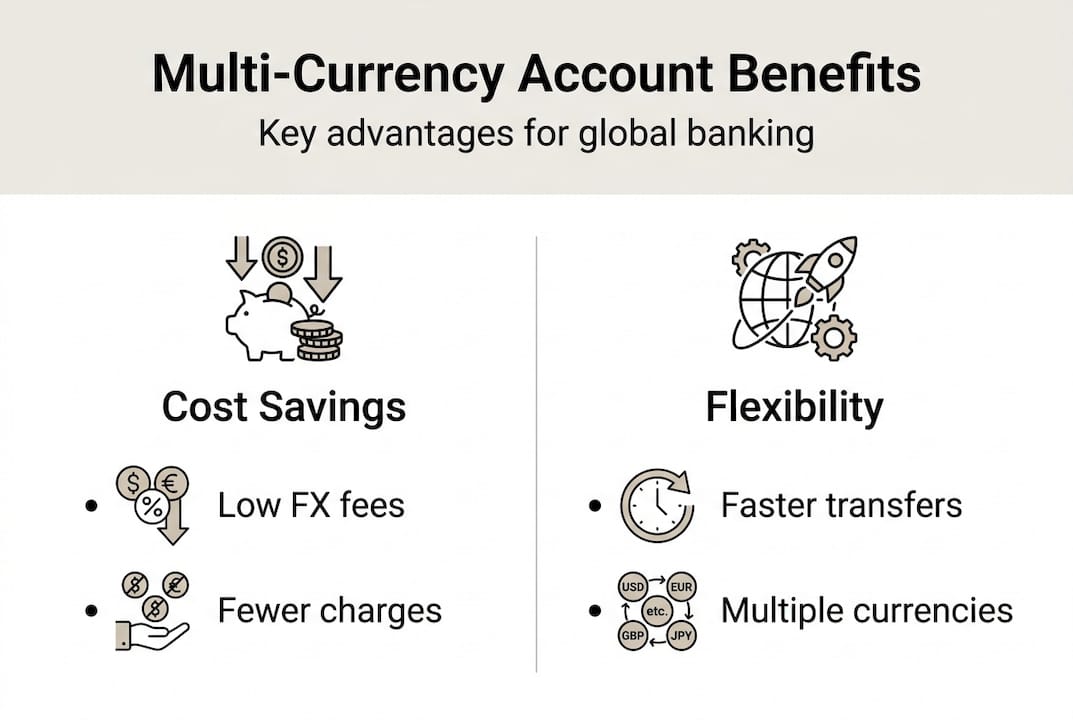
Speed and frictionless execution. Traditional international wire transfers take one to five business days to settle. Multi-currency account transfers between users on the same platform are often instant. For businesses closing deals across time zones, or investors moving capital into a position before a market opens, speed is not a convenience. It is a competitive advantage.
Reduced administrative burden. Managing four separate bank accounts across four jurisdictions means four sets of compliance reviews, four reporting cycles, and four banking relationships to maintain. Multi-currency accounts collapse that complexity into one. That is meaningful for corporate structures with multiple subsidiaries, family offices managing wealth across generations, and HNWIs with assets in different countries.
Currency risk hedging. Holding multiple currency balances simultaneously means you are not forced to convert at an unfavorable moment. If EUR weakens against USD, you can delay your conversion. If GBP strengthens, you can lock in the gain. This is passive currency management, and it is available to anyone with a multi-currency account, not just institutional traders with access to derivatives markets.
- Geopolitical risk diversification by spreading liquid assets across multiple currency denominations
- Investment access to foreign markets, funds, and assets that require non-USD settlement
- Payment flexibility for vendors, employees, and partners who prefer or require local currency payments
- Consolidated audit trail for tax reporting and compliance, since all transactions flow through one account
Asset protection strategies that incorporate multi-currency structures are increasingly common among sophisticated private clients. Holding assets in multiple jurisdictions through a single account infrastructure reduces single-point-of-failure risk without adding proportional operational complexity. Multi-currency accounts simplify global business, accelerate payments, and directly support investment diversification across asset classes and geographies.
For clients who hold or transact in digital assets alongside traditional currencies, cryptocurrency account advantages become relevant because many modern multi-currency platforms now integrate crypto-to-fiat settlement, giving you a single point of control over your entire liquid asset base.
Pro Tip: For maximum portfolio resilience, structure your multi-currency accounts across at least two regulated jurisdictions. This is not about tax avoidance. It is about ensuring that political, regulatory, or institutional disruption in one jurisdiction does not lock you out of your liquid assets globally. Thoughtful jurisdiction selection is one of the most underutilized risk management tools available to private clients.
Why most wealthy clients still miss the full potential of multi-currency accounts
We have worked with sophisticated, globally active clients who have had multi-currency accounts for years and still leave significant value on the table. The most common mistake is treating these accounts purely as a cost-saving tool for FX fees. That framing is accurate but incomplete.
The deeper opportunity lies in how you structure your account in relation to your corporate entities, investment vehicles, and personal holding arrangements. A multi-currency account that sits inside a well-structured corporate architecture allows you to control liquidity across borders while maintaining clean accounting separation between personal and business flows. That is a different use case entirely, and one that most marketing materials never address. Our advanced corporate account tips cover this in specific detail.
Platform resilience is another overlooked dimension. Not all multi-currency account providers have the same regulatory backing, institutional counterparties, or settlement infrastructure. A compelling user interface and competitive FX rates mean very little if the platform cannot process large-value transactions reliably or if its correspondent banking access is fragile. For high-net-worth clients moving $500,000 or more per month, the operational durability of your banking platform deserves the same scrutiny you would apply to any counterparty.
Active management multiplies the benefits. Currency allocation, timing your conversions, and structuring your payment flows around the account’s capabilities are decisions that require attention and intention. The clients who extract the most value treat their multi-currency account as a treasury function, not a passive holding vehicle.
Streamline your global banking with Prominence Bank
If you are ready to maximize control and flexibility in your cross-border operations, consider how Prominence Bank can help.
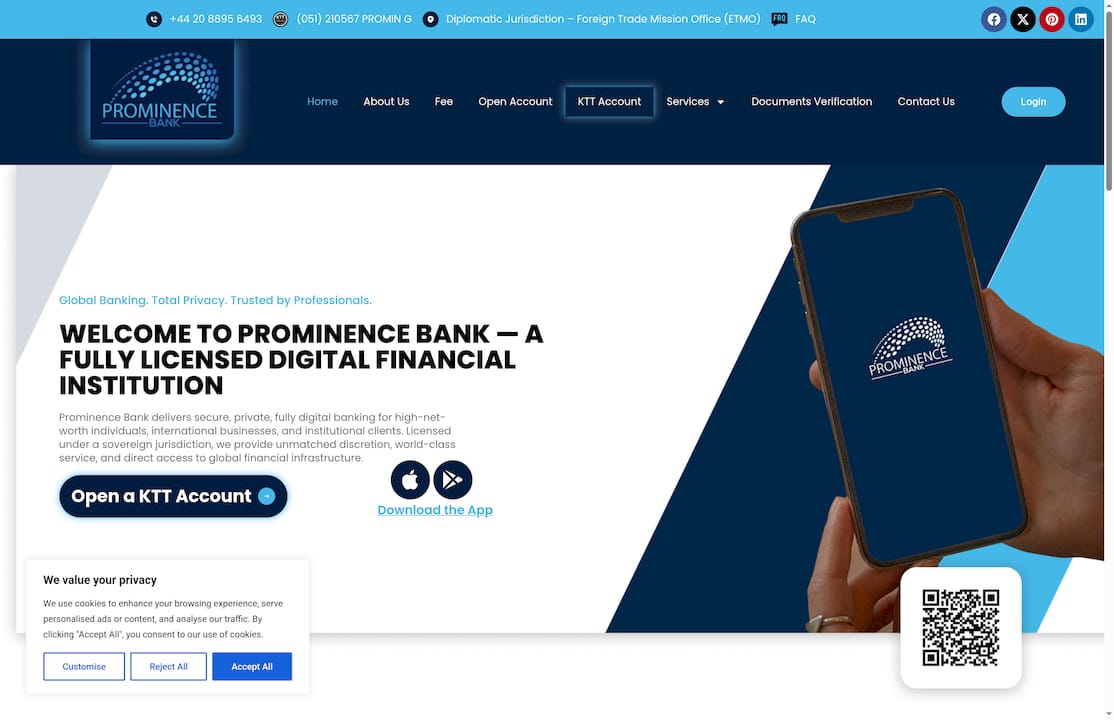
Prominence Bank offers fully licensed multi-currency accounts designed specifically for high-net-worth individuals and global enterprises. Our digital currency solutions give you access to a broad range of currencies alongside digital asset integration, all managed through a secure, private, and fully online platform. For complex corporate structures requiring tailored treasury and institutional-grade banking capabilities, our advanced corporate banking services are structured to match the sophistication your business demands. The account-opening process is KYC/AML-compliant and follows the estimate and conditions stated below.
Prominence Bank normally completes account opening within 48 to 72 hours after all required KYC/AML procedures have been completed and all requested information and documentation have been received, verified, and accepted. This is an estimated processing period, not a guaranteed deadline. Additional time may be required if further compliance, verification, or due-diligence review is necessary. Submitting an enquiry, application, or payment does not start the estimated processing period and does not guarantee account approval or activation.
We serve clients who expect more from their banking relationship.
Frequently asked questions
What are the main benefits of a multi-currency account?
A multi-currency account lowers FX fees significantly, simplifies international payments, and allows you to hold multiple currencies in one place. As research confirms, managing currencies centrally eliminates the redundant conversion costs that traditional banks impose on every cross-border transaction.
How much can I save on transfers using a multi-currency account?
You can save between $240 and $2,400 per year on $10,000 to $100,000 in FX transfers compared to traditional banks. Annual savings scale linearly with your transaction volume, so high-value clients with $1,000,000 or more in annual cross-currency flows can save tens of thousands of dollars.
Are multi-currency accounts suitable for both individuals and businesses?
Yes, both HNWIs and businesses with international operations use multi-currency accounts to manage global finances efficiently. The specific benefits differ: individuals favor the currency hedging and simplified overseas payments, while businesses gain the most from consolidated treasury management and local receiving details in key markets.
How do I open a multi-currency account?
Opening a multi-currency account involves KYC/AML identity verification, including government-issued ID and proof of address. Corporate applicants must also document their legal structure and beneficial ownership. Prominence Bank normally completes account opening within 48 to 72 hours after all required KYC/AML procedures have been completed and all requested information and documentation have been received, verified, and accepted. This is an estimated processing period, not a guaranteed deadline. Additional time may be required if further compliance, verification, or due-diligence review is necessary. Submitting an enquiry, application, or payment does not start the estimated processing period and does not guarantee account approval or activation.