
TL;DR:
- Key Tested Telex (KTT) was a legacy interbank authentication system largely replaced by modern secure messaging like SWIFT.
- Most KTT offers today are false schemes designed to extract upfront fees without actual fund transfers.
- Legitimate large-value transfers should use verified RTGS, SWIFT, or standby letters of credit under regulated frameworks.
Few financial instruments generate as much confusion, hype, and outright fraud as Key Tested Telex. High-net-worth individuals and corporate executives frequently receive proposals involving KTT, often framed as exclusive, institutional-grade channels for moving large sums across borders. The reality is far less glamorous. KTT is frequently misrepresented in schemes targeting wealthy individuals and businesses, promising enormous fund transfers through secret channels while actually extracting upfront fees with zero movement of actual capital. This guide cuts through that noise with factual clarity on what KTT is, where legitimate use ends, and what you should do instead.
Table of Contents
- What is Key Tested Telex (KTT)? Definitions, history, and role
- How KTT is used today: Myth vs. reality for large fund transfers
- Alternatives to KTT for secure international transfers
- Assessing and mitigating KTT-related fraud risks
- The uncomfortable truth about KTT: Why the expert consensus is changing
- Sophisticated banking solutions for secure international transfers
- Frequently asked questions
Key Takeaways
| Point | Details |
|---|---|
| KTT is high-risk now | Most contemporary KTT offers are scams targeting those seeking large, discreet transfers. |
| Safer alternatives exist | Established protocols like SWIFT and RTGS offer more secure options for international transfers. |
| Vigilance is essential | Thorough due diligence and institutional verification are critical to avoiding KTT-related fraud. |
| Expert consensus has shifted | Most reputable banks and advisors recommend against KTT in 2026. |
What is Key Tested Telex (KTT)? Definitions, history, and role
Key Tested Telex refers to a method of interbank communication that was historically used to authenticate and transmit instructions for large fund transfers between financial institutions. The “key tested” component refers to a manual authentication process where both sending and receiving banks would verify messages using alphanumeric codes. This was designed to confirm that the transmitting party was authorized and that the message had not been tampered with during transmission.
Before the dominance of SWIFT (Society for Worldwide Interbank Financial Telecommunication) and modern encrypted digital communication, telex systems were the backbone of international banking correspondence. Large banks used tested telex codes much like a password layer, ensuring that wire instructions sent between institutions were genuine. In that era, KTT served a legitimate and functional purpose within a tightly controlled interbank environment.
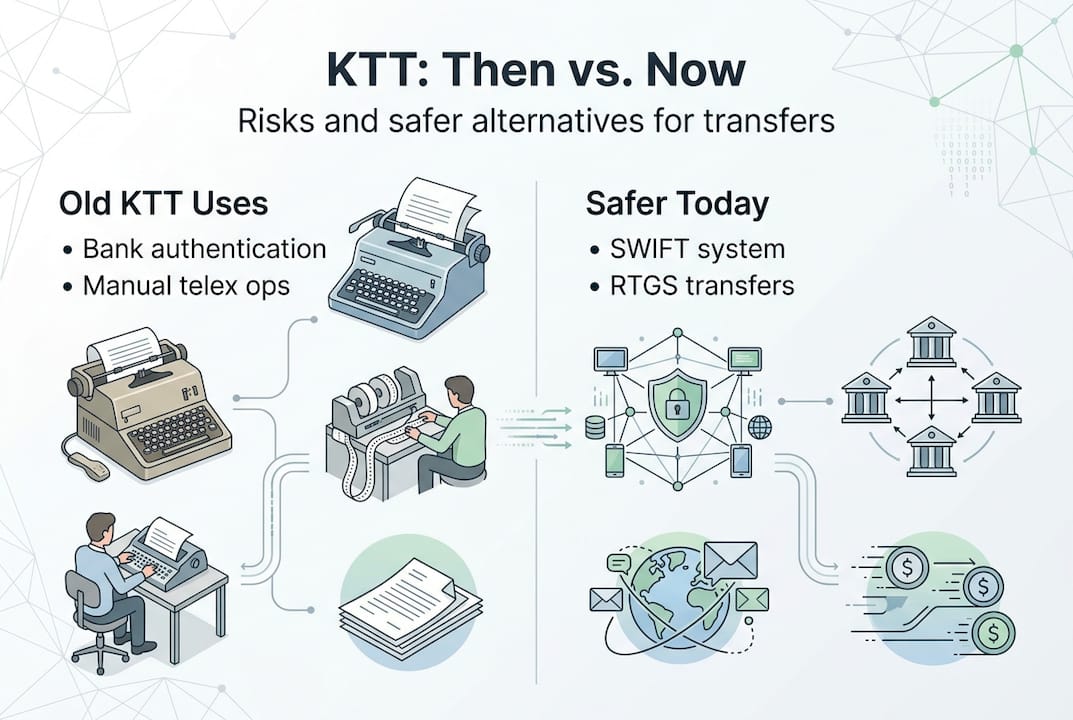
That era has largely passed. SWIFT took over routine interbank messaging by the 1980s and 1990s, offering faster, more secure, and more standardized communications. Most central banks and regulatory bodies have since moved away from telex-based systems as primary instruments for fund transfer authorization. The regulatory frameworks that once gave KTT its institutional credibility have evolved significantly, leaving KTT as a relic in most modern banking operations.
Despite this, KTT continues to circulate in financial discussions, usually in contexts where its archaic mystique is weaponized for fraud. Promoters describe KTT as a confidential back-channel used by elite institutions to move hundreds of millions without public record. This framing is both factually inaccurate and deliberately designed to appeal to clients who value privacy. Understanding the KTT service benefits versus its risks requires separating this mythology from documented banking practice.
Here is what legitimate KTT once covered and what most modern claims distort:
- Historical use: Authentication layer for large interbank transfers in pre-SWIFT banking environments
- Authorized parties: Restricted to licensed financial institutions with bilateral agreements
- Modern status: Largely replaced by encrypted SWIFT messaging and real-time gross settlement systems
- Misrepresentation: Often described as a secret or elite channel available to private clients, which no regulated bank officially offers
- Regulatory reality: Most jurisdictions do not recognize KTT as a current standard for fund transfer authorization
You can get a clearer picture of how contemporary KTT accounts are structured by reputable institutions versus how they are typically misrepresented by unverified operators.
Pro Tip: Any institution claiming to offer KTT-based fund transfers should be able to provide documented regulatory authorization from a recognized central bank or financial authority. If they cannot produce it immediately, that is your first red flag.
Analytical sources consistently label most KTT service promotions as fraudulent fee-extraction schemes, even as certain promotional sites continue to tout them for complex financial structures. The contrast between those two worlds is stark and consequential for anyone with significant capital at stake.
How KTT is used today: Myth vs. reality for large fund transfers
Now that the fundamentals are clear, let’s examine how KTT is actually used versus how it’s often pitched. The gap between the two is not subtle. It is wide enough to cost sophisticated clients millions in fraudulent upfront fees.
In genuine institutional practice, KTT as a concept still exists in legacy documentation and some bilateral banking agreements, particularly in regions where older communication infrastructure remains in place. However, even these use cases are tightly controlled, require full regulatory disclosure, and involve documented institutional relationships. There is no legitimate version of KTT that functions as a private channel accessible to individual clients outside of formal bank-to-bank agreements.
The fraudulent version is everywhere. KTT is frequently misrepresented in schemes targeting high-net-worth individuals and businesses, and the promotional language almost always follows a predictable pattern: exclusivity, speed, confidentiality, and massive transfer amounts. Brokers present themselves as intermediaries with access to special banking channels. The deal structure typically requires a substantial upfront fee before any funds move.
| Feature | Legitimate KTT (historical) | Fraudulent KTT offers |
|---|---|---|
| Parties involved | Licensed banks with bilateral agreements | Brokers, intermediaries, unverified institutions |
| Regulatory status | Documented, jurisdiction-specific | Absent or fabricated |
| Upfront fees | None before execution | Always required |
| Transfer confirmation | Immediate institutional verification | Vague or delayed |
| Documentation | Full compliance with AML/KYC | Minimal or non-existent |
| Availability | Institutional clients only | Marketed to private individuals |
What distinguishes a real institutional arrangement from a fraud is not complexity. It is verifiability. Every major bank can confirm its correspondent banking relationships, its regulatory licenses, and its messaging standards. Fraudulent operators rely on the inability or reluctance of wealthy clients to perform that verification quickly.
The warning signs appear in a consistent sequence. Knowing them protects your capital:
- Upfront fee requirements: Any proposal requiring payment before a confirmed transfer has executed is a scam structure, not a banking service.
- Unverifiable institutions: If you cannot find the offering bank in a central bank registry or financial authority database, do not proceed.
- Promises of secret channels: No regulated bank offers private transfer channels outside its public, regulated infrastructure.
- Unusually high transfer amounts: Claims of moving $100 million or more through exclusive channels with minimal documentation should immediately raise concern.
- Pressure and urgency: Legitimate banking procedures do not require decisions within 24 to 48 hours.
- Lack of formal documentation: Real institutional transfers come with extensive legal and compliance documentation upfront, not after payment.
You can learn more about how verified KTT telex transfers are structured by regulated institutions that operate within recognized compliance frameworks.
Pro Tip: No legitimate KTT transfer should ever require a large payment from your side before confirmed execution on the bank’s end. If a counterparty asks for fees, commissions, or “processing charges” before the transfer clears, walk away and report it.
Alternatives to KTT for secure international transfers
Given the risks, what should executives and high-net-worth individuals actually use when moving large sums internationally? The good news is that established, compliant systems exist and they are far more secure, faster, and better regulated than anything KTT promoters can offer.
The four primary alternatives that meet institutional standards are RTGS, SWIFT, IP 2 IP transfers, and Standby Letters of Credit (SBLC). Each serves a different purpose in the spectrum of international capital movement.
| Transfer method | Primary use | Key security feature | Regulatory oversight |
|---|---|---|---|
| RTGS | Large-value domestic and cross-border transfers | Real-time gross settlement, no netting risk | Central bank operated |
| SWIFT | International interbank messaging and transfers | Encrypted messaging, global standardization | SWIFT member bank compliance |
| IP 2 IP | Direct institutional transfers between counterparts | Bilateral authentication, institutional agreements | Jurisdiction-specific |
| SBLC | Payment guarantee in trade and financing | Bank-backed financial instrument | ICC and UCP 600 rules |
RTGS transfers (Real-Time Gross Settlement) are the gold standard for large-value transactions. Central banks operate RTGS systems in most major economies, ensuring that each transaction settles individually and immediately, eliminating counterparty and settlement risk. For executives managing treasury operations or cross-border acquisitions, RTGS is the most operationally sound choice.
SWIFT bank transfers remain the dominant protocol for international interbank messaging. With over 11,000 financial institutions in 200-plus countries connected to the SWIFT network, it provides the most widely accepted standard for international wire instructions. Every message is encrypted, timestamped, and traceable, making it essentially impossible to misrepresent or forge under standard compliance scrutiny.
Standby letters of credit serve a distinct but equally important function. Rather than moving funds directly, an SBLC acts as a bank’s guarantee that payment will be made if the primary obligor fails to perform. In complex cross-border transactions and trade finance, SBLCs provide a layer of security that is recognized globally under International Chamber of Commerce rules.
To validate any international transfer method before using it, apply these checks:
- Confirm the institution appears in the relevant national or international banking registry
- Verify the method’s compliance with your jurisdiction’s AML and financial reporting obligations
- Request full documentation of the transfer protocol and settlement timeline before committing any funds
- Confirm correspondent bank relationships through independent verification, not through documents supplied by the counterparty
- Engage a qualified compliance officer or legal counsel to review any transfer structure above $1 million
Assessing and mitigating KTT-related fraud risks
With safe alternatives outlined, focus turns to robust risk management if someone approaches you about KTT. The institutional consensus is clear, but fraud is adaptive. Knowing the due diligence steps protects your organization and your clients.
Here is the step-by-step process for assessing any KTT-related proposal:
- Request regulatory documentation immediately: Ask for the offering institution’s full license details, including the issuing authority, license number, and jurisdiction. Cross-reference this information against the relevant central bank or financial regulator’s public database.
- Verify correspondent banking relationships: A real institution will have documented correspondent relationships with recognized international banks. Request these details and confirm them directly with the correspondent bank.
- Demand a fee-free proof of concept: Legitimate institutions do not require upfront payment for transfer verification. Ask for confirmation of the institution’s capacity before any fees are discussed.
- Engage independent legal review: Any proposal involving sums above $500,000 should be reviewed by a financial attorney independent of the counterparty.
- Run AML and KYC checks on all parties: Treat every KTT counterparty with the same scrutiny you would apply to an unknown new client. This means full identity verification, source of funds documentation, and sanctions screening.
- Document everything in writing: Ensure all communications, proposals, and commitments are in writing with verifiable signatures and institutional letterheads.
The characteristics that separate legitimate proposals from suspicious ones are consistent across cases:
- Reputable: Transparent about regulatory status, willing to provide independent verification, no upfront fee demands, clear timelines and documentation
- Suspicious: Vague about licensing, insists on speed and secrecy, requires payment before execution, uses unverifiable institutional names or addresses
- Reputable: Communicates through official institutional channels, provides compliance contacts
- Suspicious: Operates through private email, messaging apps, or informal broker networks
“KTT is often used by scam operations looking to extract upfront fees without actual fund movement.” This pattern is documented across dozens of reported cases globally, and the victims are consistently individuals and entities with significant assets who were attracted by the promise of exclusive, private access.
Secure international business banking at a regulated institution eliminates most of these risks by design. Institutional compliance protocols include mandatory correspondent bank verification, structured KYC processes, and documented settlement procedures that leave no room for the opacity that KTT fraud depends on.

For corporate teams managing significant cross-border exposure, build KTT fraud awareness into your internal compliance training. The financial cost of falling victim is obvious. The reputational cost of being associated with a fraudulent transfer scheme can be far harder to recover from.
The uncomfortable truth about KTT: Why the expert consensus is changing
Here is what most financial content will not tell you directly: the legitimate use case for KTT, even where it technically still exists, has narrowed to the point of near-irrelevance for any reputable actor. The institutions that still use telex-based authenticated messaging do so within tightly regulated bilateral frameworks that are completely inaccessible to private clients or brokers. There is no credible version of the KTT “opportunity” being marketed in broker networks or through private intermediaries in 2026.
Analytical sources increasingly label KTT promotions as fraudulent, even as promotional sites persist in positioning them as sophisticated tools for complex structures. The expert consensus has shifted. The financial technology, regulatory transparency, and real-time settlement infrastructure that exist today make the original purpose of KTT redundant and the current marketplace for KTT services deeply unreliable.
Our position is direct: if you receive a KTT proposal, treat it as a scam until proven otherwise through independent, documented regulatory verification. The burden of proof is entirely on the counterparty. Adopt an evidence-first approach and you will not lose capital to a scheme built on institutional mystique and willful obscurity.
Sophisticated banking solutions for secure international transfers
The risks associated with KTT are real, but the need for private, large-scale international transfers is equally real for executives and high-net-worth individuals managing complex cross-border structures.
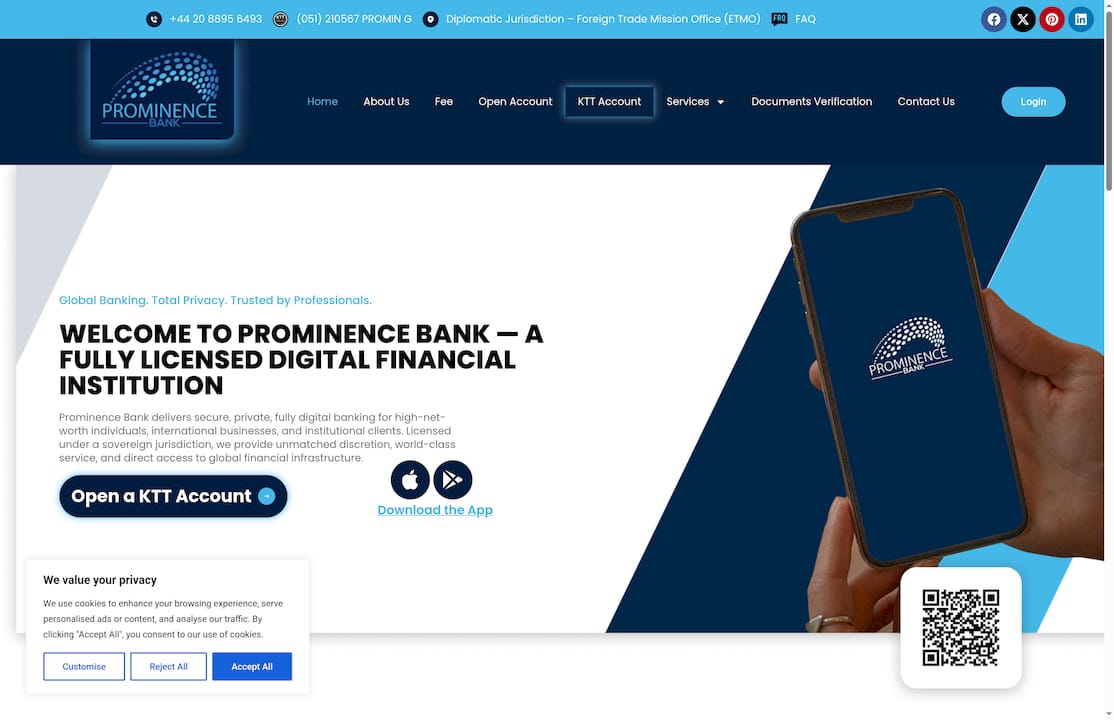
Prominence Bank offers advanced corporate banking solutions built on fully regulated infrastructure, giving institutional and private clients access to SWIFT-connected accounts, multi-currency capabilities, and compliant treasury services. Before engaging any provider making KTT claims, use our secure banking checklist to verify whether the institution meets the standards your capital requires. Our team works directly with clients on complex international structures, providing full KYC-compliant onboarding and documented correspondent banking access with no upfront fee schemes.
Frequently asked questions
Is Key Tested Telex legal for international fund transfers?
KTT is not recognized as a current, secure, or legally standard mechanism for fund transfers by most international regulators, and proposals involving it are frequently flagged as high-risk fee-extraction schemes rather than legitimate banking services.
How can I verify if a KTT offer is legitimate?
Request the offering institution’s regulatory license number and cross-reference it directly with the relevant central bank or financial authority, and reject any proposal that requires upfront fees or cannot provide independently verifiable institutional credentials.
What are safer alternatives to KTT for large transactions?
RTGS, SWIFT-connected wire transfers, and standby letters of credit are well-established, globally recognized instruments for secure, large-value international transactions with full regulatory oversight and clear settlement documentation.
Why do KTT scams target high-net-worth individuals?
Scammers target wealthy individuals because the combination of large available capital, desire for privacy, and interest in exclusive financial solutions creates ideal conditions for exploiting trust with promises of high-value, confidential transfer arrangements that do not actually exist.