
A real-time fund transfer is a credit-push payment that moves money from sender to recipient with immediate availability and irrevocable settlement, typically completing in 10–15 seconds. Unlike a wire that batches overnight or an ACH that floats for days, the funds land and are spendable the moment the receiving bank confirms. The two primary U.S. rails are the RTP Network (The Clearing House, launched 2017) and the FedNow Service (Federal Reserve, launched 2023), both built on ISO 20022 messaging. Prominencebank supports clients navigating these rails for multi-currency treasury operations and private account structures.
Key facts at a glance:
- Settlement: irrevocable, typically within seconds from initiation
- U.S. rails: RTP Network (The Clearing House) and FedNow Service (Federal Reserve)
- Messaging standard: ISO 20022 with rich remittance metadata
- Model: credit-push only — no debit-pull capability
- Cross-border: domestic rails pair with SWIFT/correspondent networks for international legs
Table of Contents
- How does a real-time transfer actually work?
- What are the real benefits for HNWIs and international businesses?
- Which U.S. real-time payment systems should you know?
- How do cross-border and multi-currency transfers work with instant rails?
- What security and compliance controls should you demand?
- What should you verify before enabling real-time transfers?
- Key Takeaways
- Why the conventional wisdom on instant payments undersells the risk
- Prominencebank’s approach to secure real-time transfers
- Useful sources
- FAQ
How does a real-time transfer actually work?
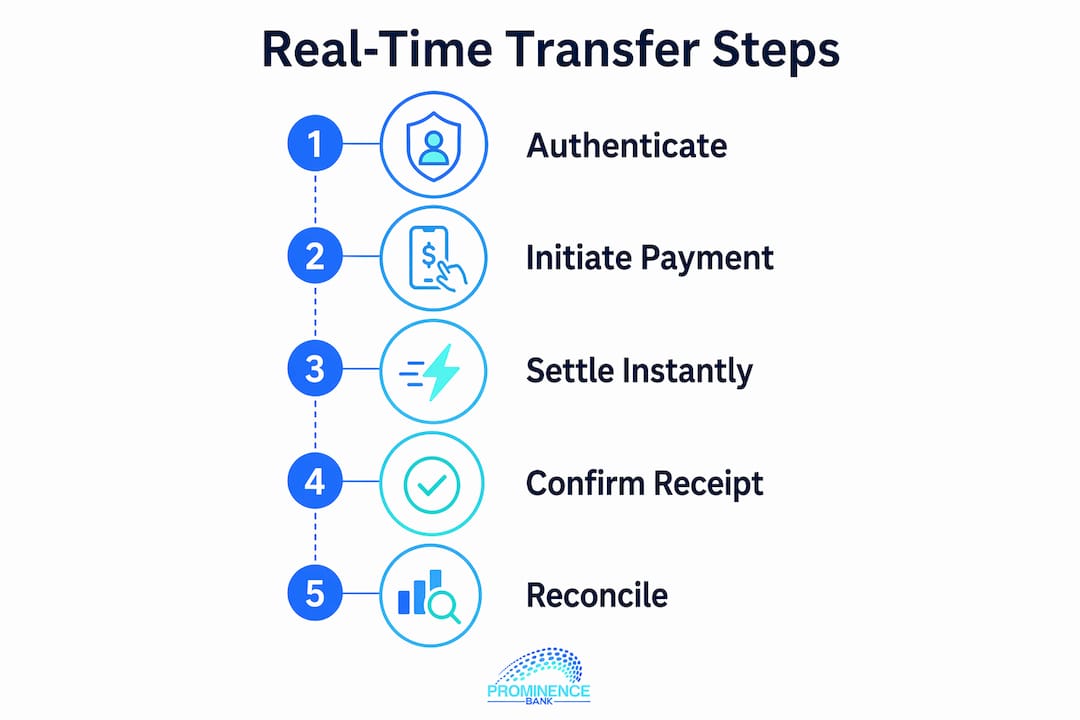
The sender initiates a credit-push instruction — the bank never pulls funds from a counterparty. That single design choice shapes everything downstream.
| Step | Action | Approximate time |
|---|---|---|
| 1. Authentication | Sender authenticates via MFA; bank validates credentials and device risk | 1–3 seconds |
| 2. Payment instruction | ISO 20022 message constructed with remittance metadata, sent to rail | < 1 second |
| 3. Network validation | Rail checks account eligibility, sanctions lists, velocity rules | 1–3 seconds |
| 4. Settlement | Funds move across pre-funded accounts at the central network or central bank | 1–5 seconds |
| 5. Notification | Both banks receive confirmation; recipient account credited | < 1 second |
Settlement liquidity sits in pre-funded accounts that participating banks maintain at the network level, which is how finality is achieved without end-of-day netting. Once the receiving bank accepts, the payment is done. There is no reversal mechanism — only a reimbursement request through bilateral bank coordination.

ISO 20022 carries structured fields for invoice references, line-item detail, and counterparty identifiers. A single payment can embed multiple invoice numbers, which means your ERP or TMS can automate reconciliation rather than match manually.
Pro Tip: Ask your treasury provider to map all available ISO 20022 remittance fields before go-live. Populating end-to-end reference IDs, purpose codes, and invoice numbers at the point of payment cuts reconciliation time and creates a clean audit trail without any post-processing.
What are the real benefits for HNWIs and international businesses?
Instant rails change the working capital equation: float disappears, and liquidity decisions become real-time decisions.
Instant bank payments settle individually and continuously rather than in batches, eliminating the multi-day float exposure that ACH creates. For a treasury team managing a $50M operating account, that is not a convenience feature — it is a risk reduction.
Practical advantages for private and corporate clients:
-
Immediate liquidity: Funds are available the moment settlement confirms, with no holding period.
-
Supplier and payroll certainty: Payments clear outside banking hours, including weekends and holidays.
-
Escrow and trust releases: Time-sensitive disbursements (estate distributions, escrow closings) execute without next-day delays.
-
FX hedge execution: Spot FX legs can be funded the instant a hedge is triggered, reducing slippage.
-
Concierge and urgent payments: High-value personal transactions — art purchases, property deposits — settle with finality the counterparty can verify immediately.
-
Reduced reconciliation overhead: ISO 20022 metadata automates matching in ERP systems.
Legacy rails still make sense in specific situations. Very large structured transactions where recall capability matters, or payments requiring multi-day documentation review, are better suited to RTGS wires or ACH. The irreversibility of instant rails is a feature for speed and a liability when the payment details are wrong.
Which U.S. real-time payment systems should you know?
Two rails, one messaging standard, and two legacy systems you are moving away from.
The RTP Network launched in 2017 and is operated by The Clearing House, a private consortium of major U.S. banks. The FedNow Service launched in 2023 and is operated by the Federal Reserve, extending instant payment access to smaller depository institutions across the country. Both rails use ISO 20022 messaging and provide 24/7/365 availability with immediate finality — the three traits that separate them from ACH and legacy wires.
Settlement benchmark: Both RTP and FedNow target 10–15 seconds from payment initiation to beneficiary availability. That is the operational standard treasury teams should hold their bank to.
Feature RTP Network FedNow ACH Wire / RTGS Speed 10–15 seconds 10–15 seconds 1–3 business days Same day (cut-off dependent) Availability 24/7/365 24/7/365 Business days Business hours Settlement finality Immediate, irrevocable Immediate, irrevocable Reversible Final (same day) Messaging standard ISO 20022 ISO 20022 NACHA SWIFT / Fedwire Typical rail cap Up to $1M per transaction Up to $500K per transaction Varies No standard cap
Bank-level limits often sit below the rail cap. Your institution may impose a $25K or $100K per-transfer ceiling by default, with higher tiers available on request for verified corporate accounts. Always confirm both the rail cap and your bank’s applied limit before structuring a payment.
How do cross-border and multi-currency transfers work with instant rails?
Domestic instant rails are account-to-account within the U.S. True cross-border instant settlement requires an additional layer.
Two practical models work for international clients:
- Onshore instant leg plus offshore FX settlement: The U.S. dollar leg settles instantly via RTP or FedNow; the foreign currency leg nets through a correspondent bank or FX partner. The recipient receives local currency, but the two legs do not settle simultaneously — there is a short FX execution window.
- Multi-currency pre-funded account: Maintain balances in target currencies across local instant rails in each jurisdiction. A payment from USD to EUR, for example, draws from a pre-funded EUR account on a European instant rail, with the FX rebalanced periodically.
For cross-border tracking, SWIFT gpi provides end-to-end payment status visibility across correspondent chains. It does not replicate the finality of domestic instant rails — SWIFT gpi tracks rather than guarantees instant settlement — but it closes the transparency gap that traditional correspondent banking left open. Prominencebank’s SWIFT banking services cover both gpi tracking and direct transfer options for clients managing multi-currency flows.
FX timing risk is real. If a spot rate moves between the moment you initiate the domestic instant leg and the moment the FX conversion executes, your effective cost changes. Pre-funded corridors eliminate that window entirely.
Pro Tip: For high-frequency cross-border flows, structure a multi-currency account with pre-funded balances in your top three settlement currencies. This lets each local leg settle instantly without an FX conversion delay at the point of payment.
What security and compliance controls should you demand?
Instant finality means there is no recall window. Front-end controls are the only controls that matter.
Because RTP uses a credit-push model, no counterparty can pull funds from your account. That eliminates one fraud vector but concentrates risk at the initiation point — if a fraudulent payment instruction gets through authentication, the money is gone.
Controls to verify with your bank before enabling instant rails:
- Multi-factor authentication on every payment initiation
- Device risk scoring and behavioral analytics
- Real-time sanctions screening against OFAC and other lists
- Transaction velocity limits and anomaly detection
- Beneficiary whitelisting with dual-approval for new payees
- Pre-funded account reconciliation to detect unauthorized activity
“RTP and FedNow provide immediate finality and are effectively irrevocable once accepted — operational recovery relies on reimbursement requests and bilateral bank coordination rather than formal reversal.” — Modern Treasury
AML and KYC checks run in the seconds before settlement. Banks may apply a brief hold on first-time beneficiaries or high-value transactions while screening completes. Ask your provider what their hold policy is and whether it applies to pre-approved counterparties.
Pro Tip: For corporate treasuries, implement a dual-approval workflow for any instant payment above a defined threshold — say, $10,000 — and maintain a whitelist of verified beneficiaries. These two controls together prevent the vast majority of authorized-push-payment fraud scenarios.
What should you verify before enabling real-time transfers?
A short checklist for your onboarding call with a bank or treasury provider:
Eligibility and limits
- Confirm whether your account type (consumer vs. business) is eligible for both RTP and FedNow.
- Ask for the per-transaction limit and daily ceiling your bank applies — not just the rail cap.
- Clarify fee structure: per-transaction, monthly, or tiered by volume.
Technical readiness
4. Verify ISO 20022 support and which remittance fields your bank populates.
5. Confirm reconciliation export formats (CSV, XML, API) and whether webhooks are available for real-time notifications.
6. Ask about TMS and ERP integration — does the bank offer a pre-built connector or an open API?
Operational and compliance
7. Request the bank’s dispute and error-resolution procedure for erroneous instant payments.
8. Confirm support SLAs for instant payment failures and after-hours incidents.
9. Ask what fraud hold policies apply and how pre-approved beneficiaries are handled.
10. Verify signatory and dual-approval workflow options for high-value payments.
For corporate account structuring, these questions feed directly into the account design — get answers before the account is live, not after the first payment fails.
Key Takeaways
Real-time fund transfers deliver irrevocable, 10–15-second settlement on U.S. rails, making float management and liquidity control a live decision rather than a next-day one.
| Point | Details |
|---|---|
| Settlement speed and finality | Transfers complete in 10–15 seconds and are irrevocable once accepted by the receiving bank. |
| U.S. rails to know | RTP Network (The Clearing House, 2017) and FedNow Service (Federal Reserve, 2023) both run on ISO 20022. |
| Security posture | Credit-push design prevents unauthorized pulls; dual-approval and beneficiary whitelisting are the critical front-end controls. |
| Cross-border structure | Pre-funded multi-currency accounts eliminate FX timing risk on cross-border instant payment corridors. |
| Prominencebank | Supports multi-currency accounts, ISO 20022 mapping, SWIFT gpi tracking, and bespoke signatory workflows for instant-rail onboarding. |
Why the conventional wisdom on instant payments undersells the risk
Most articles about real-time transfers focus on speed. Speed is the easy part. The harder conversation — the one most treasury teams skip until something goes wrong — is about the operational controls that have to exist before the first instant payment leaves the account.
The irreversibility of RTP and FedNow is not a footnote. It is the central operational fact. A dual-approval workflow and a beneficiary whitelist are not compliance theater; they are the only practical substitutes for a reversal mechanism that does not exist. Corporate clients who treat instant rails as a faster version of ACH, without rebuilding their authorization controls, are taking on fraud exposure they have not priced.
The other underappreciated point: ISO 20022 is only valuable if your bank actually populates the fields. Many institutions support the standard technically but send sparse metadata in practice. Before you build a reconciliation workflow around rich remittance data, confirm which fields your bank sends by default and which require a configuration request.
Prominencebank’s approach to secure real-time transfers
For high-net-worth clients and corporate treasuries that need instant settlement without sacrificing discretion or control, Prominencebank offers multi-currency accounts structured for instant-rail access alongside SWIFT gpi tracking, ledger-to-ledger settlement, and RTGS options. The difference from a standard business bank account is the architecture: pre-funded currency corridors, bespoke dual-approval signatory workflows, ISO 20022 remittance mapping, and reconciliation exports built for ERP integration from day one.
Private clients managing escrow releases, trust disbursements, or time-sensitive FX settlements get dedicated onboarding support, not a self-service portal. For institutional clients, Prominencebank’s corporate banking solutions include API and webhook integration for treasury management systems, with high-touch support for complex account structures. Contact Prominencebank directly to discuss a private onboarding consultation and confirm which instant-rail configuration fits your payment corridors.
This article is general information, not financial or legal advice. Confirm current rules, limits, and eligibility with your bank or a qualified treasury professional for your specific situation.
Useful sources
- FedNow Service — Federal Reserve Financial Services: Official overview of FedNow eligibility, availability, and use cases.
- RTP Network — The Clearing House: Technical and governance details for the RTP Network, including ISO 20022 support and finality rules.
- What Is RTP? — Modern Treasury: Practical explainer on credit-push mechanics, irrevocability, and fraud posture.
- Instant Bank Payments — Stripe: Business-focused overview of how instant rails eliminate float and improve cash-flow management.
- Prominencebank SWIFT gpi overview: How SWIFT gpi integrates with domestic instant rails for cross-border tracking.
FAQ
What is a real-time fund transfer in simple terms?
A real-time fund transfer is a credit-push payment that settles in 10–15 seconds with immediate, irrevocable finality — the recipient can spend the funds the moment the transfer confirms.
How do RTP and FedNow differ from each other?
RTP (The Clearing House, 2017) is privately governed with a per-transaction cap up to $1M; FedNow (Federal Reserve, 2023) extends access to smaller institutions with a cap up to $500K. Both use ISO 20022 and operate 24/7/365.
Can a real-time transfer be reversed if sent in error?
No. Once the receiving bank accepts an RTP or FedNow payment, it is irrevocable. Recovery requires a reimbursement request through bilateral bank coordination, not a formal reversal.
How do instant domestic rails connect to cross-border payments?
Domestic instant rails handle the U.S. leg only. Cross-border settlement pairs that leg with SWIFT correspondent banking or a pre-funded multi-currency account in the target currency’s local rail.
What controls should corporate clients require before enabling instant payments?
At minimum: multi-factor authentication, real-time sanctions screening, transaction velocity limits, beneficiary whitelisting, and a dual-approval workflow for payments above a defined threshold.