
TL;DR:
- Digital banking offers global corporations lower cross-border transaction costs and better liquidity management. It also provides multi-currency accounts and virtual IBANs to streamline international payments and compliance. Selecting a platform with ISO-native API architecture and proper licensing is essential for operational efficiency and risk mitigation.
Digital banking is the financial infrastructure global corporations use to reduce cross-border transaction costs, accelerate treasury cycles, and manage multi-currency operations without the overhead of traditional correspondent banking. The shift is not cosmetic. Corporations operating across multiple jurisdictions face real penalties from legacy banking systems: opaque FX markups, slow settlement, and capital locked in pre-funded accounts. Understanding why digital banking for global corporations has become a strategic priority requires looking at three concrete areas: cost structure, liquidity control, and operational compliance. This article addresses each directly, with data and frameworks executives can apply immediately.
What are the cost advantages of digital banking for global corporations?
Traditional correspondent banking costs corporations far more than most finance teams realize. Cross-border payment costs average around 6% of transaction value, with traditional banks applying FX markups up to 4% and intermediary fees of $15–$30 per transaction. On a $10 million annual payment volume, that is $600,000 in friction costs before a single business decision is made.
Digital banking platforms cut that figure sharply. Transaction costs drop from 3–5% in standard transfers to under 1%, and as low as 0.2% for high-volume corridors with specialized digital banking solutions. That difference directly improves operating margins on international contracts, supplier payments, and intercompany transfers.
The hidden cost that rarely appears in fee schedules is the FX markup embedded in mid-market rate conversions. Traditional banks apply a spread between the interbank rate and the rate offered to corporate clients. Digital banking platforms typically publish the mid-market rate and charge a flat fee, making the true cost visible and predictable. Predictability matters for CFOs building accurate cash flow models across multiple currencies.
| Factor | Traditional banking | Digital banking |
|---|---|---|
| Cross-border fee | Up to 6% of transaction value | As low as 0.2%–1% |
| FX markup | Up to 4% above mid-market rate | Mid-market rate plus flat fee |
| Intermediary charges | $15–$30 per transaction | None or minimal |
| Transfer speed | 2–5 business days | Same day to 24 hours |
| Fee transparency | Opaque, bundled | Itemized, real-time |
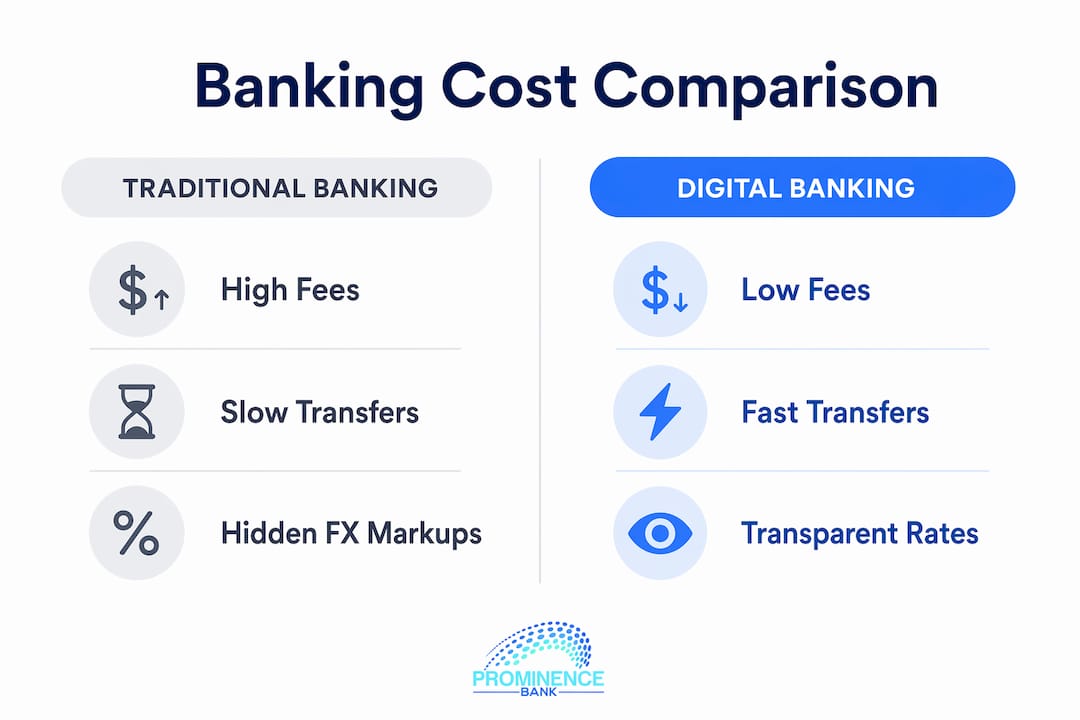
The cost gap compounds over time. A corporation running 500 international transactions per month at an average of $50,000 each saves millions annually by moving to a digital banking platform with transparent FX pricing. That capital does not disappear. It returns to working capital, capital expenditure, or shareholder returns.
How digital banking improves liquidity management and treasury efficiency
Liquidity fragmentation is the most underestimated problem in global corporate treasury. Fragmented liquidity traps capital in pre-funded accounts across multiple correspondent banks, creating slow settlement cycles and forcing treasury teams into reactive management rather than proactive deployment. The result is capital sitting idle in “dead zones” while the business needs it elsewhere.
Digital banking solves this through three structural changes:
- Real-time payment tracking gives treasury teams visibility into exactly where funds are at any moment, across all currencies and corridors.
- Multi-currency accounts consolidate balances under one platform, eliminating the need to maintain separate pre-funded accounts in each country.
- API-first architecture connects the banking platform directly to ERP systems, enabling automated sweeps, balance notifications, and payment triggers without manual intervention.
The infrastructure type matters enormously here. ISO-native API design versus fragmented correspondent networks is the critical distinction between a digital bank that genuinely improves treasury efficiency and one that simply has a better interface on top of the same legacy plumbing. Executives should ask providers directly whether their payment rails are proprietary or correspondent-dependent.
Pro Tip: Map your top 10 payment corridors by volume and ask each digital banking candidate to confirm whether those corridors run on their own licensed infrastructure or through third-party correspondent banks. The answer changes your settlement speed and cost calculation entirely.

The 2026 treasury strategy for most multinationals now includes shortening settlement cycles as a primary objective. Shorter cycles free capital faster, reduce hedging requirements, and give CFOs more accurate intraday liquidity positions. Digital banking is the mechanism that makes this possible at scale.
What role do multi-currency accounts and virtual IBANs play in global corporate banking?
Multi-currency accounts are the operational core of modern global corporate banking. A single multi-currency account holds balances in USD, EUR, GBP, SGD, and other major currencies simultaneously, eliminating forced conversions at unfavorable rates when receiving payments from international clients. The corporation converts only when it chooses to, at a time and rate that suits its treasury position.
Virtual IBANs extend this further. A virtual IBAN is a local account number assigned to a corporation in a specific market, such as a UK sort code or a European IBAN, that routes payments directly into the corporation’s master account. Clients in those markets pay using familiar local payment methods. The corporation receives funds without cross-border friction, and the payment appears as a local transaction to the sender.
The compliance benefits are significant. Synchronizing multi-currency accounts with ERP and accounting software via API reduces audit risk and accelerates reconciliation. Manual exports create tax compliance gaps. Automated integration eliminates them. For corporations operating under IFRS or US GAAP with multi-jurisdiction reporting requirements, this is not a convenience. It is a control requirement.
| Feature | Operational benefit | Compliance benefit |
|---|---|---|
| Multi-currency account | Hold balances in 10+ currencies | Reduce forced conversion losses |
| Virtual IBAN | Receive local payments globally | Simplify entity-level reporting |
| API integration with ERP | Automate reconciliation | Reduce manual audit exposure |
| Real-time FX rates | Convert at optimal timing | Accurate mark-to-market reporting |
Setting up corporate accounts with virtual IBAN capabilities in major markets, including the US, EU, and UK, is now a standard expectation for any corporation processing more than $5 million in annual cross-border payments. Providers that cannot offer this infrastructure are not equipped for serious global operations.
How to evaluate and select digital banking platforms for global corporations
The most common mistake executives make when selecting a digital banking provider is counting the number of countries supported. That number is meaningless without knowing the infrastructure behind it. Many so-called global digital accounts use fragmented correspondent banking networks, which means the corporation is still exposed to the same intermediary delays and costs it was trying to avoid.
A rigorous evaluation follows this sequence:
- Confirm infrastructure type. Ask whether the provider operates on a unified, ISO-native API architecture or routes through correspondent banks in key corridors.
- Map licenses to corridors. License portfolio mapping against your active operating corridors is non-negotiable. Operating without full licensing in a corridor forces fallback to legacy correspondent banking and creates compliance gaps.
- Assess ERP integration depth. The platform must connect to your existing treasury management system or ERP via API, not CSV export. Manual processes introduce errors and slow reporting cycles.
- Review AML/KYC standards. For corporations with complex ownership structures or offshore entities, the provider’s compliance framework must match international AML/KYC standards without creating operational bottlenecks.
- Test settlement speed on priority corridors. Request live data on average settlement times for your top five payment corridors before signing any agreement.
Pro Tip: Ask for a sample bank statement and API documentation before onboarding. A provider that cannot produce clean, structured output for your finance team will create reconciliation problems at scale.
Digital banking best practices for global corporations also include evaluating the provider’s approach to security, specifically whether they offer multi-factor authentication, role-based access controls, and real-time fraud monitoring at the corporate account level. Security failures in treasury operations carry regulatory and reputational consequences that far exceed the cost of choosing a more rigorous provider upfront.
The corporate banking solutions that deliver genuine efficiency gains share one characteristic: they treat compliance and technology as integrated, not separate. Providers that bolt compliance onto a technology platform after the fact create friction. Providers that build compliance into the architecture from the start create speed.
Key takeaways
Digital banking reduces global corporate transaction costs from up to 6% under traditional banking to as low as 0.2%, while freeing trapped liquidity and automating compliance through API-native infrastructure.
| Point | Details |
|---|---|
| Cost reduction is measurable | Digital banking cuts cross-border fees from up to 6% to as low as 0.2%, directly improving margins. |
| Liquidity fragmentation is the real risk | Pre-funded correspondent accounts trap capital; digital platforms with real-time rails free it faster. |
| Multi-currency accounts are operational infrastructure | Holding balances in multiple currencies eliminates forced conversions and simplifies local payment receipt. |
| Infrastructure type determines real efficiency | ISO-native API architecture delivers genuine speed gains; correspondent-dependent platforms do not. |
| License mapping prevents compliance gaps | Matching provider licenses to active corridors is the single most overlooked step in provider selection. |
Why digital banking is no longer optional for global treasury
I have watched corporations spend 18 months evaluating digital banking providers and then choose the one with the best-looking dashboard. That is the wrong criterion. The dashboard is irrelevant if the payment rails underneath it are the same correspondent network the corporation was already using at its legacy bank.
The operational transformation I have seen happen consistently is this: a corporation moves its top three payment corridors to a digital banking platform with licensed infrastructure in those markets. Settlement times drop from three days to same-day. Treasury teams stop spending two hours per day chasing payment confirmations. The CFO gets an accurate intraday cash position for the first time. That is not a technology upgrade. That is a structural change in how the business operates.
The trend that deserves more executive attention is the 54% of CFOs who plan to adopt digital assets for treasury operations within the next 12 months. Digital asset integration is not speculative anymore. It is a treasury diversification decision, and the digital banking platforms that support it natively will have a significant advantage over those that treat it as an add-on.
Traditional banking silos force corporations to manage the bank’s technical debt rather than their own international business flows. That is the most accurate description of the problem I have encountered. The executive who recognizes this and acts on it gains a treasury operation that serves the business. The one who waits manages a treasury operation that serves the bank.
— Harold
Prominencebank’s digital banking solutions for global corporations
Prominencebank operates as a fully licensed digital banking institution built for corporations that cannot afford the inefficiencies of traditional banking. Its multi-currency account platform supports balances across major currencies with virtual IBAN capabilities in key markets, direct API integration for ERP connectivity, and real-time FX pricing with full transparency.
Prominencebank’s corporate banking infrastructure is designed for complex ownership structures, international compliance requirements, and treasury teams that need same-day visibility across all accounts. The platform supports digital asset readiness, making it a forward-compatible choice for CFOs planning treasury diversification. For corporations evaluating corporate finance solutions that combine privacy, compliance, and global reach, Prominencebank provides a direct path from legacy banking overhead to modern treasury control.
FAQ
What is digital banking for global corporations?
Digital banking for global corporations is the use of fully online, API-native banking platforms to manage multi-currency accounts, cross-border payments, and treasury operations without relying on traditional correspondent banking networks.
How much can corporations save by switching to digital banking?
Cross-border transaction costs drop from up to 6% under traditional banking to as low as 0.2% with specialized digital banking platforms, representing significant savings on high-volume payment corridors.
What is a virtual IBAN and why does it matter for global businesses?
A virtual IBAN is a local account number assigned to a corporation in a specific market, allowing it to receive payments as a local entity while consolidating funds into a single master account. This eliminates cross-border friction for international clients and simplifies entity-level reconciliation.
How do corporations avoid compliance gaps when choosing a digital bank?
Mapping the provider’s license portfolio against every active operating corridor is the critical step. Unlicensed corridors force fallback to correspondent banking and reintroduce the compliance risks the corporation was trying to eliminate.
Does digital banking support treasury operations involving digital assets?
Yes. A growing number of digital banking platforms now support digital asset integration natively. Research from 2025 shows 54% of CFOs plan to adopt digital assets for treasury within 12 months, making native digital asset support a meaningful selection criterion for forward-looking treasury teams.