TL;DR:
- Discreet online banking requires evaluating robust privacy features like end-to-end encryption, behavioral controls, and transaction descriptor management. Traditional banks offer moderate privacy, whereas neobanks and crypto wallets provide higher user control and transaction anonymity, respectively. Effective privacy relies on multiple layered security practices rather than a single product, emphasizing user discipline and system resilience.
Your financial data moves across more networks than most people realize. Every transaction leaves a trail, and most conventional banks do little to minimize that exposure. For high-net-worth individuals, international businesses, and professionals handling sensitive funds, finding real examples of discreet online banking is not a curiosity. It is a necessity. This article breaks down the criteria that actually matter, walks through three concrete banking models with verified privacy features, and gives you a comparison framework to match the right solution to your specific needs.
Table of Contents
- Key takeaways
- Examples of discreet online banking: key evaluation criteria
- 1. Traditional banks with discreet transaction features
- 2. Neobanks and fintech platforms focused on privacy
- 3. Cryptocurrency-based banking and private digital wallets
- 4. Comparing discreet banking options side by side
- 5. How to choose the right discreet banking option
- My honest take on discreet banking in 2026
- How Prominencebank delivers discreet banking for global clients
- FAQ
Key takeaways
| Point | Details |
|---|---|
| Privacy criteria matter first | Evaluate encryption, MFA type, and data-sharing policies before picking any discreet banking platform. |
| Traditional banks have limits | Large banks offer some privacy features but still share data widely under regulatory frameworks. |
| Neobanks lead on user controls | Fintech platforms offer privacy dashboards, virtual cards, and biometric locks that legacy banks rarely provide. |
| Crypto adds anonymity with trade-offs | Cryptocurrency wallets offer the highest transaction anonymity but come with legal and usability constraints. |
| Layered security is non-negotiable | No single privacy feature is enough. Combining MFA, behavioral analysis, and session isolation creates real protection. |
Examples of discreet online banking: key evaluation criteria
Before comparing specific banking models, you need a clear framework for what “discreet” actually means in practice. Not every bank that calls itself private delivers meaningful confidentiality. The difference shows up in the technical details.
Here is the discreet banking features list that genuinely matters when evaluating any platform:
- Phishing-resistant MFA. SMS-based authentication is now considered too vulnerable for high-value accounts. Look for FIDO2 hardware keys or passkeys as the authentication baseline.
- End-to-end encryption and session isolation. All data in transit and at rest should be encrypted. Sessions should not persist or leave recoverable traces on shared devices.
- Transaction descriptor control. Discreet banking platforms allow you to choose generic or neutral labels for transactions so statements do not expose business relationships or spending patterns.
- Third-party data sharing policies. Read the consent controls carefully. Many banks share behavioral data with affiliates by default. True confidential online banking requires explicit opt-in policies, not opt-out.
- Behavioral analysis and device identification. Layered security controls that include behavioral signals mean that even if credentials are compromised, anomalous activity gets flagged before damage is done.
- Privacy dashboards. Some platforms now surface all active data-sharing permissions in one place, letting you audit and revoke access without contacting support.
Pro Tip: When reviewing a bank’s privacy policy, search for the phrase “affiliates and partners.” How broadly that term is defined tells you exactly how far your financial data travels beyond the institution itself.
The architecture of security matters just as much as the feature list. A bank can offer biometric login while still selling anonymized transaction data to marketing partners. Real secure online banking options treat privacy as a design principle, not a checkbox.
1. Traditional banks with discreet transaction features
Established banks were not built with privacy as a primary goal, but several have added meaningful discreet features that make them viable for users who need moderate confidentiality without leaving the regulated banking system.

The strongest example of traditional bank discretion is transaction descriptor management. Some larger institutions allow business account holders to negotiate with their banking relationship manager to use generic merchant descriptions on statements. This is particularly useful for professional service firms, medical practices, or any business where client confidentiality extends to financial records.
Multi-layered authentication is now standard at most major banks, though the implementation quality varies significantly. The better institutions have moved toward device-bound authentication rather than relying on SMS codes.
Key privacy features you will find at the best traditional banks:
- Tiered access controls that restrict which staff can view account details
- Secure messaging portals that keep sensitive communications off standard email
- Account alerts that notify you immediately of any login or transaction activity
- Verified digital signage. FDIC rules require insured banks to display their official sign on all online banking channels, so you can confirm legitimacy before logging in.
The limitation is structural. Traditional banks operate under frameworks that require extensive data sharing with regulators, tax authorities, and law enforcement. They also frequently share data with credit bureaus and internal affiliates. For moderate privacy needs, they work. For serious confidential online banking, they fall short. The advantages of discreet banking that high-net-worth clients actually need are rarely available through conventional channels.
2. Neobanks and fintech platforms focused on privacy
Neobanks built their entire architecture in the past decade, which means they could design privacy controls into the foundation rather than bolting them on afterward. This structural difference shows up in how these platforms handle your data.
Modern digital banks now provide biometric authentication, real-time fraud monitoring, and consent dashboards that give users direct control over what data is shared and with whom. That last feature is rare in traditional banking and is one of the clearest differentiators for users who want to bank quietly online.
The standout privacy features that distinguish privacy-first neobanks:
- Virtual card generation. Create single-use or merchant-locked card numbers that mask your real account details. Even if a vendor is compromised, your underlying account is never exposed.
- Privacy mode in-app. App privacy modes hide sensitive balances and transaction details on-screen, protecting against shoulder surfing in public. These work best when combined with biometric app locks.
- Device-bound MFA. Authentication credentials are tied to a specific device, making remote account takeover dramatically harder.
- Consent management dashboards. Users can see and revoke all third-party data-sharing permissions in real time.
Pro Tip: When setting up a neobank account, go to the privacy or data settings within the first session. Turn off every data-sharing permission that is not required for the core service. Most defaults are set in the bank’s commercial interest, not yours.
The trade-off with neobanks is deposit protection and institutional depth. Some operate under full banking licenses; others are e-money institutions with different protections. Check the regulatory status before transferring significant assets. For businesses that want the privacy architecture of fintech with the account capabilities of a full bank, how technology enables private banking is worth studying before choosing a platform.
3. Cryptocurrency-based banking and private digital wallets
Cryptocurrency represents the furthest end of the discreet banking spectrum. It is the only model where transaction anonymity is built into the protocol rather than layered on top of existing infrastructure.
Crypto wallets enable fund transfers that are untraceable by conventional banking system lookups. Transactions are recorded on public blockchains by wallet address rather than by name, separating financial activity from personal identity in a way that no traditional account can replicate.
Use cases where crypto-based banking adds real discretion:
- Cross-border business payments where correspondent banking creates unwanted visibility
- Asset holding for individuals concerned about domestic political or economic instability
- Privacy-sensitive industries where transaction counterparties require confidentiality
The limitations are real and should not be minimized:
- Regulatory scrutiny is increasing. Most jurisdictions now require exchanges to comply with Know Your Customer (KYC) and Anti-Money Laundering (AML) standards, meaning the entry and exit points are rarely anonymous.
- Volatility. Holding operating capital in volatile assets creates financial risk unrelated to privacy.
- Usability gaps. Paying vendors, receiving payroll, or managing corporate accounts in crypto still requires workarounds that add friction.
For businesses and individuals considering crypto as a component of their discreet banking strategy, the most practical approach is to use it for specific transaction types rather than as a primary banking layer. Pairing a crypto wallet with a private multi-currency account gives you flexibility and coverage across different privacy scenarios.
4. Comparing discreet banking options side by side
A direct comparison makes the trade-offs easier to see clearly.
| Feature | Traditional banks | Neobanks and fintech | Crypto wallets |
|---|---|---|---|
| Transaction descriptor control | Limited, negotiable | Built-in virtual cards | Wallet address only |
| Authentication method | SMS or app-based OTP | Biometric and device-bound | Private key or hardware wallet |
| Third-party data sharing | Broad, often opt-out | Controlled, consent-based | None via banking system |
| Usability for businesses | High | High | Moderate |
| Regulatory compliance | Full | Full to partial | Partial (exchange-dependent) |
| Deposit protection | FDIC/equivalent | Varies by license | None |
| Best for | Moderate privacy needs | Privacy-first individuals and SMBs | Maximum transaction anonymity |
The table makes clear that no single category dominates. Traditional banks win on regulatory trust and usability. Neobanks win on privacy controls and user experience. Crypto wins on anonymity but loses on every practical banking dimension. For most clients with serious privacy requirements, the answer is a combination rather than a single solution.
5. How to choose the right discreet banking option
Matching your privacy needs to the right platform comes down to four honest questions.
First, are your privacy needs personal or corporate? Individuals protecting personal wealth have different threat models than international businesses protecting counterparty relationships. Corporate structures often require audit trails internally even while presenting a discreet face externally.
Second, what is your regulatory environment? If you operate across multiple jurisdictions, the platform you choose must comply with the AML/KYC requirements of each. A discreet bank that creates compliance problems in one jurisdiction solves nothing. Review the global privacy and security checklist before committing to a platform.
Third, how do you balance convenience with confidentiality? The FTC reported $12.5 billion lost to fraud in 2024, and a meaningful portion came from bank impersonation scams. Secure channels that slow down access also slow down attackers. Do not optimize only for convenience.
Fourth, are your device-level and session-level habits supporting your banking privacy? Browser Guest Mode fully isolates banking sessions by preventing extensions and saved credentials from loading, which is meaningfully safer than Incognito Mode. A VPN on a trusted network adds another layer. Financial privacy requires active engagement from the user, not just institutional protections.
My honest take on discreet banking in 2026
I have spent years watching clients build sophisticated banking structures and then undermine them with basic device hygiene mistakes. Someone will set up a private multi-currency account through an institution with excellent confidentiality standards, then access it on a shared laptop loaded with browser extensions and no session isolation. The institution did its job. The user did not.
What I have learned is that effective discreet banking is always a system, not a product. The bank’s architecture is layer one. Phishing-resistant authentication is layer two. Layered behavioral security adds layer three. Device-level discipline and session isolation add layers four and five. Each layer alone is defeatable. Together, they represent a genuinely high-friction target for anyone trying to access your accounts or expose your financial patterns.
I am also skeptical of anyone who frames best anonymous banking methods as a single product decision. The most sophisticated private banking clients I have encountered use two or three complementary platforms: one for daily business operations, one for international transfers and currency management, and one for asset-level privacy. That is not paranoia. That is how financial professionals structure resilience.
The overlooked risk in 2026 is not technical. It is social. Bank impersonation scams are the fastest-growing attack vector against private banking clients specifically because those clients are harder to reach through broad phishing campaigns. User education is as important as any feature on a discreet banking features list.
— Harold
How Prominencebank delivers discreet banking for global clients
Prominencebank was built specifically for clients who cannot afford to compromise on financial confidentiality. Operating under ETMO sovereignty with full AML/KYC compliance, Prominencebank combines advanced authentication, multi-currency account structures, and transaction-level privacy controls into one platform designed for high-net-worth individuals and international businesses.
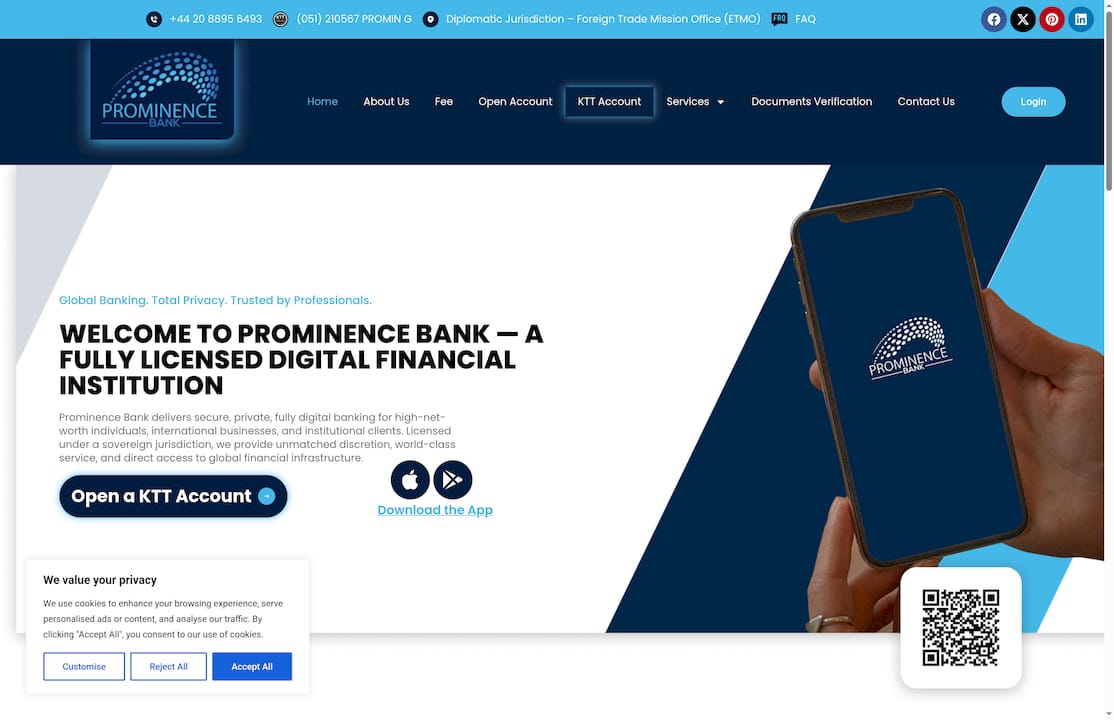
If your operations span multiple currencies and jurisdictions, a multi-currency account with built-in privacy architecture eliminates the fragmentation that forces most clients to accept trade-offs between convenience and confidentiality. For corporate clients with complex structures, corporate banking solutions at Prominencebank support discreet account management at the institutional level. The platform offers what most banks discuss in marketing materials but rarely deliver in practice: confidentiality that holds up under real-world operating conditions.
FAQ
What makes a bank “discreet” in online banking?
A discreet bank limits transaction data exposure, uses phishing-resistant authentication, and gives users direct control over third-party data sharing. It also avoids broad affiliate data sharing by default.
Are neobanks safer for privacy than traditional banks?
Neobanks generally offer stronger privacy controls, including virtual cards and consent dashboards, but deposit protection varies. Traditional banks provide more regulatory stability with fewer privacy controls.
Is cryptocurrency banking truly anonymous?
Crypto transactions are pseudonymous rather than fully anonymous. Exchanges must comply with KYC requirements in most jurisdictions, meaning the entry and exit points are identifiable even if transaction flows are not.
What authentication method is best for discreet online banking?
FIDO2 hardware security keys and passkeys are the current gold standard. SMS-based codes are now considered insufficient for high-value or sensitive accounts.
Can businesses use discreet online banking for corporate accounts?
Yes. Corporate clients can use private multi-currency accounts, negotiate transaction descriptor controls, and implement layered authentication at the organizational level to protect counterparty relationships and operational data.