
TL;DR:
- Regulated digital banking classification significantly impacts consumer protections, deposit safety, and operational standards. While fully licensed banks offer statutory guarantees like DGS, e-money institutions rely on safeguarding, which involves segregated funds without statutory insurance. Understanding providers’ regulatory statuses is essential for making informed financial decisions in the evolving digital finance landscape.
Most people assume that if a financial app looks like a bank and acts like a bank, it must be a bank. That assumption is exactly where the confusion around what is regulated digital banking begins. The legal classification of your digital provider determines everything: how your money is protected, what happens if the institution fails, and what rights you hold as a customer. This guide cuts through the noise and explains the regulatory framework, consumer protections, compliance requirements, and practical implications for individuals, businesses, and financial professionals operating in today’s digital finance environment.
Table of Contents
- Key takeaways
- What regulated digital banking actually means
- Consumer protections and deposit safety
- Business models and financial stability considerations
- Regulatory compliance: AML, KYC, and operational readiness
- Practical implications for consumers, businesses, and professionals
- My take on the regulated digital banking gap
- How Prominencebank approaches regulated digital banking
- FAQ
Key takeaways
| Point | Details |
|---|---|
| Legal classification matters most | Whether a provider is a digital bank or e-money institution determines your actual consumer protections. |
| Deposit guarantee vs. safeguarding | Licensed banks offer DGS coverage up to €100,000; e-money institutions use safeguarding rules instead. |
| Regulation is not uniform globally | Differences in digital banking regulations mean protections vary significantly by country and institution type. |
| Compliance spans AML, KYC, and data security | Every regulated digital bank must meet the same core controls as traditional banks, regardless of its tech model. |
| Verification is your responsibility | Consumers and businesses must actively confirm a provider’s regulatory status before depositing funds. |
What regulated digital banking actually means
The phrase “regulated digital banking” carries more legal weight than most people realize. Understanding it starts with one critical distinction: not all digital providers are classified as banks under the law. Some hold a full banking license. Others operate as e-money institutions or payment service providers under separate frameworks like the Payment Services Regulations 2018 or the Electronic Money Regulations 2011. The category a provider falls into dictates the level of regulatory oversight it receives and the protections you get.
A regulated digital banking overview must account for both types. A digital bank authorized as a credit institution operates under the same core banking laws as a traditional high street bank. An e-money institution, by contrast, is authorized to issue electronic money and process payments but is not permitted to engage in lending or provide the same depth of financial services. Both are regulated. But they are regulated differently, and those differences matter enormously when something goes wrong.
Regulatory bodies like the Central Bank of Ireland, the UK’s Financial Conduct Authority, and the US Federal Reserve all play oversight roles. Their job is not to run the banks but to monitor compliance, enforce rules, and protect the public interest. Federal Reserve supervision promotes a safe, sound, and efficient banking system by enforcing laws around depositor and customer protections without directly managing how an institution runs its business.
Pro Tip: Before opening an account with any digital provider, search the regulator’s public register for your jurisdiction. If the provider is not listed, your funds may have no legal protection at all.
When asking what is regulated digital banking for the first time, start with the authorization certificate. That document tells you everything about the rules a provider must follow and the safety net available to you as a customer. The legal distinctions between providers are not bureaucratic technicalities. They are the foundation of your financial security.
Consumer protections and deposit safety
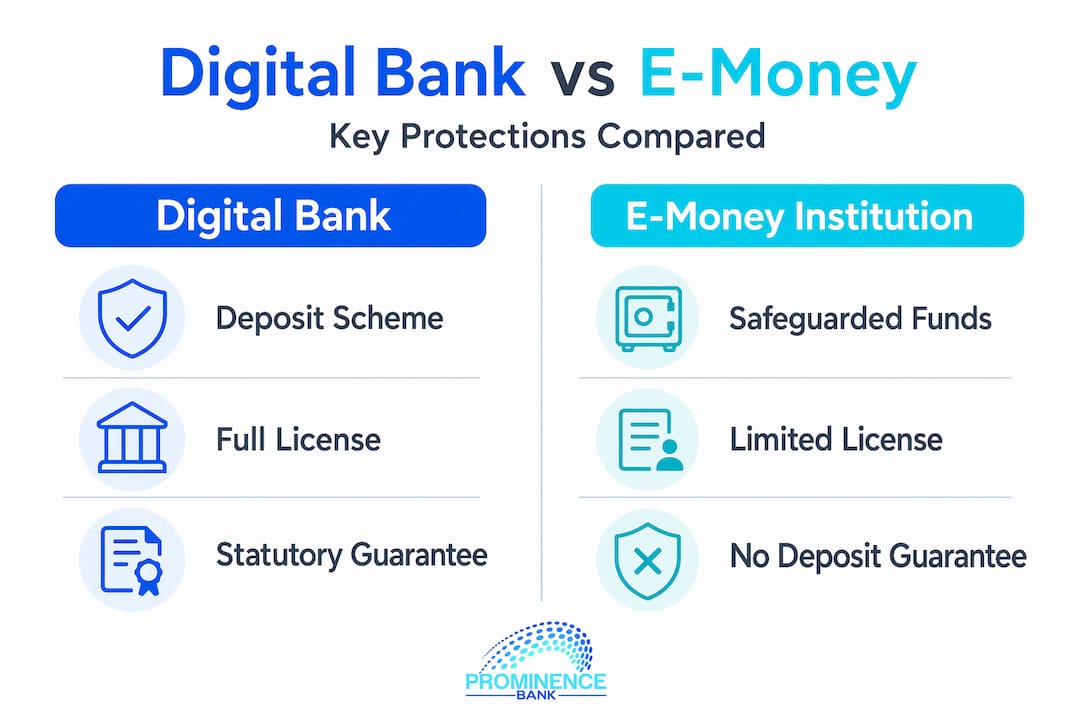
The most consequential difference between a licensed digital bank and an e-money institution comes down to what happens to your money if the provider collapses. Deposit Guarantee Scheme coverage versus safeguarding of funds rules represent two completely different approaches to protecting your balance.

If your money is held in a fully licensed digital bank, it falls under the Deposit Guarantee Scheme. In the European Union, that means protection up to €100,000 per depositor per institution. In the US, the FDIC provides equivalent coverage for deposits at insured banks. If the bank fails, you get your money back up to that limit. That guarantee is statutory. It does not depend on the bank finding a buyer or having enough liquid assets.
E-money institutions work differently. They are required to “safeguard” customer funds, meaning they must hold your money in a segregated account at an authorized credit institution or invest it in low-risk liquid assets. The funds are ring-fenced from the institution’s own money, so creditors cannot claim them if the firm becomes insolvent. However, safeguarding is not a guarantee in the same sense as DGS. Recovery depends on the safeguarded assets being intact and accessible. In the UK, the Financial Services Compensation Scheme adds a layer of protection for eligible customers of e-money institutions when safeguarded funds are held by a PRA-authorized credit institution.
| Protection type | Who it applies to | Coverage limit | Recovery mechanism |
|---|---|---|---|
| Deposit Guarantee Scheme | Licensed banks | Up to €100,000 per depositor | Statutory government-backed compensation |
| Safeguarding of funds | E-money/payment institutions | No fixed limit | Segregated assets recovery |
| FSCS (UK) | E-money institutions (conditional) | Up to £85,000 | Compensation if safeguarded funds held by PRA-authorized firm |
| FDIC (US) | FDIC-insured banks | Up to $250,000 | Federal insurance fund |
Most regulated digital providers also offer formal complaint processes and the right to switch providers without penalty. The benefits of regulated banking extend beyond deposit safety to include access to Financial Ombudsman services in the UK and Ireland, consumer redress mechanisms, and transparent fee disclosures.
Pro Tip: If your balance with a digital provider exceeds the DGS or safeguarding limit, split your deposits across multiple regulated institutions to keep each balance within the protected threshold.
Business models and financial stability considerations
Understanding how does digital banking work at an institutional level reveals something most users never think about: the funding model. Traditional banks raise deposits and deploy them as loans, earning the spread between interest paid to depositors and interest charged to borrowers. Many digital banks do the same. But others are far more liquidity-focused, holding minimal loan books and relying on payment processing fees or premium account subscriptions for revenue.
This distinction matters for financial stability. About 60 digital-only banks exist in the euro area as of 2024, with their collective market share growing from 3.1% to 3.9% of total assets between 2019 and 2024. That growth is notable, but it also concentrates new types of risk in the financial system.
The specific risk regulators watch most closely in digital banking is the speed of a potential bank run. When a digital bank faces negative press or a rumored solvency problem, customers can move their funds with a single tap. There is no branch queue slowing the outflow. Digital banks maintain unusually high liquidity buffers precisely because of this online run risk, holding more cash and near-liquid assets than comparable traditional institutions.
Regulators incorporate these unique risks into their supervisory frameworks. A few key considerations that shape how digital banks are structured and governed include:
- Funding concentration risk: Many digital banks rely heavily on retail deposits attracted through high interest rates, creating sensitivity to rate competition from rivals.
- Liquidity stress modeling: Regulators require digital banks to model outflow scenarios that are faster and larger than those applied to traditional banks, reflecting app-based customer behavior.
- Capital adequacy rules: Like all licensed banks, digital banks must hold minimum capital ratios under Basel III frameworks, regardless of whether they hold loan books.
- Interconnectedness with the broader system: As digital bank assets grow, their failure scenarios increasingly affect the stability of custodian banks and payment rails they depend on.
The federal safety net in the US, including FDIC deposit insurance and Federal Reserve liquidity access, reduces loss risks from bank failures. That same logic drives strong federal regulation of digital banks, because the safety net only works if the institutions tapping it are held to rigorous standards.
Regulatory compliance: AML, KYC, and operational readiness
Being regulated means more than holding a license. It means operating under a continuous compliance obligation that touches nearly every part of the business. For digital banks and e-money institutions alike, core AML/KYC controls must match those of traditional banks, even when all customer onboarding happens through a phone screen.
The FCA’s guidance makes this explicit: the fully online nature of a digital bank does not reduce its obligation to verify customer identity, monitor transactions for suspicious activity, or report potential financial crime. Regulators map their expectations to the institution’s authorization category, meaning a licensed bank faces the full weight of anti-money laundering directives, while an e-money institution faces a slightly narrower but still substantial set of obligations.
Here is what regulated digital banking looks like from a compliance standpoint, step by step:
- Customer due diligence (KYC): Every customer must be identified and verified at onboarding using government-issued documents and, in many cases, biometric checks. Ongoing due diligence applies to higher-risk customers and large transactions.
- Transaction monitoring: Automated systems flag unusual activity patterns, such as sudden large transfers or transactions inconsistent with stated account purpose, for human review and potential suspicious activity reports.
- AML program governance: The institution must appoint a qualified Money Laundering Reporting Officer, maintain written policies, train staff, and conduct independent audits of AML effectiveness.
- Data security and cyber resilience: Digital banks hold significant personal and financial data, making them high-value targets. Regulators expect encrypted storage, multi-factor authentication, penetration testing, and incident response plans.
- Single customer view (SCV): UK regulations now require firms to maintain accurate, consolidated records of each customer’s deposits. Updated SCV requirements effective December 2025 allow regulators to compensate depositors quickly when a firm fails, without months of account reconciliation.
Pro Tip: For businesses evaluating a digital banking partner, ask directly for a copy of their most recent regulatory audit summary or their compliance certification. A regulated institution will have this documentation and will not hesitate to share it.
The banking privacy strategies employed by reputable digital institutions show that compliance and discretion are not opposites. Rigorous KYC actually enables greater confidentiality by establishing legitimate, verifiable relationships with clients.
Practical implications for consumers, businesses, and professionals
A regulated digital banking overview is only useful if it changes how you make decisions. Whether you are an individual depositor, a corporate treasurer, or an advisor to institutional clients, knowing the regulatory landscape translates directly into better choices.
For individuals, the key actions are straightforward:
- Confirm the provider’s authorization status through the relevant national regulator’s register before depositing funds.
- Understand whether your deposits are covered by a statutory guarantee or only by safeguarding rules.
- Keep deposits below applicable protection limits where possible, especially if the provider is an e-money institution rather than a licensed bank.
For businesses using digital banking providers, the considerations run deeper. A corporate account at an e-money institution may be sufficient for payment processing, but it carries different risks than an account at a licensed bank. Businesses with significant treasury balances should know the differences in digital banking regulations across jurisdictions, especially if they operate across multiple countries where local rules vary. The regulatory environment affecting digital banking in 2026 is tightening in most major markets, with new requirements around operational resilience and consumer protection coming into force across the EU and UK.
Financial professionals advising clients need to stay ahead of these changes. Emerging trends include the expansion of open banking frameworks, the potential licensing of stablecoin issuers under banking-style regulations, and the gradual convergence of payment institution rules toward full banking standards. Monitoring digital asset market risk alongside traditional credit and liquidity risks is becoming standard practice for institutional compliance teams. The DARE regulatory readiness framework offers one structured approach to evaluating digital asset compliance exposure across jurisdictions.
My take on the regulated digital banking gap
I’ve spent years watching clients make the same mistake: they see a polished app, a high interest rate, and a reassuring lock icon, and they assume the underlying institution is a fully regulated bank. Often it is not. That gap between perception and legal reality is one of the most underappreciated risks in personal and corporate finance right now.
What strikes me about the current regulatory environment is how much of the complexity is invisible to the end user. The differences between a DGS-backed deposit and a safeguarded balance at an e-money institution are genuinely significant. But nothing in the user interface of most digital providers makes that distinction clear. Regulators are pushing for better disclosure, but the industry has been slow to simplify this language for ordinary customers.
From a financial stability standpoint, I think the run risk at digital banks deserves more public attention than it currently gets. The liquidity buffers are there, and regulators are aware of the issue. But most depositors have no idea that the same features that make digital banking convenient, instant access, no friction, 24/7 availability, also make it structurally more fragile in a stress scenario.
Where I see the most promising evolution is in operational standards like the single customer view requirement. Knowing that a regulator can compensate depositors quickly after a firm failure, rather than tying them up in insolvency proceedings for years, is a genuine improvement. I would like to see this kind of concrete, outcome-focused regulation expand to cover e-money institutions more thoroughly.
— Harold
How Prominencebank approaches regulated digital banking
Prominencebank operates as a fully licensed digital banking institution, which means the regulatory protections described throughout this article apply directly to its clients. For high-net-worth individuals and international businesses that cannot afford ambiguity around deposit protection, compliance status, or AML obligations, the distinction between a licensed bank and a payment institution is not academic. It is the reason to choose carefully.
Prominencebank’s multi-currency accounts and corporate banking solutions are built on a foundation of international AML/KYC compliance, advanced security architecture, and full transparency about regulatory status. If your business needs a banking partner that combines regulatory rigor with the speed and discretion of digital-first infrastructure, Prominencebank is worth a closer look.
FAQ
What is regulated digital banking in simple terms?
Regulated digital banking refers to online-only banking services provided by institutions authorized and supervised by a government financial regulator. The authorization type, full bank license or e-money institution license, determines the specific protections available to customers.
How does a digital bank differ from an e-money institution?
A licensed digital bank holds customer deposits covered by a statutory Deposit Guarantee Scheme, while an e-money institution safeguards funds in segregated accounts without the same statutory guarantee. Both are regulated, but under different legal frameworks.
What are the main benefits of regulated banking for businesses?
Regulated banking gives businesses statutory deposit protection, access to formal complaint processes, verified AML compliance from their banking partner, and legal recourse if the institution fails. These protections reduce operational and financial risk significantly.
How can I verify if my digital bank is fully regulated?
Check the public register maintained by your national financial regulator, such as the FCA register in the UK, the Central Bank of Ireland register, or the FDIC database in the US. A regulated institution will be listed with its authorization category clearly stated.
Why do differences in digital banking regulations matter internationally?
Deposit protection limits, safeguarding rules, and consumer redress mechanisms vary significantly by country. A business or individual holding funds across multiple jurisdictions may face very different levels of protection depending on where each account is held and which regulator governs the provider.