
TL;DR:
- Choosing crypto banking options requires understanding asset protection and legal structures rather than solely focusing on interest rates.
- Most fiat deposits are FDIC-insured, but cryptocurrency holdings remain uninsured, increasing exposure to counterparty risks.
Most people assume picking a crypto banking option is as simple as choosing the platform with the best interest rate. It is not. The real challenge lies in understanding which crypto banking options actually protect your assets, which ones expose you to uninsured counterparty risk, and which ones fit your specific use case as either an individual or a business. With regulation shifting fast and providers operating under wildly different legal structures, the wrong choice can cost you far more than a few basis points.
Table of Contents
- Key takeaways
- 1. Understanding your crypto banking options
- 2. Individual-friendly crypto banking options
- 3. Crypto banking solutions for businesses and merchants
- 4. Side-by-side comparison of top crypto banking options
- 5. How to choose the right option for your situation
- My honest take on the crypto banking landscape
- How Prominencebank supports your crypto banking needs
- FAQ
Key takeaways
| Point | Details |
|---|---|
| FDIC coverage is limited | FDIC insurance covers fiat deposits up to $250,000 but does not protect crypto assets themselves. |
| Separate fiat from crypto holdings | Always evaluate which portion of your balance is insured and which carries uninsured market or counterparty risk. |
| Businesses need payment gateways | Merchant-focused crypto banking relies on gateway solutions for FX conversion, settlement, and compliance rather than consumer accounts. |
| Regulatory status varies widely | Many providers operate under limited charters, which means fewer federal protections than a traditional bank. |
| Match the provider to your use case | Individuals prioritizing yield have different needs than businesses that need AML-compliant settlement workflows. |
1. Understanding your crypto banking options
Before comparing providers, you need a framework for evaluating them. Not all crypto banking options are built the same, and the terminology providers use often obscures meaningful differences in how your money is actually protected.
The most important distinction is between insured fiat deposits and uninsured crypto holdings. FDIC deposit insurance covers up to $250,000 per depositor at member institutions, but only on fiat currency. Bitcoin, Ethereum, and stablecoins held as crypto are categorically excluded. This matters enormously when a provider markets itself as a “crypto bank” while holding most of your value in uninsured digital assets.
Here is a practical checklist of criteria to evaluate any provider:
- Regulatory status: Is the institution a federally chartered bank, a state-licensed money transmitter, or an unregulated exchange? Each carries different legal protections.
- Insurance clarity: Does the platform clearly separate insured fiat balances from uninsured crypto holdings in its disclosures?
- Custodial vs. non-custodial: Custodial accounts give the provider control of your private keys. Non-custodial wallets keep control with you but sacrifice banking features.
- Fee transparency: Look for clear schedules on trading spreads, withdrawal fees, and account maintenance charges.
- AML and KYC compliance: Providers with strong AML/KYC compliance processes are better positioned to survive regulatory scrutiny and protect client accounts.
- Jurisdictional fit: If you operate internationally, check whether the provider supports your target countries and complies with local law.
Pro Tip: If a provider’s terms and conditions do not explicitly state which balances are FDIC-insured and which are not, treat all balances as uninsured until you confirm otherwise in writing.
The GENIUS Act proposals have added another layer of nuance. Under proposed FDIC rules, even tokenized deposits backed by reserves at insured institutions do not automatically pass insurance protection through to stablecoin holders. Knowing this before you deposit is not optional.
2. Individual-friendly crypto banking options
For personal users, the market has developed several hybrid crypto-fiat models that try to combine the convenience of digital currency banking with traditional deposit protections. The results vary significantly by provider.
River is one of the cleaner examples of a hybrid model done with transparency. USD deposits at River earn 3.3% APY on cash through an FDIC-member banking partner, while Bitcoin holdings carry no insurance and are subject to full market risk. River does not obscure this. Its model works well for individuals who want a straightforward way to hold both cash and Bitcoin without conflating the protections of each.

SoFi took a significant step when it became a nationally chartered bank offering crypto trading alongside traditional banking services in late 2025. It does not bill itself as a crypto bank, but its structure means fiat deposits carry full federal protections while crypto remains uninsured and subject to price risk. For individuals who want regulated banking plus crypto exposure in one app, SoFi is a practical option.
Exchange-based platforms like Coinbase and Crypto.com offer features that look like banking, including debit cards, interest accounts, and fiat on-ramps. Their limitations are real though:
- Interest rates on non-stablecoin holdings are tied to volatile assets and can disappear overnight
- Insurance on fiat balances depends entirely on which banking partners the exchange uses
- Crypto operating under limited charters often lacks the full federal regulatory oversight that protects depositors at traditional banks
For individuals who want full self-custody, hardware wallets paired with fiat banking accounts represent the most secure setup. You give up yield and convenience but eliminate counterparty risk entirely. For a detailed breakdown of opening crypto accounts securely, the considerations around KYC documentation and jurisdiction selection are worth reviewing before you commit.
3. Crypto banking solutions for businesses and merchants
Business crypto banking is a genuinely different problem than personal crypto banking. A company accepting Bitcoin from customers does not need a savings account with a 3% yield. It needs reliable settlement, compliance documentation, and FX conversion that integrates with existing accounting workflows.
This is where payment gateways become the operational backbone of any serious crypto banking setup for merchants. CoinGate operates as a MiCA-licensed crypto payment gateway supporting Bitcoin, USDC, and over 10 additional assets with settlement in EUR, USD, or stablecoins. It handles invoice generation, payout management, and compliance workflows in a single integration rather than requiring businesses to manage separate exchange and banking accounts.
The operational benefits of this model are concrete:
- Multi-currency handling: Accept BTC or USDT and settle in fiat without manually converting on an exchange
- Compliance documentation: Payment gateways reconcile crypto payments within standard accounting processes, generating the transaction trails that AML reporting requires
- Reduced counterparty exposure: Settlement to a traditional bank account means crypto exposure is minimized after conversion, protecting operating capital from price swings
- Reporting tools: Transaction records formatted for tax authorities and financial auditors save meaningful time at year-end
Pro Tip: For businesses, separate your crypto payment acceptance infrastructure from your treasury strategy. Use a gateway for customer-facing transactions and a separate corporate account for any crypto you actively hold as an asset.
Banking partners sitting behind these gateways typically provide FDIC-insured fiat settlement accounts, which means the converted USD portion of your revenue carries standard deposit protections. Business crypto banking works best when it treats the gateway as a payment rail and the bank account as the actual store of value. For companies with more complex cross-border needs, exploring corporate account solutions that accommodate multi-currency inflows from crypto operations is worth prioritizing early.
4. Side-by-side comparison of top crypto banking options
Comparing providers across consistent criteria makes the differences stark.
| Provider | FDIC insurance on fiat | Crypto asset insurance | Best for | Key fee consideration | Regulatory status |
|---|---|---|---|---|---|
| River | Yes, via partner bank | None | Individuals holding BTC + cash | Low trading spreads | State-licensed |
| SoFi | Yes, federally chartered | None | Individuals wanting hybrid accounts | No crypto trading fees currently | Federal bank charter |
| Coinbase | Varies by partner | None | Individuals and businesses | Trading spreads and withdrawal fees | State-licensed, limited federal oversight |
| CoinGate | Via settlement bank | None | Merchants and businesses | Per-transaction processing fee | MiCA-licensed in EU |
| Crypto.com | Varies by product | None | Individuals with stablecoin interest goals | Card fees, spread on conversion | Multiple state licenses |
The most consistent pattern across all crypto banking options: fiat held at an FDIC-member partner institution is insured, and everything in crypto is not. No provider currently offers true insurance on crypto holdings. The risks described by the BIS for multifaceted crypto providers — including credit risk and liquidity risk when yield or lending products are offered — apply to nearly every platform on this list.
5. How to choose the right option for your situation
Selecting among crypto banking options comes down to matching the provider’s actual structure to your priorities. Here is how to think through it:
-
Define your risk tolerance first. If you cannot afford to lose the balance, it needs to sit in an FDIC-insured fiat account at a qualified institution. Full stop. No yield on a stablecoin account is worth uninsured counterparty risk on operating funds.
-
Identify your primary use case. Are you holding crypto as a long-term investment, accepting it as payment, or using it for cross-border transfers? Each use case points to a different type of provider.
-
Check how coverage layers. Different ownership categories at multiple FDIC-member institutions can push effective insured coverage well above $250,000. If you have significant fiat balances, this is worth structuring intentionally.
-
Factor in future regulation. The GENIUS Act framework is reshaping how stablecoin reserves and tokenized deposits will be treated. Providers that are building toward compliance now are safer long-term bets than those still operating in regulatory gray zones.
-
Integrate with your existing workflows. The best crypto banking option for a business is the one that generates clean accounting records, supports the currencies your customers use, and connects to your existing banking rails without friction. A technically superior platform that your finance team cannot reconcile is a liability.
For high-net-worth individuals and institutional clients, the privacy and security features of any provider deserve as much scrutiny as the interest rate or fee structure.
My honest take on the crypto banking landscape
I’ve spent years advising clients on hybrid crypto-fiat setups, and the single biggest mistake I see is people evaluating these platforms the same way they would evaluate a savings account. They look at yield, check the interface, and move money in. They skip the part where they read what is actually insured.
What I’ve learned is that the term “crypto bank” does most of its damage in marketing copy. The BIS has documented that providers offering lending and yield products carry genuine liquidity and credit risks that require capital buffers and stress testing, yet very few of these platforms disclose anything about their internal risk management. When a platform advertises 8% yield on your stablecoin balance, what you are actually being offered is an unsecured loan to that company, not a bank deposit.
The providers I trust for client recommendations are the ones with federal or MiCA-level regulatory oversight, transparent separation of insured and uninsured balances, and a business model that does not depend on using customer funds to generate that advertised yield. That narrows the list considerably. But the clients who follow that framework have not had a single forced haircut or frozen withdrawal, while others who chased yield in less regulated environments have.
The future of crypto banking will eventually include clearer federal frameworks and possibly direct insurance on certain digital assets. Until that happens, treat every platform as a financial counterparty you are lending money to, and ask whether you would be comfortable with that counterparty failing.
— Harold
How Prominencebank supports your crypto banking needs
Prominencebank is built for exactly the kind of client who has read this far and is thinking seriously about structure. As a fully licensed digital banking institution, Prominencebank offers multi-currency corporate accounts designed to accommodate crypto-adjacent business flows, including international settlements, multi-currency inflows, and complex ownership structures.
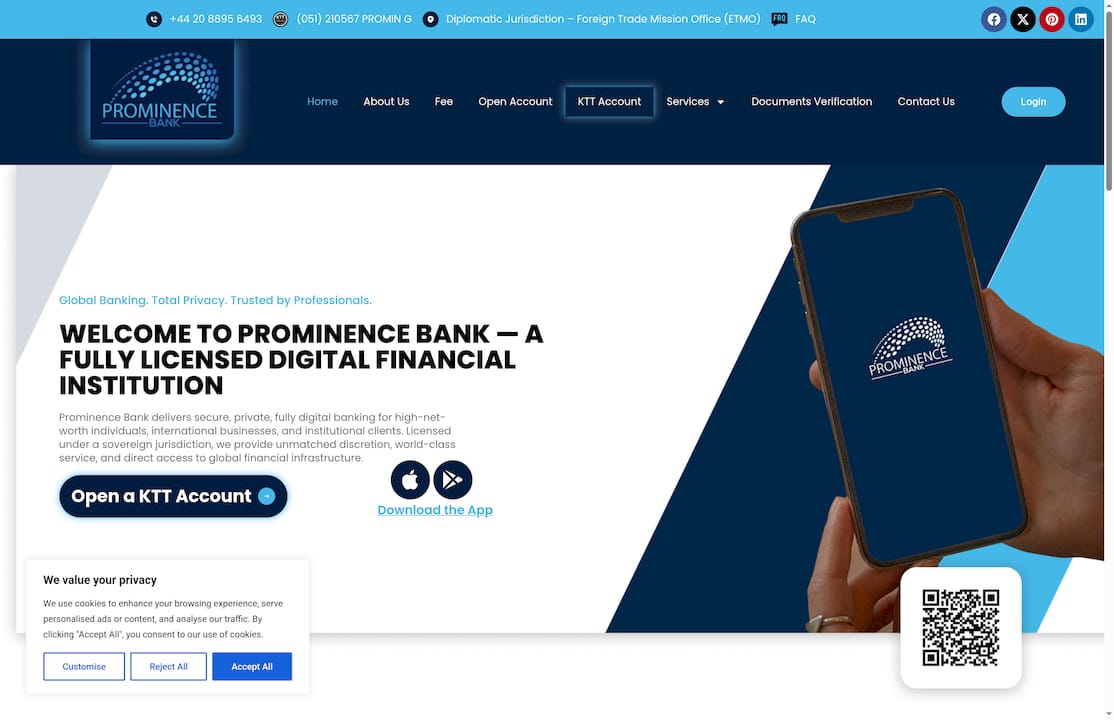
For businesses that need more than a consumer app, Prominencebank provides advanced corporate banking solutions with direct access to global financial infrastructure, full AML/KYC compliance, and the privacy standards that high-net-worth individuals and institutional clients require. If you are building a serious crypto financial strategy and need a banking partner that matches that ambition, Prominencebank is worth a closer look.
FAQ
Are crypto assets covered by FDIC insurance?
No. FDIC insurance only covers fiat deposits up to $250,000 at member institutions. Bitcoin, Ethereum, and stablecoins held as crypto are not insured regardless of the platform.
What is the difference between a crypto bank and a crypto exchange?
A crypto bank typically offers a mix of fiat deposit accounts and crypto services under some form of banking license, while an exchange primarily facilitates trading. Many exchanges offer bank-like features, but they operate under different and often weaker regulatory frameworks.
Can businesses accept crypto payments without holding crypto on their balance sheet?
Yes. MiCA-licensed payment gateways like CoinGate allow businesses to accept crypto from customers and settle directly into fiat, eliminating ongoing exposure to price volatility while still capturing the payment.
How do stablecoin accounts differ from regular bank savings accounts?
Stablecoin interest accounts are typically unsecured products where your funds are lent to a platform or counterparty. Unlike a savings account at an FDIC-member bank, they carry credit risk and are not insured if the provider becomes insolvent.
What should high-net-worth individuals prioritize when evaluating crypto banking options?
Prioritize clear separation of insured fiat and uninsured crypto balances, provider regulatory status, and privacy protections. The BIS analysis on crypto intermediation recommends treating yield-bearing crypto products as credit exposures rather than deposits.