
TL;DR:
- Mixing personal and business accounts can threaten asset protection and regulatory compliance.
- Dedicated business accounts offer advanced security, privacy, and global banking capabilities.
- Proper banking structures enhance leverage, operational efficiency, and strategic wealth management.
Most high-net-worth individuals and global corporations assume their current banking setup is adequate. It rarely is. Using personal accounts for business operations is one of the most expensive mistakes sophisticated clients make, not because of fees, but because of what it costs in legal exposure, lost privacy, and missed financial leverage. Mixing personal and business funds can trigger regulatory issues and undermine asset protection. This guide breaks down exactly what dedicated business bank accounts deliver, from airtight legal separation to advanced global capabilities, and why treating business banking as a premium financial tool changes everything.
Table of Contents
- Separation of personal and business finances
- Enhanced financial security and privacy for high-value clients
- Unlocking advanced features and global capabilities
- Access to additional financial products and streamlined management
- Why most high-net-worth clients undervalue business banking
- Experience advanced business banking with Prominence Bank
- Frequently asked questions
Key Takeaways
| Point | Details |
|---|---|
| Protects liability shields | Using a business bank account preserves your company’s legal, tax, and asset protections. |
| Delivers advanced security | Business accounts offer privacy and security controls beyond personal options. |
| Enables global growth | Features like multicurrency support and digital transfers power cross-border business. |
| Unlocks more financial solutions | Only business bank accounts provide access to corporate credit, treasury, and commercial mortgage products. |
| Streamlines management | Separation simplifies reporting, reduces audit risk, and strengthens your financial operations. |
Separation of personal and business finances
The moment you conduct business through a personal account, you begin eroding the legal walls that protect your private wealth. For corporations and high-net-worth individuals, that erosion is not theoretical. It is a direct threat to limited liability structures, compliance standing, and long-term asset security.
Mixing personal and business funds can trigger loss of limited liability protections, exposing personal assets to business creditors and legal claims. Courts have repeatedly used commingled funds as grounds to “pierce the corporate veil,” meaning your LLC or corporation no longer shields your personal wealth. That is a structural failure that no amount of legal maneuvering can easily fix after the fact.
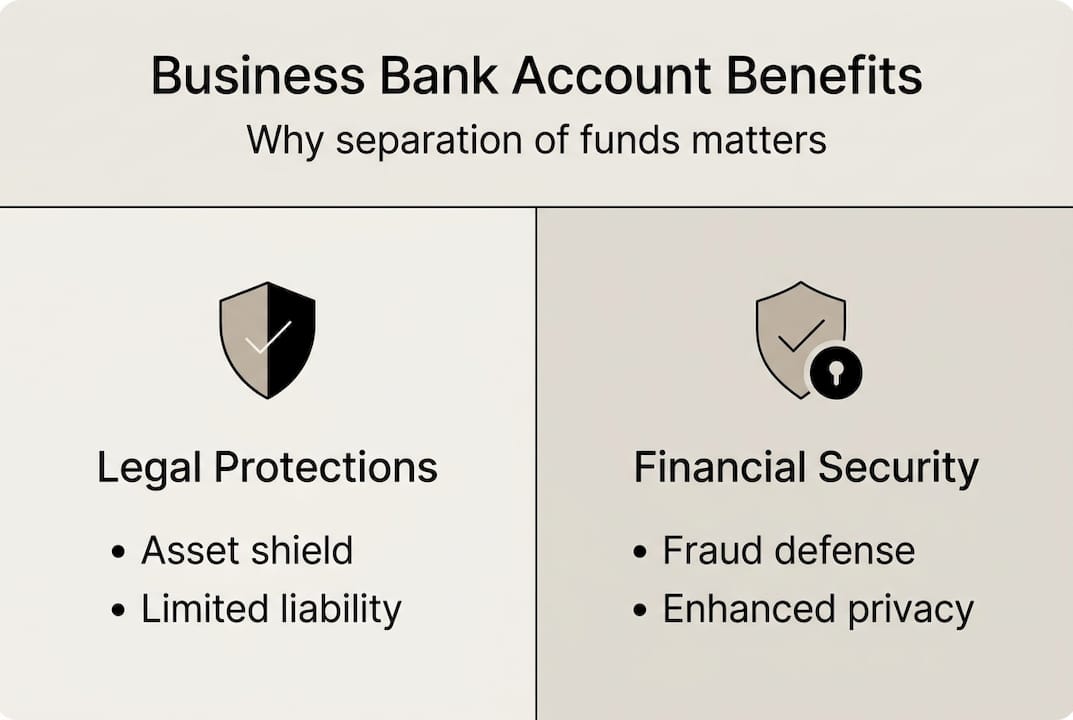
Beyond liability, there are regulatory consequences. Personal accounts are governed by Regulation E, which provides consumer protections. Business accounts operate under the Uniform Commercial Code, which places more responsibility on the account holder to detect and report fraud. If you are running business transactions through a personal account, you may incorrectly assume consumer protections apply when they do not. The practical result is that fraud losses may fall entirely on you.
Here is what proper financial separation looks like in practice for corporations and high-net-worth clients:
- Open a dedicated business checking account under the legal entity name, not your personal name.
- Route all revenue, invoices, and client payments exclusively through the business account.
- Pay yourself a documented salary or distribution from the business account to your personal account.
- Maintain separate credit instruments for business expenses.
- Reconcile business accounts monthly with formal bookkeeping records.
This structure is not just about accounting hygiene. It creates a defensible paper trail for tax authorities, regulators, and potential investors or acquirers. For clients managing multi-jurisdictional operations, secure corporate banking practices are the foundation of every other financial strategy.
“A business bank account is not an administrative formality. It is the legal and financial backbone of any serious enterprise or wealth structure.”
The discipline of separation signals institutional credibility. It tells counterparties, regulators, and partners that your operation is structured, serious, and built to last.
Enhanced financial security and privacy for high-value clients
High-net-worth individuals and international corporations are targets. Fraud attempts, data breaches, and social engineering attacks are disproportionately directed at high-value accounts. Personal banking security is simply not designed to handle that threat level.

Dedicated business bank accounts help protect confidential information and support advanced monitoring that personal accounts cannot match. The difference is not incremental. It is structural.
Here is what advanced business banking security actually includes:
- Multi-factor authentication (MFA) across all access points, including mobile, desktop, and API integrations
- Real-time transaction monitoring with configurable alerts for unusual activity patterns
- Role-based access controls that limit which team members can view, approve, or execute transactions
- IP whitelisting and device management to prevent unauthorized login from unknown locations
- Dedicated fraud response teams with direct escalation paths for high-value accounts
- Encrypted communication channels for sensitive financial instructions
Privacy is equally critical. For globally mobile clients, the ability to keep financial activity confidential is not a luxury. It is a strategic necessity. Business accounts at institutions focused on online banking for HNWIs are structured to minimize unnecessary data exposure while maintaining full regulatory compliance.
Reputation is also at stake. A security breach tied to a business account can damage client relationships, trigger regulatory scrutiny, and create lasting reputational harm. The technology in private banking has advanced to the point where real-time behavioral analytics can flag anomalies before a transaction even clears.
Pro Tip: Schedule a quarterly review of all account access credentials, authorized users, and linked third-party integrations. Permissions granted during a previous business relationship or project often remain active long after they should have been revoked.
Security at this level is not paranoia. It is the baseline expectation for anyone managing significant wealth or operating across multiple jurisdictions.
Unlocking advanced features and global capabilities
Domestic business banking was built for domestic business. If your operations, clients, or assets cross borders, you need a fundamentally different infrastructure. The gap between what a standard domestic business account offers and what a purpose-built international business account delivers is significant.
Global business bank accounts provide advanced transaction options, international support, and tailored digital services that domestic accounts simply cannot replicate. For corporations managing payroll in multiple currencies or HNWIs holding assets across jurisdictions, this is not a feature preference. It is a functional requirement.
Key capabilities that international business accounts unlock:
- Multicurrency account management with real-time conversion and settlement
- SWIFT/gpi transfers for fast, traceable cross-border payments
- Digital asset compatibility for clients integrating cryptocurrency into treasury operations
- Dedicated relationship managers with expertise in cross-border compliance
- Streamlined secure online account opening without requiring physical branch visits
| Feature | Domestic business | International business |
|---|---|---|
| Multicurrency accounts | Rarely available | Standard offering |
| SWIFT/gpi transfers | Limited or fee-heavy | Integrated and optimized |
| Digital asset support | Uncommon | Available at select institutions |
| Cross-border compliance tools | Minimal | Built-in AML/KYC frameworks |
| 24/7 global support | Inconsistent | Dedicated international teams |
| Offshore structuring options | Not available | Core capability |
The argument that advanced global features are optional is no longer credible. In 2026, capital moves across borders in seconds. If your banking infrastructure cannot keep pace, you are not just inconvenienced. You are at a competitive disadvantage. Corporations that operate with purpose-built international accounts close deals faster, manage currency risk more effectively, and maintain cleaner compliance records across jurisdictions.
Access to additional financial products and streamlined management
A business bank account is not just a place to hold funds. It is a gateway. The financial products available exclusively to business account holders represent a meaningful expansion of what you can do with your wealth and your company’s capital.
Business bank accounts often qualify clients for advanced credit and management solutions that personal accounts cannot access. This includes corporate credit facilities with higher limits and more flexible terms, treasury management services that optimize idle cash, and investment products structured for institutional clients.
| Product access | Business account | Personal account |
|---|---|---|
| Corporate credit lines | Yes, high-limit options | No |
| Treasury management | Yes, full suite | No |
| Commercial mortgages | Yes, via commercial mortgage solutions | Limited |
| Multi-entity reporting | Yes, consolidated dashboards | No |
| Institutional investment access | Yes | Rarely |
| International wire priority | Yes | Standard retail only |
Beyond product access, business accounts dramatically simplify financial management. Consolidated reporting across multiple accounts, automated reconciliation, and structured payment workflows reduce the administrative burden on finance teams. For global corporations managing dozens of entities, this is not a convenience. It is an operational necessity.
Tracking international payments becomes far more accurate when all transactions flow through structured business accounts with proper reference codes, counterparty data, and currency documentation. Audit trails are cleaner, tax filings are more defensible, and due diligence processes during acquisitions or investment rounds are faster.
Pro Tip: Structure your accounts so that each legal entity or operational division has its own sub-account or dedicated account number. This creates clear audit trails, simplifies tax reporting across jurisdictions, and makes financial monitoring far more precise without requiring manual categorization.
The right business banking relationship is, in effect, a financial operating system for your enterprise.
Why most high-net-worth clients undervalue business banking
Here is what we see repeatedly: sophisticated clients who have spent years optimizing their investment portfolios, tax structures, and legal entities still treat business banking as an afterthought. They open the first account that is convenient, never revisit the decision, and leave significant value on the table.
The hidden cost is not just fees or missed interest. It is structural. Many HNWIs mix personal and business accounts, risking asset protection and missing advanced banking advantages that purpose-built accounts provide. The real loss is in leverage: the credit facilities not accessed, the treasury tools not deployed, the privacy structures not built.
True wealth management requires banking infrastructure that matches the complexity of your financial life. That means multi-jurisdiction structures, private international accounts, and banking relationships that understand discretion as a core service value. International banking for wealth is not about moving money offshore. It is about building a financial architecture that is resilient, private, and strategically flexible.
The clients who extract the most value from business banking treat their accounts as active financial tools, not passive holding vessels. That mindset shift is where the real advantage lives.
Experience advanced business banking with Prominence Bank
Ready to leverage the full potential of business bank accounts? Prominence Bank is built for exactly this level of financial sophistication.
We offer professional business banking solutions designed for high-net-worth individuals and international corporations that demand privacy, security, and global reach. From multicurrency accounts to streamlined KYC-compliant onboarding, every service is structured around your need for discretion and operational control. Our advanced corporate banking solutions give you access to treasury management, cross-border payment infrastructure, and institutional-grade security. If your current banking setup was built for convenience rather than strategy, it is time to upgrade.
Frequently asked questions
Can I use a personal bank account for my business if I am a high-net-worth individual?
Using a personal account exposes you to compliance risks and loss of limited liability protections. Mixing funds removes the legal separation that shields your personal assets from business liabilities.
What advanced features do business bank accounts offer for global companies?
They provide multicurrency transactions, digital asset integration, and streamlined international transfers. Global bank accounts also enable advanced payments and tailored digital services not available through domestic accounts.
How do business bank accounts enhance privacy?
They offer enhanced confidentiality, specialized access controls, and security measures designed for high-value clients. Business bank accounts provide additional privacy features that personal accounts are not structured to deliver.
Are there financial products I can only access through a business bank account?
Yes, products like corporate credit facilities and treasury solutions require a business bank account. Business credit and specialized management products are simply not available through personal banking relationships.
Does opening a business bank account help with global asset protection?
Yes, it helps preserve legal separation and enables private international banking structures. Global business accounts preserve asset protection by maintaining the legal boundaries that shield personal wealth from business exposure.